
.png)
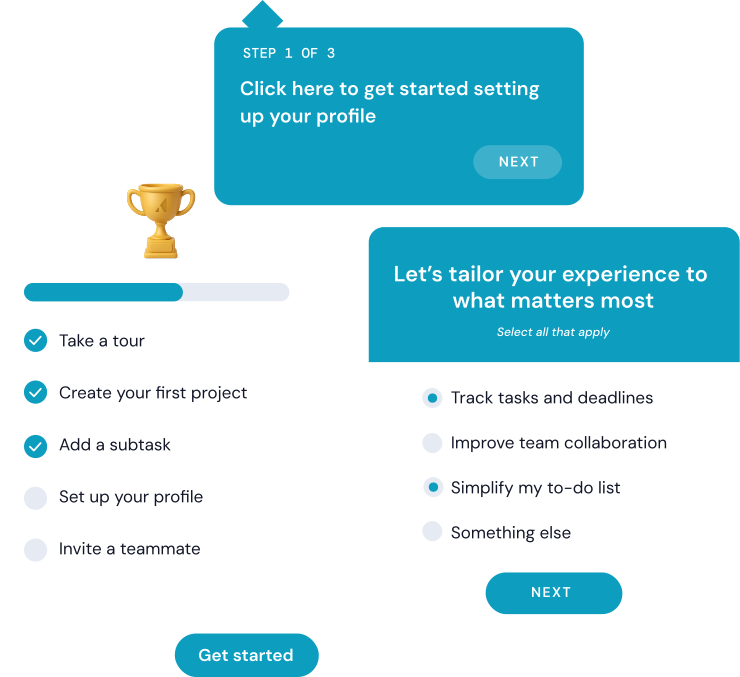
What you'll get: Nine actionable customer retention strategies organized across three phases - onboarding, product adoption, and advocacy - that product, growth, and CS teams can start implementing today.
Who it's for: SaaS teams looking to reduce churn and build lasting user relationships without a six-month overhaul.
The core idea: Retention isn't a single initiative. It's a series of small, well-timed moments - from a personalized signup flow to a closed-loop feedback program - that compound into durable growth.
Acquiring a new customer costs five to 25 times more than retaining an existing one. And according to research from Bain & Company, increasing customer retention by just 5% can boost profits by 25 to 95%. The math is clear: the fastest path to sustainable growth runs through the customers you already have.
Customer retention is the ability of a company to keep its existing customers over a given period. It sounds simple, but in practice, retention is shaped by every interaction a user has with your product - from the first signup screen to the moment they decide whether to renew. Strong customer retention strategies don't just prevent churn. They create compounding value: retained users adopt more features, generate more revenue, and refer more new customers over time.
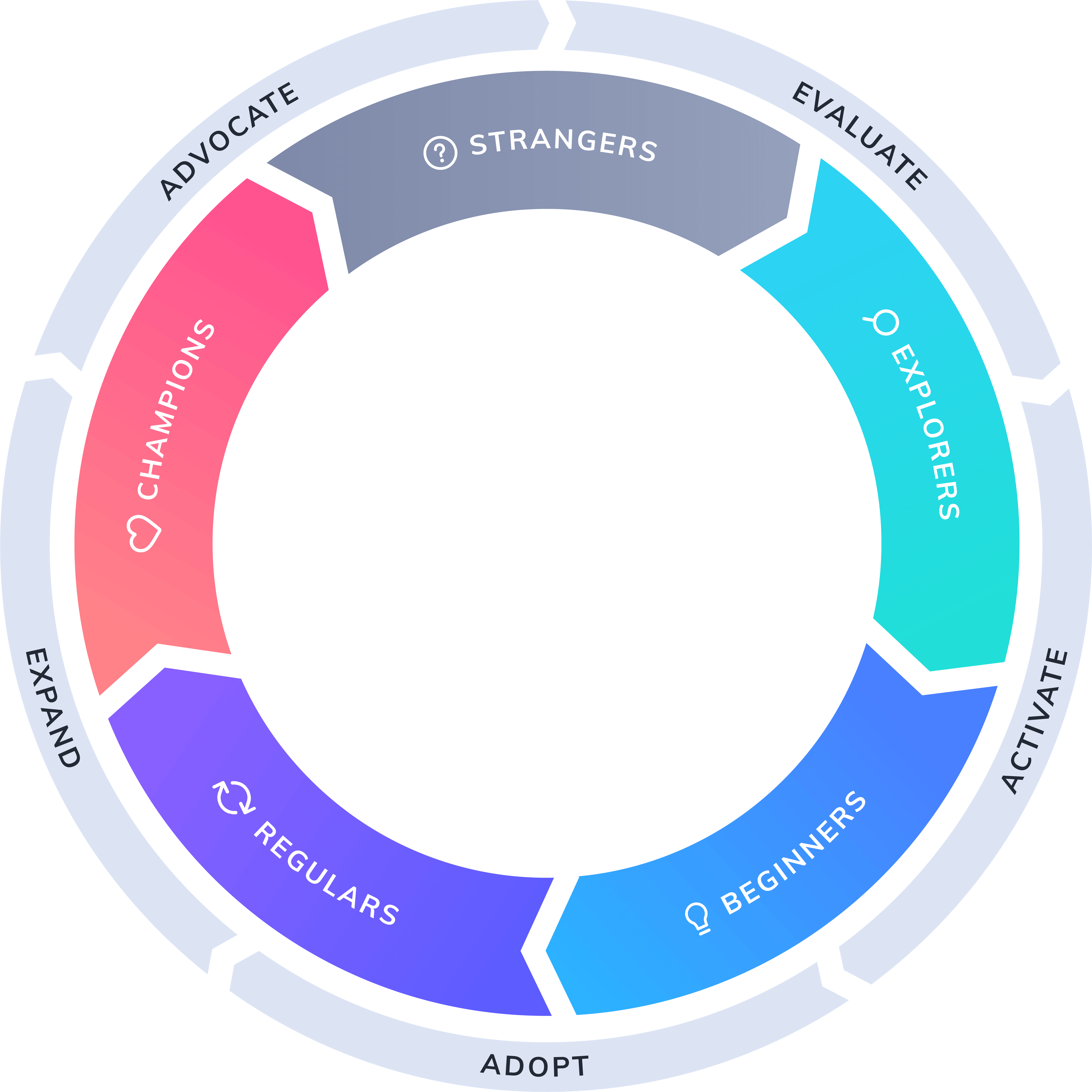
At Appcues, we think about retention as a journey with five stages: Strangers discover your product, Explorers evaluate its value, Beginners find their first use case, Regulars build proficiency across multiple workflows, and Champions become invested advocates. Visualizing these stages as a flywheel helps you see where users are losing momentum - and where a well-timed experience can pull them forward.
In this guide, we'll walk through nine user retention strategies organized across three phases: onboarding (getting users to value fast), product adoption (deepening engagement over time), and advocacy (turning power users into growth engines). For a broader look at the onboarding phase, see our guide to user onboarding strategies. We'll also cover how to measure retention effectively, so you know which levers are actually working. Whether you're focused on in-app messaging, behavioral segmentation, or lifecycle campaigns, these strategies give you a practical starting point.
Before you implement new campaigns, you need to know what you're measuring. Customer retention has several key metrics, and the right mix depends on your business model. Here are the ones that matter most:
For a deeper dive into retention metrics, check out our full guide.
See also: The real impact of in-app messaging on end-user retention
The best customer retention strategies aren't isolated tactics. They work together across the user lifecycle. We've organized these nine strategies into three phases: onboarding (wins 1 - 3) builds the foundation, product adoption (wins 4 - 7) deepens engagement, and advocacy (wins 8 - 9) turns loyal users into growth drivers. A strong user onboarding experience gets users to their aha moment fast, and the strategies that follow keep that momentum going. Together, they form a practical playbook for user retention strategies that compound over time.
A great onboarding experience starts before users even reach your product's core interface. A well-designed signup flow captures the data you need to deliver a personalized, relevant experience from minute one. Many apps combine this step with welcome screens that reiterate core value propositions and highlight features tailored to the user's role or goals.
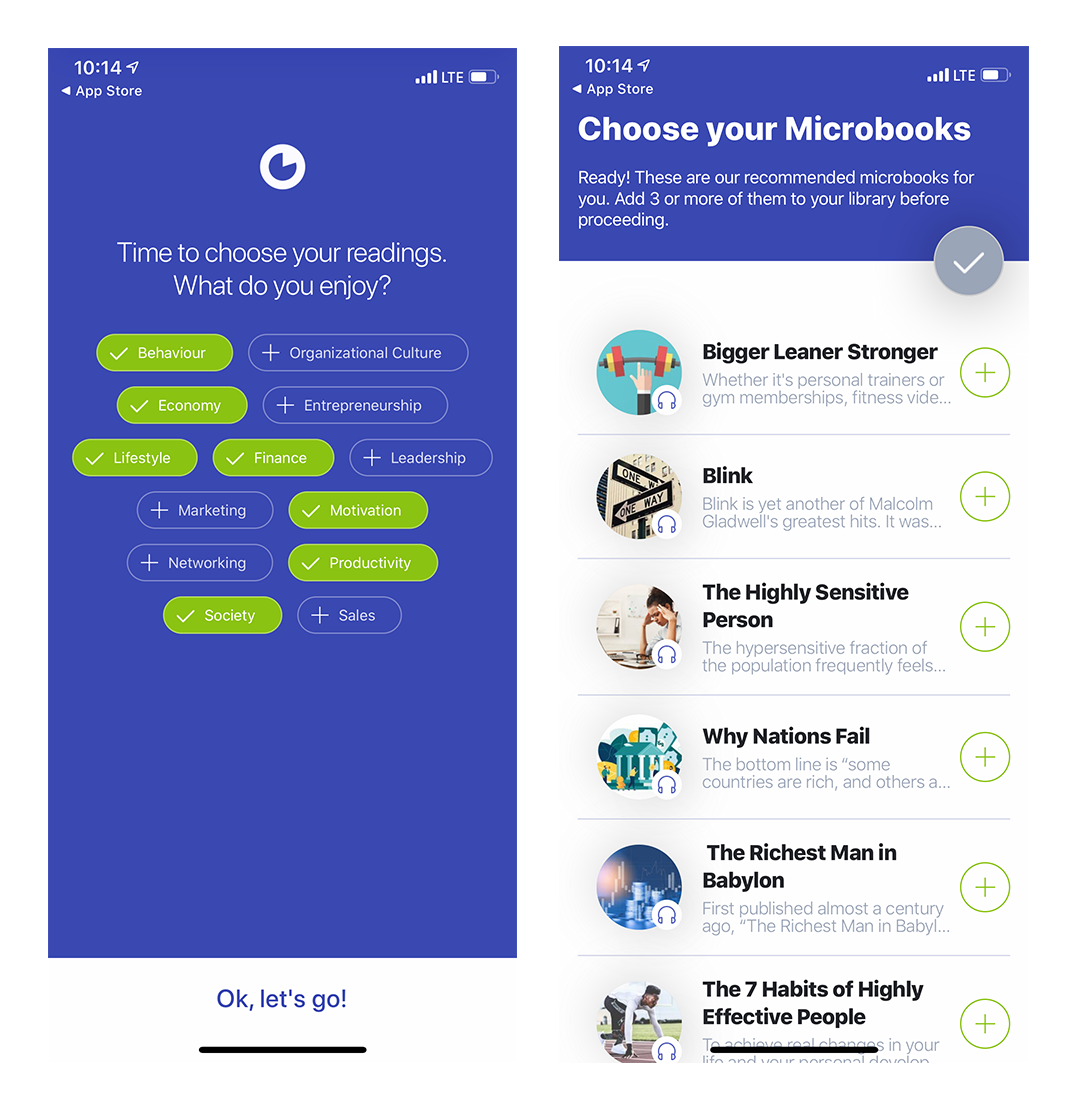
Mobile app 12min curates and condenses the best business and personal development books into digestible snippets. Their welcome screens clearly articulate the value proposition before asking users to self-segment by language, interests, and reading goals.
On the SaaS side, tools like Notion and Canva ask new users about their role, team size, and primary use case during signup, then route each user into a tailored onboarding path. The principle is the same: collecting context early lets you accelerate time to value. Appcues supports welcome surveys and signup flow segmentation so teams can route users to the right onboarding path without engineering work. With features like the best onboarding experiences as inspiration, you can build user retention into the very first interaction.
A welcome message is typically the first thing a user sees after signing up and logging into your product for the first time. Welcome messages reduce the anxiety a new user can feel as they transition from your landing page experience into your product by restating your product's promise of value.
Loom does this well. After signup, new users see a short modal that reinforces what Loom helps them do (record and share video quickly), then guides them toward recording their first video. The message is warm, specific, and action-oriented - it doesn't just say "welcome," it points toward the first meaningful step.
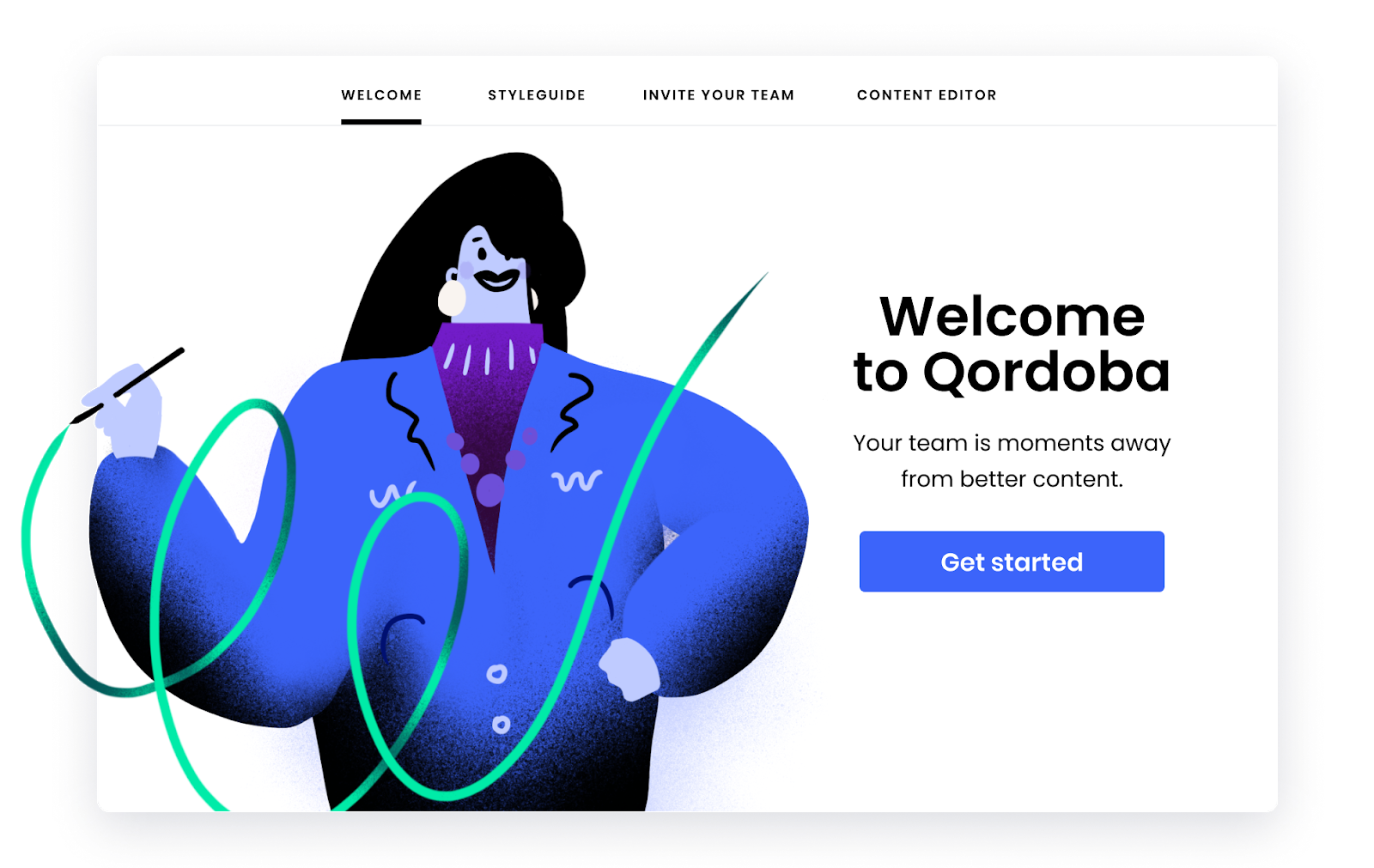
An informative welcome message like this buys you time and patience from new users and keeps their initial motivation up longer. The goal: reduce uncertainty, restate the value promise, and give users a clear next step.
Product tours get a bit of a bad rep for being overbearing, but when done right, they're effective at introducing new users to your product's interface and steering them toward their aha moment.
Here is a great example of an onboarding walkthrough from Asana:
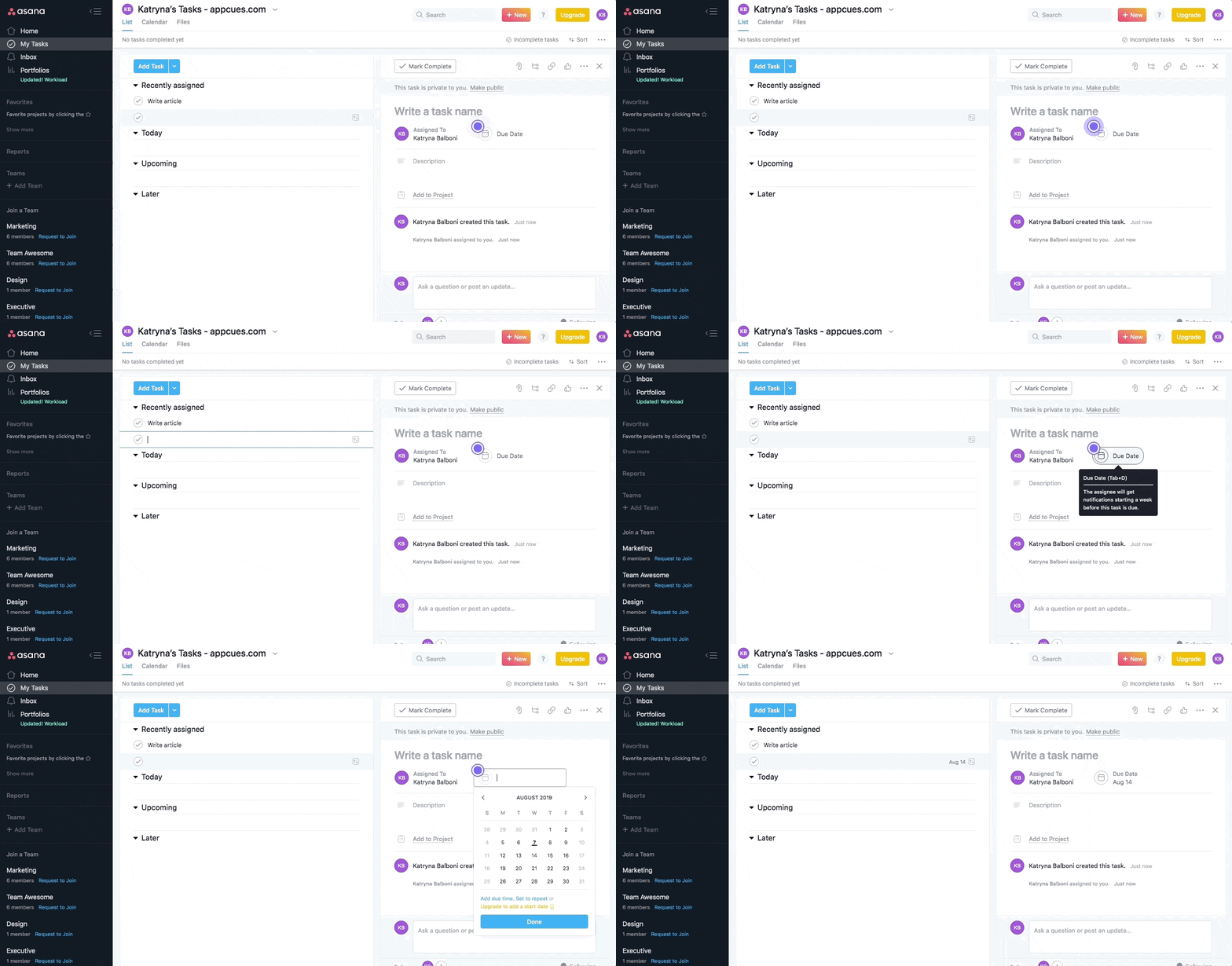
Asana's product tour inspires user engagement through participation - users must click on each element the page points to in order to continue. This action-oriented approach to product tours helps get users to their aha moment faster and start actively using the tool.
Think of good product tours like a set of training wheels. They're great to help your users get up and running, but in order to convey the maximum impact of your product, you'll need to let them experience the aha moment on their own. A word of caution: tours that are too long, non-skippable, or explain things users could discover on their own tend to backfire. The best tours are short, interactive, and lead users to do something valuable - not just read about it. Appcues tours are action-driven, meaning users interact with real elements rather than passively clicking "Next."
Gamification applies game mechanics - progress bars, streaks, badges, and milestones - to product experiences to encourage repeated engagement. It works because it taps into habit loops: a cue triggers a routine, and a reward reinforces it. Over time, these loops increase session frequency and stickiness, making your product part of the user's daily workflow.
Duolingo's streak mechanic is the most recognizable example. Users are motivated to return daily to maintain their streak, and the app reinforces the behavior with celebratory animations and social accountability. On the B2B side, LinkedIn's profile completion progress bar nudges users to fill in more details - each step closer to 100% feels like a small win.
You don't need a custom engineering sprint to add gamification to your product. Onboarding checklists with progress bars drive completion rates by giving users a visible sense of momentum. In-app modals can celebrate milestones ("You've completed 50 tasks!") and keep users moving forward. With a low-code platform like Appcues, teams can ship these lightweight customer retention strategies without waiting on a dev cycle.
The more value you can provide a user, the stickier your product becomes. Feature discoverability is essential to promoting further engagement and driving up app stickiness. Tried-and-true onboarding patterns like tooltips or hotspots are a perfect way to guide users into more meaningful engagement with your product.
Airtable uses a mix of UI patterns and design elements like tooltips, slideouts, and hotspots to introduce active users to helpful features and encourage further exploration.
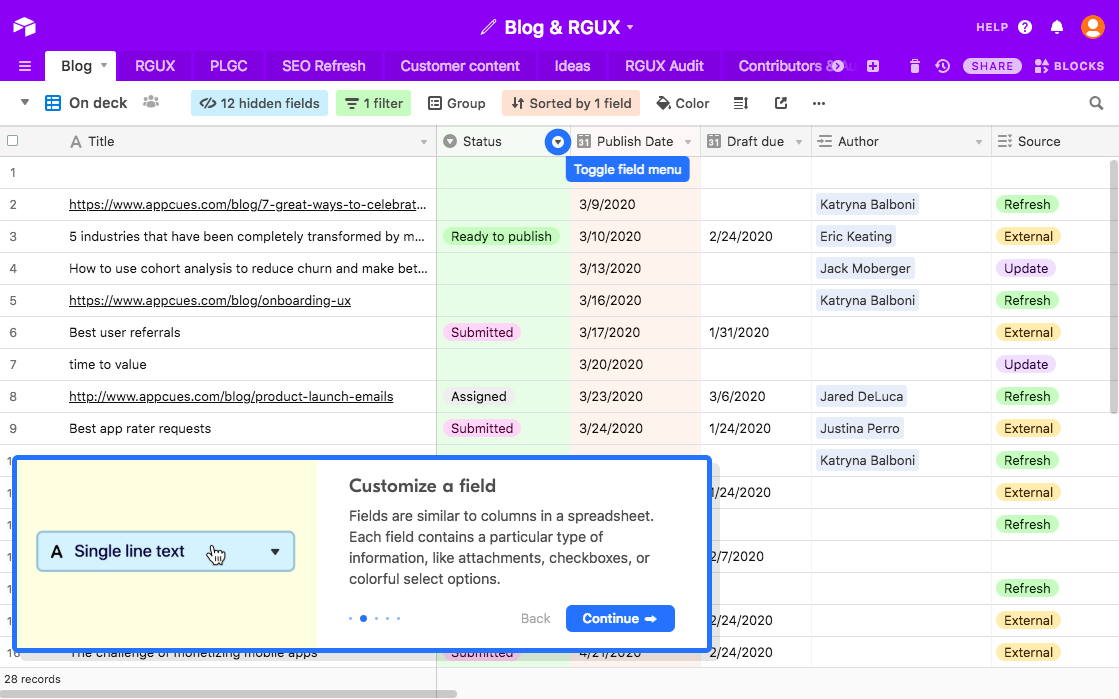
The key is not to bombard users all at once. Instead, use behavioral segmentation to surface the right feature at the right time based on what users have (or haven't) done. Don't show every feature to every user. A new user who hasn't completed setup doesn't need to see your advanced reporting tools yet. A power user who's never tried your API integration might benefit from a timely prompt. Appcues' behavioral targeting lets teams trigger feature prompts based on lifecycle stage and in-product behavior, and Appcues AI can identify which user segments are underusing high-value features. By driving users to additional aha moments one at a time, you'll continue to encourage engagement and boost user sessions well after initial onboarding.
Each time you launch a new feature, you're providing additional value to your existing users. The challenge is visibility: most users won't discover a new feature on their own. Every feature launch is a retention event because it adds value users didn't have yesterday. The tricky part is relaying that value to your users and getting them to adopt the new feature into their regular workflow.
While blog posts and emails are useful for getting the word out to subscribers and prospects, relaying the message to active users should be done within your application itself. In-app feature announcements catch users when they're actively engaged and positioned to take action. We've seen that features launched this way can help increase feature adoption by up to 400%.
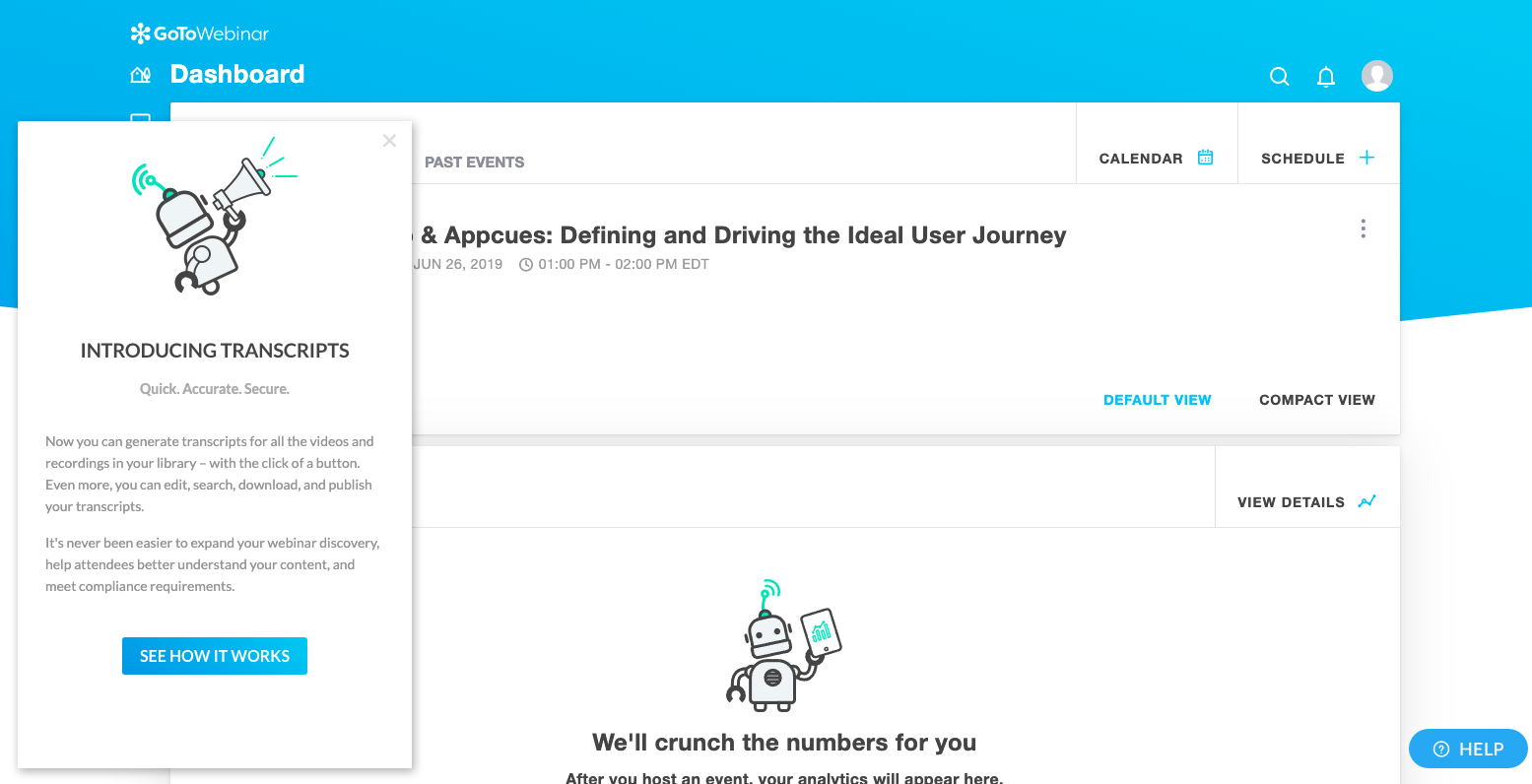
GoToWebinar used Appcues to introduce a new transcription feature. With a simple animated slideout, GoToWebinar effectively captures users' attention on login.
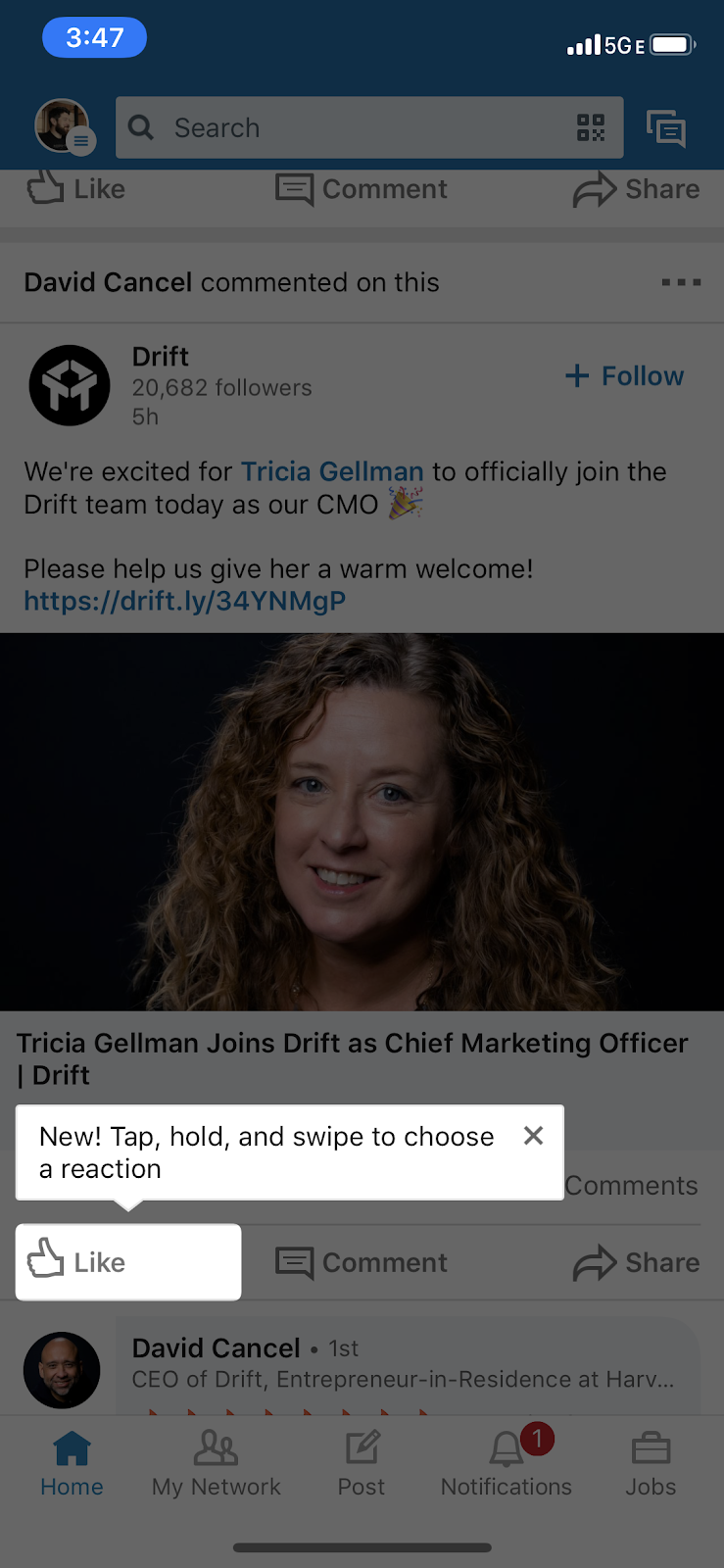
New feature announcements are just as important on mobile. When LinkedIn launched LinkedIn reactions, they used a simple tooltip to highlight the feature:
Friction is the silent killer of retention. Every unnecessary step, confusing workflow, or unanswered question is an opportunity for users to disengage. The best retention teams don't just build features - they remove barriers.
Self-service support is one of the highest-impact, lowest-cost retention levers available. Start by looking at your most-viewed help docs and consider how you might be able to help users solve those problems up front. Implement tooltips or hotspots that address commonly asked how-to questions and measure if views to that help doc drop over time. In-app resource centers, contextual help widgets, and searchable knowledge bases all reduce time-to-resolution and prevent frustration from escalating.
Beyond support, think about permission requests and opt-ins. Ask for information at the right moment (after users see the value, not before), make opt-outs easy, and remove unnecessary steps from key workflows. Appcues lets teams publish in-app help content and contextual guidance without engineering tickets.
And for users who do go quiet? Proactive re-engagement - through push notifications, email sequences, and in-app messages triggered by inactivity - is one of the most important tools for reducing churn before it becomes permanent.
The key is timing and personalization. A generic "We miss you!" email sent to every inactive user is easy to ignore. A targeted push notification that says "You haven't tried [specific feature] yet - here's how it can help with [their use case]" sent 48 hours after last login is much harder to dismiss. For users who've been inactive for 14 or more days, a short win-back email sequence can resurface value: remind them what they've already accomplished, show what's new since they left, and offer a low-friction path back in.
Think about re-engagement as a three-tier system. The first tier is a lightweight in-app nudge triggered after three to five days of inactivity - something like a tooltip highlighting a feature the user hasn't explored yet. The second tier is a push notification or email at the seven-to-ten-day mark, surfacing personalized value ("Your team saved 12 hours last month using [feature] - here's what else you can do"). The third tier is a structured win-back sequence for users who've been dormant for two or more weeks, often including a direct invitation to a one-on-one session or a curated list of recent product updates.
Research consistently shows that push notifications can boost app engagement significantly when they're relevant and well-timed. The opposite is also true: poorly timed or generic notifications accelerate churn by training users to ignore you.
Appcues supports multi-channel delivery (in-app, email, push), and behavioral triggers can fire re-engagement messages based on inactivity thresholds - so your team can reduce churn proactively, not reactively.
Solicit feedback from your power users in any way you can. Hop on the phone, send email surveys, and prompt them with in-product feedback forms. NPS and CSAT surveys are lightweight mechanisms that work especially well in-app, where response rates tend to be higher than email. It isn't always easy to get your customers to provide feedback - collecting it at scale requires a passionate user base and a little creative thinking.
The best feedback requests are thoughtfully timed and clearly framed. For inspiration, check out these examples of the persuasive power of a clever rating request - they show how small design choices (asking at moments of delight, offering a clear reason to respond) can dramatically lift response rates.
But collecting feedback is table stakes. The real retention value comes from closing the loop: acting on what users tell you and letting them know you did. When users see their suggestions reflected in product updates, they feel invested in your product's direction. That emotional connection is what turns a regular user into a long-term customer.
When gathering feedback, try to identify a few themes. Make those themes a priority in both product development and customer success. For more on building a feedback-driven product organization, Steven Blank's Four Steps to the Epiphany is a foundational read.
Customer referrals are incredibly powerful for user acquisition, but their retention impact is often overlooked. When users refer your product to a colleague or friend, they're making a public commitment to your brand. That act of advocacy deepens their own connection to the product - they become more invested in seeing it succeed.
The key is to make the offer both easy and compelling. Dropbox's referral program is the classic example: give 500 MB of free storage, get 500 MB of free storage. The offer was simple, the reward was immediately useful, and it helped Dropbox grow from 100,000 to 4 million users in 15 months. The referral message was integrated into the product experience so users couldn't miss it.
Whether you offer account credits, extended trials, or exclusive features, the best referral programs make both the giver and the receiver feel like they're getting a win. And the advocate's retention strengthens in the process, because they've put their reputation behind your product. Consider building referral prompts into natural moments of delight - right after a user hits a milestone, completes a project, or gives you positive feedback. Those moments of satisfaction are when users are most likely to share.
Customer retention strategies work best when they span the full user lifecycle, not just the moments when churn is already happening. Here's a quick recap of the nine strategies covered in this guide:
User retention isn't a one-time fix. It's an ongoing practice that compounds over time. Every onboarding improvement, every well-timed feature prompt, and every closed feedback loop lays the groundwork for stronger relationships and more durable growth. If your customer retention rate isn't where you want it, start with one strategy, measure the impact, and build from there.
Learn more about proactive strategies for reducing customer churn.
The nine strategies in this guide share a common thread: they meet users where they are, with the right experience at the right time. Appcues gives product, growth, and CS teams the tools to make that happen - in-app messaging, behavioral segmentation, and multi-channel delivery, all without waiting on engineering. If you're ready to turn these customer retention strategies into action, book a demo and see how Appcues can help.
Lifecycle Marketing
Retention & Churn
In-App Messaging
Product Launches
TL;DR
What you'll get: Nine actionable customer retention strategies organized across three phases - onboarding, product adoption, and advocacy - that product, growth, and CS teams can start implementing today.
Who it's for: SaaS teams looking to reduce churn and build lasting user relationships without a six-month overhaul.
The core idea: Retention isn't a single initiative. It's a series of small, well-timed moments - from a personalized signup flow to a closed-loop feedback program - that compound into durable growth.
Acquiring a new customer costs five to 25 times more than retaining an existing one. And according to research from Bain & Company, increasing customer retention by just 5% can boost profits by 25 to 95%. The math is clear: the fastest path to sustainable growth runs through the customers you already have.
Customer retention is the ability of a company to keep its existing customers over a given period. It sounds simple, but in practice, retention is shaped by every interaction a user has with your product - from the first signup screen to the moment they decide whether to renew. Strong customer retention strategies don't just prevent churn. They create compounding value: retained users adopt more features, generate more revenue, and refer more new customers over time.
At Appcues, we think about retention as a journey with five stages: Strangers discover your product, Explorers evaluate its value, Beginners find their first use case, Regulars build proficiency across multiple workflows, and Champions become invested advocates. Visualizing these stages as a flywheel helps you see where users are losing momentum - and where a well-timed experience can pull them forward.
In this guide, we'll walk through nine user retention strategies organized across three phases: onboarding (getting users to value fast), product adoption (deepening engagement over time), and advocacy (turning power users into growth engines). For a broader look at the onboarding phase, see our guide to user onboarding strategies. We'll also cover how to measure retention effectively, so you know which levers are actually working. Whether you're focused on in-app messaging, behavioral segmentation, or lifecycle campaigns, these strategies give you a practical starting point.
Before you implement new campaigns, you need to know what you're measuring. Customer retention has several key metrics, and the right mix depends on your business model. Here are the ones that matter most:
For a deeper dive into retention metrics, check out our full guide.
See also: The real impact of in-app messaging on end-user retention
The best customer retention strategies aren't isolated tactics. They work together across the user lifecycle. We've organized these nine strategies into three phases: onboarding (wins 1 - 3) builds the foundation, product adoption (wins 4 - 7) deepens engagement, and advocacy (wins 8 - 9) turns loyal users into growth drivers. A strong user onboarding experience gets users to their aha moment fast, and the strategies that follow keep that momentum going. Together, they form a practical playbook for user retention strategies that compound over time.
A great onboarding experience starts before users even reach your product's core interface. A well-designed signup flow captures the data you need to deliver a personalized, relevant experience from minute one. Many apps combine this step with welcome screens that reiterate core value propositions and highlight features tailored to the user's role or goals.
Mobile app 12min curates and condenses the best business and personal development books into digestible snippets. Their welcome screens clearly articulate the value proposition before asking users to self-segment by language, interests, and reading goals.
On the SaaS side, tools like Notion and Canva ask new users about their role, team size, and primary use case during signup, then route each user into a tailored onboarding path. The principle is the same: collecting context early lets you accelerate time to value. Appcues supports welcome surveys and signup flow segmentation so teams can route users to the right onboarding path without engineering work. With features like the best onboarding experiences as inspiration, you can build user retention into the very first interaction.
A welcome message is typically the first thing a user sees after signing up and logging into your product for the first time. Welcome messages reduce the anxiety a new user can feel as they transition from your landing page experience into your product by restating your product's promise of value.
Loom does this well. After signup, new users see a short modal that reinforces what Loom helps them do (record and share video quickly), then guides them toward recording their first video. The message is warm, specific, and action-oriented - it doesn't just say "welcome," it points toward the first meaningful step.
An informative welcome message like this buys you time and patience from new users and keeps their initial motivation up longer. The goal: reduce uncertainty, restate the value promise, and give users a clear next step.
Product tours get a bit of a bad rep for being overbearing, but when done right, they're effective at introducing new users to your product's interface and steering them toward their aha moment.
Here is a great example of an onboarding walkthrough from Asana:
Asana's product tour inspires user engagement through participation - users must click on each element the page points to in order to continue. This action-oriented approach to product tours helps get users to their aha moment faster and start actively using the tool.
Think of good product tours like a set of training wheels. They're great to help your users get up and running, but in order to convey the maximum impact of your product, you'll need to let them experience the aha moment on their own. A word of caution: tours that are too long, non-skippable, or explain things users could discover on their own tend to backfire. The best tours are short, interactive, and lead users to do something valuable - not just read about it. Appcues tours are action-driven, meaning users interact with real elements rather than passively clicking "Next."
Gamification applies game mechanics - progress bars, streaks, badges, and milestones - to product experiences to encourage repeated engagement. It works because it taps into habit loops: a cue triggers a routine, and a reward reinforces it. Over time, these loops increase session frequency and stickiness, making your product part of the user's daily workflow.
Duolingo's streak mechanic is the most recognizable example. Users are motivated to return daily to maintain their streak, and the app reinforces the behavior with celebratory animations and social accountability. On the B2B side, LinkedIn's profile completion progress bar nudges users to fill in more details - each step closer to 100% feels like a small win.
You don't need a custom engineering sprint to add gamification to your product. Onboarding checklists with progress bars drive completion rates by giving users a visible sense of momentum. In-app modals can celebrate milestones ("You've completed 50 tasks!") and keep users moving forward. With a low-code platform like Appcues, teams can ship these lightweight customer retention strategies without waiting on a dev cycle.
The more value you can provide a user, the stickier your product becomes. Feature discoverability is essential to promoting further engagement and driving up app stickiness. Tried-and-true onboarding patterns like tooltips or hotspots are a perfect way to guide users into more meaningful engagement with your product.
Airtable uses a mix of UI patterns and design elements like tooltips, slideouts, and hotspots to introduce active users to helpful features and encourage further exploration.
The key is not to bombard users all at once. Instead, use behavioral segmentation to surface the right feature at the right time based on what users have (or haven't) done. Don't show every feature to every user. A new user who hasn't completed setup doesn't need to see your advanced reporting tools yet. A power user who's never tried your API integration might benefit from a timely prompt. Appcues' behavioral targeting lets teams trigger feature prompts based on lifecycle stage and in-product behavior, and Appcues AI can identify which user segments are underusing high-value features. By driving users to additional aha moments one at a time, you'll continue to encourage engagement and boost user sessions well after initial onboarding.
Each time you launch a new feature, you're providing additional value to your existing users. The challenge is visibility: most users won't discover a new feature on their own. Every feature launch is a retention event because it adds value users didn't have yesterday. The tricky part is relaying that value to your users and getting them to adopt the new feature into their regular workflow.
While blog posts and emails are useful for getting the word out to subscribers and prospects, relaying the message to active users should be done within your application itself. In-app feature announcements catch users when they're actively engaged and positioned to take action. We've seen that features launched this way can help increase feature adoption by up to 400%.
GoToWebinar used Appcues to introduce a new transcription feature. With a simple animated slideout, GoToWebinar effectively captures users' attention on login.
New feature announcements are just as important on mobile. When LinkedIn launched LinkedIn reactions, they used a simple tooltip to highlight the feature:
Friction is the silent killer of retention. Every unnecessary step, confusing workflow, or unanswered question is an opportunity for users to disengage. The best retention teams don't just build features - they remove barriers.
Self-service support is one of the highest-impact, lowest-cost retention levers available. Start by looking at your most-viewed help docs and consider how you might be able to help users solve those problems up front. Implement tooltips or hotspots that address commonly asked how-to questions and measure if views to that help doc drop over time. In-app resource centers, contextual help widgets, and searchable knowledge bases all reduce time-to-resolution and prevent frustration from escalating.
Beyond support, think about permission requests and opt-ins. Ask for information at the right moment (after users see the value, not before), make opt-outs easy, and remove unnecessary steps from key workflows. Appcues lets teams publish in-app help content and contextual guidance without engineering tickets.
And for users who do go quiet? Proactive re-engagement - through push notifications, email sequences, and in-app messages triggered by inactivity - is one of the most important tools for reducing churn before it becomes permanent.
The key is timing and personalization. A generic "We miss you!" email sent to every inactive user is easy to ignore. A targeted push notification that says "You haven't tried [specific feature] yet - here's how it can help with [their use case]" sent 48 hours after last login is much harder to dismiss. For users who've been inactive for 14 or more days, a short win-back email sequence can resurface value: remind them what they've already accomplished, show what's new since they left, and offer a low-friction path back in.
Think about re-engagement as a three-tier system. The first tier is a lightweight in-app nudge triggered after three to five days of inactivity - something like a tooltip highlighting a feature the user hasn't explored yet. The second tier is a push notification or email at the seven-to-ten-day mark, surfacing personalized value ("Your team saved 12 hours last month using [feature] - here's what else you can do"). The third tier is a structured win-back sequence for users who've been dormant for two or more weeks, often including a direct invitation to a one-on-one session or a curated list of recent product updates.
Research consistently shows that push notifications can boost app engagement significantly when they're relevant and well-timed. The opposite is also true: poorly timed or generic notifications accelerate churn by training users to ignore you.
Appcues supports multi-channel delivery (in-app, email, push), and behavioral triggers can fire re-engagement messages based on inactivity thresholds - so your team can reduce churn proactively, not reactively.
Solicit feedback from your power users in any way you can. Hop on the phone, send email surveys, and prompt them with in-product feedback forms. NPS and CSAT surveys are lightweight mechanisms that work especially well in-app, where response rates tend to be higher than email. It isn't always easy to get your customers to provide feedback - collecting it at scale requires a passionate user base and a little creative thinking.
The best feedback requests are thoughtfully timed and clearly framed. For inspiration, check out these examples of the persuasive power of a clever rating request - they show how small design choices (asking at moments of delight, offering a clear reason to respond) can dramatically lift response rates.
But collecting feedback is table stakes. The real retention value comes from closing the loop: acting on what users tell you and letting them know you did. When users see their suggestions reflected in product updates, they feel invested in your product's direction. That emotional connection is what turns a regular user into a long-term customer.
When gathering feedback, try to identify a few themes. Make those themes a priority in both product development and customer success. For more on building a feedback-driven product organization, Steven Blank's Four Steps to the Epiphany is a foundational read.
Customer referrals are incredibly powerful for user acquisition, but their retention impact is often overlooked. When users refer your product to a colleague or friend, they're making a public commitment to your brand. That act of advocacy deepens their own connection to the product - they become more invested in seeing it succeed.
The key is to make the offer both easy and compelling. Dropbox's referral program is the classic example: give 500 MB of free storage, get 500 MB of free storage. The offer was simple, the reward was immediately useful, and it helped Dropbox grow from 100,000 to 4 million users in 15 months. The referral message was integrated into the product experience so users couldn't miss it.
Whether you offer account credits, extended trials, or exclusive features, the best referral programs make both the giver and the receiver feel like they're getting a win. And the advocate's retention strengthens in the process, because they've put their reputation behind your product. Consider building referral prompts into natural moments of delight - right after a user hits a milestone, completes a project, or gives you positive feedback. Those moments of satisfaction are when users are most likely to share.
Customer retention strategies work best when they span the full user lifecycle, not just the moments when churn is already happening. Here's a quick recap of the nine strategies covered in this guide:
User retention isn't a one-time fix. It's an ongoing practice that compounds over time. Every onboarding improvement, every well-timed feature prompt, and every closed feedback loop lays the groundwork for stronger relationships and more durable growth. If your customer retention rate isn't where you want it, start with one strategy, measure the impact, and build from there.
Learn more about proactive strategies for reducing customer churn.
The nine strategies in this guide share a common thread: they meet users where they are, with the right experience at the right time. Appcues gives product, growth, and CS teams the tools to make that happen - in-app messaging, behavioral segmentation, and multi-channel delivery, all without waiting on engineering. If you're ready to turn these customer retention strategies into action, book a demo and see how Appcues can help.

Sign up for Quickcues and get our monthly updates!
.svg)