.png)

Ah, the thrill of a new customer—there's nothing quite like it, right? But let's be honest: the real magic happens when those newcomers become repeat customers. You've poured your heart into catching their eye and building trust through stellar marketing strategies and sales efforts. It makes total sense to put just as much effort into fostering brand loyalty and keeping them around.
Customer retention? It's easier said than done, especially when every brand out there is tempting your customers with the next shiny thing. It’s a bit like keeping a band together: you’ve got to keep hitting the right notes and shaking things up with new tunes to stay relevant and loved. That means weaving engaging, delightful experiences into every note of your customer's journey to ensure customer satisfaction at every turn.
In this guide, we'll dive into the nitty-gritty of customer retention strategies—no jargon, just plain good advice that you can chat about as easily as if you were talking over coffee. We'll lay out the tools, metrics, and, yes, the secret sauce that can help you reduce customer churn and keep those hard-earned fans coming back for more encores. Because at the end of the day, it's about making every step of the customer experience feel like a VIP backstage pass, ensuring that every interaction builds trust and cements a lasting relationship.
Customer retention is the process of retaining your current customers and getting them to return to your product for subsequent purchases, user sessions, or engagement. It goes beyond having a customer success team that answers requests and facilitates onboarding. It’s the art of turning first-time buyers into lifelong fans by ensuring every encounter with your brand is nothing short of delightful.
Why spend all your effort drumming up new business when you can dance with those who already know your moves? Here’s why customer retention is crucial for hitting those high business notes:
A comprehensive customer retention strategy is like the perfect playlist—it keeps your fans tuned in and excited for what’s next, turning casual listeners into devoted followers who boost your brand’s volume in the market.
You should absolutely celebrate every new customer your SaaS company lands. However, if you’re losing two customers for every one you gain, you need to take a closer look at your customer retention strategy. Building a business with poor retention is like trying to fill a leaky bucket. No matter what you do, you’ll never fill it up with enough water (customers) to sustain a healthy business.
Customer retention is essential to maintaining the health of your business. It provides more recurring revenue than acquisition. Understanding what it is, how to measure it, and how to improve it will keep customer satisfaction high—helping you gain more renewals and deal with less churn.
📖 Read more: The importance of customer retention by the numbers
You want to achieve the highest possible retention rate to minimize churn and fuel growth. However, before you can improve your existing customer retention rate, you need to measure it first. You can calculate your basic customer retention rate using this formula:
Customer retention rate (CRR) = number of customers at the end of the period / total number of customers
To get the most out of the customer retention rate formula, you must make sure you:
Getting a clear view of your retention metrics provides insights into the effectiveness of your engagement strategies, helping you fine-tune your approach to keep your fan base growing and thriving. With the right data at your fingertips, you can turn every customer interaction into an opportunity to enhance customer lifetime value (CLV), making every moment count.
A SaaS business isn’t sustainable if it doesn’t retain its customers. Negative retention—aka churn—is bad. But if you're experiencing high churn rates, take comfort in the fact that you're not alone.
Here’s how you can enhance your customer retention rate, each strategy backed by a clear understanding of why it matters and how it makes your customers feel more valued.
The more you know about your customers, the better you can serve them. Start with thorough research to understand their desires, pain points, and successes. Tools like Appcues can help collect customer feedback directly through interactive surveys and feedback widgets, which provide insights directly from the horse's mouth, helping you tailor the customer journey to reduce churn and enhance retention.
Today’s users expect personalized experiences tailored to their needs. From the onboarding process to ongoing interaction, personalizing the customer journey can significantly boost retention. For example, using Appcues to create tailored onboarding flows that address different user segments can help make every user feel like your product is built just for them.
Effective email communication is crucial for nurturing and retaining customers. From welcome emails to ongoing engagement strategies like newsletters and personalized updates, ensure each communication adds value and reinforces the user's decision to choose your brand.
Use Appcues to trigger personalized email sequences based on user behavior, such as completing an onboarding step or achieving a new milestone.
Exceptional customer support can be a significant differentiator. Ensure that you offer multiple channels for support and that each interaction is as helpful and human as possible. Using tools like Appcues, you can guide users to helpful resources before they even need to ask for help, proactively preventing frustration.
Set up in-app messaging for common queries and direct users towards self-help resources, effectively reducing the load on your support team while increasing user satisfaction.
Customer loyalty programs (aka customer retention programs) reward continued engagement and purchases, giving users a reason to stick around. With Appcues, you can design engaging loyalty programs that reward users for their activities within your app, enhancing their attachment to your brand.
Develop in-app challenges or milestones that reward users with points, badges, or discounts, encouraging continued engagement and fostering loyalty. It can also include a referral program with exclusive incentives based on the number of new customers signed up over a specific period of time.
Communities can significantly enhance customer retention by giving users a platform to connect and support each other. Implementing a community within your product or on your site can keep your users engaged and provide them with value beyond the basic functionalities of your product. Social media platforms are typically full of word-of-mouth posts sharing their favorite parts about products and even some customer complaints. Giving your customers a place to have an open discussion can help promote transparency and prevent negative brand awareness.
Positive reviews and testimonials not only attract new customers but also reinforce the loyalty of existing ones. Make it easy for satisfied customers to share their experiences with new products and use these testimonials to showcase the value of your product.
Use automation to integrate a review prompt within your product at strategic points, such as after a positive interaction or a successful customer support resolution.
A simple "thank you" can go a long way. Regularly express gratitude to your customers with personalized messages, occasional gifts, or exclusive offers that make them feel valued.
Set up automated, personalized thank you messages using Appcues after significant engagements or milestones.
To improve customer retention, treat each customer segment differently. Customer expectations and experiences change throughout their lifecycle. It’s important to address the problems specific to each customer as they progress along their journey to improve retention and make your customer relationships last.
The best retention strategies target customers at different stages in their user journey. Break down your strategies into these three stages to address customer needs at any given point in their life cycle:
📖 Read more: Improve user and customer retention with these 9 quick wins
User onboarding is the most important part of the customer journey. You only have a narrow window of time to drive users to their moment of value before you can expect to see a 2.6x increase in revenue through onboarding improvements. The better you can engage prospective customers on day one, the more likely they are to buy, engage, and stick around for longer.
Onboarding optimization encompasses anything from tailoring the onboarding process to different buyer personas, finding ways to offer users wins (or “aha moments”) early on, and thorough testing to improve your UX patterns. Onboarding doesn't have to be complicated. In fact, it shouldn't be. With a few simple best practices, it's easy to put together a top-notch product tour that will lead your customers from novices to adept users. After all, it's worked for companies like Slack, Duolingo, and Grammarly.
Software companies often make a grave mistake when onboarding their customers: they quit onboarding at their customers’ first activation event. Avoid this mistake within your own product and keep pushing customers to adopt new features and use cases.
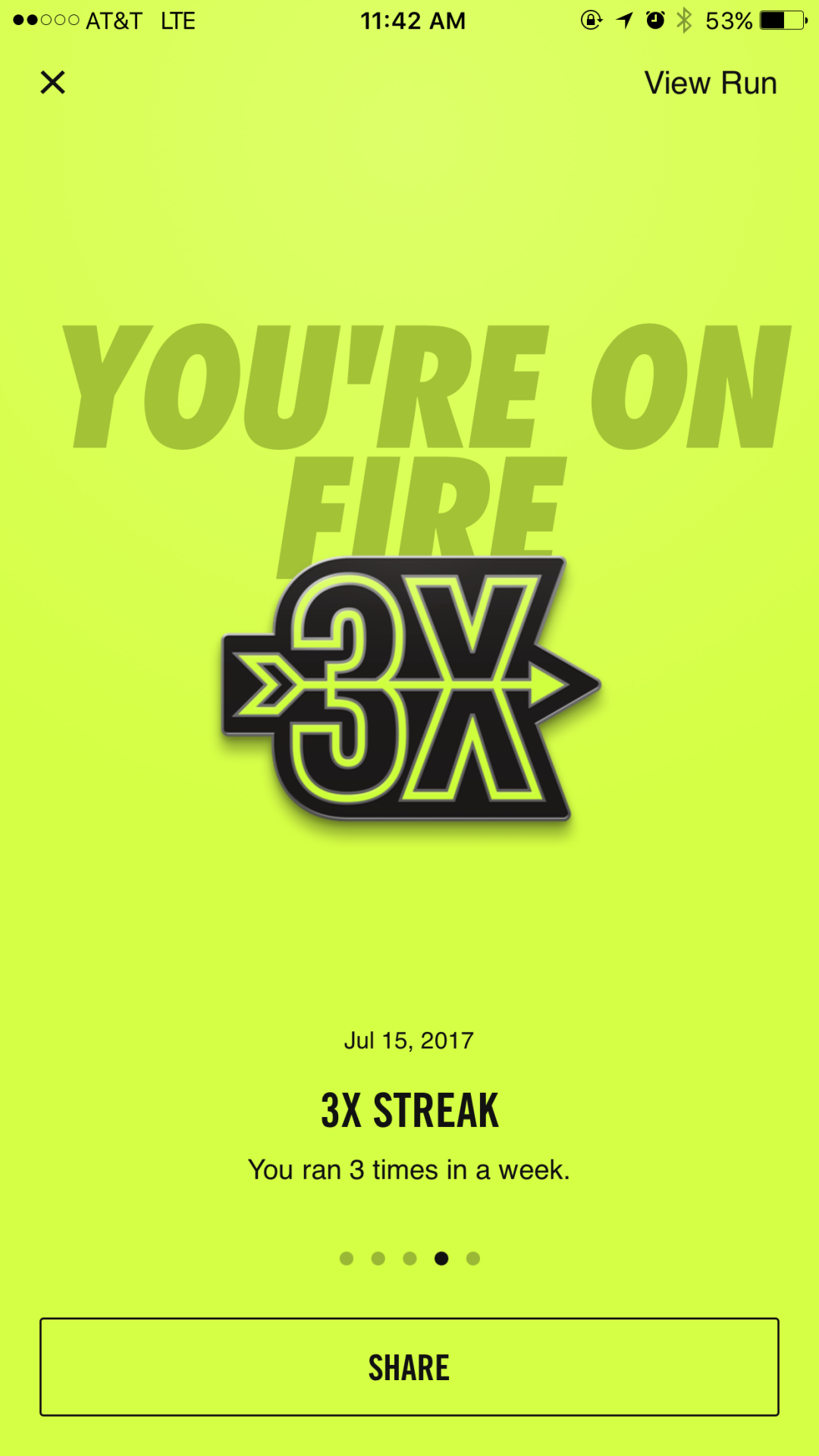
Celebrate whenever they reach important milestones to keep customers motivated as they deepen their engagement with your product. Little things like this simple congratulatory message from Nike Run Club can go a long way:
New feature releases are an important place to educate and retain new customers. New features provide value to seasoned customers, and communicating that value is key. Do this through things like product release note emails, in-app feature announcements, and even blog posts.
Your power users are a special group. These customers who get consistent value out of your product and stick around for years have a lot to say about your business. Their perspective on your product should be amplified to bring in more customers like them.
You can create customer feedback loops within their product, like the Norwegian healthcare platform PatientSky did with the help of Appcues. They used the Appcues NPS survey to gather information on their users’ sentiments that provided quantifiable feedback for use in follow-up campaigns.

How PatientSky uses Appcues to create feedback loops to understand user sentiment.
Customer retention is the unconquerable beast of SaaS. It’s never “done”.
And although you can never retain every single customer, you should always aim to improve your customer retention strategy. It's the easiest—and the cheapest—way to lift your MRR and help your business scale. In fact, a SaaS Capital study found that reducing your churn by just 1% can increase your company's valuation by 12% in 5 years.
Having a holistic strategy for re-engaging users is paramount. To realistically prevent user inactivity, you have to take a deep dive into why customers are losing interest and address those issues. You'll prevent churn in the short-term, and you'll have the data to improve your overall customer retention strategy in the long-term.
Here are 6 sure-fire ways to re-engage those inactive users and improve your retention rates.
You already know how essential a solid onboarding strategy is to your product’s success. But did you know the best onboarding strategies continue to nurture users far beyond their first session? The goal of your onboarding experience is to get users to value as quickly as possible. But understanding your core value doesn’t mean new users can automatically navigate the nuances of your product.
Continue to provide learning aids to users as they familiarize themselves with use cases and more advanced functionality. Use patterns like tooltips and modals to guide users through a workflow. The same rules that should guide your initial onboarding flow apply here, too:
Github, for example, uses a tooltip to highlight a shortcut for new or inexperienced users:

Github’s tooltip is effective because it provides valuable insight into how a user can streamline their in-app experience and accomplish tasks faster. Their use of emojis provides a touch of flair that will hopefully grab the user’s attention and their “Got It” CTA provides an easy out for users who are already aware of the shortcut.
Hubspot also does an exceptional job at extending the onboarding experience with a tooltip. This tooltip grabs the user’s attention and clearly depicts the benefit of the feature (make your conversations more efficient at scale):

By focusing on the benefit to the user, Hubspot re-emphasizes its value and promotes customer retention in the process.
And of course, you don't have to wait around for your user to come back to your app themselves. You can send a friendly email (or push notification, if you have a mobile app) reminding users about your product’s unique solution to their needs or announcing a feature. If you’re smart about it, re-engagement emails can be great levers for driving lapsed users back to your product, where you can then rekindle that spark they felt when they first subscribed.
There are many reasons a user may stop engaging with your product. Perhaps they found your onboarding experience laborious, encountered bugs in your software, or just decided to go a different route with their needs.
According to a Harvard Business Review study, the biggest reason that customers stop engaging is because the workflow isn't easy enough. If using your app is too complicated, users will give up.
Take a look at your user data and identify points where they’re dropping off. Analyze these parts of your product to understand what users experience and what’s causing them to churn. From there, you can start A/B testing to see if changing the flow improves retention.
There's no better way to learn about customers' experiences with your app than hearing it straight from the horses' mouth. Send around surveys to learn how you can re-engage each type of customer. Customers—especially churned customers—can provide invaluable real-world feedback.. Lean into it!
When done effectively, email surveys are a great way to solicit feedback so that you can pinpoint what didn't work in the customer experience, and whether their issue with your product is something you can address expediently and directly.
But an email survey that only makes an ask will come off as too self-serving. In your email, you want to make the customers recognize why taking this survey will benefit them (not you). Take a look at how the WordPress outsourcing service Codeable accomplishes this:

The opening sentence recognizes that Jimmy hasn’t been using Codeable lately, and then launches into a compelling pitch for open feedback. Codeable’s email successfully asks for feedback while making them come across as super customer-centric.
One of the best ways to inspire re-engagement is by continually improving your product. New features have a way of reinvigorating customers, even those who have been fairly inactive.
For active users, in-app announcements are one of the most effective ways to increase engagement with a new feature. But of course, you need to get folks into your product first! A multichannel social and email campaign around your feature updates is a great way to reach lapsed users. Below are a few real-world examples of compelling email announcements for inspiration:
When Litmus made some serious product updates, they took the opportunity to relaunch the product and get lapsed (as well as active) users excited to explore the changes. They position their email as an invitation to use the new and improved Litmus platform, creating a sense of exclusivity:

Litmus highlights all the new features of their product while assuring their core users that the product they know and love still exists—even giving users the option to switch back and forth between new and old. This strategy works because they’re appealing to lapsed users searching for a different experience without abandoning their loyal fanbase.
User research app Dovetail takes a bit of a different approach to feature announcements by providing them regularly in the form of a monthly newsletter:

This is especially effective for young companies with a new product—it lets users know you are truly invested and making updates on the regular. Inactive users who receive this email can see that the product is being optimized and all the kinks are being worked out on the regular. Dovetail’s newsletter instills confidence in their product and gives lapsed users that extra push needed to re-engage.
Plus, we love the friendly, straightforward copy that succinctly explains each update.
Dropbox directly targets lapsed users with their email entitled, “21 reasons to give Dropbox Paper another try”:
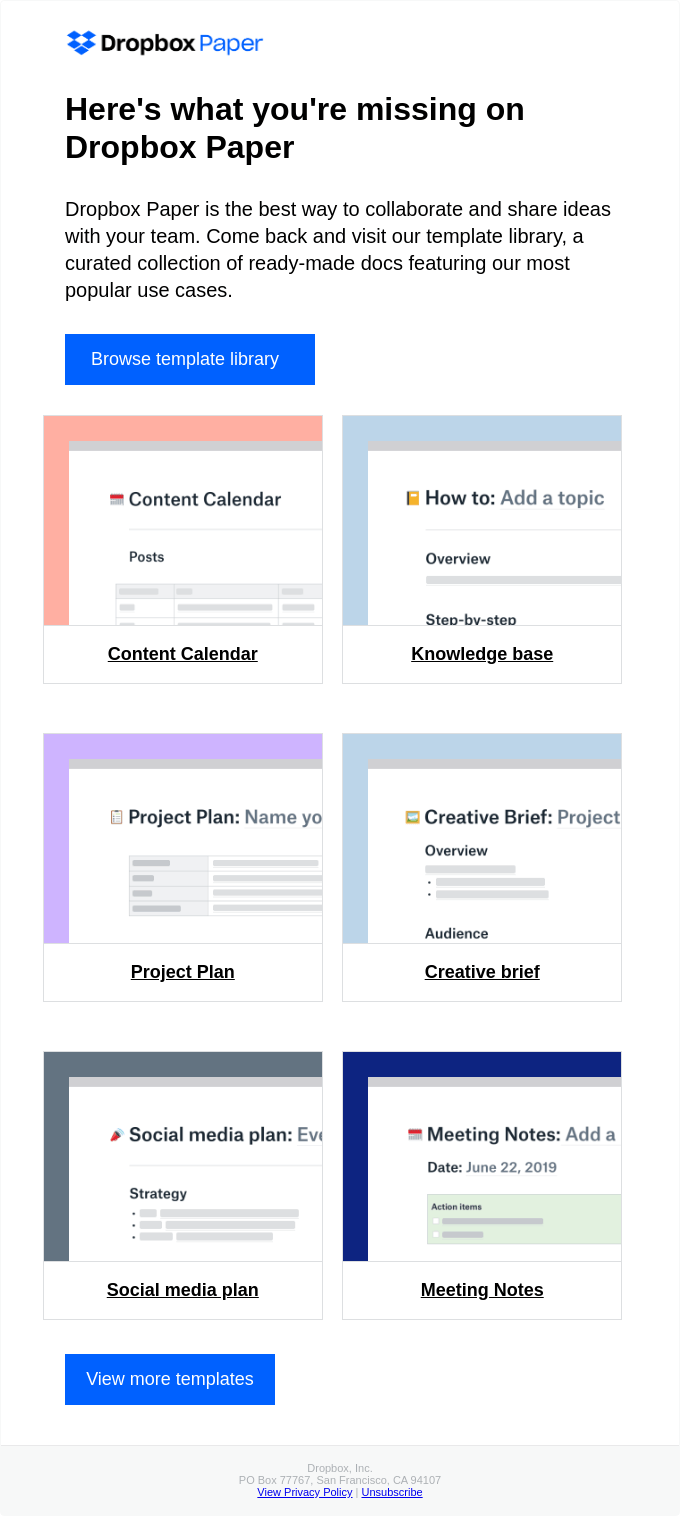
The idea is simple—give lapse users a picture into your product’s value by informing them of features they probably didn’t even know existed. The hope is that they give you another shot and try out some features they hadn’t before.
A Lee Resources International study revealed that for every customer who issues a complaint, there are 26 unhappy who don’t—many of whom go on to unsubscribe immediately. So if your customer support team only engages with customers once they've put in a ticket, they're missing 96% of your customers' problems.
Address this issue and re-engage your customers by asking your support team to provide proactive customer support. That means reaching out to inactive customers and reminding them that the team is ready and willing to help them with any issue.
Have your customer-facing teams reach out with helpful reminders. These can be instructions on how to start using your product, FAQs, or advice on different use cases. Equipping users with selected pieces of manageable guidance will make the product more accessible and relevant.
Take this example from RescueTime, a productivity app that tracks how you spend your work time:
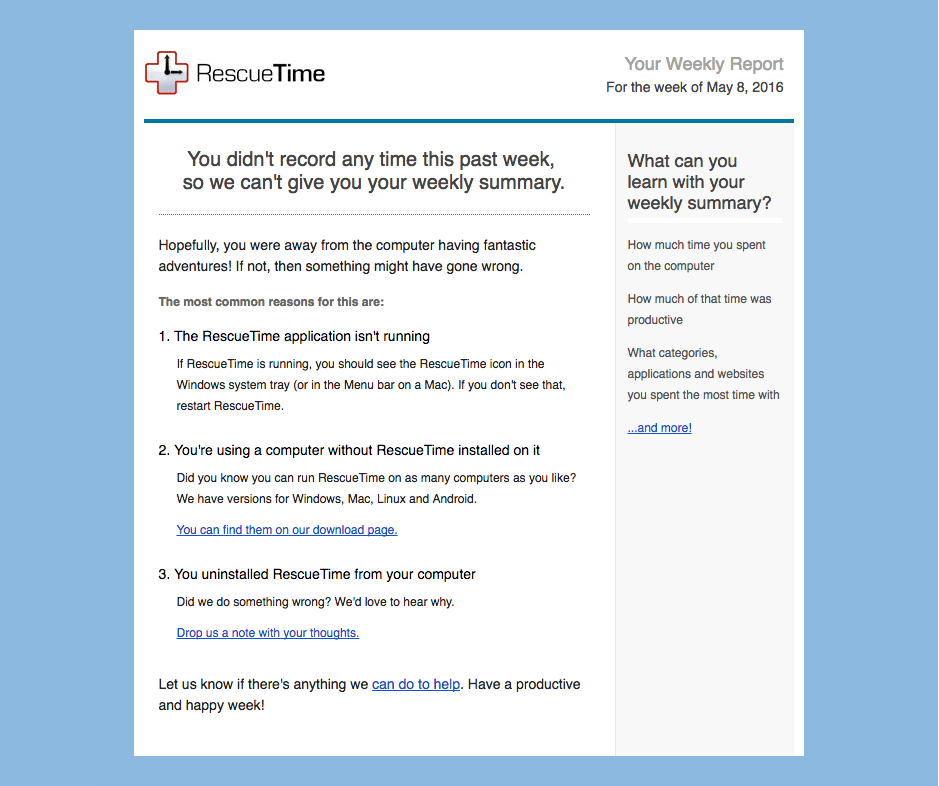
This example may be several years old, but there’s still a lot to learn from here. For one thing, RescueTime did their research: They found the 3 most common reasons for inactivity and then sent tangible solutions for each. They also provided a link to a customer support page so that users can let the company know their own reasons for being inactive.
Another way to go about this is to have a support team member send a personal message. It can be something simple like:
Hi Yume,
Hope all is well! Just checking in to see if there’s anything I could do to help you get more out of [our product]. Don’t hesitate to reach out with questions or frustrations. I’ll be happy to help!
Best,
Marcus
An informal personal message like this can help your team seem more accessible. It also frees the user from the process of having to go through a ticketing platform to submit a complaint.
Sometimes, when a user and product meet, it’s just bad timing. Maybe the user ended up switching companies or was just too distracted to give your product a fair shake. This is where re-engagement marketing campaigns come in handy.
There are many ways to approach re-engagement campaigns. There is the simple awareness approach, in which you invest in ads to keep your product top-of-mind. For a more targeted approach, think about what it is your prospects are trying to accomplish and adapt your strategy to address their needs.
For instance, many users give up on the product because they didn't spend long enough getting to know how it works. By enticing them with an extended free trial or a discounted upgrade, you'll give yourself more time to win them over.
Of course this strategy won't work if there are deeper issues—such as UI preferences, bugs, compatibility issues, etc. But it can work wonders for the users who just need a little bit more time getting to know your product in the first place.
The key is to offer users promotions that encourage users to actually use your product more. This type of promo can come in several forms, including:
These strategies work best for users that have had some experience with your service already. Since you can't give away free stuff to all your inactive users, target those who have interacted with the stickiest features of your app. Take a look at how dating app Hinge accomplishes this:

Hinge positions their free upgrade as an opportunity to give users more time exploring their product—in premium style. This not only encourages lapsed users to re-engage, but also to explore the best features Hinge has to offer. It’s a great strategy for turning users who are halfway out the door into long-term, paying customers.
While it might seem counter-intuitive to think of a goodbye message as a customer retention strategy, not all customers are sure about their decision to leave. A good user offboarding experience won’t save every account, but for some customers, it can provide just the right amount of positive friction to keep them from churning. Others who still leave, might eventually decide to come back if you make their last moments with your brand pleasant.
Put some thought into the options you give users on their way out the door. Create an offboarding flow that addresses common reasons for churn with options like:
Check out this example from Leadpages:
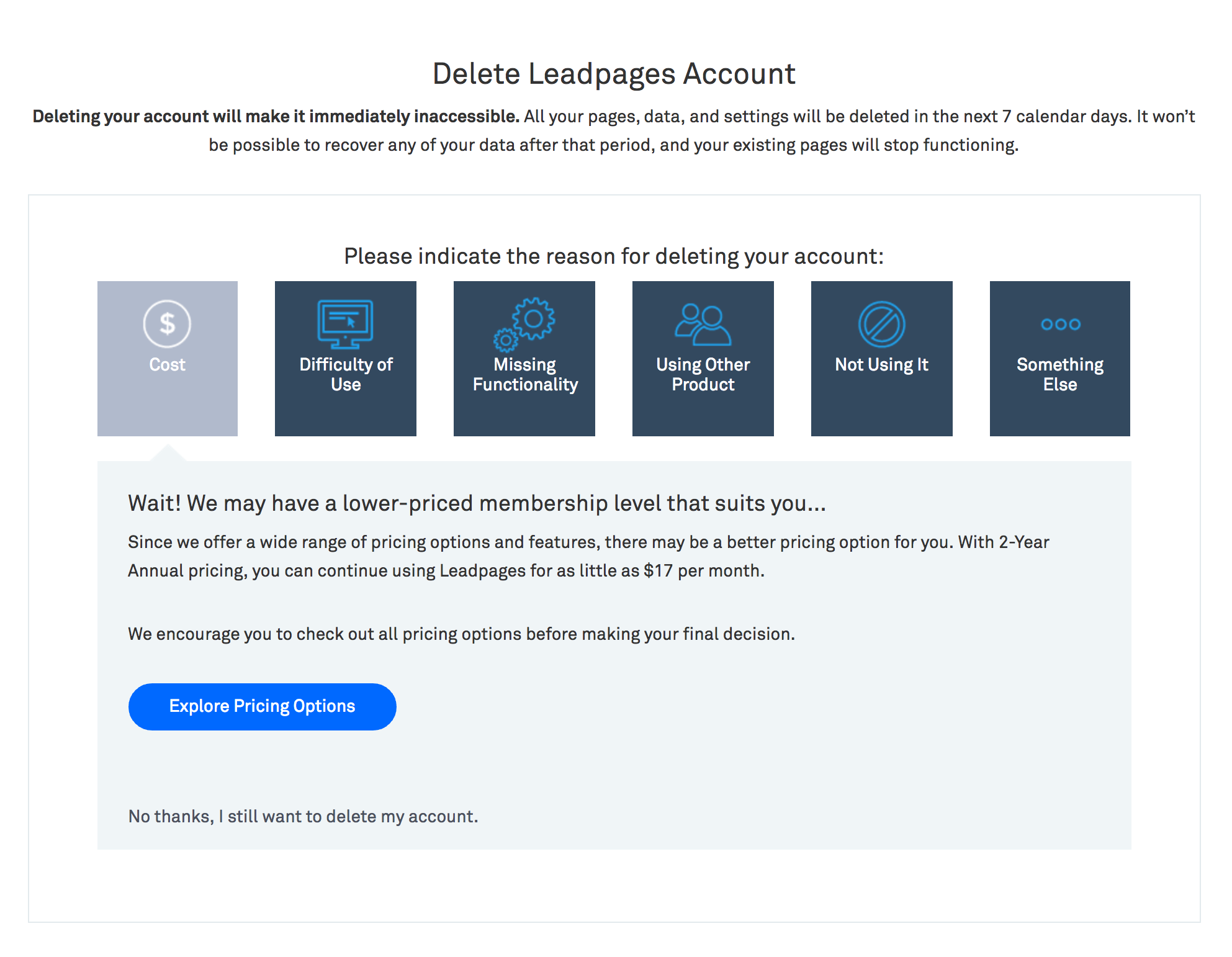
Leadpages asks users to indicate their reason for deleting their account, and provides 6 options to choose from. Based on their reason for canceling, Leadpages offers targeted responses within their offboarding flow. They try to address every possible reason why a customer might leave—cost, difficulty, missing functionality, etc. If none of that convinces them, they still have the option to leave.
Hulu takes the cancellation confirmation approach and keeps their goodbye email short and sweet:
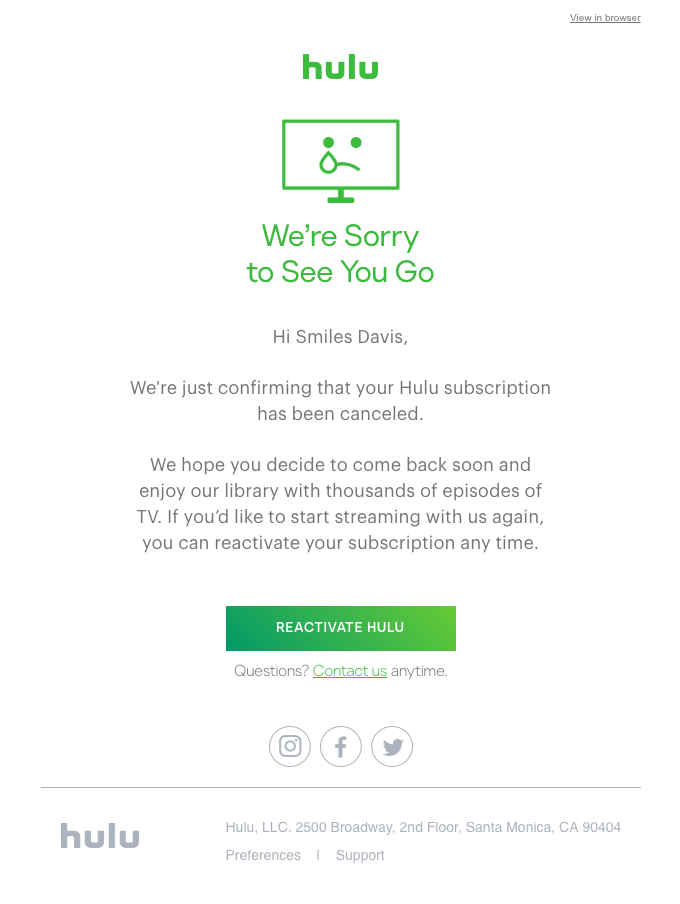
Hulu’s email provides a gentle reminder that users can become subscribers again at any time—they even provide a reactivate CTA, in case users change their mind immediately. What’s important here is that the cancellation message keeps the door open for future opportunities to re-engage, instead of treating churned users like they’re lost forever.
Re-engaging customers is too important to take lightly. You need a fool-proof re-engagement strategy, not a few last ditch effort emails.
Reconnect with your customers—whether it's through in-product messaging, emails, or even direct mail—and dig deep to find out why they disengaged in the first place. Only then will you be able to prevent your active users from becoming inactive users and improve your overall customer retention strategy.
Chasing after a bad churn rate with just any tool can feel like trying to fix a leaky faucet with a hammer—frustrating and futile. But don’t worry, we’ve got the right tool for the job. Say hello to Appcues: your friendly neighborhood retention hero. Imagine having a digital Mr. Rogers in your toolkit, ready to help you make every user feel right at home.
Why Appcues? Because we get it. Onboarding and retaining customers can sometimes feel like hosting a dinner party that never ends. Appcues makes it effortless to roll out the red carpet for every user, every time they log in, with personalized flows, in-app messages, and oh-so-timely nudges that show your users just how much you care.
Appcues is all about:
Keeping your users coming back is about more than just great features; it’s about making them feel valued and understood. And with killer features, terrific customer support, and a stellar user experience facilitated by Appcues, you're not just retaining customers—you're delighting them.
Dive deeper into how Appcues can transform your retention strategy from mundane to magical. Here are some resources to get you started on your journey to more "Hellos" and fewer "Goodbyes":
Remember, every step you take towards improving customer retention boosts your bottom line and builds a community of users who believe in your product as much as you do. Let Appcues help you make every user interaction feel like a part of something bigger, something better. Because at the end of the day, we're all just humans helping humans make the digital world a friendlier place.
Lifecycle Marketing
Retention & Churn
Personalization
Advocacy & Referrals
Ah, the thrill of a new customer—there's nothing quite like it, right? But let's be honest: the real magic happens when those newcomers become repeat customers. You've poured your heart into catching their eye and building trust through stellar marketing strategies and sales efforts. It makes total sense to put just as much effort into fostering brand loyalty and keeping them around.
Customer retention? It's easier said than done, especially when every brand out there is tempting your customers with the next shiny thing. It’s a bit like keeping a band together: you’ve got to keep hitting the right notes and shaking things up with new tunes to stay relevant and loved. That means weaving engaging, delightful experiences into every note of your customer's journey to ensure customer satisfaction at every turn.
In this guide, we'll dive into the nitty-gritty of customer retention strategies—no jargon, just plain good advice that you can chat about as easily as if you were talking over coffee. We'll lay out the tools, metrics, and, yes, the secret sauce that can help you reduce customer churn and keep those hard-earned fans coming back for more encores. Because at the end of the day, it's about making every step of the customer experience feel like a VIP backstage pass, ensuring that every interaction builds trust and cements a lasting relationship.
Customer retention is the process of retaining your current customers and getting them to return to your product for subsequent purchases, user sessions, or engagement. It goes beyond having a customer success team that answers requests and facilitates onboarding. It’s the art of turning first-time buyers into lifelong fans by ensuring every encounter with your brand is nothing short of delightful.
Why spend all your effort drumming up new business when you can dance with those who already know your moves? Here’s why customer retention is crucial for hitting those high business notes:
A comprehensive customer retention strategy is like the perfect playlist—it keeps your fans tuned in and excited for what’s next, turning casual listeners into devoted followers who boost your brand’s volume in the market.
You should absolutely celebrate every new customer your SaaS company lands. However, if you’re losing two customers for every one you gain, you need to take a closer look at your customer retention strategy. Building a business with poor retention is like trying to fill a leaky bucket. No matter what you do, you’ll never fill it up with enough water (customers) to sustain a healthy business.
Customer retention is essential to maintaining the health of your business. It provides more recurring revenue than acquisition. Understanding what it is, how to measure it, and how to improve it will keep customer satisfaction high—helping you gain more renewals and deal with less churn.
📖 Read more: The importance of customer retention by the numbers
You want to achieve the highest possible retention rate to minimize churn and fuel growth. However, before you can improve your existing customer retention rate, you need to measure it first. You can calculate your basic customer retention rate using this formula:
Customer retention rate (CRR) = number of customers at the end of the period / total number of customers
To get the most out of the customer retention rate formula, you must make sure you:
Getting a clear view of your retention metrics provides insights into the effectiveness of your engagement strategies, helping you fine-tune your approach to keep your fan base growing and thriving. With the right data at your fingertips, you can turn every customer interaction into an opportunity to enhance customer lifetime value (CLV), making every moment count.
A SaaS business isn’t sustainable if it doesn’t retain its customers. Negative retention—aka churn—is bad. But if you're experiencing high churn rates, take comfort in the fact that you're not alone.
Here’s how you can enhance your customer retention rate, each strategy backed by a clear understanding of why it matters and how it makes your customers feel more valued.
The more you know about your customers, the better you can serve them. Start with thorough research to understand their desires, pain points, and successes. Tools like Appcues can help collect customer feedback directly through interactive surveys and feedback widgets, which provide insights directly from the horse's mouth, helping you tailor the customer journey to reduce churn and enhance retention.
Today’s users expect personalized experiences tailored to their needs. From the onboarding process to ongoing interaction, personalizing the customer journey can significantly boost retention. For example, using Appcues to create tailored onboarding flows that address different user segments can help make every user feel like your product is built just for them.
Effective email communication is crucial for nurturing and retaining customers. From welcome emails to ongoing engagement strategies like newsletters and personalized updates, ensure each communication adds value and reinforces the user's decision to choose your brand.
Use Appcues to trigger personalized email sequences based on user behavior, such as completing an onboarding step or achieving a new milestone.
Exceptional customer support can be a significant differentiator. Ensure that you offer multiple channels for support and that each interaction is as helpful and human as possible. Using tools like Appcues, you can guide users to helpful resources before they even need to ask for help, proactively preventing frustration.
Set up in-app messaging for common queries and direct users towards self-help resources, effectively reducing the load on your support team while increasing user satisfaction.
Customer loyalty programs (aka customer retention programs) reward continued engagement and purchases, giving users a reason to stick around. With Appcues, you can design engaging loyalty programs that reward users for their activities within your app, enhancing their attachment to your brand.
Develop in-app challenges or milestones that reward users with points, badges, or discounts, encouraging continued engagement and fostering loyalty. It can also include a referral program with exclusive incentives based on the number of new customers signed up over a specific period of time.
Communities can significantly enhance customer retention by giving users a platform to connect and support each other. Implementing a community within your product or on your site can keep your users engaged and provide them with value beyond the basic functionalities of your product. Social media platforms are typically full of word-of-mouth posts sharing their favorite parts about products and even some customer complaints. Giving your customers a place to have an open discussion can help promote transparency and prevent negative brand awareness.
Positive reviews and testimonials not only attract new customers but also reinforce the loyalty of existing ones. Make it easy for satisfied customers to share their experiences with new products and use these testimonials to showcase the value of your product.
Use automation to integrate a review prompt within your product at strategic points, such as after a positive interaction or a successful customer support resolution.
A simple "thank you" can go a long way. Regularly express gratitude to your customers with personalized messages, occasional gifts, or exclusive offers that make them feel valued.
Set up automated, personalized thank you messages using Appcues after significant engagements or milestones.
To improve customer retention, treat each customer segment differently. Customer expectations and experiences change throughout their lifecycle. It’s important to address the problems specific to each customer as they progress along their journey to improve retention and make your customer relationships last.
The best retention strategies target customers at different stages in their user journey. Break down your strategies into these three stages to address customer needs at any given point in their life cycle:
📖 Read more: Improve user and customer retention with these 9 quick wins
User onboarding is the most important part of the customer journey. You only have a narrow window of time to drive users to their moment of value before you can expect to see a 2.6x increase in revenue through onboarding improvements. The better you can engage prospective customers on day one, the more likely they are to buy, engage, and stick around for longer.
Onboarding optimization encompasses anything from tailoring the onboarding process to different buyer personas, finding ways to offer users wins (or “aha moments”) early on, and thorough testing to improve your UX patterns. Onboarding doesn't have to be complicated. In fact, it shouldn't be. With a few simple best practices, it's easy to put together a top-notch product tour that will lead your customers from novices to adept users. After all, it's worked for companies like Slack, Duolingo, and Grammarly.
Software companies often make a grave mistake when onboarding their customers: they quit onboarding at their customers’ first activation event. Avoid this mistake within your own product and keep pushing customers to adopt new features and use cases.
Celebrate whenever they reach important milestones to keep customers motivated as they deepen their engagement with your product. Little things like this simple congratulatory message from Nike Run Club can go a long way:
New feature releases are an important place to educate and retain new customers. New features provide value to seasoned customers, and communicating that value is key. Do this through things like product release note emails, in-app feature announcements, and even blog posts.
Your power users are a special group. These customers who get consistent value out of your product and stick around for years have a lot to say about your business. Their perspective on your product should be amplified to bring in more customers like them.
You can create customer feedback loops within their product, like the Norwegian healthcare platform PatientSky did with the help of Appcues. They used the Appcues NPS survey to gather information on their users’ sentiments that provided quantifiable feedback for use in follow-up campaigns.
How PatientSky uses Appcues to create feedback loops to understand user sentiment.
Customer retention is the unconquerable beast of SaaS. It’s never “done”.
And although you can never retain every single customer, you should always aim to improve your customer retention strategy. It's the easiest—and the cheapest—way to lift your MRR and help your business scale. In fact, a SaaS Capital study found that reducing your churn by just 1% can increase your company's valuation by 12% in 5 years.
Having a holistic strategy for re-engaging users is paramount. To realistically prevent user inactivity, you have to take a deep dive into why customers are losing interest and address those issues. You'll prevent churn in the short-term, and you'll have the data to improve your overall customer retention strategy in the long-term.
Here are 6 sure-fire ways to re-engage those inactive users and improve your retention rates.
You already know how essential a solid onboarding strategy is to your product’s success. But did you know the best onboarding strategies continue to nurture users far beyond their first session? The goal of your onboarding experience is to get users to value as quickly as possible. But understanding your core value doesn’t mean new users can automatically navigate the nuances of your product.
Continue to provide learning aids to users as they familiarize themselves with use cases and more advanced functionality. Use patterns like tooltips and modals to guide users through a workflow. The same rules that should guide your initial onboarding flow apply here, too:
Github, for example, uses a tooltip to highlight a shortcut for new or inexperienced users:
Github’s tooltip is effective because it provides valuable insight into how a user can streamline their in-app experience and accomplish tasks faster. Their use of emojis provides a touch of flair that will hopefully grab the user’s attention and their “Got It” CTA provides an easy out for users who are already aware of the shortcut.
Hubspot also does an exceptional job at extending the onboarding experience with a tooltip. This tooltip grabs the user’s attention and clearly depicts the benefit of the feature (make your conversations more efficient at scale):
By focusing on the benefit to the user, Hubspot re-emphasizes its value and promotes customer retention in the process.
And of course, you don't have to wait around for your user to come back to your app themselves. You can send a friendly email (or push notification, if you have a mobile app) reminding users about your product’s unique solution to their needs or announcing a feature. If you’re smart about it, re-engagement emails can be great levers for driving lapsed users back to your product, where you can then rekindle that spark they felt when they first subscribed.
There are many reasons a user may stop engaging with your product. Perhaps they found your onboarding experience laborious, encountered bugs in your software, or just decided to go a different route with their needs.
According to a Harvard Business Review study, the biggest reason that customers stop engaging is because the workflow isn't easy enough. If using your app is too complicated, users will give up.
Take a look at your user data and identify points where they’re dropping off. Analyze these parts of your product to understand what users experience and what’s causing them to churn. From there, you can start A/B testing to see if changing the flow improves retention.
There's no better way to learn about customers' experiences with your app than hearing it straight from the horses' mouth. Send around surveys to learn how you can re-engage each type of customer. Customers—especially churned customers—can provide invaluable real-world feedback.. Lean into it!
When done effectively, email surveys are a great way to solicit feedback so that you can pinpoint what didn't work in the customer experience, and whether their issue with your product is something you can address expediently and directly.
But an email survey that only makes an ask will come off as too self-serving. In your email, you want to make the customers recognize why taking this survey will benefit them (not you). Take a look at how the WordPress outsourcing service Codeable accomplishes this:
The opening sentence recognizes that Jimmy hasn’t been using Codeable lately, and then launches into a compelling pitch for open feedback. Codeable’s email successfully asks for feedback while making them come across as super customer-centric.
One of the best ways to inspire re-engagement is by continually improving your product. New features have a way of reinvigorating customers, even those who have been fairly inactive.
For active users, in-app announcements are one of the most effective ways to increase engagement with a new feature. But of course, you need to get folks into your product first! A multichannel social and email campaign around your feature updates is a great way to reach lapsed users. Below are a few real-world examples of compelling email announcements for inspiration:
When Litmus made some serious product updates, they took the opportunity to relaunch the product and get lapsed (as well as active) users excited to explore the changes. They position their email as an invitation to use the new and improved Litmus platform, creating a sense of exclusivity:
Litmus highlights all the new features of their product while assuring their core users that the product they know and love still exists—even giving users the option to switch back and forth between new and old. This strategy works because they’re appealing to lapsed users searching for a different experience without abandoning their loyal fanbase.
User research app Dovetail takes a bit of a different approach to feature announcements by providing them regularly in the form of a monthly newsletter:
This is especially effective for young companies with a new product—it lets users know you are truly invested and making updates on the regular. Inactive users who receive this email can see that the product is being optimized and all the kinks are being worked out on the regular. Dovetail’s newsletter instills confidence in their product and gives lapsed users that extra push needed to re-engage.
Plus, we love the friendly, straightforward copy that succinctly explains each update.
Dropbox directly targets lapsed users with their email entitled, “21 reasons to give Dropbox Paper another try”:
The idea is simple—give lapse users a picture into your product’s value by informing them of features they probably didn’t even know existed. The hope is that they give you another shot and try out some features they hadn’t before.
A Lee Resources International study revealed that for every customer who issues a complaint, there are 26 unhappy who don’t—many of whom go on to unsubscribe immediately. So if your customer support team only engages with customers once they've put in a ticket, they're missing 96% of your customers' problems.
Address this issue and re-engage your customers by asking your support team to provide proactive customer support. That means reaching out to inactive customers and reminding them that the team is ready and willing to help them with any issue.
Have your customer-facing teams reach out with helpful reminders. These can be instructions on how to start using your product, FAQs, or advice on different use cases. Equipping users with selected pieces of manageable guidance will make the product more accessible and relevant.
Take this example from RescueTime, a productivity app that tracks how you spend your work time:
This example may be several years old, but there’s still a lot to learn from here. For one thing, RescueTime did their research: They found the 3 most common reasons for inactivity and then sent tangible solutions for each. They also provided a link to a customer support page so that users can let the company know their own reasons for being inactive.
Another way to go about this is to have a support team member send a personal message. It can be something simple like:
Hi Yume,
Hope all is well! Just checking in to see if there’s anything I could do to help you get more out of [our product]. Don’t hesitate to reach out with questions or frustrations. I’ll be happy to help!
Best,
Marcus
An informal personal message like this can help your team seem more accessible. It also frees the user from the process of having to go through a ticketing platform to submit a complaint.
Sometimes, when a user and product meet, it’s just bad timing. Maybe the user ended up switching companies or was just too distracted to give your product a fair shake. This is where re-engagement marketing campaigns come in handy.
There are many ways to approach re-engagement campaigns. There is the simple awareness approach, in which you invest in ads to keep your product top-of-mind. For a more targeted approach, think about what it is your prospects are trying to accomplish and adapt your strategy to address their needs.
For instance, many users give up on the product because they didn't spend long enough getting to know how it works. By enticing them with an extended free trial or a discounted upgrade, you'll give yourself more time to win them over.
Of course this strategy won't work if there are deeper issues—such as UI preferences, bugs, compatibility issues, etc. But it can work wonders for the users who just need a little bit more time getting to know your product in the first place.
The key is to offer users promotions that encourage users to actually use your product more. This type of promo can come in several forms, including:
These strategies work best for users that have had some experience with your service already. Since you can't give away free stuff to all your inactive users, target those who have interacted with the stickiest features of your app. Take a look at how dating app Hinge accomplishes this:
Hinge positions their free upgrade as an opportunity to give users more time exploring their product—in premium style. This not only encourages lapsed users to re-engage, but also to explore the best features Hinge has to offer. It’s a great strategy for turning users who are halfway out the door into long-term, paying customers.
While it might seem counter-intuitive to think of a goodbye message as a customer retention strategy, not all customers are sure about their decision to leave. A good user offboarding experience won’t save every account, but for some customers, it can provide just the right amount of positive friction to keep them from churning. Others who still leave, might eventually decide to come back if you make their last moments with your brand pleasant.
Put some thought into the options you give users on their way out the door. Create an offboarding flow that addresses common reasons for churn with options like:
Check out this example from Leadpages:
Leadpages asks users to indicate their reason for deleting their account, and provides 6 options to choose from. Based on their reason for canceling, Leadpages offers targeted responses within their offboarding flow. They try to address every possible reason why a customer might leave—cost, difficulty, missing functionality, etc. If none of that convinces them, they still have the option to leave.
Hulu takes the cancellation confirmation approach and keeps their goodbye email short and sweet:
Hulu’s email provides a gentle reminder that users can become subscribers again at any time—they even provide a reactivate CTA, in case users change their mind immediately. What’s important here is that the cancellation message keeps the door open for future opportunities to re-engage, instead of treating churned users like they’re lost forever.
Re-engaging customers is too important to take lightly. You need a fool-proof re-engagement strategy, not a few last ditch effort emails.
Reconnect with your customers—whether it's through in-product messaging, emails, or even direct mail—and dig deep to find out why they disengaged in the first place. Only then will you be able to prevent your active users from becoming inactive users and improve your overall customer retention strategy.
Chasing after a bad churn rate with just any tool can feel like trying to fix a leaky faucet with a hammer—frustrating and futile. But don’t worry, we’ve got the right tool for the job. Say hello to Appcues: your friendly neighborhood retention hero. Imagine having a digital Mr. Rogers in your toolkit, ready to help you make every user feel right at home.
Why Appcues? Because we get it. Onboarding and retaining customers can sometimes feel like hosting a dinner party that never ends. Appcues makes it effortless to roll out the red carpet for every user, every time they log in, with personalized flows, in-app messages, and oh-so-timely nudges that show your users just how much you care.
Appcues is all about:
Keeping your users coming back is about more than just great features; it’s about making them feel valued and understood. And with killer features, terrific customer support, and a stellar user experience facilitated by Appcues, you're not just retaining customers—you're delighting them.
Dive deeper into how Appcues can transform your retention strategy from mundane to magical. Here are some resources to get you started on your journey to more "Hellos" and fewer "Goodbyes":
Remember, every step you take towards improving customer retention boosts your bottom line and builds a community of users who believe in your product as much as you do. Let Appcues help you make every user interaction feel like a part of something bigger, something better. Because at the end of the day, we're all just humans helping humans make the digital world a friendlier place.

Sign up for Quickcues and get our monthly updates!
.svg)