
.png)

There are two kinds of teams:
The first kind has a mile-long list of “quick fixes” they genuinely want to tackle… right after the next sprint, or the next launch, or whenever things finally slow down.
The second kind ships consistently, confidently, and with a rhythm that makes progress feel natural instead of chaotic.
Whether your product is a SaaS platform, a customer portal, or a digital workflow inside a larger operation, the same bottlenecks keep showing up.
The difference between these teams isn’t talent or headcount. And it isn’t some secret playbook that high-growth companies keep locked in a safe.
It’s workflow and a reliable digital adoption platform.
Teams can move when engineering becomes a true partner instead of an outside reference point. They combine best practices with a digital adoption platform to not only gain autonomy, but make iteration and quick growth possible.
So let’s break down what the fast teams do differently, and how Appcues customers have been quietly operating this way for years.
A PM or lifecycle marketer spots something small they want to fix: a line of copy, a tooltip, a fork for enterprise accounts, a nudge where users get stuck.
But if it requires code? Forget about it. Progress halts. You wait for a sprint slot, UI review, QA, release timing… and by the time the change goes live, the insight that sparked it is old news and user feedback has gotten stale.
For many teams, especially in financial services, healthcare, logistics, and operations, slow iteration doesn’t just hurt activation; it drives up support volume and manual intervention.
Engineering integrates a digital adoption platform once, and then lets product and growth teams build on top of that foundation. That cuts down the dependency chain for more controlled autonomy and faster iteration.
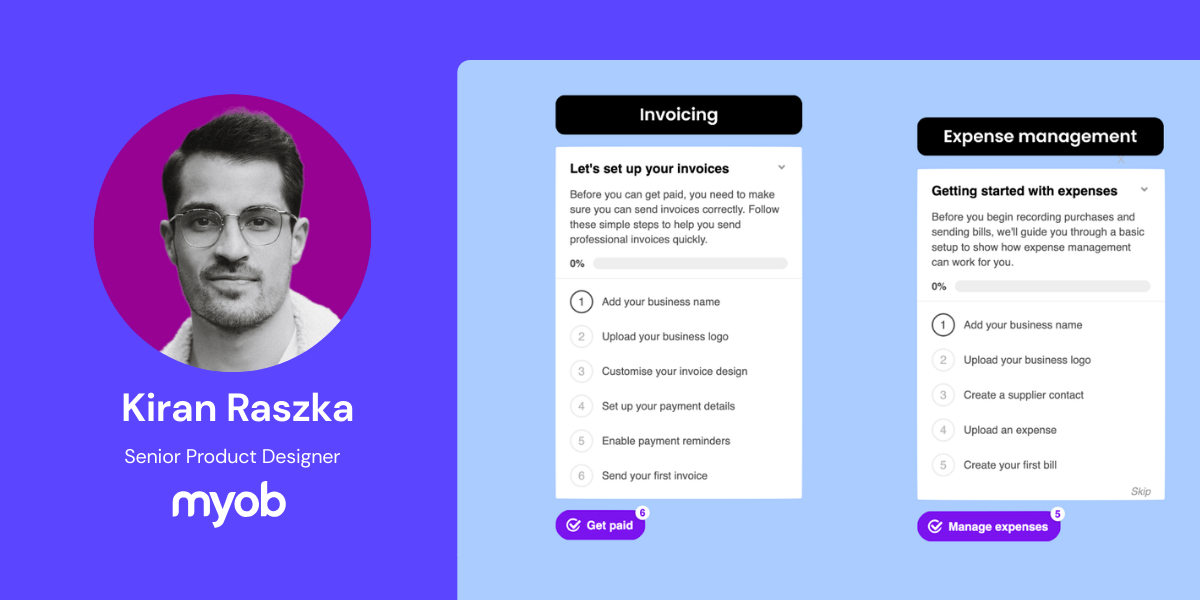
When MYOB looked at their onboarding, they realized two things: too many new users were stalling out early, and every improvement required engineering time they didn’t have.
Once they moved their onboarding into Appcues, the team could finally start shaping the experience themselves.
Before , even small onboarding tweaks required engineering to hard-code updates directly into the UI which created an expensive and slow loop. Moving the experience into Appcues freed engineers from maintenance work and gave Product the autonomy to iterate.
They replaced a static first-run with a personalized checklist, added lightweight in-app guidance where users typically got stuck, and started iterating in days instead of sprints.
This shift didn’t just increase activation by 21%; it also cut the engineering hours needed to maintain onboarding.
And they did it by giving their product and growth teams the ability to act on insights immediately with digital tools, not waiting for whenever a sprint opened up.
You know exactly where users drop off. The analytics leave no mystery.
But the fix requires UI changes, and the roadmap’s full.
They connect their analytics and in-app experiences so the people closest to the insights can immediately ship improvements: adjusting flows, prompting users contextually, or reworking paths for specific segments right when the issues surface.
Or, if you’re like SignalPet, you have both in one place without any extra connections.
SignalPET had no shortage of data. They could see the moments where users hesitated or missed value. What they lacked was a way to respond in the moment without rebuilding the UI.
With Appcues, they started layering small but targeted nudges inside the product; this looked like guidance for users who hadn’t tried a key feature yet, prompts tied to specific behaviors, subtle hand-offs at friction points.
Because the team could deploy right away, they were able to support adoption across multiple products without slowing engineering down. The team not only drove a 36% activation rate for a new offering, they also reduced the operational overhead of building UI changes.
Proof of what happens when the people closest to the insights don’t have to wait months to act, and can take matters into their own hands with a digital adoption platform.

If every branch of an onboarding flow has to be coded and maintained, most teams don’t do it. Everyone gets the same generic experience; not because it’s the best option, but because the alternative is too resource-intensive.
No one’s got the time to sit down and execute on personalized experiences, let alone think them all the way through. We’ve all been told a thousand times that it’s best practice, but no one addresses the real time commitment it takes.
They segment by behavior, plan, role, or setup and tailor onboarding based on key attributes they already have in their CRM. This creates autonomy without anyone building new conditional logic.The result is more relevance with far less lift.
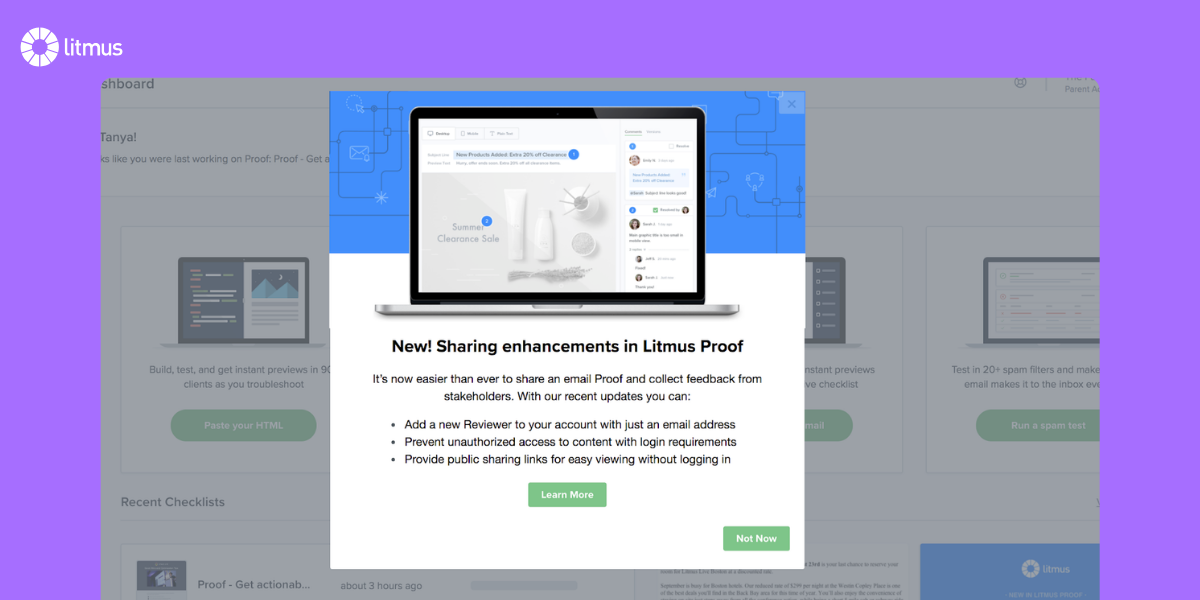
Litmus had a classic challenge: different customer types used their product in completely different ways, but everyone went through the same onboarding and saw the same prompts.
Personalization was always on the roadmap, but never high enough to get engineering attention.
Once they switched to Appcues, the team started segmenting users based on behavior and role and shaping experiences around what each group actually needed. That included targeted feature announcements and onboarding paths that felt meaningfully different for each persona.
The result was dramatic. Litmus increased adoption of a key feature by 2,100%.
That jump didn’t come from a redesign. It came from finally being able to deliver the right guidance to the right users without having to build new conditional logic every time.
That 2,100% lift also came without requiring ongoing engineering bandwidth for branching logic. They did it all from the right digital adoption platform.
The real tension doesn't live between PMs vs. Engineering. It's squarely in the middle of the teams who need to move fast (Product, Ops, Lifecycle, Training, CX) and the person or group accountable for keeping the UI stable, consistent, and compliant.
That governance role varies. In SaaS, it’s often Engineering; in digital transformation orgs, it might be Modernization, Operations, CX, or a Digital Experience owner. They’re the ones who have to live with the system, so they care deeply about performance, accessibility, brand safety, and risk.
When speed lives in one place and governance lives in another, updates slow down. Even small fixes feel like a hot potato: Who owns this? Who’s allowed to change it? Will it break something upstream?
They stop treating speed and governance as opposing forces. They give the platform owner clear guardrails (brand-safe components, permissions, approvals) and give the teams closest to the insight the autonomy to act safely within them.
This isresponsible autonomy: governance as the foundation, speed as the outcome.
Before adopting a digital adoption platform, AdRoll’s growth team had big ideas but limited ways to test them.
Engineering understandably worried about performance, visual consistency, and surprise UI changes landing in production.
Appcues gave them a middle path. Engineering set the guardrails, those brand-safe components, performance expectations, permissions we all need, and the growth team handled iteration inside those boundaries. And that led to a series of successful cross-sell flows.
Everyone could see what was being shipped, nothing bypassed the process, and the UI stayed consistent.
With that system in place, AdRoll’s growth team was able to quickly test and refine in-app experiences that contributed directly to conversion lift.
The speed didn’t create chaos; it created alignment. By keeping governance intact, they eliminated back-and-forth cycles and sped up iteration.

When onboarding requires code, teams treat it like a big project instead of a living system. It ships once and gradually stops matching the actual product.
They treat onboarding like an evolving asset that’s updated weekly, not annually. Small improvements stack up, and the experience stays aligned with the product as it grows.
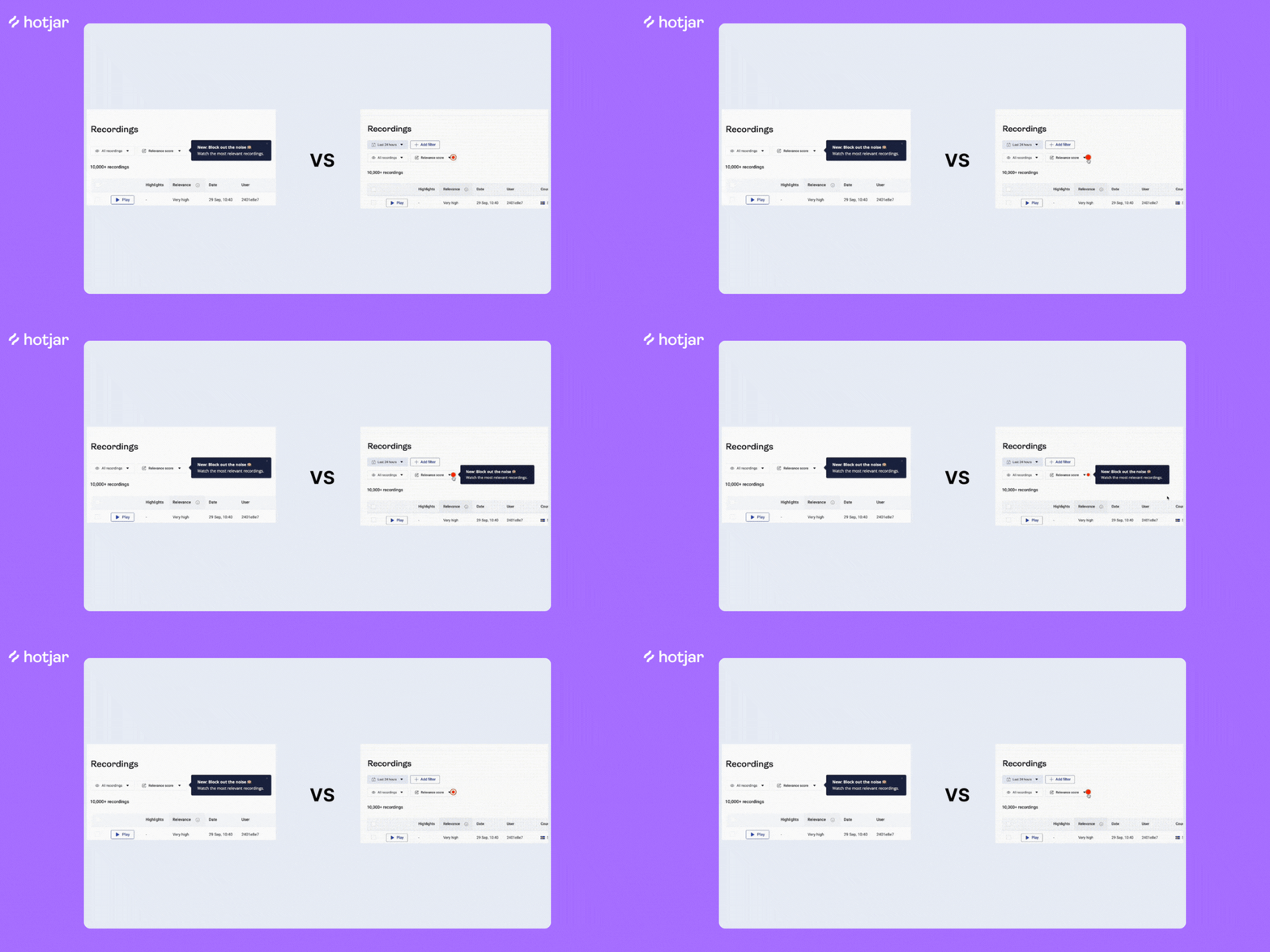
Hotjar had a strong product, but their onboarding struggled to keep up. Every time the product evolved, the onboarding lagged behind. And updating it meant writing more code.
By moving onboarding into Appcues, the team started treating it as something they could tune continuously. They experimented with messaging, updated guidance as features changed, and delivered different paths based on a user’s setup.
Those improvements added up: Hotjar increased installations by 26%. They also reduced the manual engineering lift needed to keep onboarding aligned with the product.
More importantly, onboarding stopped being a one-and-done project and became something that could evolve alongside the product.
These teams aren’t reckless; they’ve redesigned the workflow so speed is safe.
It starts when a leader knows the team needs to change: wether it's from already knowing they need a digital adoption platform, or they're following a digital transformation mandate.
Once they vet all the solutions out there and take their pick, the work begins.
Engineering lays the groundwork once. Product, lifecycle, and onboarding teams iterate continuously. Everyone works from the same data. Changes ship without waiting for deployment cycles. Onboarding evolves alongside the product instead of falling behind.
This is what “code-lite digital adoption” actually looks like: responsible autonomy at speed.
It’s not about whether your digital tools can build a tooltip, a checklist, or a personalized flow. Those features matter, but they’re not the core issue. It's deeper than that.
The question is: Does this not only remove bottlenecks, but create a strong enough foundation that sustains autonomy?
For our customers, the answer has consistently been yes. And it’s why they move faster than teams still hard-coding everything. Engineering is brought in early enough to build, so they don’t keep getting pulled back in for changes.
Why high-velocity teams choose Appcues as their digital adoption platform:
Product Adoption
Checklists, Tooltips & Modals
User Engagement
Product Tours & Walkthroughs
There are two kinds of teams:
The first kind has a mile-long list of “quick fixes” they genuinely want to tackle… right after the next sprint, or the next launch, or whenever things finally slow down.
The second kind ships consistently, confidently, and with a rhythm that makes progress feel natural instead of chaotic.
Whether your product is a SaaS platform, a customer portal, or a digital workflow inside a larger operation, the same bottlenecks keep showing up.
The difference between these teams isn’t talent or headcount. And it isn’t some secret playbook that high-growth companies keep locked in a safe.
It’s workflow and a reliable digital adoption platform.
Teams can move when engineering becomes a true partner instead of an outside reference point. They combine best practices with a digital adoption platform to not only gain autonomy, but make iteration and quick growth possible.
So let’s break down what the fast teams do differently, and how Appcues customers have been quietly operating this way for years.
A PM or lifecycle marketer spots something small they want to fix: a line of copy, a tooltip, a fork for enterprise accounts, a nudge where users get stuck.
But if it requires code? Forget about it. Progress halts. You wait for a sprint slot, UI review, QA, release timing… and by the time the change goes live, the insight that sparked it is old news and user feedback has gotten stale.
For many teams, especially in financial services, healthcare, logistics, and operations, slow iteration doesn’t just hurt activation; it drives up support volume and manual intervention.
Engineering integrates a digital adoption platform once, and then lets product and growth teams build on top of that foundation. That cuts down the dependency chain for more controlled autonomy and faster iteration.
When MYOB looked at their onboarding, they realized two things: too many new users were stalling out early, and every improvement required engineering time they didn’t have.
Once they moved their onboarding into Appcues, the team could finally start shaping the experience themselves.
Before , even small onboarding tweaks required engineering to hard-code updates directly into the UI which created an expensive and slow loop. Moving the experience into Appcues freed engineers from maintenance work and gave Product the autonomy to iterate.
They replaced a static first-run with a personalized checklist, added lightweight in-app guidance where users typically got stuck, and started iterating in days instead of sprints.
This shift didn’t just increase activation by 21%; it also cut the engineering hours needed to maintain onboarding.
And they did it by giving their product and growth teams the ability to act on insights immediately with digital tools, not waiting for whenever a sprint opened up.
You know exactly where users drop off. The analytics leave no mystery.
But the fix requires UI changes, and the roadmap’s full.
They connect their analytics and in-app experiences so the people closest to the insights can immediately ship improvements: adjusting flows, prompting users contextually, or reworking paths for specific segments right when the issues surface.
Or, if you’re like SignalPet, you have both in one place without any extra connections.
SignalPET had no shortage of data. They could see the moments where users hesitated or missed value. What they lacked was a way to respond in the moment without rebuilding the UI.
With Appcues, they started layering small but targeted nudges inside the product; this looked like guidance for users who hadn’t tried a key feature yet, prompts tied to specific behaviors, subtle hand-offs at friction points.
Because the team could deploy right away, they were able to support adoption across multiple products without slowing engineering down. The team not only drove a 36% activation rate for a new offering, they also reduced the operational overhead of building UI changes.
Proof of what happens when the people closest to the insights don’t have to wait months to act, and can take matters into their own hands with a digital adoption platform.
If every branch of an onboarding flow has to be coded and maintained, most teams don’t do it. Everyone gets the same generic experience; not because it’s the best option, but because the alternative is too resource-intensive.
No one’s got the time to sit down and execute on personalized experiences, let alone think them all the way through. We’ve all been told a thousand times that it’s best practice, but no one addresses the real time commitment it takes.
They segment by behavior, plan, role, or setup and tailor onboarding based on key attributes they already have in their CRM. This creates autonomy without anyone building new conditional logic.The result is more relevance with far less lift.
Litmus had a classic challenge: different customer types used their product in completely different ways, but everyone went through the same onboarding and saw the same prompts.
Personalization was always on the roadmap, but never high enough to get engineering attention.
Once they switched to Appcues, the team started segmenting users based on behavior and role and shaping experiences around what each group actually needed. That included targeted feature announcements and onboarding paths that felt meaningfully different for each persona.
The result was dramatic. Litmus increased adoption of a key feature by 2,100%.
That jump didn’t come from a redesign. It came from finally being able to deliver the right guidance to the right users without having to build new conditional logic every time.
That 2,100% lift also came without requiring ongoing engineering bandwidth for branching logic. They did it all from the right digital adoption platform.
The real tension doesn't live between PMs vs. Engineering. It's squarely in the middle of the teams who need to move fast (Product, Ops, Lifecycle, Training, CX) and the person or group accountable for keeping the UI stable, consistent, and compliant.
That governance role varies. In SaaS, it’s often Engineering; in digital transformation orgs, it might be Modernization, Operations, CX, or a Digital Experience owner. They’re the ones who have to live with the system, so they care deeply about performance, accessibility, brand safety, and risk.
When speed lives in one place and governance lives in another, updates slow down. Even small fixes feel like a hot potato: Who owns this? Who’s allowed to change it? Will it break something upstream?
They stop treating speed and governance as opposing forces. They give the platform owner clear guardrails (brand-safe components, permissions, approvals) and give the teams closest to the insight the autonomy to act safely within them.
This isresponsible autonomy: governance as the foundation, speed as the outcome.
Before adopting a digital adoption platform, AdRoll’s growth team had big ideas but limited ways to test them.
Engineering understandably worried about performance, visual consistency, and surprise UI changes landing in production.
Appcues gave them a middle path. Engineering set the guardrails, those brand-safe components, performance expectations, permissions we all need, and the growth team handled iteration inside those boundaries. And that led to a series of successful cross-sell flows.
Everyone could see what was being shipped, nothing bypassed the process, and the UI stayed consistent.
With that system in place, AdRoll’s growth team was able to quickly test and refine in-app experiences that contributed directly to conversion lift.
The speed didn’t create chaos; it created alignment. By keeping governance intact, they eliminated back-and-forth cycles and sped up iteration.
When onboarding requires code, teams treat it like a big project instead of a living system. It ships once and gradually stops matching the actual product.
They treat onboarding like an evolving asset that’s updated weekly, not annually. Small improvements stack up, and the experience stays aligned with the product as it grows.
Hotjar had a strong product, but their onboarding struggled to keep up. Every time the product evolved, the onboarding lagged behind. And updating it meant writing more code.
By moving onboarding into Appcues, the team started treating it as something they could tune continuously. They experimented with messaging, updated guidance as features changed, and delivered different paths based on a user’s setup.
Those improvements added up: Hotjar increased installations by 26%. They also reduced the manual engineering lift needed to keep onboarding aligned with the product.
More importantly, onboarding stopped being a one-and-done project and became something that could evolve alongside the product.
These teams aren’t reckless; they’ve redesigned the workflow so speed is safe.
It starts when a leader knows the team needs to change: wether it's from already knowing they need a digital adoption platform, or they're following a digital transformation mandate.
Once they vet all the solutions out there and take their pick, the work begins.
Engineering lays the groundwork once. Product, lifecycle, and onboarding teams iterate continuously. Everyone works from the same data. Changes ship without waiting for deployment cycles. Onboarding evolves alongside the product instead of falling behind.
This is what “code-lite digital adoption” actually looks like: responsible autonomy at speed.
It’s not about whether your digital tools can build a tooltip, a checklist, or a personalized flow. Those features matter, but they’re not the core issue. It's deeper than that.
The question is: Does this not only remove bottlenecks, but create a strong enough foundation that sustains autonomy?
For our customers, the answer has consistently been yes. And it’s why they move faster than teams still hard-coding everything. Engineering is brought in early enough to build, so they don’t keep getting pulled back in for changes.
Why high-velocity teams choose Appcues as their digital adoption platform:

Sign up for Quickcues and get our monthly updates!
.svg)