12 tooltip libraries covered: JavaScript, jQuery, and CSS options organized by language, with GitHub stars, key features, and install details for each.
Best overall pick: Tippy.js for general JavaScript use; Shepherd.js for product tours; Hint.css if you want zero JavaScript overhead.
No engineering bandwidth? Low-code tools like Appcues let product and CS teams create, target, and measure tooltips through a visual editor - without waiting on a dev cycle.
What is a tooltip?
A tooltip is a small, contextual overlay that appears when a user hovers over, clicks, or focuses on a UI element. It provides a brief explanation, hint, or label without forcing the user to leave the page or open documentation.
In SaaS products, tooltips are one of the most versatile UI patterns you'll reach for. They show up across:
Onboarding flows - guiding new users through key actions during their first session
App walkthroughs - stepping users through a multi-part workflow or feature
Feature releases - drawing attention to newly shipped capabilities without interrupting the user's workflow
Field definitions - explaining what a form field, metric, or setting means right where the user encounters it
Here's a concrete example: imagine your team just shipped a new dashboard filter in your analytics product. Rather than sending an email that most users won't read, you attach a tooltip to the filter icon. When a user hovers over it, they see: "New: Filter results by date range, team, or custom segment." It's timely and contextual - the user gets the hint right when they need it, without doing anything extra.
JavaScript tooltip libraries
JavaScript libraries give you the most flexibility and the largest ecosystem. These five are actively maintained, well-documented, and cover everything from lightweight positioning to full product tour frameworks.
1. Tippy.js
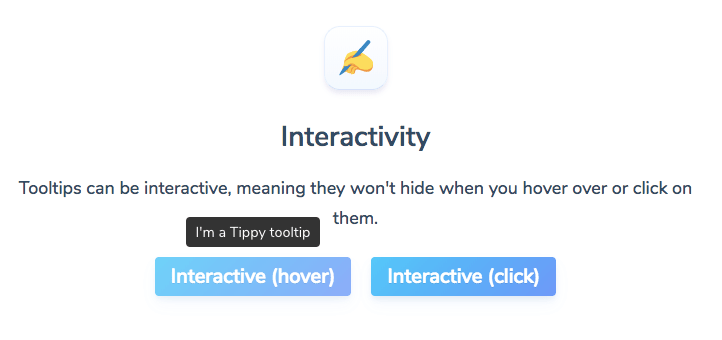
Tippy.js is the most popular general-purpose tooltip library in the JavaScript ecosystem. Built on top of Floating UI (formerly Popper.js), it provides a complete tooltip, popover, dropdown, and menu solution with sensible defaults and deep customization.
Key differentiator: Full-featured out of the box with animations, themes, and accessibility built in. If you need one library that handles tooltips and popovers cleanly, this is it.
Install: npm install tippy.js
2. Floating UI
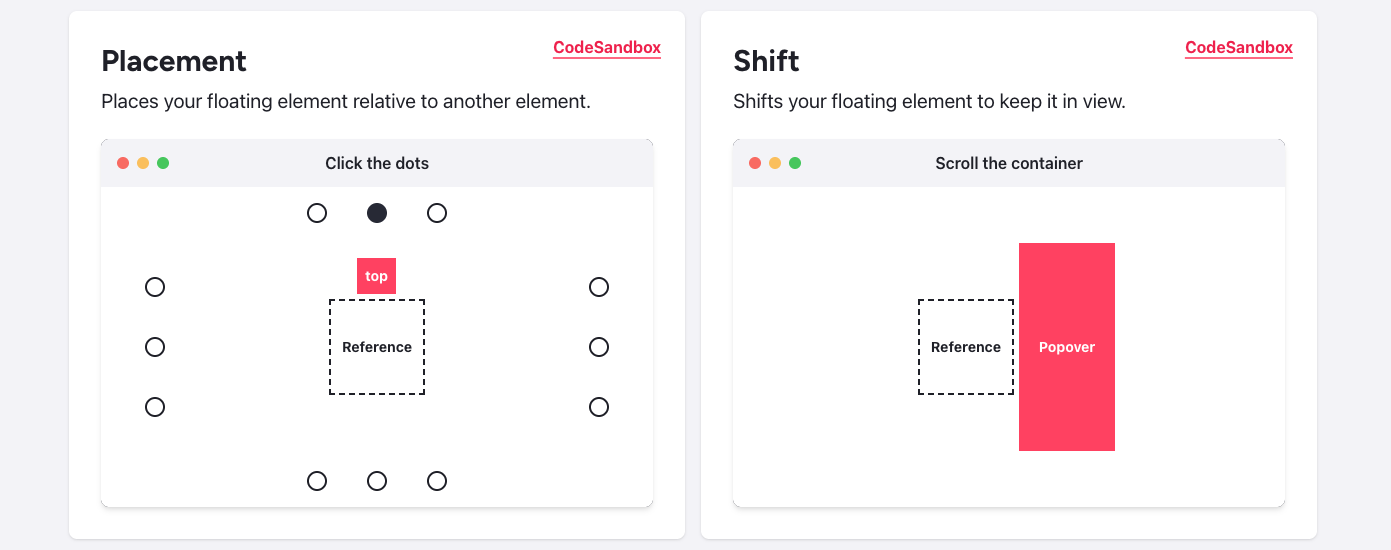
Floating UI is the successor to Popper.js and the positioning engine that powers Tippy.js, among others. It's a low-level library that handles the hard part of tooltip development: keeping floating elements anchored to their reference elements regardless of scroll, resize, or overflow.
Key differentiator: Ultra-lightweight at 0.6 KB minified. Not a tooltip library per se, but the best positioning primitive to build your own.
Install: npm install @floating-ui/dom
3. Shepherd.js
Shepherd.js is a guided-tour library that uses tooltips as its primary interface. If your goal is to walk users through a multi-step flow rather than show a standalone hint, Shepherd is purpose-built for that.
Language/framework: Vanilla JS, React, Vue, Angular, Ember
GitHub stars: 13k+
Key differentiator: Focused on product tours and step-by-step guides with built-in accessibility (a11y) compliance and keyboard navigation.
Install: npm install shepherd.js
4. Intro.js
Intro.js is a mature product tour library that combines tooltip-style hints with step-by-step onboarding sequences. It has no dependencies and a simple API, which makes it a solid pick if you want something battle-tested with minimal setup.
Key differentiator: Zero dependencies, long track record, and a dual-mode API (tours and standalone hints). Well-suited for teams that want tooltip capabilities alongside guided tours.
Install: npm install intro.js
5. Bootstrap Tooltip
Bootstrap Tooltip is the tooltip component built into the Bootstrap framework. If your project already uses Bootstrap, this is the path of least resistance - no extra dependencies, consistent styling, and solid documentation.
Language/framework: Bootstrap (HTML/CSS/JS), built on Popper
GitHub stars: Part of the Bootstrap framework (168k+ total)
Key differentiator: Seamless integration with Bootstrap's design system. If you're in the Bootstrap ecosystem, there's no reason to add another tooltip library.
Install: Already included with Bootstrap 5
jQuery tooltip plugins
jQuery isn't the default choice for new projects, but plenty of production codebases still rely on it. If you're working in a jQuery environment, these three plugins handle tooltips well without requiring a framework migration.
1. jQuery UI Tooltip
jQuery UI Tooltip is the official tooltip widget from the jQuery UI library. It replaces native browser tooltips with customizable, themeable overlays and integrates smoothly with the rest of jQuery UI's widget ecosystem.
Key strength: Simple setup if you're already using jQuery UI. Works out of the box with jQuery UI themes.
Best for: Teams maintaining existing jQuery UI projects that need basic tooltip functionality without adding new dependencies.
2. JBox
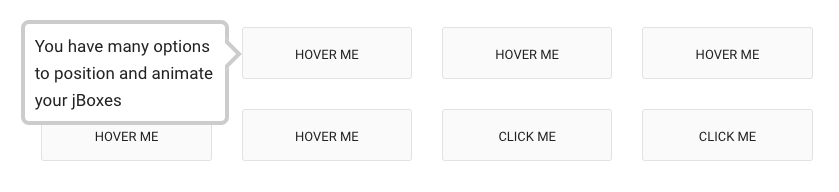
JBox is a versatile jQuery plugin that handles tooltips, modal windows, notices, and confirmations in a single package. It's lightweight, customizable, and responsive.
Key strength: One plugin covers multiple UI patterns (tooltips, modals, alerts), which reduces the number of dependencies in your project.
Best for: jQuery projects that need more than just tooltips and want a single, well-maintained library for multiple overlay types.
3. Popper.js
Popper.js is the positioning library that powered Bootstrap's tooltips and spawned Floating UI as its successor. It's still widely used in jQuery projects and older codebases.
Key strength: Rock-solid positioning logic with a small footprint. If you're maintaining a project that already uses Popper, it still works well.
Best for: Legacy projects. For new work, consider Floating UI, which carries the same approach forward with a smaller bundle and modern API.
CSS tooltip plugins
If you want tooltips without adding any JavaScript to your page, CSS-only solutions are as lightweight as it gets. These four libraries use pseudo-elements, data- attributes, and aria-label to render tooltips with zero runtime overhead.
1. Hint.css
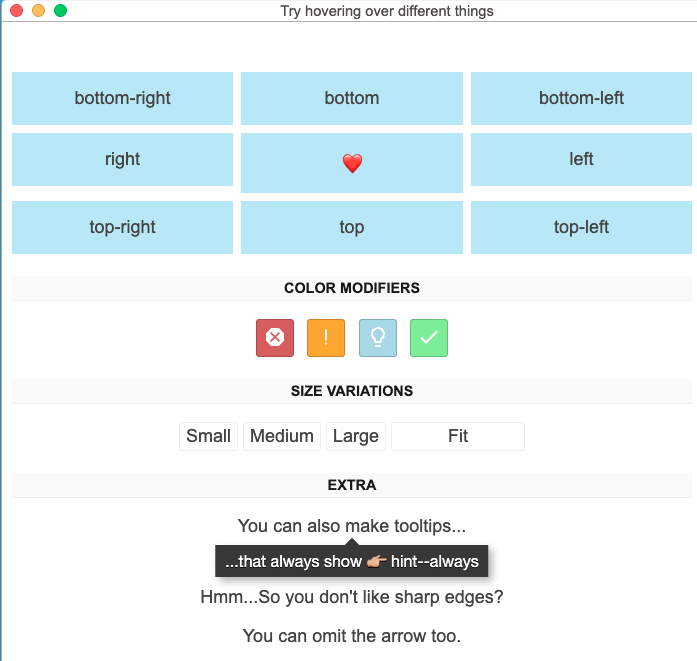
Hint.css is one of the most widely adopted CSS-only tooltip libraries. It uses aria-label for tooltip content, which means your tooltips are accessible by default.
GitHub stars: 8.3k
Size: 1.5 KB
Key differentiator: Accessibility-first approach via aria-label, so screen readers get the tooltip content without extra work.
2. Microtip
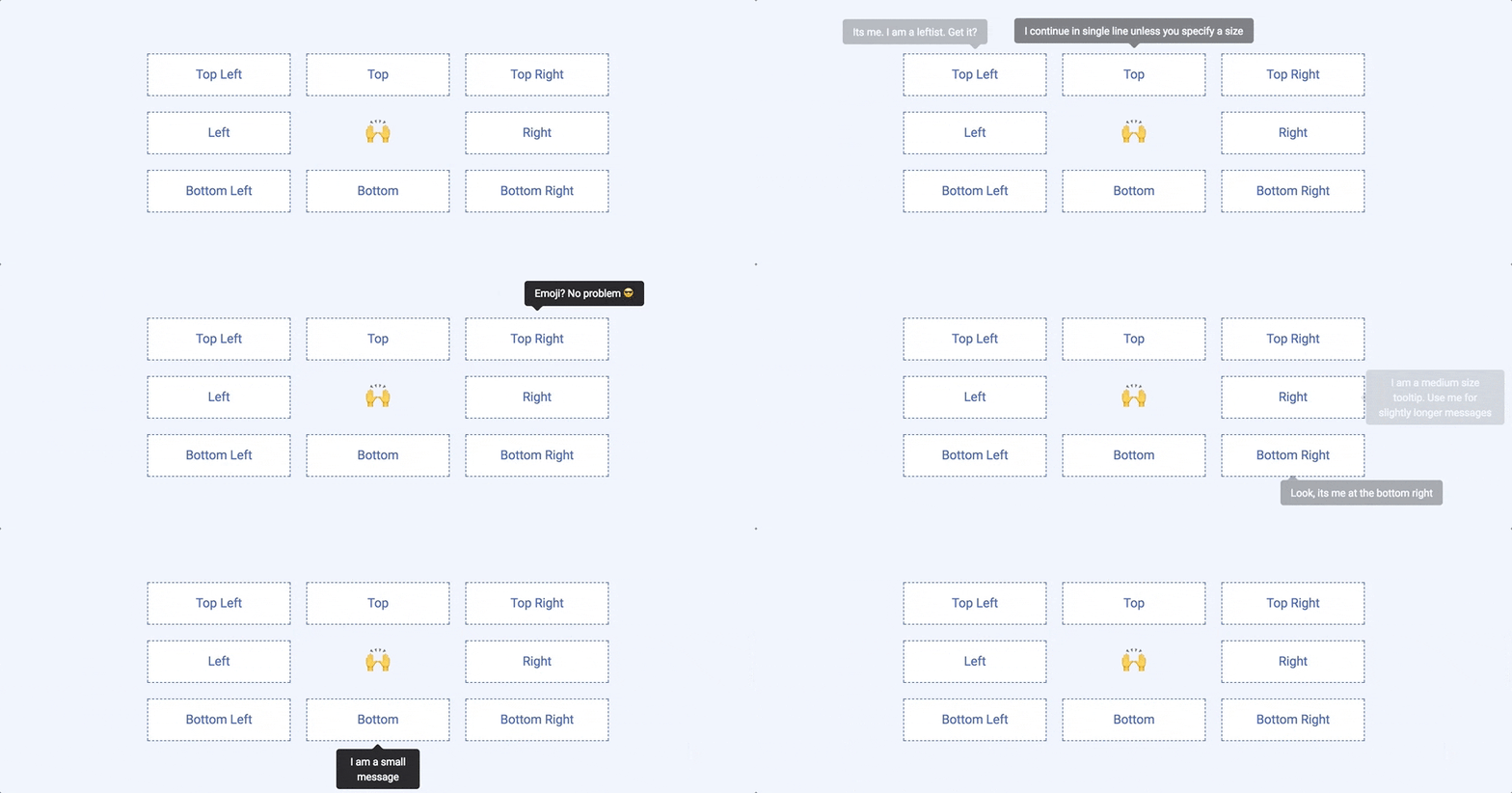
Microtip is a modern, minimal CSS-only tooltip library that emphasizes clean design and tiny file size.
Size: Under 1 KB
Key differentiator: Modern aesthetic with smooth animations and a minimal API. Great for projects where you want good-looking tooltips with zero configuration.
3. Tootik
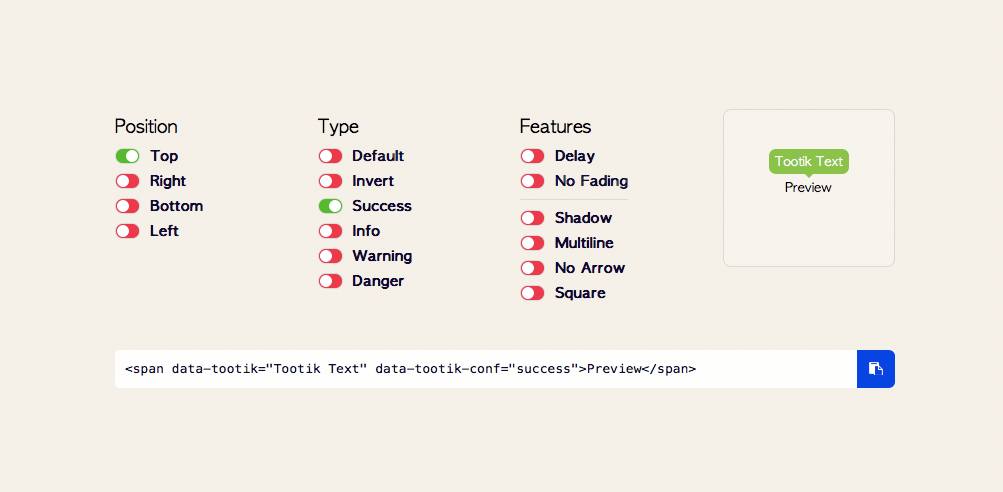
Tootik is a pure CSS tooltip library with built-in support for CSS, SCSS, and LESS, making it easy to integrate with whatever preprocessor your project uses.
Key differentiator: Straightforward customization through SCSS/LESS variables. Supports multiple positions and can handle multiline content.
4. Balloon.css
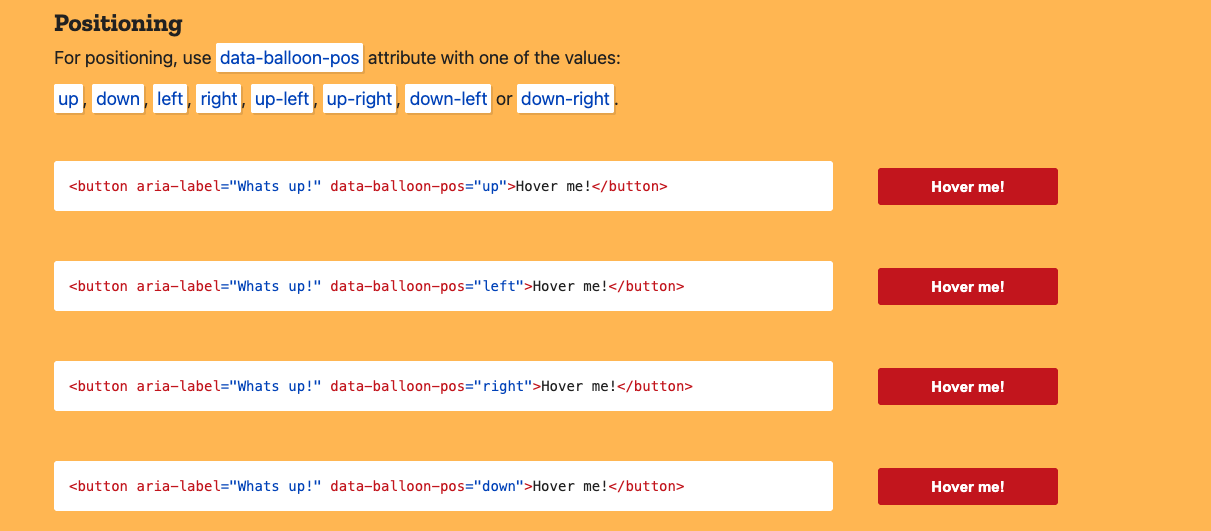
Balloon.css is a CSS-only tooltip library that uses HTML5 data- attributes to define tooltip content and positioning.
GitHub stars: 5.5k
Key differentiator: Simple, declarative API via data-balloon attributes. Easy to adopt incrementally across existing HTML.Balloon.css is a CSS-only tooltip library that uses HTML5 data- attributes to define tooltip content and positioning.
GitHub stars: 5.5k
Key differentiator: Simple, declarative API via data-balloon attributes. Easy to adopt incrementally across existing HTML.
Tooltip plugin comparison table
Tooltip plugins comparison — preview
Styled mockup. Your live blog CSS will override these styles.
Plugin
Language/Framework
GitHub Stars
Key Feature
Effort Level
Tippy.js
JS, React, Vue, Angular
12k+
Full-featured tooltips and popovers
Low
Floating UI
Framework-agnostic JS
24k+
Ultra-lightweight positioning (0.6 KB)
Medium
Shepherd.js
JS, React, Vue, Angular, Ember
13k+
Product tours with a11y compliance
Low–Medium
Intro.js
Vanilla JS
22k+
Tours and hints, zero dependencies
Low
Bootstrap Tooltip
Bootstrap (HTML/CSS/JS)
168k+ (framework)
Native Bootstrap integration
Low
jQuery UI Tooltip
jQuery
Part of jQuery UI
Simple, themeable jQuery widget
Low
JBox
jQuery
1.4k+
Tooltips + modals in one plugin
Low
Popper.js
JS (jQuery-compatible)
Evolved into Floating UI
Battle-tested positioning
Medium
Hint.css
CSS only
8.3k
Accessible via aria-label (1.5 KB)
Very Low
Microtip
CSS only
—
Modern, minimal, under 1 KB
Very Low
Tootik
CSS/SCSS/LESS
—
Preprocessor variable customization
Very Low
Balloon.css
CSS only
5.5k
Declarative data-attribute API
Very Low
Note: The plain HTML I gave you in chat has no inline styling — your CMS/blog theme will style it automatically. This preview just shows one possible look with Appcues-style purple branding.

.png)