.png)

Appcues and Intercom often appear on the same shortlist, but they were built to solve different problems. Intercom is an AI-first customer support platform that added Product Tours as an add-on, with per-seat pricing that adds up as your needs grow. Appcues is a user engagement platform purpose-built for onboarding, adoption, and retention, with MAU-based pricing that includes the full platform on every plan and full feature parity across web and mobile apps. If your priority is reactive support, Intercom is a strong fit. If your priority is engagement programs that drive activation, adoption, and retention, Appcues was built for it, and many teams run both.
If you're researching Appcues vs Intercom, chances are you're sitting in the middle of a decision that feels deceptively simple. On the surface, both tools help you reach users inside your product. Both offer in-app messages, surveys, and product tours. Both promise to lift activation and retention. The pricing pages can even look surprisingly comparable at a glance.
But the longer you spend with each platform, the more obvious it becomes that they were built with different jobs in mind. Intercom started its life as a customer messaging product that grew into an AI-first customer service platform. Appcues was built from the ground up for user onboarding, product adoption, and lifecycle engagement. Choosing between them is less about which one has more features, and more about which one is actually built to do the thing you're trying to do.
This comparison digs into where Appcues and Intercom overlap, where they diverge, and where each one earns its keep. We'll cover pricing, features, mobile, AI, customer outcomes, and the awkward question every shortlist eventually hits: do you actually need both?
Before we get into the details, here's the quick scan version. Skip ahead if you want the full breakdown, or come back to it once you've read the rest.
Intercom describes itself as the only complete AI-first customer service platform. That language is intentional. Intercom's core business is helping support teams reduce ticket volume and resolve customer issues faster, primarily through live chat, AI agents like Fin, the Help Center, and ticketing workflows. Their bet is that AI will reshape what a customer support team looks like, and they're investing accordingly.
Product Tours sit inside that ecosystem as an add-on. They were added to help support teams cut down on the same questions arriving in the inbox, so users could find answers in the product instead of opening a ticket. That's a useful purpose, and Intercom does it competently. But it's worth understanding the design intent. Intercom's product tours are an extension of their support platform, not the heart of the product.
Intercom is a strong tool for reactive customer engagement and cross-channel communication, especially if your priority is service efficiency. The Help Center, Fin AI, and Messenger integration give support teams a unified customer view that's hard to replicate with point solutions. If your team's primary job is making support faster and smarter, that integration valuable.

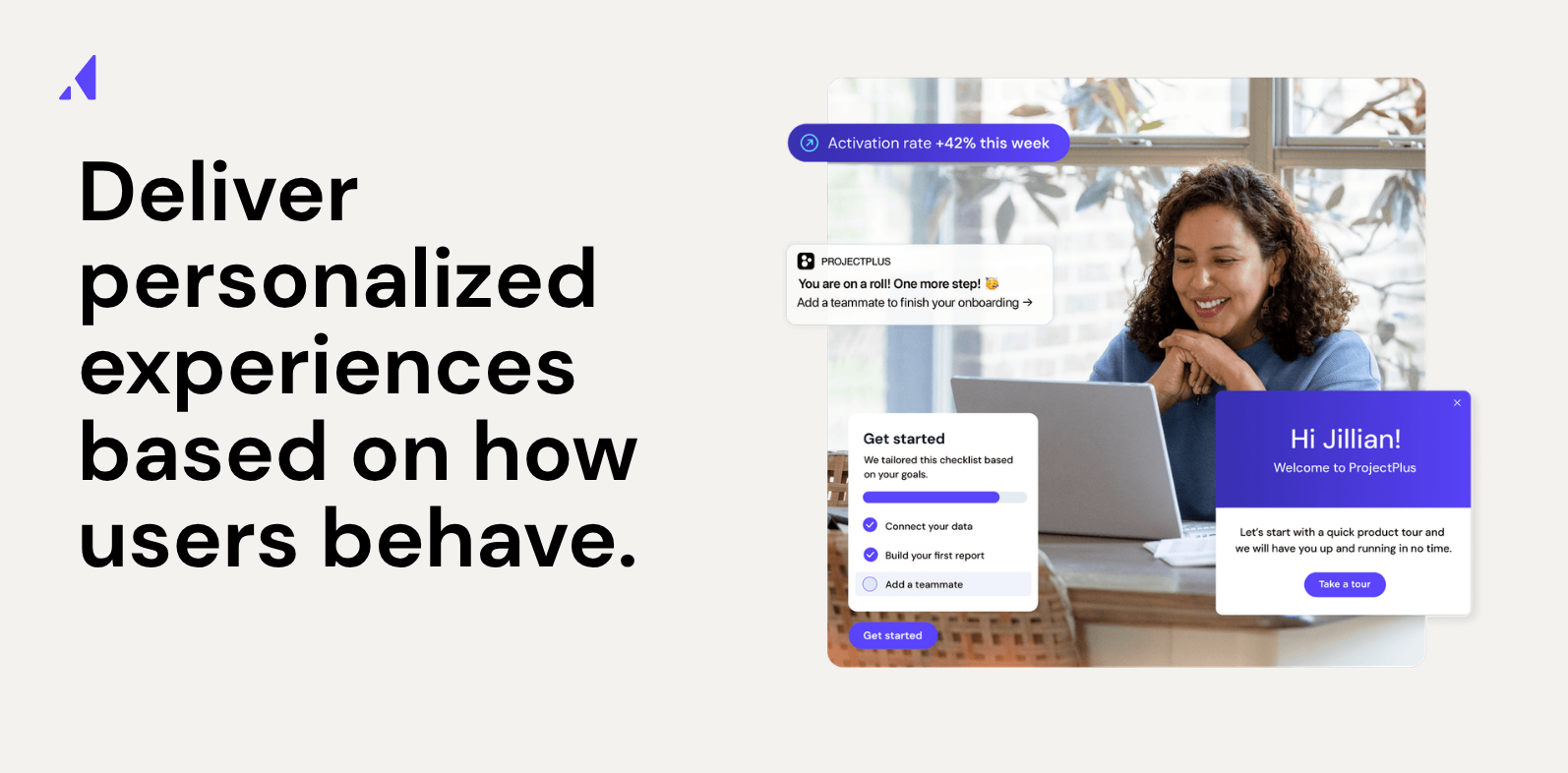
Appcues approaches the same in-product real estate from a different angle. The whole platform is purpose-built to help product, marketing, and digital engagement teams launch personalized experiences inside their software, without burning engineering cycles. Onboarding flows, feature announcements, in-app messages, behavioral email, push notifications, and customizable surveys all live in one place, with behavioral targeting that fires in real time based on what a user actually does.
The mental model is a continuous loop. Understand what users are doing, decide how to engage them, deliver the right experience in the right channel, and learn from the results. More than 1,500 scaling businesses use Appcues today, reaching over 200 million end users across web and mobile apps. The platform holds a 4.6/5 rating on G2 and a 4.8/5 on Capterra, with reviewers consistently pointing to ease of use, the strength of the implementation team, and the freedom to launch experiences without waiting on engineering.
It's the difference between a tool that helps you talk to users when they raise their hand, and one that helps you reach them at the moments that drive activation and retention.
This is where the comparison tends to surprise people, and it's worth slowing down on.
Intercom prices on a per-seat model. Their Essentials plan starts at roughly $39 per seat per month, with Advanced and Expert plans climbing from there. That covers Intercom's core support tooling: Fin, Messenger, Help Center, and ticketing. Product Tours, the feature most relevant to user onboarding and feature announcements, is an add-on. The add-on typically runs around $99 per month on top of your base plan, with messaging caps that climb as you grow. Adding more seats, more channels, or more usage adds line items quickly.
The complaint that comes up most often in Intercom reviews on G2 is the pricing structure. It can feel like every capability your team wants lives behind another add-on or a higher tier. Once you stack up Fin, Tours, additional seats, and overages, the bill climbs faster than the original quote suggested.

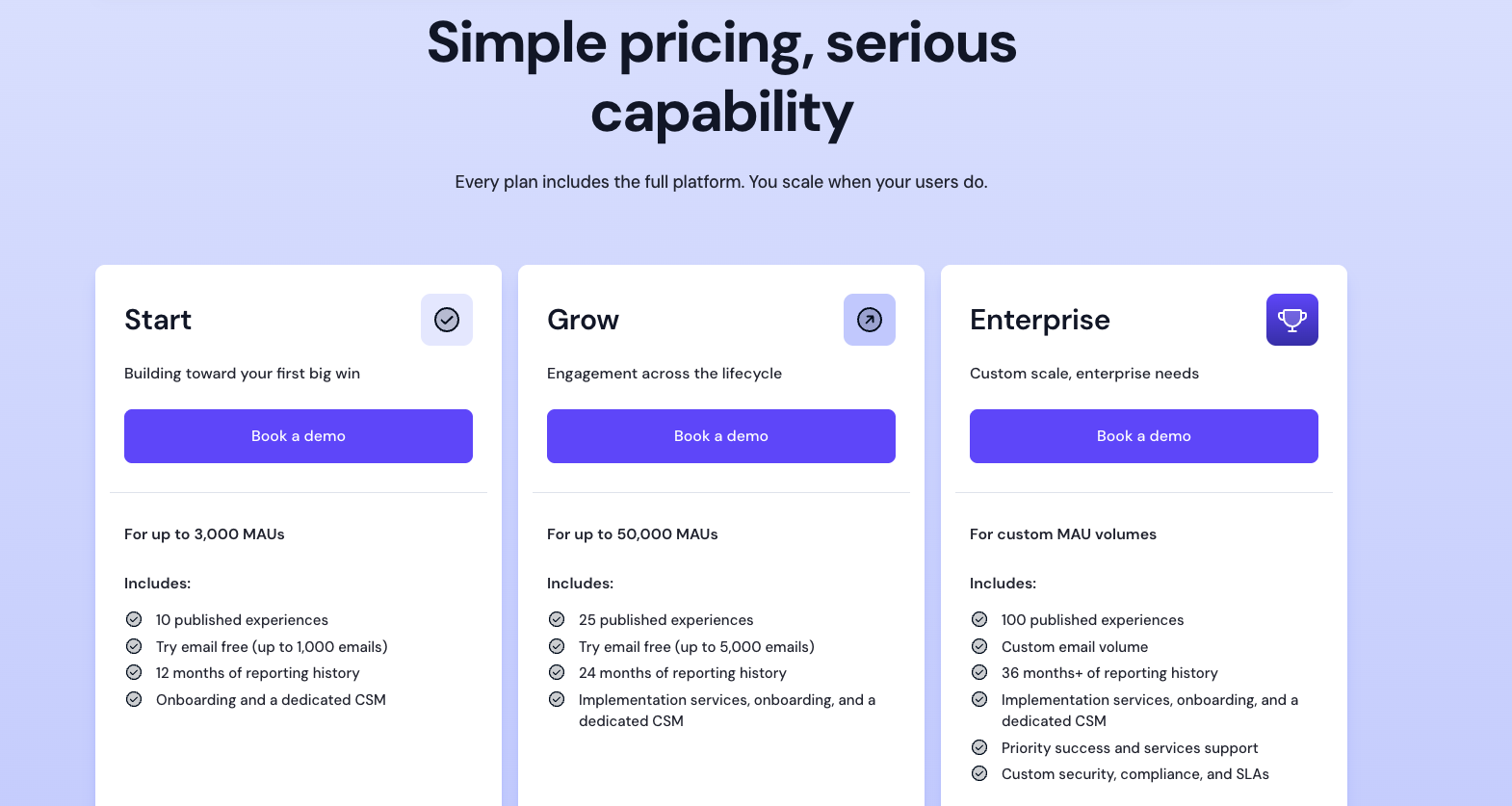
Appcues uses a different model. Pricing is based on monthly active users (MAUs) and the number of installations, with three plans:
The detail that matters most: every plan includes the full platform. Every experience type, every feature, every integration is included from day one. You scale with your users, not against your feature wishlist. There's no separate add-on for surveys, no upsell for mobile, no premium tier to unlock real-time triggers.
If you'd rather see the live numbers, the Appcues pricing page walks through what's included in each plan.
If you're already running Intercom for live chat and customer support, the marginal cost of adding Product Tours can feel manageable. You already have the seat licenses, the team is trained, and the customer data lives in one place. That convenience has real value.
If you're evaluating Intercom primarily because you need product tours, onboarding flows, or feature announcements, the math gets harder to defend. You're paying for a customer support platform you don't need, plus an add-on that costs as much as some standalone tools, plus messaging caps you'll hit as you grow.
Both platforms support modals, banners, surveys, NPS, and basic flows. Intercom's pattern library is competent but more limited in scope. Intercom flows skew toward modals, with no built-in slideouts and no hotspots. Checklists exist but must be served inside the Intercom Messenger, which constrains where and how they appear.

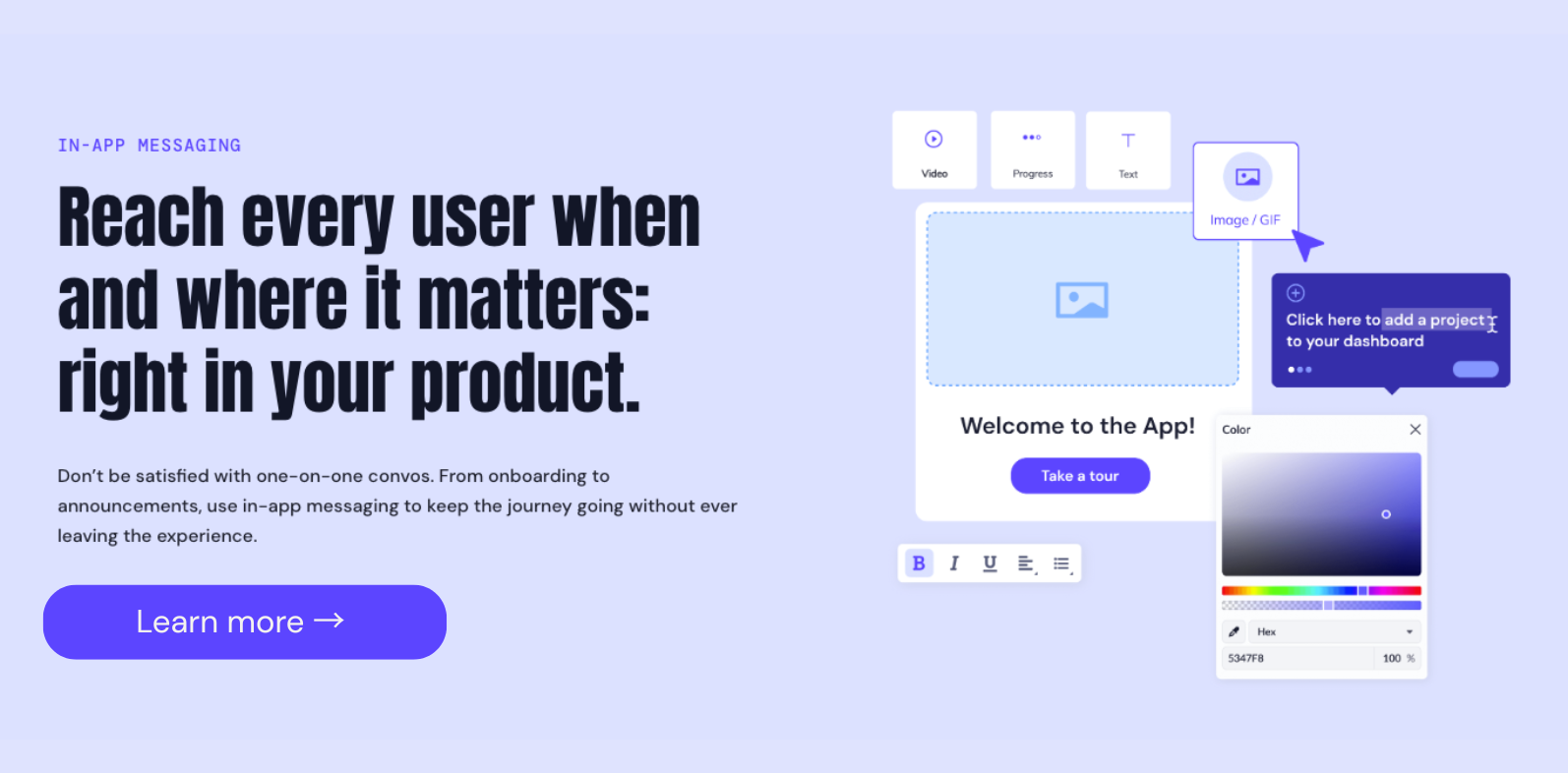
Appcues offers a wider pattern library: Modals, Slideouts, Tooltips, Hotspots, Banners, Pins, Checklists that can run standalone, surveys, and resource centers (called Launchpads). The visual builder lets non-engineers create branded, native-looking experiences without writing CSS. That last part matters more than it sounds. One of the most consistent complaints about Intercom's product tours is that they read as third-party overlays sitting on top of the product, rather than experiences that feel like the product itself. Appcues was designed to disappear into your brand.
This is also where the team independence Appcues talks about shows up in real reviews. UX designers and PMs on G2 frequently call out how easy it is to build, test, and ship flows without involving engineering, with one reviewer summing up a common refrain: their team is "not dependent on our dev team to help us." That speed turns into measurable outcomes.
Litmus, the email marketing platform, used Appcues to drive a 2,100% increase in adoption of one of their features. LingQ replaced their homemade tooltips with Appcues flows and saw lesson open rates climb 10%.
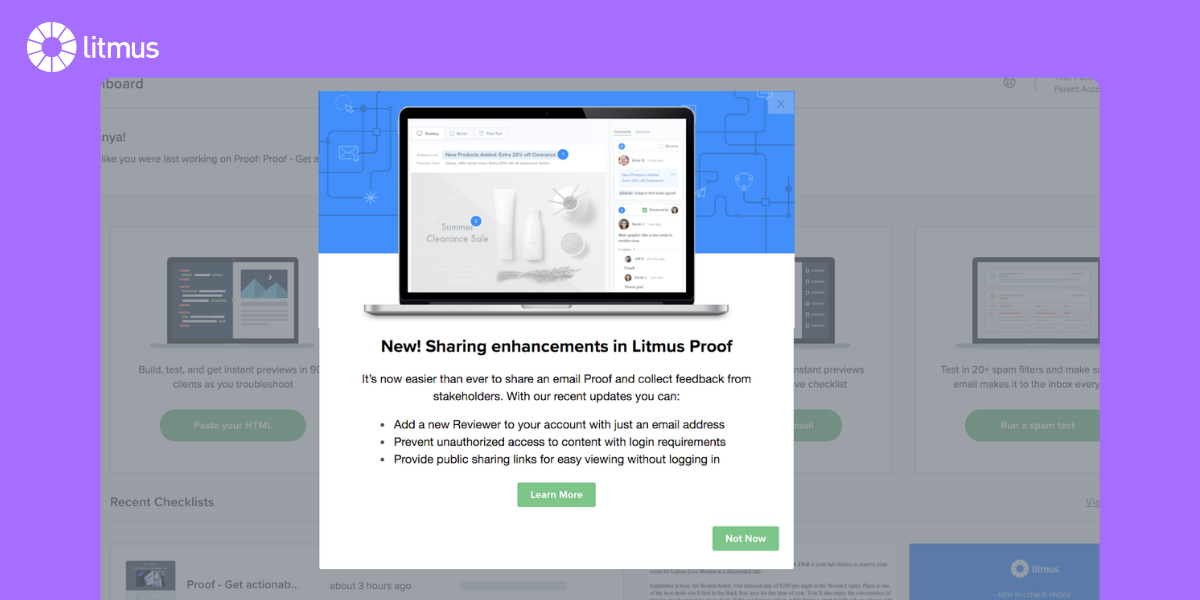
Mobile is one of the clearest differentiation points. Appcues offers a mobile SDK with native iOS, Android, and React Native support, plus frameworks like Flutter and Ionic. Feature parity with the web product is a deliberate design choice. Tooltips, Embeds, Surveys, push notifications, and Checklists all work natively on mobile, which is critical if you ship a mobile-first product.
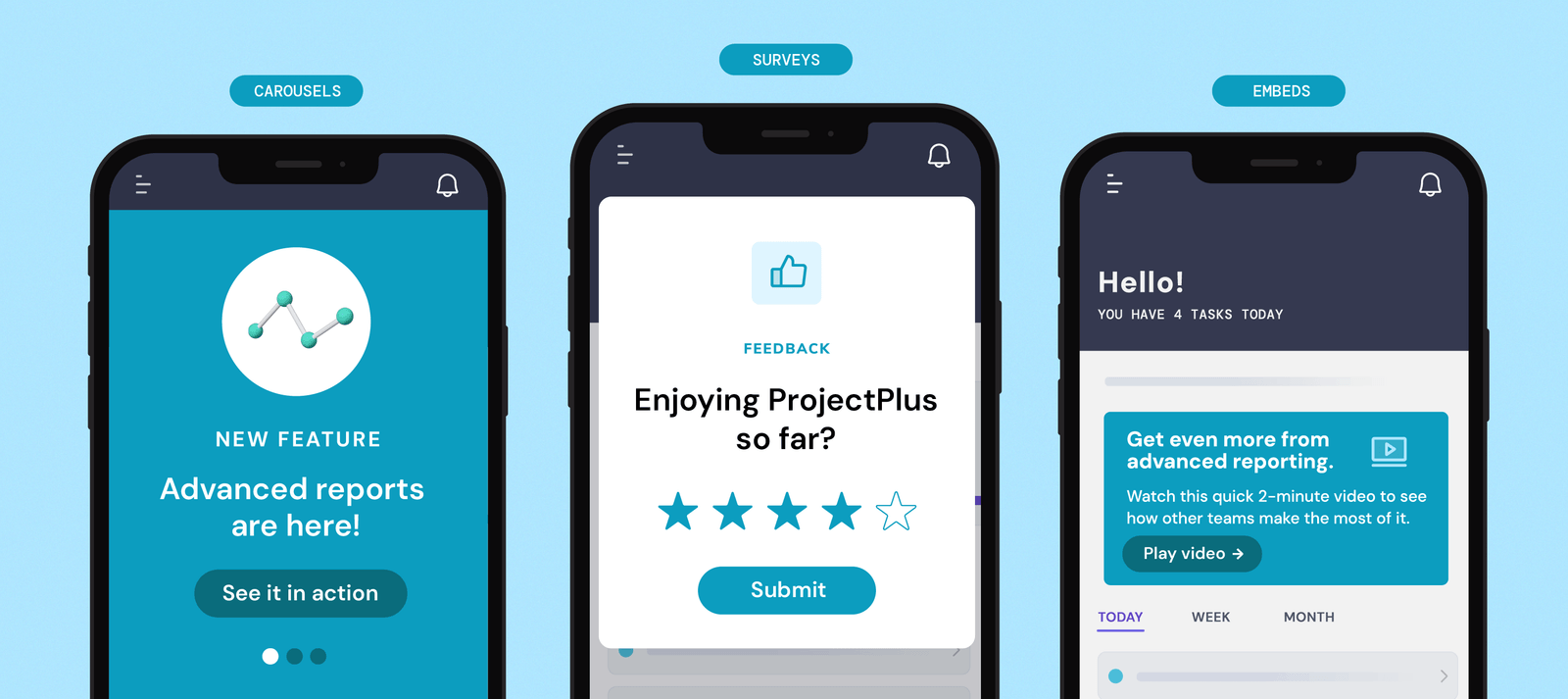
That depth shows up in customer outcomes. North One, a digital banking platform for small businesses, used Appcues to deliver a mobile launch experience that drove 25% more conversions. Surfline turned every mobile release into a growth lever rather than a quiet ship-and-pray moment. Both stories rely on the kind of native pattern depth that's hard to replicate with a support-first tool.

Intercom does have a mobile presence, primarily through Intercom for Mobile and Messenger. The product tour functionality on mobile is largely carousels, integrated with their AI Agent and Help Center. That works for support and basic announcements. It doesn't replace a true mobile engagement layer for teams running adoption programs across native iOS and Android apps.
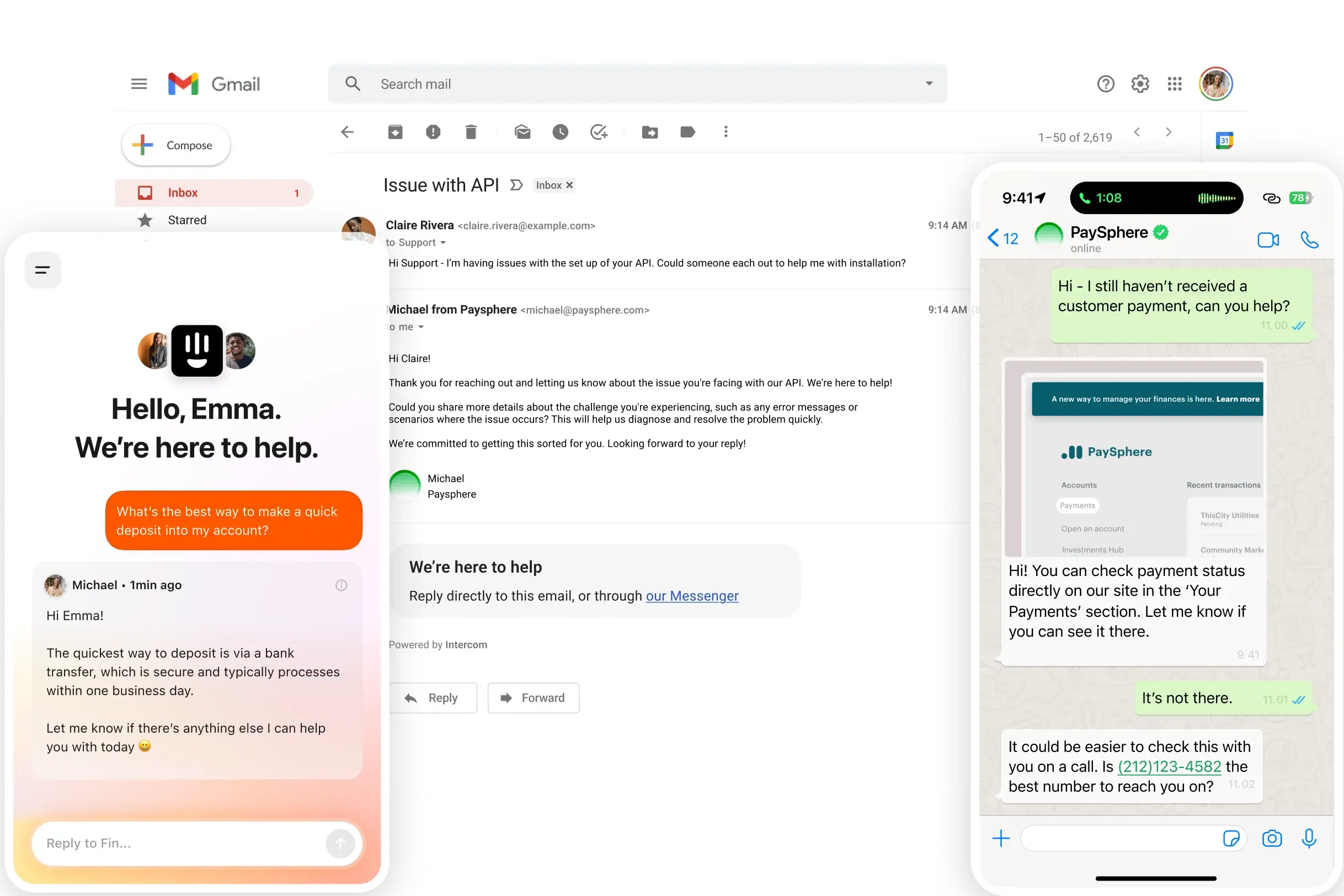
Both platforms support segmentation, scheduling, dynamic personalization, and event-based triggering on paper. The depth differs in practice.
Appcues includes click-to-track events, which let your team capture user actions and trigger experiences in real time without engineering support. The Events Explorer visualizes how users are interacting with specific elements over time, so you can see where users are actually getting stuck before you build the flow to fix it. Flow priority lets you control which experience wins when multiple could fire.

When teams use that targeting precision well, the results can be dramatic. Hotjar, the behavior analytics company, A/B tested subtle in-app callouts to drive feature adoption and ran a separate personalized onboarding experiment that increased installations by 26%.
Intercom supports event triggering and scheduling, but the depth of behavioral targeting is generally tuned for support workflows. Click-to-track is not natively available the way it is in Appcues, and reporting on individual flows is more limited than the workflow-level reporting Appcues offers.
Intercom's reporting is strongest where Intercom is strongest: support efficiency, conversation routing, response times, AI agent performance. Their analytics are built around conversations and tickets, not engagement programs.

Appcues offers flow reporting, workflow reporting, goals, control group testing, and flow variation testing. The reporting is built to answer the questions an engagement team actually asks. Did the new onboarding flow improve activation? Which announcement drove more feature adoption? Which audience responded best to the upgrade prompt? Goals tie individual experiences directly to business outcomes, so your team can stop guessing whether the work is paying off.
Printify used that reporting layer to drive a 10% uplift in flow conversion by tying experience design directly to the data.

AI: Fin AI versus Captain AI
Both companies have invested in AI, in very different directions.
Fin AI is Intercom's flagship. It's a customer service AI agent that resolves tickets, answers questions, and handles support volume autonomously. It's a serious product and one of the strongest things Intercom does. If you're trying to reduce support load, Fin is the headline.

Captain AI is the AI assistant inside Appcues. It's built to help product, marketing, and digital teams create, refine, and analyze customer experiences faster. Captain AI generates content, suggests targeting, and helps teams move from idea to live experience in a fraction of the time. It surfaces what's working, what isn't, and where to focus next. The two AIs aren't really competitors. They're solving different problems for different teams.
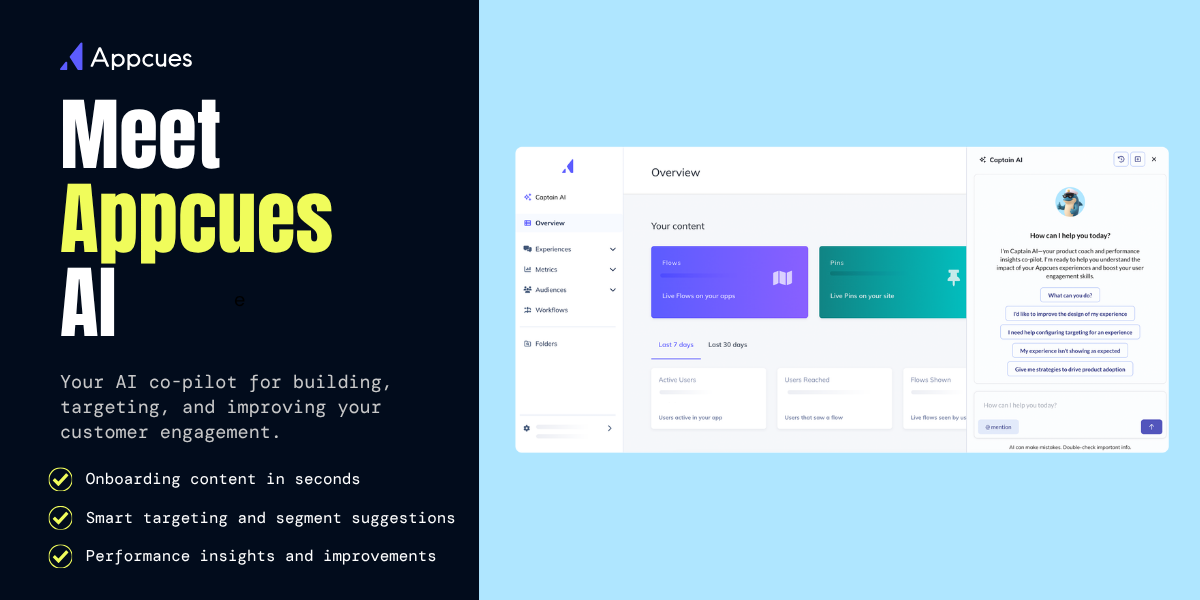
Intercom integrates with a wide ecosystem, but the data flow is generally one-way. You can sync events from analytics tools like Mixpanel and Amplitude into Intercom, but pushing data back out is more limited.
Appcues offers two-way integrations with the same analytics tools, plus Heap, Segment, Salesforce, HubSpot, and the rest of the typical SaaS stack. That bidirectional flow matters when your engagement program needs to read from and write to your source-of-truth systems. Behavior captured in Appcues can enrich your CRM. Cohorts defined in Mixpanel can target experiences in Appcues. Your tech stack stays connected, and no team is stuck rebuilding pipes.

It helps to step back from the feature lists and look at the actual jobs each tool gets hired for.
Awareness. Launching a new feature, promoting an event, surfacing a relevant offer to the right segment. Appcues handles this with cross-channel coordination across in-app, email, and mobile. Tactical Arbitrage, for example, used in-app banners to drive a 60% increase in live event attendance. Xometry used in-app messaging to drive 500+ orders and move the revenue needle on a single launch. Intercom can deliver feature announcements in-app, but cross-channel orchestration is not its strength.
Adoption. Onboarding new users, activating accounts, driving deeper feature usage. This is where Appcues focuses, and where the platform's behavioral targeting and onboarding flows do their best work. MYOB, the accounting software giant, increased new user activation by 21% with personalized onboarding checklists. Blip, a marketing tech platform, increased activation by 124% and reduced time to value by 9.7x. OneTable accelerated host onboarding and slashed time to first value by 31%. Intercom can support a portion of this through Product Tours, especially for teams whose adoption needs are mostly checklists and tooltips.
Engagement. Gathering customer feedback in real time, prompting referrals, running NPS, connecting users to your team at high-impact moments. Appcues runs this layer end to end. Circa drove a 370% surge in customer feedback with in-app NPS. Text-Em-All gathered more than 1,000 customer responses in 48 hours, reshaping their roadmap. ProfitWell increased first-week retention by 20% with targeted in-app flows. Intercom is strongest where engagement crosses into support, with Messenger acting as the conversation layer.
A useful pattern to watch for: if your engagement plan lives mostly inside the messenger and concerns reactive customer support, Intercom's integrated approach has real advantages. If your engagement plan lives across the user journey, from first visit through expansion, Appcues focuses on that work.
There are a few places where Appcues focuses its energy that show up in real evaluations:
Here's the honest answer many vendor comparisons skip: a lot of teams run both Appcues and Intercom together, and it works well. They aren't an either-or choice for every business.
Intercom is a strong choice for customer support. Live chat, Fin AI, ticketing, the Messenger experience, and the conversational data that flows out of those interactions are genuinely best-in-class for what they're built to do. Many Appcues customers run Intercom for support and Appcues for engagement, with the two platforms talking to each other through a native integration.
The pattern that works:
Accelo, a professional services platform, paired Appcues with their existing support stack and increased help guide interaction by 253%, reducing the load on their support team while improving the user experience. PatientSky used Appcues to gather feedback, announce updates, and reduce support burden by 30%. The two tools, used for what each is good at, can compound rather than compete.
“Now whenever we launch a new product, the product team comes to me and asks me to create an Appcues flow for them which is amazing.” - Lawrence Barreca, Customer Success Technical Content Manager @ Accelo
You don't have to choose one tool to do everything. You do have to be honest about what each one is good at.
The honest answer to "Appcues vs Intercom" is that they're built to solve different problems, and the right choice depends on what your team is actually trying to do.
Choose Intercom if your priority is customer support efficiency, AI-driven ticket deflection, and a unified messenger experience that combines reactive support with light proactive engagement. The integration between Fin, Messenger, and Help Center is genuinely strong, and Product Tours can extend that ecosystem in useful ways.
Choose Appcues if your priority is user onboarding, feature adoption, retention, and cross-channel engagement programs that respond to user behavior in real time. The platform was built for this work, the pricing keeps the full platform available on every plan, and the team behind it operates as a strategic partner rather than a vendor. The customer outcomes (Litmus 2,100% adoption lift, MYOB 21% activation lift, North One 25% mobile conversion lift, Hotjar 26% installation lift, ProfitWell 20% retention lift) tell the same story from different angles.
Run both if you have meaningful customer support volume and meaningful engagement programs. Most teams that integrate the two stop fighting the wrong battles, and let each platform do what it's actually good at.
The shortest version: don't pick a tool for what it can technically do. Pick the one that was built for your problem.
If user engagement is the problem you're solving, book a demo and see what's possible with a platform built for it, with the customer outcomes to back it up.
Product Adoption
Retention & Churn
User Engagement
AI
TL;DR
Appcues and Intercom often appear on the same shortlist, but they were built to solve different problems. Intercom is an AI-first customer support platform that added Product Tours as an add-on, with per-seat pricing that adds up as your needs grow. Appcues is a user engagement platform purpose-built for onboarding, adoption, and retention, with MAU-based pricing that includes the full platform on every plan and full feature parity across web and mobile apps. If your priority is reactive support, Intercom is a strong fit. If your priority is engagement programs that drive activation, adoption, and retention, Appcues was built for it, and many teams run both.
If you're researching Appcues vs Intercom, chances are you're sitting in the middle of a decision that feels deceptively simple. On the surface, both tools help you reach users inside your product. Both offer in-app messages, surveys, and product tours. Both promise to lift activation and retention. The pricing pages can even look surprisingly comparable at a glance.
But the longer you spend with each platform, the more obvious it becomes that they were built with different jobs in mind. Intercom started its life as a customer messaging product that grew into an AI-first customer service platform. Appcues was built from the ground up for user onboarding, product adoption, and lifecycle engagement. Choosing between them is less about which one has more features, and more about which one is actually built to do the thing you're trying to do.
This comparison digs into where Appcues and Intercom overlap, where they diverge, and where each one earns its keep. We'll cover pricing, features, mobile, AI, customer outcomes, and the awkward question every shortlist eventually hits: do you actually need both?
Before we get into the details, here's the quick scan version. Skip ahead if you want the full breakdown, or come back to it once you've read the rest.
Intercom describes itself as the only complete AI-first customer service platform. That language is intentional. Intercom's core business is helping support teams reduce ticket volume and resolve customer issues faster, primarily through live chat, AI agents like Fin, the Help Center, and ticketing workflows. Their bet is that AI will reshape what a customer support team looks like, and they're investing accordingly.
Product Tours sit inside that ecosystem as an add-on. They were added to help support teams cut down on the same questions arriving in the inbox, so users could find answers in the product instead of opening a ticket. That's a useful purpose, and Intercom does it competently. But it's worth understanding the design intent. Intercom's product tours are an extension of their support platform, not the heart of the product.
Intercom is a strong tool for reactive customer engagement and cross-channel communication, especially if your priority is service efficiency. The Help Center, Fin AI, and Messenger integration give support teams a unified customer view that's hard to replicate with point solutions. If your team's primary job is making support faster and smarter, that integration valuable.
Appcues approaches the same in-product real estate from a different angle. The whole platform is purpose-built to help product, marketing, and digital engagement teams launch personalized experiences inside their software, without burning engineering cycles. Onboarding flows, feature announcements, in-app messages, behavioral email, push notifications, and customizable surveys all live in one place, with behavioral targeting that fires in real time based on what a user actually does.
The mental model is a continuous loop. Understand what users are doing, decide how to engage them, deliver the right experience in the right channel, and learn from the results. More than 1,500 scaling businesses use Appcues today, reaching over 200 million end users across web and mobile apps. The platform holds a 4.6/5 rating on G2 and a 4.8/5 on Capterra, with reviewers consistently pointing to ease of use, the strength of the implementation team, and the freedom to launch experiences without waiting on engineering.
It's the difference between a tool that helps you talk to users when they raise their hand, and one that helps you reach them at the moments that drive activation and retention.
This is where the comparison tends to surprise people, and it's worth slowing down on.
Intercom prices on a per-seat model. Their Essentials plan starts at roughly $39 per seat per month, with Advanced and Expert plans climbing from there. That covers Intercom's core support tooling: Fin, Messenger, Help Center, and ticketing. Product Tours, the feature most relevant to user onboarding and feature announcements, is an add-on. The add-on typically runs around $99 per month on top of your base plan, with messaging caps that climb as you grow. Adding more seats, more channels, or more usage adds line items quickly.
The complaint that comes up most often in Intercom reviews on G2 is the pricing structure. It can feel like every capability your team wants lives behind another add-on or a higher tier. Once you stack up Fin, Tours, additional seats, and overages, the bill climbs faster than the original quote suggested.
Appcues uses a different model. Pricing is based on monthly active users (MAUs) and the number of installations, with three plans:
The detail that matters most: every plan includes the full platform. Every experience type, every feature, every integration is included from day one. You scale with your users, not against your feature wishlist. There's no separate add-on for surveys, no upsell for mobile, no premium tier to unlock real-time triggers.
If you'd rather see the live numbers, the Appcues pricing page walks through what's included in each plan.
If you're already running Intercom for live chat and customer support, the marginal cost of adding Product Tours can feel manageable. You already have the seat licenses, the team is trained, and the customer data lives in one place. That convenience has real value.
If you're evaluating Intercom primarily because you need product tours, onboarding flows, or feature announcements, the math gets harder to defend. You're paying for a customer support platform you don't need, plus an add-on that costs as much as some standalone tools, plus messaging caps you'll hit as you grow.
Both platforms support modals, banners, surveys, NPS, and basic flows. Intercom's pattern library is competent but more limited in scope. Intercom flows skew toward modals, with no built-in slideouts and no hotspots. Checklists exist but must be served inside the Intercom Messenger, which constrains where and how they appear.
Appcues offers a wider pattern library: Modals, Slideouts, Tooltips, Hotspots, Banners, Pins, Checklists that can run standalone, surveys, and resource centers (called Launchpads). The visual builder lets non-engineers create branded, native-looking experiences without writing CSS. That last part matters more than it sounds. One of the most consistent complaints about Intercom's product tours is that they read as third-party overlays sitting on top of the product, rather than experiences that feel like the product itself. Appcues was designed to disappear into your brand.
This is also where the team independence Appcues talks about shows up in real reviews. UX designers and PMs on G2 frequently call out how easy it is to build, test, and ship flows without involving engineering, with one reviewer summing up a common refrain: their team is "not dependent on our dev team to help us." That speed turns into measurable outcomes.
Litmus, the email marketing platform, used Appcues to drive a 2,100% increase in adoption of one of their features. LingQ replaced their homemade tooltips with Appcues flows and saw lesson open rates climb 10%.
Mobile is one of the clearest differentiation points. Appcues offers a mobile SDK with native iOS, Android, and React Native support, plus frameworks like Flutter and Ionic. Feature parity with the web product is a deliberate design choice. Tooltips, Embeds, Surveys, push notifications, and Checklists all work natively on mobile, which is critical if you ship a mobile-first product.
That depth shows up in customer outcomes. North One, a digital banking platform for small businesses, used Appcues to deliver a mobile launch experience that drove 25% more conversions. Surfline turned every mobile release into a growth lever rather than a quiet ship-and-pray moment. Both stories rely on the kind of native pattern depth that's hard to replicate with a support-first tool.
Intercom does have a mobile presence, primarily through Intercom for Mobile and Messenger. The product tour functionality on mobile is largely carousels, integrated with their AI Agent and Help Center. That works for support and basic announcements. It doesn't replace a true mobile engagement layer for teams running adoption programs across native iOS and Android apps.
Both platforms support segmentation, scheduling, dynamic personalization, and event-based triggering on paper. The depth differs in practice.
Appcues includes click-to-track events, which let your team capture user actions and trigger experiences in real time without engineering support. The Events Explorer visualizes how users are interacting with specific elements over time, so you can see where users are actually getting stuck before you build the flow to fix it. Flow priority lets you control which experience wins when multiple could fire.
When teams use that targeting precision well, the results can be dramatic. Hotjar, the behavior analytics company, A/B tested subtle in-app callouts to drive feature adoption and ran a separate personalized onboarding experiment that increased installations by 26%.
Intercom supports event triggering and scheduling, but the depth of behavioral targeting is generally tuned for support workflows. Click-to-track is not natively available the way it is in Appcues, and reporting on individual flows is more limited than the workflow-level reporting Appcues offers.
Intercom's reporting is strongest where Intercom is strongest: support efficiency, conversation routing, response times, AI agent performance. Their analytics are built around conversations and tickets, not engagement programs.
Appcues offers flow reporting, workflow reporting, goals, control group testing, and flow variation testing. The reporting is built to answer the questions an engagement team actually asks. Did the new onboarding flow improve activation? Which announcement drove more feature adoption? Which audience responded best to the upgrade prompt? Goals tie individual experiences directly to business outcomes, so your team can stop guessing whether the work is paying off.
Printify used that reporting layer to drive a 10% uplift in flow conversion by tying experience design directly to the data.
AI: Fin AI versus Captain AI
Both companies have invested in AI, in very different directions.
Fin AI is Intercom's flagship. It's a customer service AI agent that resolves tickets, answers questions, and handles support volume autonomously. It's a serious product and one of the strongest things Intercom does. If you're trying to reduce support load, Fin is the headline.
Captain AI is the AI assistant inside Appcues. It's built to help product, marketing, and digital teams create, refine, and analyze customer experiences faster. Captain AI generates content, suggests targeting, and helps teams move from idea to live experience in a fraction of the time. It surfaces what's working, what isn't, and where to focus next. The two AIs aren't really competitors. They're solving different problems for different teams.
Intercom integrates with a wide ecosystem, but the data flow is generally one-way. You can sync events from analytics tools like Mixpanel and Amplitude into Intercom, but pushing data back out is more limited.
Appcues offers two-way integrations with the same analytics tools, plus Heap, Segment, Salesforce, HubSpot, and the rest of the typical SaaS stack. That bidirectional flow matters when your engagement program needs to read from and write to your source-of-truth systems. Behavior captured in Appcues can enrich your CRM. Cohorts defined in Mixpanel can target experiences in Appcues. Your tech stack stays connected, and no team is stuck rebuilding pipes.
It helps to step back from the feature lists and look at the actual jobs each tool gets hired for.
Awareness. Launching a new feature, promoting an event, surfacing a relevant offer to the right segment. Appcues handles this with cross-channel coordination across in-app, email, and mobile. Tactical Arbitrage, for example, used in-app banners to drive a 60% increase in live event attendance. Xometry used in-app messaging to drive 500+ orders and move the revenue needle on a single launch. Intercom can deliver feature announcements in-app, but cross-channel orchestration is not its strength.
Adoption. Onboarding new users, activating accounts, driving deeper feature usage. This is where Appcues focuses, and where the platform's behavioral targeting and onboarding flows do their best work. MYOB, the accounting software giant, increased new user activation by 21% with personalized onboarding checklists. Blip, a marketing tech platform, increased activation by 124% and reduced time to value by 9.7x. OneTable accelerated host onboarding and slashed time to first value by 31%. Intercom can support a portion of this through Product Tours, especially for teams whose adoption needs are mostly checklists and tooltips.
Engagement. Gathering customer feedback in real time, prompting referrals, running NPS, connecting users to your team at high-impact moments. Appcues runs this layer end to end. Circa drove a 370% surge in customer feedback with in-app NPS. Text-Em-All gathered more than 1,000 customer responses in 48 hours, reshaping their roadmap. ProfitWell increased first-week retention by 20% with targeted in-app flows. Intercom is strongest where engagement crosses into support, with Messenger acting as the conversation layer.
A useful pattern to watch for: if your engagement plan lives mostly inside the messenger and concerns reactive customer support, Intercom's integrated approach has real advantages. If your engagement plan lives across the user journey, from first visit through expansion, Appcues focuses on that work.
There are a few places where Appcues focuses its energy that show up in real evaluations:
Here's the honest answer many vendor comparisons skip: a lot of teams run both Appcues and Intercom together, and it works well. They aren't an either-or choice for every business.
Intercom is a strong choice for customer support. Live chat, Fin AI, ticketing, the Messenger experience, and the conversational data that flows out of those interactions are genuinely best-in-class for what they're built to do. Many Appcues customers run Intercom for support and Appcues for engagement, with the two platforms talking to each other through a native integration.
The pattern that works:
Accelo, a professional services platform, paired Appcues with their existing support stack and increased help guide interaction by 253%, reducing the load on their support team while improving the user experience. PatientSky used Appcues to gather feedback, announce updates, and reduce support burden by 30%. The two tools, used for what each is good at, can compound rather than compete.
“Now whenever we launch a new product, the product team comes to me and asks me to create an Appcues flow for them which is amazing.” - Lawrence Barreca, Customer Success Technical Content Manager @ Accelo
You don't have to choose one tool to do everything. You do have to be honest about what each one is good at.
The honest answer to "Appcues vs Intercom" is that they're built to solve different problems, and the right choice depends on what your team is actually trying to do.
Choose Intercom if your priority is customer support efficiency, AI-driven ticket deflection, and a unified messenger experience that combines reactive support with light proactive engagement. The integration between Fin, Messenger, and Help Center is genuinely strong, and Product Tours can extend that ecosystem in useful ways.
Choose Appcues if your priority is user onboarding, feature adoption, retention, and cross-channel engagement programs that respond to user behavior in real time. The platform was built for this work, the pricing keeps the full platform available on every plan, and the team behind it operates as a strategic partner rather than a vendor. The customer outcomes (Litmus 2,100% adoption lift, MYOB 21% activation lift, North One 25% mobile conversion lift, Hotjar 26% installation lift, ProfitWell 20% retention lift) tell the same story from different angles.
Run both if you have meaningful customer support volume and meaningful engagement programs. Most teams that integrate the two stop fighting the wrong battles, and let each platform do what it's actually good at.
The shortest version: don't pick a tool for what it can technically do. Pick the one that was built for your problem.
If user engagement is the problem you're solving, book a demo and see what's possible with a platform built for it, with the customer outcomes to back it up.

Sign up for Quickcues and get our monthly updates!
.svg)