
Appcues vs. Contentsquare: Understanding the Difference Between Observing and Acting

April 17, 2026
Appcues vs ContentSquare comparison
TL;DR

Appcues and Contentsquare are both valuable tools, but they're solving different problems. Contentsquare is a digital experience analytics platform: it shows you where users struggle through session replays, heatmaps, and journey analysis.

Appcues is a digital adoption platform: it lets you build onboarding flows, in-app guidance, and cross-channel experiences that guide users toward value. Contentsquare diagnoses friction; Appcues removes it. Many high-growth SaaS teams use both, but if you're resource-constrained, the more pressing question is whether better diagnosis or better intervention will move the needle for you right now.

Picture this: your product team pulls up a session replay. A new user lands on the dashboard, clicks around uncertainly for about forty seconds, and then disappears. The heatmap confirms it. The funnel analysis confirms it. The journey visualization confirms it. Users are dropping off at step three of your onboarding process, and you have a very clear picture of exactly where it happens — but no way to intervene from inside that platform.

This is the central tension when teams start comparing Appcues vs. Contentsquare. Both tools live in the user experience universe, both surface user behavior data, and both have a role in the onboarding conversation. But they answer fundamentally different questions, and treating them as substitutes leads to either overspending on analytics you can't act on, or underinvesting in the in-app guidance that would actually move the needle.

This comparison covers what each platform does well, where they diverge, and how to figure out which one (or which combination) belongs in your stack.

What Is Contentsquare?

Contentsquare is a digital experience analytics platform. Its core job is observation and diagnosis: helping teams understand how users interact with a product, where they struggle, and what's driving drop-off.

The platform is built around a few flagship capabilities. Zone-based heatmaps visualize which areas of a page get the most attention and interaction, giving teams a clear picture of what users notice versus what they ignore. Session replays let you watch recordings of real user sessions, frame by frame, to see exactly where confusion creeps in. Journey analysis maps user paths across websites and mobile apps to identify bottlenecks and drop-offs. Funnel analysis pinpoints where users are falling out of checkout or lead flows, supporting conversion rate optimization.

Contentsquare also layers in experience monitoring: technical performance tracking that surfaces slow-loading pages or errors before they become retention problems. The platform describes its offering as a "360-degree view" of the customer experience, combining experience analytics, product analytics, and experience monitoring into one unified analytics platform.

It's used heavily by digital, UX, and product teams. One thing worth knowing if you're evaluating Contentsquare at the smaller end: Hotjar is now part of the Contentsquare group, which is partly why they have a generous SMB-friendly free plan. The free tier reflects Hotjar's product DNA — accessible, visual, and easy to get started with. The deeper enterprise analytics platform is a different deployment conversation. If you want to know what happened and why, Contentsquare is a serious tool at any size.

What Is Appcues?

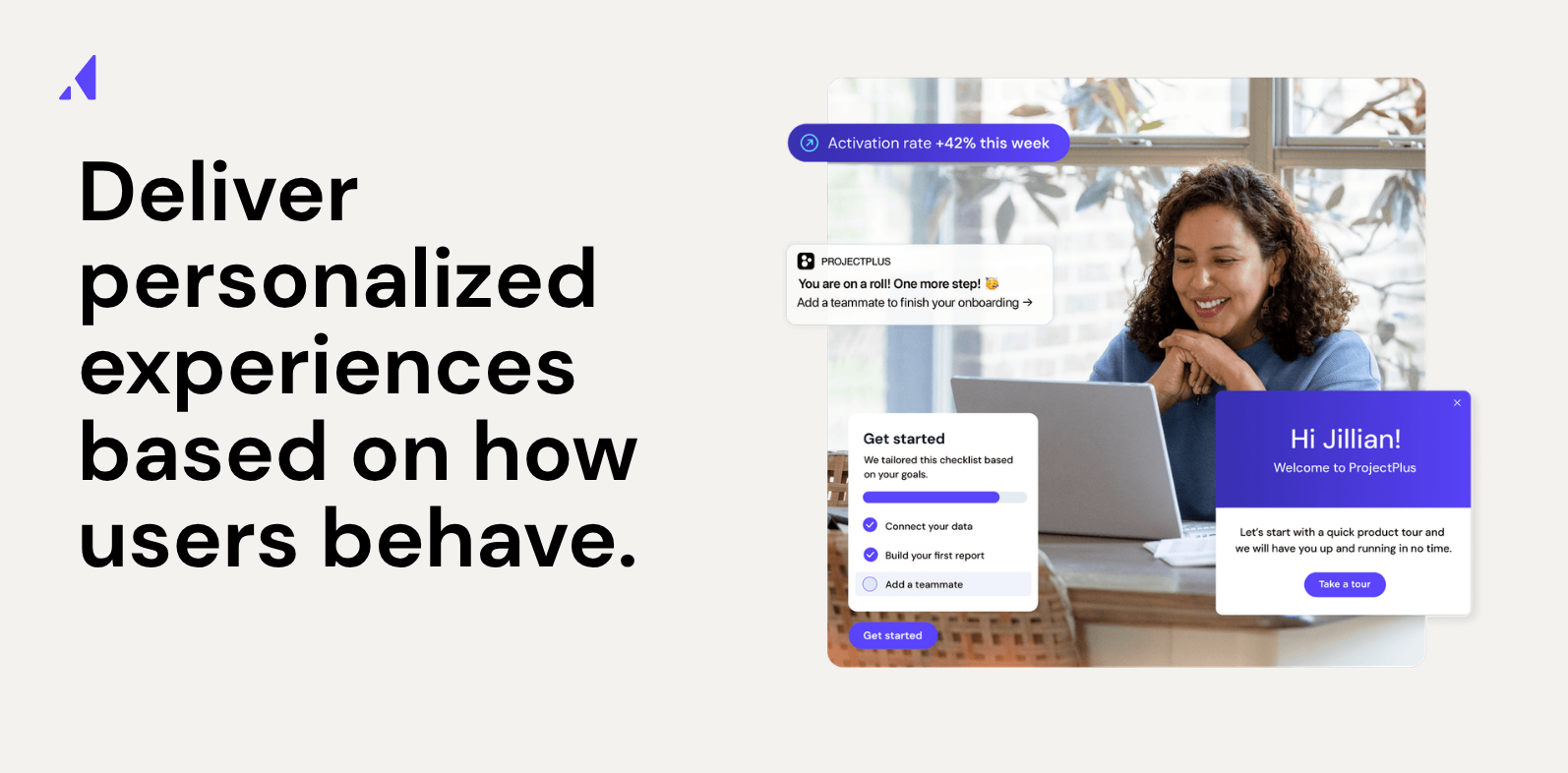
Appcues is a digital adoption platform and customere engagement tool built to create and deliver personalized in-app experiences. Where Contentsquare helps you observe, Appcues helps you act.

The platform lets teams build onboarding flows, product tours, tooltips, checklists, banners, modals, and in-app messaging without engineering resources. It connects user behavior to targeted experiences: when someone hasn't touched a key feature yet, when a new user hasn't completed the onboarding process, or when a power user hits a usage milestone, Appcues lets your team meet them at that moment with the right guidance.

The platform extends beyond in-app as well. Behavioral email, mobile experiences, and push notifications allow teams to coordinate outreach across channels based on what users are actually doing in the product. That cross-channel coordination becomes increasingly valuable as engagement programs grow in complexity and scope.

Captain AI, Appcues' built-in AI assistant, is worth distinguishing from the AI analytics features showing up across behavioral tools. Contentsquare uses AI to surface patterns in what users have already done — summarizing session data, flagging anomalies, and helping teams interpret behavioral trends. Captain AI is oriented toward what you're about to do: it helps teams generate in-app experience content, suggest targeting rules, and analyze how existing flows are performing so the next version is better. The difference is between AI that helps you understand the past and AI that helps you act on it faster.

The low-code visual builder is designed so that non-technical teams can launch and iterate on onboarding experiences in hours rather than sprint cycles, with no engineering resources required for day-to-day creation.
At-a-Glance: Appcues vs. Contentsquare

Here's a quick look at how Appcues and Contentsquare break down:

Appcues vs. Contentsquare
Appcues Contentsquare
Experience creation
Onboarding flows & checklists
Tooltips, modals & banners
In-app NPS & feedback forms
Low-code visual builder
Analytics
Flow & step-level analytics
A/B testing
Session replays
Heatmaps
Journey & funnel analysis
Channels
Web in-app
Mobile
Email & push
Other
AI assistant Captain AI AI-powered insights
Free option Generous free plan (200K sessions, heatmaps, replays)
Transparent paid pricing Start, Grow, Enterprise Not publicly listed

Where They Overlap (and Why Teams Get Confused)

The reason Appcues and Contentsquare end up in the same evaluation conversation is that both tools touch user behavior and the onboarding experience. Both surface some form of analytics. Both claim to help improve the customer journey. So when a team is trying to solve something like "our user onboarding isn't working," it's easy to land on both platforms as candidate solutions.

The overlap feels real until you look closely. Contentsquare does have analytics that touch on user onboarding: session replays can show you how users interact with an onboarding checklist, and journey analysis can reveal where users leave an onboarding flow. But these are diagnostic capabilities. They help you see the problem, not respond to it.

Contentsquare's journey analysis

Appcues has analytics too. Flow completion rates, step-by-step engagement data, A/B testing on onboarding flows, and user segment comparisons give teams the feedback they need to iterate. But those analytics are tied directly to the experiences being built. They answer "is this onboarding message working?" rather than "what is every user doing across every surface of my product?"

Neither platform is a substitute for the other. The confusion comes from expecting one tool to do both jobs.

The Real Difference: Diagnosis vs. Intervention

Contentsquare excels at providing deep, retroactive analytics to understand user interactions and optimize user journeys. Appcues is designed to actively guide users through a product.

This distinction matters most when you zoom in on the onboarding process. User onboarding analytics tools can help identify where users experience friction, but identifying friction and removing it are two different operations. Contentsquare can tell you that 60% of new users never click the "invite team member" button during onboarding. Appcues lets you build an onboarding checklist that surfaces that action at exactly the right moment, A/B test different versions of the prompt, and measure whether the change improved completion rates.

Analyzing user behavior during onboarding reveals critical insights into how quickly users reach their "ah-ha" moment. Contentsquare helps you see where that moment isn't happening. Appcues helps you engineer the conditions that make it more likely to arrive.

This is also where the nature of user engagement differs between the platforms. Contentsquare is a passive lens: it records, analyzes, and reports on how different user segments interact with your product. Appcues is an active lever: it lets teams engage users directly, guide users through complex workflows, and deliver in-app notifications at moments of high intent.

One of the more underappreciated aspects of Appcues is how it handles segmentation. You can segment users based on behavioral events, account attributes, lifecycle stage, or data passed in from your CRM or analytics stack. The onboarding experience a user sees isn't generic; it's shaped by what they've done, what role they're in, and where they are in the customer journey. Contentsquare also supports segmentation, but its purpose is analytical: understanding how different user segments interact with the product, not delivering differentiated experiences to those segments in real time.

Use Cases by Team

Product Teams

Product teams tend to reach for Contentsquare when they need to understand behavioral data at scale: where users struggle, what they interact with, and how different user segments move through complex workflows. Session replays and zone-based heatmaps give a deeper understanding of friction points that quantitative metrics alone can't surface.

Product managers using Appcues are solving a different problem. They want to drive feature adoption, launch in-app guidance for new features without filing a dev ticket, and collect feedback forms directly inside the product. The analytics in Appcues are purpose-built around experience performance: are users completing onboarding flows? Are they engaging with the new feature you just announced? Did the modal prompt a conversion?

Marketing Teams

Marketing teams are rarely the primary buyer of Contentsquare, which sits squarely in the product and digital analytics world.

Appcues is a more natural fit for marketing because it extends to behavioral email and cross-channel experiences, meaning marketing teams can coordinate in-app messaging with email campaigns based on what users are actually doing, without fragmenting the customer experience across multiple software solutions.

Customer Success Teams

Customer success teams benefit from both platforms in distinct ways. Contentsquare surfaces where customers are struggling, which supports proactive outreach and retention conversations. Appcues gives customer success teams a way to build self-serve help into the product itself: in-app guidance, knowledge base integrations, video onboarding flows, and contextual tooltips that reduce customer support tickets without requiring a human touch. For customer success teams trying to scale without scaling headcount, self-serve support built through Appcues often delivers higher leverage than additional analytics infrastructure.

Non-Technical Teams

Both platforms market themselves as accessible to non-technical teams, but the experience is genuinely different. Contentsquare is powerful, but it's an analytics platform. Interpreting heatmaps, analyzing session replays, and drawing actionable insights from journey data requires analytical fluency even if it doesn't require code. The insight-to-action gap is real.

Appcues is built specifically so that non-technical teams can create in-app experiences without engineering resources. The low-code visual builder means someone on the product, marketing, or customer success team can build and launch onboarding flows, modals, and in-app notifications without touching the codebase. That independence is the point.

Pricing and Value

Contentsquare has a permanent free plan that's more generous than most: 200K monthly sessions, unlimited heatmaps, session replay, funnel analysis, surveys, and unlimited team members — no credit card required. They also offer a 15-day trial of their Growth plan before automatically dropping to the free tier. Paid plans (Growth, Pro, Enterprise) exist above that, but pricing isn't publicly listed and is scoped through a sales conversation. The free plan entry point makes Contentsquare genuinely accessible to smaller teams, not just enterprise.

Contentsquare pricing

Appcues offers three tiers: Start (up to 3,000 MAUs), Grow (up to 50,000 MAUs), and Enterprise for custom volumes. Every plan includes the full platform from day one — no feature gating by tier. Pricing scales based on monthly active users, and all plans come with a dedicated CSM and onboarding support. Paid pricing is transparent and publicly listed, which makes it easier to evaluate fit before a sales conversation.

Appcues pricing

The ROI models are different for each platform. Contentsquare's value is in the behavioral insights it produces; how much that's worth depends on whether your team has the capacity to act on what it finds. Appcues' value is tied directly to the experiences it enables and the outcomes those drive — activation, adoption, retention — which are easier to measure and attribute.

It's also worth naming the sequencing question directly: Contentsquare's free plan is a legitimate starting point for teams that want behavioral analytics without commitment. But it doesn't build experiences. A team that starts there and then wants to act on what they find — building onboarding flows, running in-app messaging, guiding users toward the features they keep missing — will still need a tool like Appcues. The two platforms aren't competing for the same job. They're adjacent steps in the same process.

When Using Both Makes Sense

Some high-growth SaaS teams use Appcues and Contentsquare in tandem: Contentsquare to diagnose friction, Appcues to remove it. A team might use Contentsquare session replays to discover that new users keep clicking a navigation element that doesn't lead anywhere useful. They then build an onboarding message in Appcues that redirects those users at exactly that moment. A/B testing in Appcues shows which version of the message performs better. Then back to Contentsquare to confirm the behavior has shifted.

This workflow is productive when you have the budget and capacity to operationalize both. But for most teams, the more useful question is which gap is more expensive right now: not knowing where the friction is, or not being able to do anything about it. Most teams evaluating user onboarding tools already have some visibility into where users struggle. What they're missing is the ability to intervene quickly, without engineering involvement, and measure whether the intervention worked. That's the gap Appcues is built to close.

Which Is Right for You?

Appcues is likely the stronger fit if:

  • Your primary need is building and delivering in-app experiences: onboarding flows, feature announcements, tooltips, NPS surveys
  • You want to drive user activation, feature adoption, or customer engagement without depending on engineering resources
  • You need cross-channel coordination: in-app messaging that connects with behavioral email and mobile
  • You want analytics tied directly to the experiences you're running — completion rates, A/B test results, flow performance — rather than broad behavioral data across your whole product
  • Your customer success teams need scalable self-serve in-app guidance that reduces support ticket volume

Contentsquare is likely the stronger fit if:

  • Your primary need is understanding what users are doing across your product at scale: where they click, where they drop off, where they struggle
  • You want session replays and heatmaps to diagnose friction before deciding what to fix
  • You're running conversion rate optimization on high-traffic pages and need visual behavioral data to guide those decisions
  • You have a UX, product, or digital team focused on research and analysis rather than experience delivery

Consider both if:

  • You need diagnostic depth and the ability to respond at the product level — Contentsquare to find the friction, Appcues to remove it
  • You have teams with different mandates: analytics for product and UX, experience delivery for marketing and customer success

The Bottom Line

Appcues and Contentsquare are both serious tools that earn their spot in a B2B SaaS stack. They're just doing fundamentally different jobs.

If your team's biggest challenge is understanding user behavior at scale, and you have the analytical capacity to act on what you find, Contentsquare is a powerful diagnostic engine. If your biggest challenge is getting users to activate, engage with new features, and make it through the onboarding process with less friction, Appcues is built for exactly that.

For many teams, diagnosis is not actually the bottleneck. The bottleneck is having a fast, flexible way to deliver the right in-app experience to the right user at the right moment, without waiting on an engineering sprint. That's where Appcues earns its place.

If you're evaluating user onboarding tools for your team, see what Appcues can do in a live demo.

Facts & Questions

Is Appcues an analytics platform like Contentsquare?
Can Contentsquare help me build onboarding flows?
Do I need a developer to use Appcues?
Are there use cases where Appcues replaces the need for Contentsquare?
Does Appcues support mobile apps?
Appcues logo

Ready to see what your journey could look like with Appcues?

See how your team can remove friction, move faster, and deliver experiences that are easy for users... and safe for your systems. We’ll walk through your workflows, your governance needs, and the outcomes that matter most to your business.