.png)

The traditional sales funnel had a good run. But for most SaaS companies today, it's becoming a liability — expensive to operate, slow to scale, and increasingly misaligned with how modern buyers want to discover and adopt software. The product-led growth flywheel offers a fundamentally different model: one where growth compounds on itself rather than requiring constant reinvestment to restart.
This guide is for product, growth, and marketing teams who want to understand the PLG flywheel not as a buzzword but as a mechanical system — one with specific stages, specific levers, and specific ways to break or accelerate it. We'll cover what the product-led growth flywheel is, how it differs from the classic funnel, what drives its velocity, which metrics actually matter, and how to build one deliberately.
The Product-Led Growth Flywheel is a framework developed by Appcues that describes how software companies can grow by making the product the center of the user experience at every stage. It replaces the traditional marketing and sales funnel with a circular model where each stage of the user journey reinforces the next.
In a product-led growth strategy, the product itself is the main vehicle for acquiring, activating, and retaining customers. PLG companies invest in making the product so valuable and easy to use that it sells itself.
Product-led growth is a business methodology where the product itself is the primary driver of acquisition, activation, retention, and expansion. Instead of relying on a sales team to move prospects through a pipeline, PLG companies let users experience value first — and let that value do the selling.
It's worth being clear about what PLG is not. It's not just freemium. It's not just self-serve. It's a philosophy that puts the user experience at the center of every growth decision — from how you design your signup flow to how you price your product to how you decide which features to build next.
Companies like Slack, Dropbox, and Figma scaled to billions in revenue by making the product itself the most powerful growth channel they had. Users didn't need a sales rep to explain the value. They experienced it directly, shared it with colleagues, and brought their entire teams along.
The flywheel is a physics metaphor, and it's a useful one. A flywheel is a heavy rotating disk that stores rotational energy. The more energy you put into spinning it, the more momentum it builds — and the harder it becomes to stop. Critically, it doesn't need a constant input of energy to keep moving once it's spinning fast enough.
In a PLG context, the flywheel works the same way. Each satisfied user generates more users — through word of mouth, viral sharing, referrals, and expansion within their organization. Those new users, when they have a great experience, generate even more users. The loop is self-reinforcing.
This is the key insight: the flywheel doesn't just sustain growth — it compounds it. The more energy you invest at the right points, the less effort is required over time to maintain momentum. That's a fundamentally different economics than the traditional funnel.
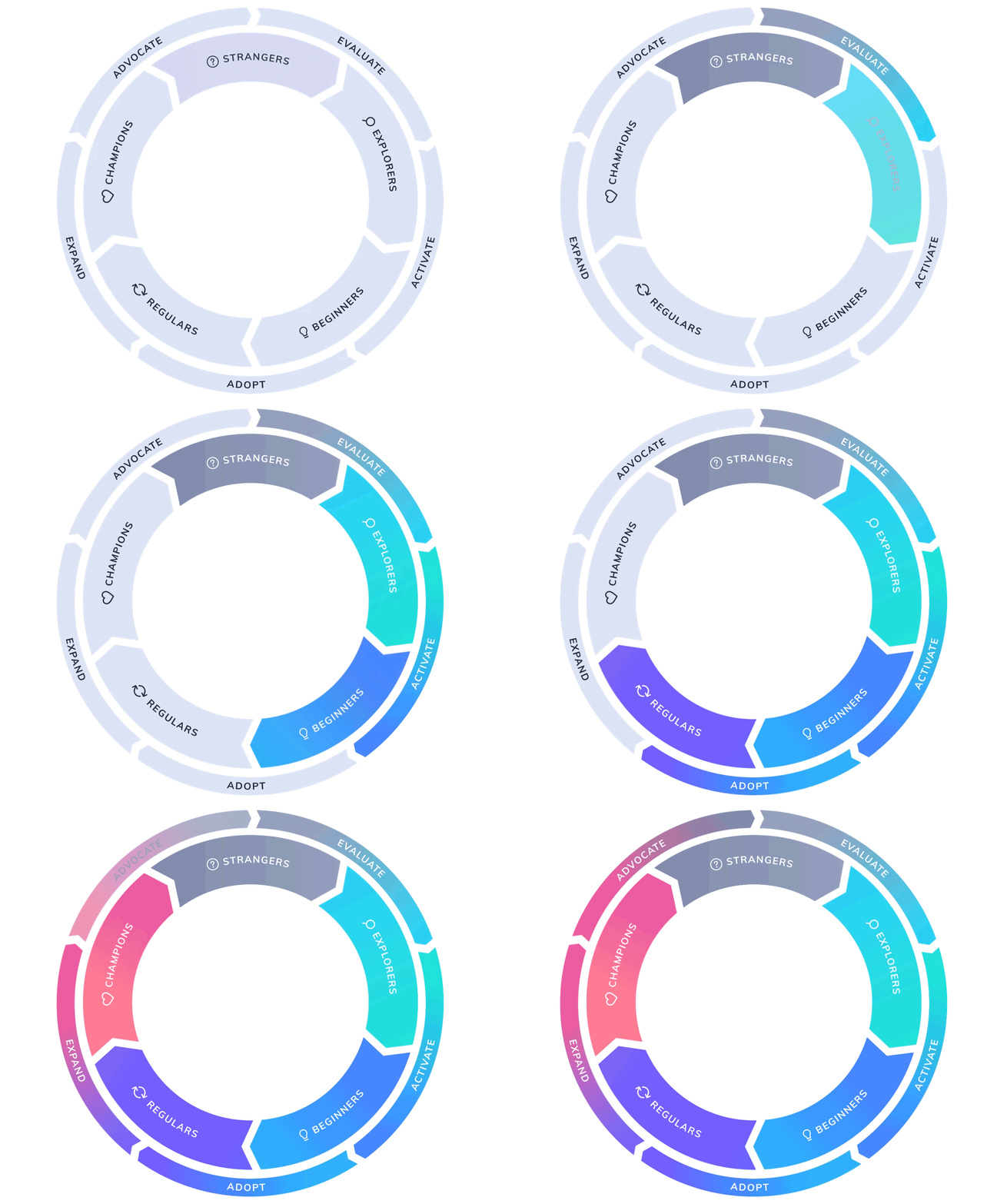
The traditional marketing and sales funnel is linear. Prospects enter at the top, move through awareness, consideration, and decision stages, and either convert or fall out. Every time a prospect falls out, the process has to restart from scratch. The funnel is also leaky by design — customers exit at every stage, and the only way to compensate is to pour more volume in at the top.
The PLG flywheel is circular and cumulative. Happy customers don't just stay — they become advocates who feed new users back into the top of the loop. The output of one cycle becomes the input for the next.
This distinction has real strategic consequences. In a funnel model, your CAC tends to stay flat or increase over time because you're always hunting for new prospects. In a flywheel model, your effective CAC decreases as advocacy and viral loops generate users you didn't have to pay to acquire. The flywheel is a long-term CAC reduction engine — but only if you build it deliberately.
Acquisition in a PLG flywheel looks different from acquisition in a sales-led model. Instead of relying primarily on outbound sales or paid advertising, PLG companies attract users through low-friction entry points: free trials, freemium tiers, self-serve signups, and viral sharing mechanisms built directly into the product.
The product itself becomes a distribution channel. A Calendly scheduling link exposes the product to every meeting recipient. A Loom video introduces the tool to every viewer. A Figma share link pulls collaborators into the product. These aren't marketing campaigns — they're product interactions that happen to generate new users.
The first lever to optimize is signup friction. Every unnecessary field, every required credit card, every mandatory sales call before a user can touch the product is a leak in the acquisition stage. Reducing that friction is the starting point for building a healthy flywheel.
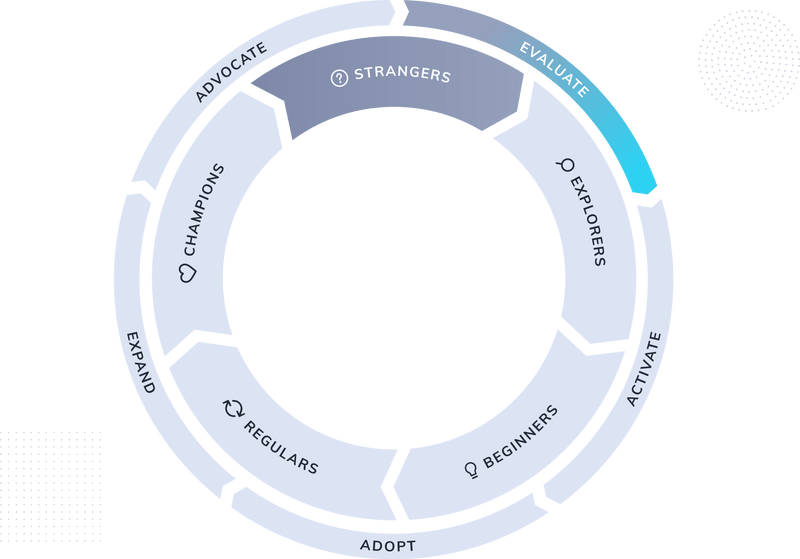
Activation is the most critical stage of the flywheel — and the most commonly broken one. It's the point where a user first experiences the core value of your product: the moment they understand, viscerally, why this tool exists and why they need it. This is the "aha moment."
A user who doesn't reach that moment quickly is unlikely to retain, expand, or advocate. They'll sign up, poke around, get confused, and leave. The activation stage is where most PLG flywheels stall.
The primary tools for accelerating activation are onboarding flows, in-app guidance, progress checklists, and contextual tooltips. The goal is to guide users from signup to their first experience of core value as quickly and clearly as possible — removing every obstacle between them and the moment that makes the product click.
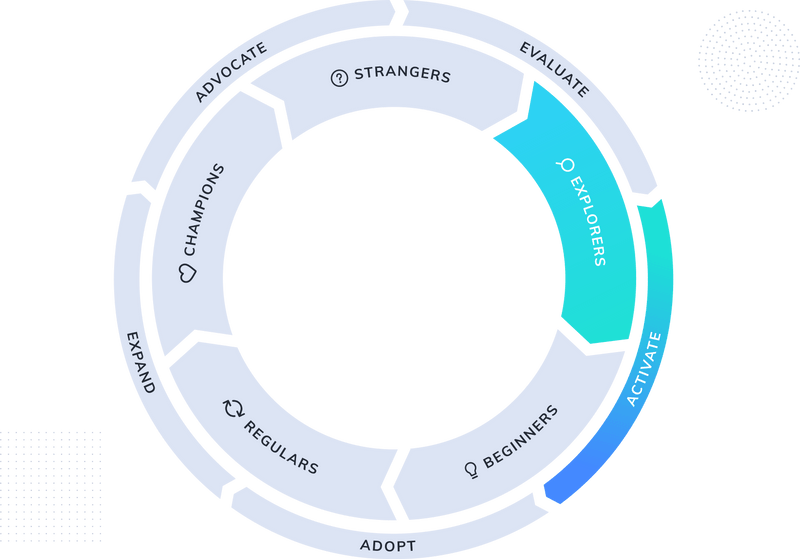
Retention is the stage that determines whether your flywheel gains momentum or loses it. A product that activates users but fails to keep them engaged is spinning in place — it's not building the compounding momentum that makes the flywheel model powerful.
Retention is driven by habit formation, ongoing value delivery, and proactive re-engagement. Users need reasons to come back, and those reasons need to be built into the product experience — not just sent as email reminders.
In-app messaging, feature announcements, behavioral triggers, and milestone celebrations all play a role in keeping users engaged over time. Retained users are the fuel for the next stages of the flywheel. Without them, expansion and advocacy are impossible.
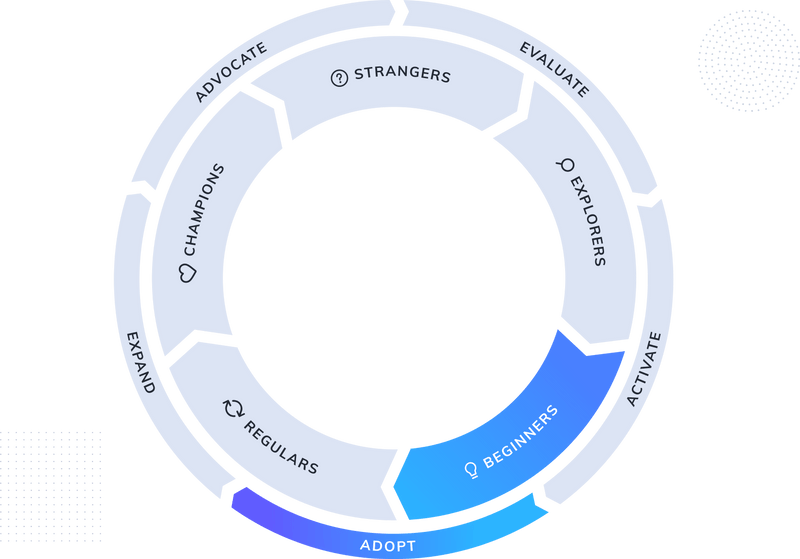
Expansion revenue is one of the most powerful and most underutilized stages of the PLG flywheel. It's the process of converting free or lower-tier users into paying or higher-tier customers — not through a sales call, but through contextual, product-driven prompts that appear at exactly the right moment.
Upsell prompts triggered by usage limits, contextual upgrade nudges when a user tries to access a premium feature, and usage-based pricing that naturally scales with value delivered — these are the mechanisms of expansion in a PLG model.
Expansion is more cost-efficient than new acquisition by a significant margin. You're selling to users who already know your product, already trust it, and are already experiencing value. Investing in expansion is one of the highest-leverage moves a PLG team can make.
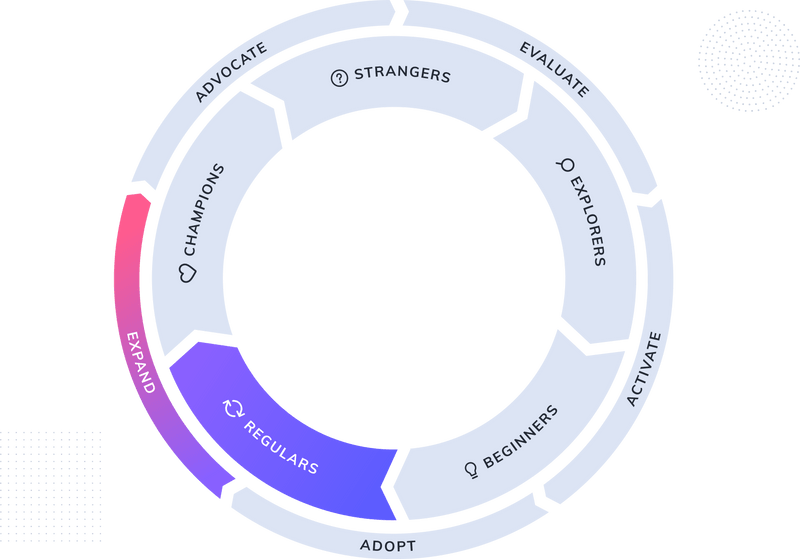
Advocacy is what closes the loop and makes the flywheel self-sustaining. Delighted users share the product organically, leave reviews on G2 or Capterra, refer colleagues, and create viral loops that feed new users back into the acquisition stage — without any additional spend on your part.
But advocacy isn't accidental. It's engineered. Great UX creates the conditions for advocacy, but you still need to build the mechanisms: referral programs, in-app review requests at peak satisfaction moments, shareable product outputs, and community touchpoints that give advocates a place to engage.
The advocacy stage is what separates a PLG flywheel from a PLG funnel. Without it, you have a better funnel. With it, you have a compounding growth engine.
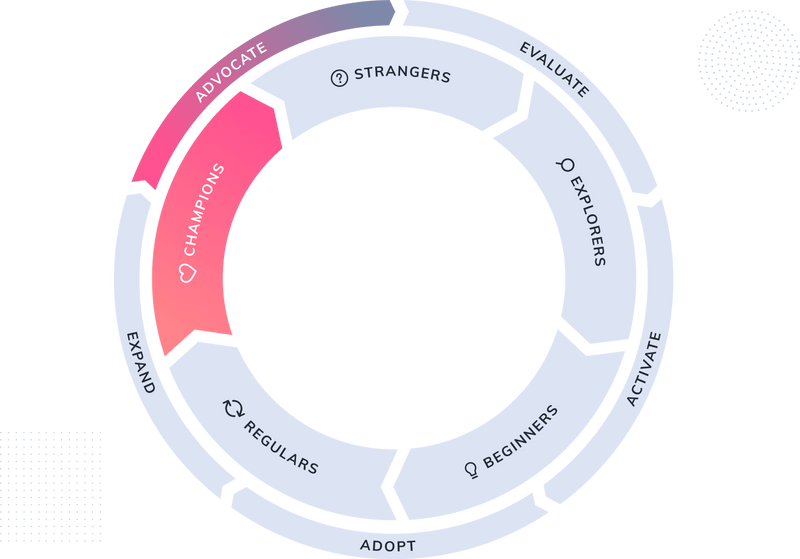
Flywheel velocity — how fast the loop spins — is primarily determined by how much friction exists at each stage. Friction is anything that slows a user down, confuses them, or causes them to abandon the path toward value.
The most common friction points in a PLG flywheel include:
Friction reduction is the primary engineering and design challenge in a PLG motion. Every point of friction is a place where the flywheel slows down.
Teams should audit each stage of the flywheel systematically using product analytics, session recordings, and funnel analysis. The goal is to find where users drop off, stall, or disengage and understand why.
Think of this as friction mapping: a deliberate process of identifying every point in the user journey where someone might hesitate, get confused, or abandon. Not all friction points are equally costly — prioritize the ones that affect the most users or occur at the highest-value stages of the flywheel.
Once you've mapped the friction, you can address it in order of impact. A confusing activation step that affects 60% of new users is a higher priority than an edge case that affects 5%.
Beyond removing friction, teams can actively add force to the flywheel through strategic investments. These are the things that don't just stop the flywheel from slowing down — they actively make it spin faster.
Key force-adding investments include:
Each of these investments compounds over time. That's the nature of the flywheel — the right inputs keep paying dividends long after the initial investment.
Activation rate is the leading indicator of flywheel health. It measures the percentage of new users who reach your defined activation milestone — the specific action or outcome that signals they've experienced core value.

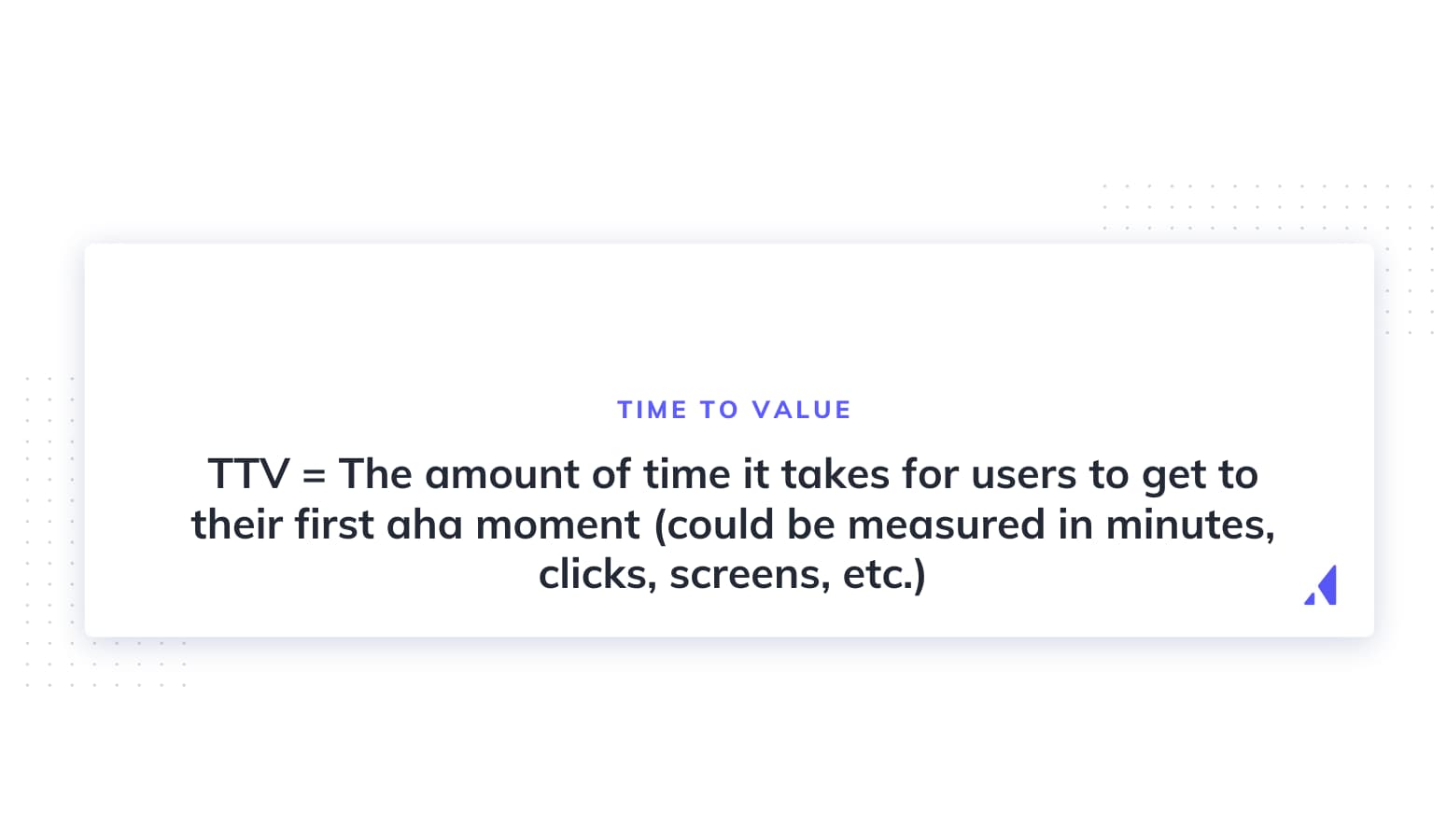
Time-to-value (TTV) measures how long it takes a user to reach that milestone. Shortening TTV is one of the highest-leverage activities in a PLG model because it directly affects how many users make it through the activation stage and into the retention loop.
If your activation rate is low or your TTV is long, the flywheel is leaking at its most critical stage. Fix this before optimizing anything else.
Retention metrics reveal whether your product is delivering ongoing value or just a one-time experience. The key metrics to track include:
Strong retention is the prerequisite for expansion and advocacy. If users aren't sticking around, the later stages of the flywheel can't function.
Net Revenue Retention (NRR) is the single most important financial metric for a PLG flywheel business. It measures the percentage of revenue retained from existing customers over a given period, accounting for churn, contraction, and expansion.
An NRR above 100% means you're generating more revenue from your existing user base than you're losing to churn — a compounding effect that makes the flywheel increasingly powerful over time. The best PLG companies maintain NRR well above 100%, which means their existing customer base alone would grow the business even if they acquired no new customers.
Track expansion MRR, upgrade conversion rates, and the effectiveness of your upsell triggers to understand how well your expansion stage is performing.
The viral coefficient quantifies the advocacy stage of the flywheel. It measures how many new users each existing user generates. A viral coefficient above 1.0 means each user generates more than one additional user — a condition for exponential, self-sustaining growth.
To calculate it: multiply the number of invitations or referrals sent per user by the conversion rate of those invitations. Track referral volume, referral conversion rates, and NPS scores as a proxy for advocacy potential. Product data can also help you identify your most likely advocates — the users who are highly engaged, have adopted multiple features, and have been using the product long enough to have formed strong opinions about it.
One of the most common PLG mistakes is pushing users toward paid plans before they've experienced core value. It feels logical — you want to convert users while they're engaged. But premature monetization breaks the flywheel by cutting off the activation stage before it can generate retention and advocacy.
Map your activation milestone clearly before you design any upgrade prompts. Users who haven't activated yet aren't ready to pay — and asking them to will only increase churn.
Many teams build a single onboarding flow, ship it, and consider the job done. In reality, onboarding should be continuous — adapting to user behavior, role, and lifecycle stage as users evolve in their relationship with the product.
Secondary onboarding matters just as much as first-run onboarding. When you ship a new feature, users need guidance. When a user returns after a period of inactivity, they need re-engagement. When a user upgrades to a new plan, they need to understand what's now available to them. Treating onboarding as a one-time event leaves enormous value on the table.
Most PLG teams over-invest in acquisition and activation — the stages that are easiest to measure and most visible — while neglecting expansion and advocacy. These are the stages that actually make the flywheel self-sustaining.
Build explicit programs for each stage. Don't assume that satisfied users will naturally upgrade or refer colleagues. Design the mechanisms that make those behaviors easy and rewarding.
Signups and page views feel good to report, but they can mask a broken flywheel. A product can have high signup volume and catastrophically low retention simultaneously. Vanity metrics don't tell you whether the flywheel is spinning — they just tell you how many people touched it.
Build a PLG dashboard that tracks all five flywheel stages: acquisition volume and quality, activation rate and TTV, retention and engagement metrics, expansion MRR and NRR, and referral and advocacy indicators. If you're only measuring the top of the funnel, you're flying blind.
Before you can optimize activation, you need to know what it looks like. Use product analytics to identify the behavioral patterns that correlate with long-term retention — the specific actions that users who stick around tend to take early on, and that users who churn tend to skip.
Your activation milestone should be specific, measurable, and tied to a real user outcome — not just a feature interaction. "User creates their first project and invites a collaborator" is an activation milestone. "User visits the dashboard" is not.
Map the ideal path from signup to your activation milestone. Then remove every unnecessary step from that path. Every field, screen, and decision point that doesn't directly move a user toward their first experience of core value is a candidate for elimination.
The tools for guiding users along this path include welcome modals, progress checklists, empty state guidance, and contextual tooltips. Each of these serves a specific purpose: welcome flows orient users, checklists give them a clear sense of progress, empty states show them what's possible, and tooltips provide just-in-time guidance when they need it.
Onboarding design should be tested and iterated continuously. The first version you ship is not the final version — it's the starting point for a series of experiments.
Retention doesn't happen by accident. It's the result of designing product experiences that create habits and give users reasons to return. Notification strategies, in-app milestone celebrations, feature discovery nudges, and personalized re-engagement flows all contribute to building those habits.
The most effective retention mechanisms are behavioral — triggered by what users have and haven't done, rather than by arbitrary time intervals. A user who hasn't used a key feature yet should receive guidance about that feature. A user who just hit a significant milestone should receive recognition. The right message at the right moment is far more effective than a generic weekly email.
Expansion prompts work best when they appear at moments of peak value — when a user is actively experiencing what the product can do, or when they're hitting the limits of their current plan. These are the moments when the case for upgrading is self-evident.
Use product data to segment users by expansion readiness. A user who has been active for 30 days, has adopted three core features, and is approaching their usage limit is a very different prospect than a user who signed up last week and has barely explored the product. Deliver contextual, non-disruptive upgrade nudges to the right users at the right time. Expansion should feel like a natural next step, not an interruption.
Advocacy doesn't happen just because users are happy. You need to build the mechanisms that make it easy and timely. Referral prompts should appear at peak satisfaction moments — right after a user achieves something meaningful in the product. Shareable outputs should make it natural for users to expose the product to people outside their organization. In-app review requests should be triggered by engagement signals, not by a calendar schedule.
Identify your power users — the highly engaged, long-tenured users who have adopted multiple features and have strong opinions about the product — and activate them as advocates through targeted outreach and recognition programs. These users are your most credible growth channel.
Appcues enables product teams to build, test, and iterate onboarding flows — welcome modals, checklists, tooltips, and product tours — without requiring engineering resources for every change. That matters because onboarding is never truly finished. The ability to iterate quickly means teams can continuously improve their activation rates rather than waiting for development cycles.
Appcues also supports personalized onboarding by user role, plan, or behavior. A new user on a free plan has different needs than an enterprise user who just onboarded their team. Delivering the right onboarding experience to each segment accelerates time-to-value and gets more users through the activation stage and into the retention loop.
Appcues uses in-app event data and user properties to trigger contextually relevant messages at exactly the right moment. A feature announcement for a power user who's ready to go deeper. A re-engagement nudge for a user who hasn't logged in for two weeks. An upgrade prompt for someone who just hit their usage limit.
This kind of behavioral targeting is what separates effective retention and expansion from generic in-app messaging. The right message, delivered to the right user at the right moment, is the difference between an interruption and a genuinely helpful nudge.
One of the most common causes of churn is users who never discover the features that would make the product indispensable to them. Appcues helps teams drive adoption of new and underused features through in-app announcements, guided tours, and contextual tooltips — delivered to the users most likely to benefit from them.
Users who adopt more features are less likely to churn, more likely to expand, and more likely to advocate. Feature adoption is a direct driver of flywheel velocity, and it's an area where in-app guidance consistently outperforms email or documentation.
Appcues provides analytics on flow performance, checklist completion, and user engagement — giving teams the data they need to identify where the flywheel is slowing down and test improvements. The ability to A/B test onboarding flows and iterate based on real user behavior is essential for continuously accelerating flywheel velocity.
A PLG flywheel is never fully optimized. There's always a friction point to remove, a message to improve, or a trigger to refine. Appcues gives teams the tools to keep making those improvements without depending on a development queue.
The Product-Led Growth (PLG) Flywheel is a framework for growing a software business by investing in the product itself as the primary driver of customer acquisition, conversion, and expansion. Unlike the traditional sales funnel, which treats growth as a linear process ending at purchase, the flywheel treats growth as a self-reinforcing cycle with four stages: Activate, Adopt, Adore, and Advocate.
The product-led growth flywheel is not a tactic you deploy — it's a compounding system you build deliberately, stage by stage. Acquisition, activation, retention, expansion, and advocacy are not independent initiatives. They're interconnected stages of a single loop, and weakness in any one of them slows the entire system down.
The teams that win with PLG are the ones who invest in all five stages, reduce friction systematically, and add force at the points where it compounds most. They measure flywheel health — not vanity metrics — and they treat onboarding, retention, and advocacy as ongoing programs rather than one-time builds.
The flywheel starts with a great product experience. Everything else — the guidance, the messaging, the triggers, the analytics — exists to help more users reach that experience faster and stay there longer.
If you're ready to build and accelerate your own PLG flywheel, Appcues can help you do it at every stage. Take the tour or request a personalized demo to see how teams use Appcues to turn their product into a self-sustaining growth engine.
Lifecycle Marketing
Customer Journeys
Retention & Churn
Upsell & Cross-sell
The traditional sales funnel had a good run. But for most SaaS companies today, it's becoming a liability — expensive to operate, slow to scale, and increasingly misaligned with how modern buyers want to discover and adopt software. The product-led growth flywheel offers a fundamentally different model: one where growth compounds on itself rather than requiring constant reinvestment to restart.
This guide is for product, growth, and marketing teams who want to understand the PLG flywheel not as a buzzword but as a mechanical system — one with specific stages, specific levers, and specific ways to break or accelerate it. We'll cover what the product-led growth flywheel is, how it differs from the classic funnel, what drives its velocity, which metrics actually matter, and how to build one deliberately.
The Product-Led Growth Flywheel is a framework developed by Appcues that describes how software companies can grow by making the product the center of the user experience at every stage. It replaces the traditional marketing and sales funnel with a circular model where each stage of the user journey reinforces the next.
In a product-led growth strategy, the product itself is the main vehicle for acquiring, activating, and retaining customers. PLG companies invest in making the product so valuable and easy to use that it sells itself.
Product-led growth is a business methodology where the product itself is the primary driver of acquisition, activation, retention, and expansion. Instead of relying on a sales team to move prospects through a pipeline, PLG companies let users experience value first — and let that value do the selling.
It's worth being clear about what PLG is not. It's not just freemium. It's not just self-serve. It's a philosophy that puts the user experience at the center of every growth decision — from how you design your signup flow to how you price your product to how you decide which features to build next.
Companies like Slack, Dropbox, and Figma scaled to billions in revenue by making the product itself the most powerful growth channel they had. Users didn't need a sales rep to explain the value. They experienced it directly, shared it with colleagues, and brought their entire teams along.
The flywheel is a physics metaphor, and it's a useful one. A flywheel is a heavy rotating disk that stores rotational energy. The more energy you put into spinning it, the more momentum it builds — and the harder it becomes to stop. Critically, it doesn't need a constant input of energy to keep moving once it's spinning fast enough.
In a PLG context, the flywheel works the same way. Each satisfied user generates more users — through word of mouth, viral sharing, referrals, and expansion within their organization. Those new users, when they have a great experience, generate even more users. The loop is self-reinforcing.
This is the key insight: the flywheel doesn't just sustain growth — it compounds it. The more energy you invest at the right points, the less effort is required over time to maintain momentum. That's a fundamentally different economics than the traditional funnel.
The traditional marketing and sales funnel is linear. Prospects enter at the top, move through awareness, consideration, and decision stages, and either convert or fall out. Every time a prospect falls out, the process has to restart from scratch. The funnel is also leaky by design — customers exit at every stage, and the only way to compensate is to pour more volume in at the top.
The PLG flywheel is circular and cumulative. Happy customers don't just stay — they become advocates who feed new users back into the top of the loop. The output of one cycle becomes the input for the next.
This distinction has real strategic consequences. In a funnel model, your CAC tends to stay flat or increase over time because you're always hunting for new prospects. In a flywheel model, your effective CAC decreases as advocacy and viral loops generate users you didn't have to pay to acquire. The flywheel is a long-term CAC reduction engine — but only if you build it deliberately.
Acquisition in a PLG flywheel looks different from acquisition in a sales-led model. Instead of relying primarily on outbound sales or paid advertising, PLG companies attract users through low-friction entry points: free trials, freemium tiers, self-serve signups, and viral sharing mechanisms built directly into the product.
The product itself becomes a distribution channel. A Calendly scheduling link exposes the product to every meeting recipient. A Loom video introduces the tool to every viewer. A Figma share link pulls collaborators into the product. These aren't marketing campaigns — they're product interactions that happen to generate new users.
The first lever to optimize is signup friction. Every unnecessary field, every required credit card, every mandatory sales call before a user can touch the product is a leak in the acquisition stage. Reducing that friction is the starting point for building a healthy flywheel.
Activation is the most critical stage of the flywheel — and the most commonly broken one. It's the point where a user first experiences the core value of your product: the moment they understand, viscerally, why this tool exists and why they need it. This is the "aha moment."
A user who doesn't reach that moment quickly is unlikely to retain, expand, or advocate. They'll sign up, poke around, get confused, and leave. The activation stage is where most PLG flywheels stall.
The primary tools for accelerating activation are onboarding flows, in-app guidance, progress checklists, and contextual tooltips. The goal is to guide users from signup to their first experience of core value as quickly and clearly as possible — removing every obstacle between them and the moment that makes the product click.
Retention is the stage that determines whether your flywheel gains momentum or loses it. A product that activates users but fails to keep them engaged is spinning in place — it's not building the compounding momentum that makes the flywheel model powerful.
Retention is driven by habit formation, ongoing value delivery, and proactive re-engagement. Users need reasons to come back, and those reasons need to be built into the product experience — not just sent as email reminders.
In-app messaging, feature announcements, behavioral triggers, and milestone celebrations all play a role in keeping users engaged over time. Retained users are the fuel for the next stages of the flywheel. Without them, expansion and advocacy are impossible.
Expansion revenue is one of the most powerful and most underutilized stages of the PLG flywheel. It's the process of converting free or lower-tier users into paying or higher-tier customers — not through a sales call, but through contextual, product-driven prompts that appear at exactly the right moment.
Upsell prompts triggered by usage limits, contextual upgrade nudges when a user tries to access a premium feature, and usage-based pricing that naturally scales with value delivered — these are the mechanisms of expansion in a PLG model.
Expansion is more cost-efficient than new acquisition by a significant margin. You're selling to users who already know your product, already trust it, and are already experiencing value. Investing in expansion is one of the highest-leverage moves a PLG team can make.
Advocacy is what closes the loop and makes the flywheel self-sustaining. Delighted users share the product organically, leave reviews on G2 or Capterra, refer colleagues, and create viral loops that feed new users back into the acquisition stage — without any additional spend on your part.
But advocacy isn't accidental. It's engineered. Great UX creates the conditions for advocacy, but you still need to build the mechanisms: referral programs, in-app review requests at peak satisfaction moments, shareable product outputs, and community touchpoints that give advocates a place to engage.
The advocacy stage is what separates a PLG flywheel from a PLG funnel. Without it, you have a better funnel. With it, you have a compounding growth engine.
Flywheel velocity — how fast the loop spins — is primarily determined by how much friction exists at each stage. Friction is anything that slows a user down, confuses them, or causes them to abandon the path toward value.
The most common friction points in a PLG flywheel include:
Friction reduction is the primary engineering and design challenge in a PLG motion. Every point of friction is a place where the flywheel slows down.
Teams should audit each stage of the flywheel systematically using product analytics, session recordings, and funnel analysis. The goal is to find where users drop off, stall, or disengage and understand why.
Think of this as friction mapping: a deliberate process of identifying every point in the user journey where someone might hesitate, get confused, or abandon. Not all friction points are equally costly — prioritize the ones that affect the most users or occur at the highest-value stages of the flywheel.
Once you've mapped the friction, you can address it in order of impact. A confusing activation step that affects 60% of new users is a higher priority than an edge case that affects 5%.
Beyond removing friction, teams can actively add force to the flywheel through strategic investments. These are the things that don't just stop the flywheel from slowing down — they actively make it spin faster.
Key force-adding investments include:
Each of these investments compounds over time. That's the nature of the flywheel — the right inputs keep paying dividends long after the initial investment.
Activation rate is the leading indicator of flywheel health. It measures the percentage of new users who reach your defined activation milestone — the specific action or outcome that signals they've experienced core value.
Time-to-value (TTV) measures how long it takes a user to reach that milestone. Shortening TTV is one of the highest-leverage activities in a PLG model because it directly affects how many users make it through the activation stage and into the retention loop.
If your activation rate is low or your TTV is long, the flywheel is leaking at its most critical stage. Fix this before optimizing anything else.
Retention metrics reveal whether your product is delivering ongoing value or just a one-time experience. The key metrics to track include:
Strong retention is the prerequisite for expansion and advocacy. If users aren't sticking around, the later stages of the flywheel can't function.
Net Revenue Retention (NRR) is the single most important financial metric for a PLG flywheel business. It measures the percentage of revenue retained from existing customers over a given period, accounting for churn, contraction, and expansion.
An NRR above 100% means you're generating more revenue from your existing user base than you're losing to churn — a compounding effect that makes the flywheel increasingly powerful over time. The best PLG companies maintain NRR well above 100%, which means their existing customer base alone would grow the business even if they acquired no new customers.
Track expansion MRR, upgrade conversion rates, and the effectiveness of your upsell triggers to understand how well your expansion stage is performing.
The viral coefficient quantifies the advocacy stage of the flywheel. It measures how many new users each existing user generates. A viral coefficient above 1.0 means each user generates more than one additional user — a condition for exponential, self-sustaining growth.
To calculate it: multiply the number of invitations or referrals sent per user by the conversion rate of those invitations. Track referral volume, referral conversion rates, and NPS scores as a proxy for advocacy potential. Product data can also help you identify your most likely advocates — the users who are highly engaged, have adopted multiple features, and have been using the product long enough to have formed strong opinions about it.
One of the most common PLG mistakes is pushing users toward paid plans before they've experienced core value. It feels logical — you want to convert users while they're engaged. But premature monetization breaks the flywheel by cutting off the activation stage before it can generate retention and advocacy.
Map your activation milestone clearly before you design any upgrade prompts. Users who haven't activated yet aren't ready to pay — and asking them to will only increase churn.
Many teams build a single onboarding flow, ship it, and consider the job done. In reality, onboarding should be continuous — adapting to user behavior, role, and lifecycle stage as users evolve in their relationship with the product.
Secondary onboarding matters just as much as first-run onboarding. When you ship a new feature, users need guidance. When a user returns after a period of inactivity, they need re-engagement. When a user upgrades to a new plan, they need to understand what's now available to them. Treating onboarding as a one-time event leaves enormous value on the table.
Most PLG teams over-invest in acquisition and activation — the stages that are easiest to measure and most visible — while neglecting expansion and advocacy. These are the stages that actually make the flywheel self-sustaining.
Build explicit programs for each stage. Don't assume that satisfied users will naturally upgrade or refer colleagues. Design the mechanisms that make those behaviors easy and rewarding.
Signups and page views feel good to report, but they can mask a broken flywheel. A product can have high signup volume and catastrophically low retention simultaneously. Vanity metrics don't tell you whether the flywheel is spinning — they just tell you how many people touched it.
Build a PLG dashboard that tracks all five flywheel stages: acquisition volume and quality, activation rate and TTV, retention and engagement metrics, expansion MRR and NRR, and referral and advocacy indicators. If you're only measuring the top of the funnel, you're flying blind.
Before you can optimize activation, you need to know what it looks like. Use product analytics to identify the behavioral patterns that correlate with long-term retention — the specific actions that users who stick around tend to take early on, and that users who churn tend to skip.
Your activation milestone should be specific, measurable, and tied to a real user outcome — not just a feature interaction. "User creates their first project and invites a collaborator" is an activation milestone. "User visits the dashboard" is not.
Map the ideal path from signup to your activation milestone. Then remove every unnecessary step from that path. Every field, screen, and decision point that doesn't directly move a user toward their first experience of core value is a candidate for elimination.
The tools for guiding users along this path include welcome modals, progress checklists, empty state guidance, and contextual tooltips. Each of these serves a specific purpose: welcome flows orient users, checklists give them a clear sense of progress, empty states show them what's possible, and tooltips provide just-in-time guidance when they need it.
Onboarding design should be tested and iterated continuously. The first version you ship is not the final version — it's the starting point for a series of experiments.
Retention doesn't happen by accident. It's the result of designing product experiences that create habits and give users reasons to return. Notification strategies, in-app milestone celebrations, feature discovery nudges, and personalized re-engagement flows all contribute to building those habits.
The most effective retention mechanisms are behavioral — triggered by what users have and haven't done, rather than by arbitrary time intervals. A user who hasn't used a key feature yet should receive guidance about that feature. A user who just hit a significant milestone should receive recognition. The right message at the right moment is far more effective than a generic weekly email.
Expansion prompts work best when they appear at moments of peak value — when a user is actively experiencing what the product can do, or when they're hitting the limits of their current plan. These are the moments when the case for upgrading is self-evident.
Use product data to segment users by expansion readiness. A user who has been active for 30 days, has adopted three core features, and is approaching their usage limit is a very different prospect than a user who signed up last week and has barely explored the product. Deliver contextual, non-disruptive upgrade nudges to the right users at the right time. Expansion should feel like a natural next step, not an interruption.
Advocacy doesn't happen just because users are happy. You need to build the mechanisms that make it easy and timely. Referral prompts should appear at peak satisfaction moments — right after a user achieves something meaningful in the product. Shareable outputs should make it natural for users to expose the product to people outside their organization. In-app review requests should be triggered by engagement signals, not by a calendar schedule.
Identify your power users — the highly engaged, long-tenured users who have adopted multiple features and have strong opinions about the product — and activate them as advocates through targeted outreach and recognition programs. These users are your most credible growth channel.
Appcues enables product teams to build, test, and iterate onboarding flows — welcome modals, checklists, tooltips, and product tours — without requiring engineering resources for every change. That matters because onboarding is never truly finished. The ability to iterate quickly means teams can continuously improve their activation rates rather than waiting for development cycles.
Appcues also supports personalized onboarding by user role, plan, or behavior. A new user on a free plan has different needs than an enterprise user who just onboarded their team. Delivering the right onboarding experience to each segment accelerates time-to-value and gets more users through the activation stage and into the retention loop.
Appcues uses in-app event data and user properties to trigger contextually relevant messages at exactly the right moment. A feature announcement for a power user who's ready to go deeper. A re-engagement nudge for a user who hasn't logged in for two weeks. An upgrade prompt for someone who just hit their usage limit.
This kind of behavioral targeting is what separates effective retention and expansion from generic in-app messaging. The right message, delivered to the right user at the right moment, is the difference between an interruption and a genuinely helpful nudge.
One of the most common causes of churn is users who never discover the features that would make the product indispensable to them. Appcues helps teams drive adoption of new and underused features through in-app announcements, guided tours, and contextual tooltips — delivered to the users most likely to benefit from them.
Users who adopt more features are less likely to churn, more likely to expand, and more likely to advocate. Feature adoption is a direct driver of flywheel velocity, and it's an area where in-app guidance consistently outperforms email or documentation.
Appcues provides analytics on flow performance, checklist completion, and user engagement — giving teams the data they need to identify where the flywheel is slowing down and test improvements. The ability to A/B test onboarding flows and iterate based on real user behavior is essential for continuously accelerating flywheel velocity.
A PLG flywheel is never fully optimized. There's always a friction point to remove, a message to improve, or a trigger to refine. Appcues gives teams the tools to keep making those improvements without depending on a development queue.
The Product-Led Growth (PLG) Flywheel is a framework for growing a software business by investing in the product itself as the primary driver of customer acquisition, conversion, and expansion. Unlike the traditional sales funnel, which treats growth as a linear process ending at purchase, the flywheel treats growth as a self-reinforcing cycle with four stages: Activate, Adopt, Adore, and Advocate.
The product-led growth flywheel is not a tactic you deploy — it's a compounding system you build deliberately, stage by stage. Acquisition, activation, retention, expansion, and advocacy are not independent initiatives. They're interconnected stages of a single loop, and weakness in any one of them slows the entire system down.
The teams that win with PLG are the ones who invest in all five stages, reduce friction systematically, and add force at the points where it compounds most. They measure flywheel health — not vanity metrics — and they treat onboarding, retention, and advocacy as ongoing programs rather than one-time builds.
The flywheel starts with a great product experience. Everything else — the guidance, the messaging, the triggers, the analytics — exists to help more users reach that experience faster and stay there longer.
If you're ready to build and accelerate your own PLG flywheel, Appcues can help you do it at every stage. Take the tour or request a personalized demo to see how teams use Appcues to turn their product into a self-sustaining growth engine.

Sign up for Quickcues and get our monthly updates!
.svg)