.png)
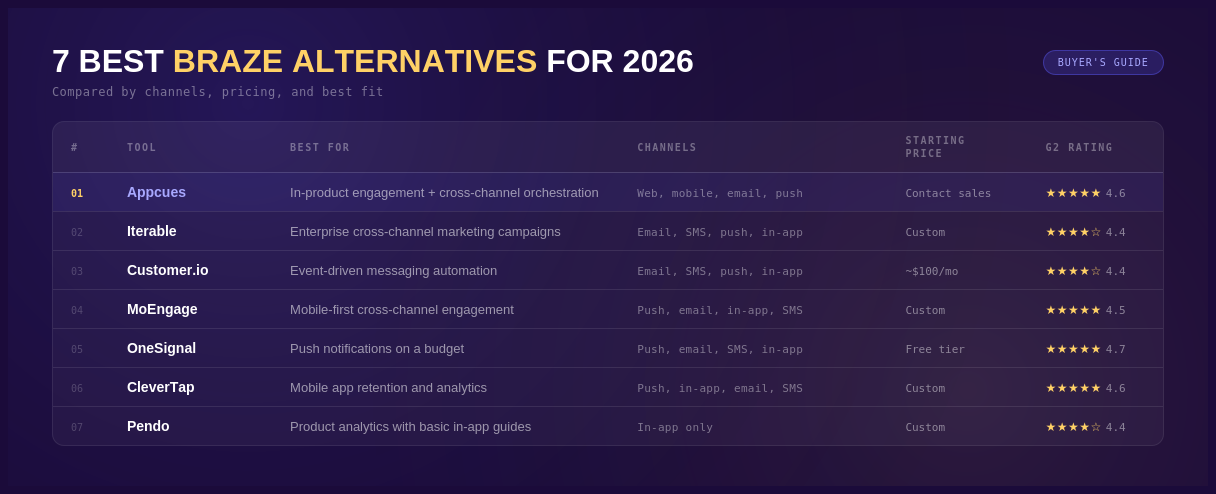
Braze is great at sending messages across channels, but it's expensive, complex, and thin on in-app experiences.
If your engagement strategy starts inside your product, Appcues gives you the deepest in-app pattern library (Flows, Checklists, Banners, NPS, Launchpad) plus cross-channel reach to email, push, and mobile.
If you need a messaging-first tool, Iterable is the closest Braze equivalent; Customer.io does something similar for a fraction of the price.
MoEngage and CleverTap are strong for mobile-first consumer apps.
OneSignal covers push notifications on a budget.
And Pendo makes the list for teams who realize they need product analytics more than messaging.
The right pick depends on where your most important engagement actually happens.
Let's start with what's true: Braze is really good at what it does. If you need to send millions of emails, push notifications, and SMS messages to precisely targeted audiences across dozens of markets, it's one of the best customer engagement platforms money can buy. There's a reason it's a $600-million-a-year business.
But "best tool money can buy" is doing a lot of work in that sentence. And if you're reading this, you've probably already run into one of the reasons teams start looking elsewhere.
Maybe it's the price. Maybe it's the realization that Braze can send a message about your product but can't really help you guide people through it. Maybe you're tired of needing engineering for everything. Or maybe it's the feeling that your engagement strategy should start inside your product, not in someone's inbox, and Braze just isn't built for that.
Whatever brought you here, this post walks through seven Braze alternatives that approach the problem differently. Some are direct Braze competitors. Others take a fundamentally different angle. We'll be honest about all of them.
Before we get into the Braze alternatives, it's worth naming the specific gaps. Even among leading customer engagement platforms, no tool is perfect, and Braze's gaps will help you figure out what kind of platform you actually need next.
The steep learning curve is real. Braze requires significant developer resources for implementation and ongoing maintenance. Many teams discover that the complexity only grows as their engagement needs expand, and they end up needing dedicated technical staff just to keep things running.
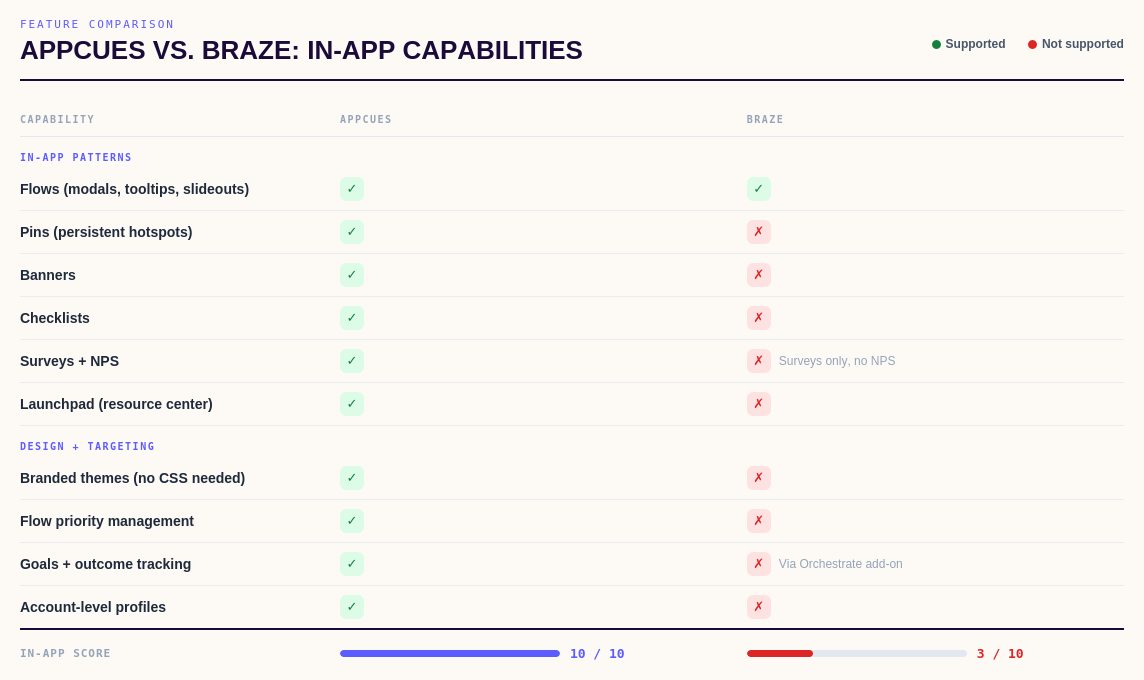
In-app messaging is surface-level. Braze can deliver basic in-app messages, but it lacks the deeper patterns most product and CX teams need: onboarding checklists, guided tours, resource centers, NPS. If your customer engagement strategy depends on in-product experiences, you'll need separate tools to fill the gaps.
No loyalty programs or web personalization. Unlike some customer engagement platforms, Braze doesn't include built-in loyalty programs or website personalization capabilities. E-commerce businesses and consumer brands often find they need additional tools for these key features, which means more ongoing maintenance and more integration headaches. If you've been getting by with basic email tools, the jump to Braze can feel like paying for a sports car to drive to the grocery store.
It's not a customer data platform. Braze doesn't unify customer data the way a real customer data platform does. You'll still need a separate layer to consolidate behavioral data, event data, and purchase history into unified customer data profiles. For many users, that means managing multiple tools just to get a complete picture of real-time customer behavior.
Enterprise pricing isn't built for mid-market teams. Contracts typically start around $60K/year, and Braze's reporting tools are often criticized for lacking detailed metrics. Enterprise-grade capabilities like advanced segmentation can feel overkill (and overpriced) for mid-market teams that just want to deliver personalized experiences without the overhead.
None of this means Braze is bad. It means it was built for a specific kind of team with a specific kind of budget. If that's not you, one of the Braze alternatives below probably is.
Not every tool on this list is trying to do the same thing, so comparing them feature-for-feature doesn't quite work. Instead, we focused on the questions that come up most when teams are actively evaluating a switch.
How deep are the in-app experiences? Can your marketing teams actually build and ship things without filing engineering tickets? Does targeting go beyond "everyone who signed up last week," using real-time customer behavior and behavioral data to get more precise? Can you reach people across multiple channels (email, push, mobile)? Is the pricing predictable, or do you need three sales calls to get a number? And when you get stuck, is there a real team with specialized expertise behind the tool, or just a help center?
Those are the threads running through each write-up below.
Here's the simplest way to think about the difference between Braze and Appcues: Braze starts with a message and hopes it drives someone into your product. Appcues starts with what someone is already doing in your product and meets them there.
If the reason you're leaving Braze is that your in-app experience feels like an afterthought, this is probably what you're looking for.
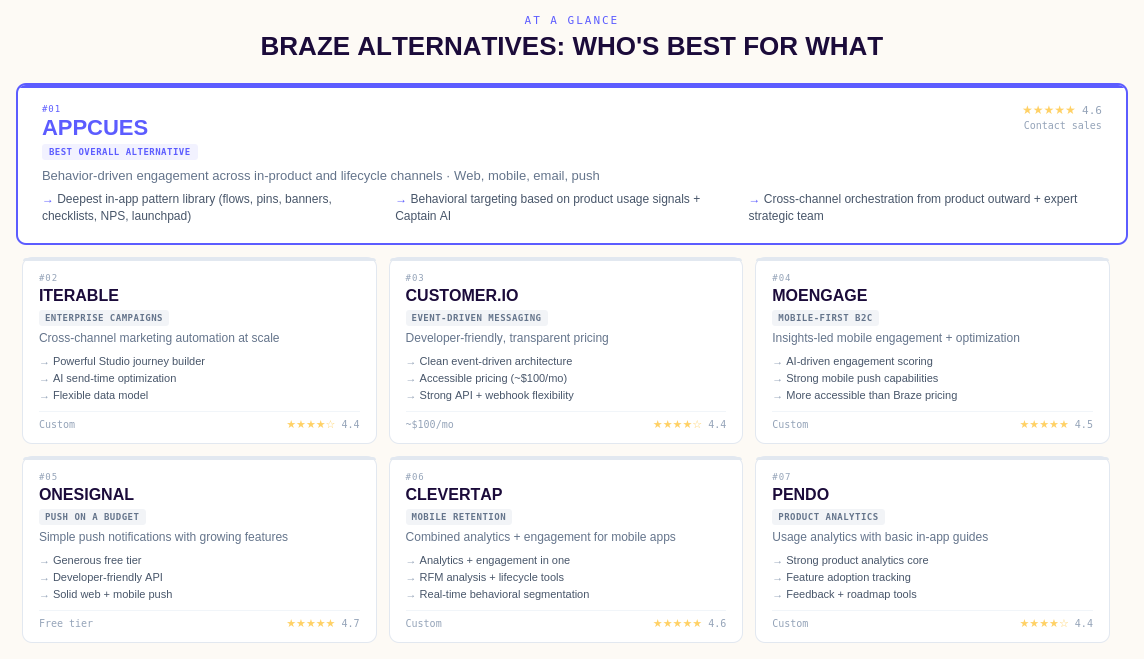
What you can actually do with it. Appcues has the widest set of in-app patterns we've seen in this category: Flows (modals, tooltips, slideouts), Pins, Banners, Checklists, Surveys, NPS, and a Launchpad that works like an in-app resource center. These are all the things Braze doesn't offer. You can also coordinate those in-app experiences with email, push, and web push, so you're not stuck choosing between "in-product" and "everywhere else." It's a unified platform for customer engagement that works across messaging channels without the usual duct-taping.
What it looks like in practice. Say your team just launched a new reporting feature. With Appcues, you could build a targeted tooltip walkthrough for power users who are likely to care, trigger an email to users who haven't logged in recently to bring them back, and surface a Banner for everyone else next time they're in the app. All coordinated from one place, no engineering tickets required. That kind of thing (coordinated campaigns across channels, triggered by what users actually do) is what Appcues was designed for, and it's where Braze leaves gaps.
Targeting that actually reflects what people do. Instead of building audiences based on static lists or demographic segments, Appcues uses advanced segmentation based on user behavior: which features they've used, where they get stuck, how far along they are in onboarding. It sounds like a small difference, but it completely changes what "the right message at the right time" actually means. You're working with user events and behavioral data, not guesswork.
Branded Themes let your marketing teams make everything look like your product, not a third-party overlay. No custom CSS, no developer needed. Captain AI helps you build experiences faster, from generating copy to suggesting who should see what. And unlike most tools in this space, Appcues comes with a team who'll provide strategic guidance on your engagement strategies, not just your setup, enabling marketers to move faster without waiting on engineering.
Where it falls short. If your needs are simple (maybe you just want to send better emails and don't care much about in-app), Appcues will feel like more tool than you need. It's at its best when you're running multiple use cases (onboarding, feature adoption, feedback, expansion) and want them all working together in one unified platform. Also, the product analytics side is still growing. It's not a replacement for dedicated analytics tools yet.
Pricing: Predictable pricing that scales with what you're using it for. Not the cheapest option if all you need is email, but strong value when you're consolidating multiple engagement use cases into one platform.
Best for: Mid-market and enterprise SaaS teams who've realized their most important customer engagement happens inside the product and want to deliver personalized experiences across channels, all from one place.
If you like what Braze does but don't like working with Braze (the contract, the complexity, the implementation timeline), Iterable is the most natural lateral move. It's the closest direct Braze competitor on this list, a cross-channel marketing automation platform built for large-scale customer engagement campaigns.
Iterable's visual journey builder (they call it Studio) is genuinely well-designed. Building multi-step marketing campaigns across email, SMS, and push feels intuitive in a way that Braze's can sometimes struggle with. Email and SMS capabilities are strong, AI-powered send-time optimization is solid, and the customer data model is flexible enough to handle complex audience setups without requiring a dedicated engineer.
The catch is that you'll run into the same in-app messaging limitations as Braze. No checklists, no launchpads, no branded theming, no product-led engagement patterns. If the in-app gap is why you're leaving Braze, Iterable won't solve that. And enterprise pricing and implementation complexity are comparable, so if budget was the issue, you might just be trading one expensive contract for another.
Pricing: Custom. Enterprise-tier, comparable to Braze's enterprise plans.
Best for: Enterprise marketers who want Braze's capabilities with (potentially) better usability and a fresh start on the contract. Not a fit if your problem is that messaging-first tools don't go deep enough inside the product.
Customer.io is what you get when engineers build a messaging tool for other engineers. That's a compliment. It's clean, event-driven, transparent about pricing, and doesn't try to be something it's not.
The whole platform is organized around user events (things users do), which makes building triggered personalized messaging workflows feel natural if your team thinks that way. Predictable pricing starts at around $100/month, which is refreshing after getting Braze quotes. The API and webhook flexibility is excellent for teams that want to create campaigns and build personalized customer journeys with precise control over event data.
The tradeoff is that in-app messaging exists as an add-on, not the main attraction. You won't find onboarding flows, checklists, NPS, or any of the product-led customer engagement patterns that tools like Appcues specialize in. And if your marketing team isn't technical, the lack of visual no-code builders could be a friction point. It's not an SMS marketing platform either; email is the primary channel.
Pricing: Starts around $100/month. Scales with message volume. Paid plans are transparent in a way that Braze and Iterable are not.
Best for: Growth-stage SaaS teams with some technical chops who mainly need to send smarter email and SMS without overpaying. Not a fit if in-product customer engagement is the priority.
If your users mostly interact with you through a mobile app, and you're not a B2B SaaS company, MoEngage is worth a look. It's a customer engagement platform built for the consumer and mobile-heavy markets where mobile push notifications, in-app messaging, and web push notifications are the primary engagement surface.
Mobile app engagement is strong. AI-driven send-time optimization and engagement scoring help you figure out when and how to reach people across cross-channel campaigns. Personalization capabilities let you tailor content based on purchase behavior, and pricing tends to be more accessible than Braze, especially for growth-stage consumer brands.
On the other hand, in-app experiences are still message-shaped, not experience-shaped. You won't find onboarding checklists, launchpads, or guided flows. The personalization engine is clearly optimized for B2C mobile app engagement, so if you're running a B2B SaaS product, the fit gets awkward. The integration ecosystem is also smaller than what you'd get with Braze.
Pricing: Custom, but generally more accessible than Braze for growing companies.
Best for: Consumer apps and mobile-first businesses that want cross-channel customer engagement without the Braze price tag. Less relevant for B2B SaaS teams.
OneSignal is the "just get push notifications working" option. No frills, no complicated setup, and a free plan that actually lets you do real things.
The free plan is generous enough to be genuinely useful, not just a teaser. Setup is quick and developer-friendly. Web push notifications and mobile push work well across platforms. Email and SMS features are growing but still secondary. For a cross-channel messaging tool, the key features are solid and the implementation is fast.
The limitations are pretty straightforward: there's no in-app experience layer at all. No modals, no tooltips, no onboarding flows, no advanced features for in-product engagement. Segmentation is basic compared to every other tool on this list. OneSignal is a notification delivery system, not a customer engagement platform. That's fine if that's what you need, but know what you're getting.
Pricing: Free plan available. Paid plans are affordable and scale with volume.
Best for: Early-stage teams or anyone who just needs reliable web and mobile push notifications without committing to a full platform. If your needs grow beyond notifications, you'll eventually outgrow it.
CleverTap's pitch is that you shouldn't need one tool to understand your users and a different tool to reach them. For mobile-heavy e-commerce businesses (think gaming, fintech, retail), that combined approach gives you unified customer data and engagement in one place, which can save real money and complexity.
You get retention analytics (RFM analysis, lifecycle optimization, cohorts) and customer engagement tools in the same platform. Real-time advanced segmentation based on user behavior is solid. You can target based on purchase history, average order value, or any combination of customer data. It's popular with consumer companies in mobile-heavy markets for a reason.
The downsides are real, though. Desktop and web in-app experiences are thin compared to Appcues or Pendo. It's designed for B2C mobile apps, which means B2B SaaS teams will feel like they're fighting the tool. And there's a steep learning curve if you don't have someone comfortable with analytics configuration.
Pricing: Custom. Competitive for mobile-focused mid-market companies.
Best for: Mobile-first consumer companies (e-commerce, gaming, fintech) who want analytics and customer engagement combined instead of paying for each separately. Not a fit for B2B SaaS.
Pendo is the odd one out on this list, and that's exactly why it belongs here. Some teams search for "Braze alternatives" when what they actually need isn't a better messaging tool. It's better visibility into what users are doing in the product. If that sounds familiar, Pendo might be the answer to a different question than the one you started with.
Product analytics are the real strength: feature adoption tracking, path analysis, session replays. Pendo helps product teams see what's working and what's not. In-app guides (tooltips, walkthroughs, announcements) layer on top, plus feedback collection and content management for roadmap prioritization.
But the in-app guide library is more limited than what you'd get with Appcues. Fewer pattern types, less flexible theming, limited feature access on lower tiers, and less sophisticated targeting. There's also essentially no cross-channel capability: no email, no push, no SMS. If you need to reach users outside the product through multiple channels, Pendo can't help.
Pricing: Custom. Enterprise-oriented, with a free tier for limited use.
Best for: Product teams that need to understand usage data first and layer in basic in-app guidance second. Not a fit if you need cross-channel customer engagement or deep in-product experience building.
If you're evaluating Braze alternatives, Salesforce Marketing Cloud probably came up in your research. It's worth addressing quickly.
Salesforce Marketing Cloud is a comprehensive marketing automation suite with deep CRM integration and enterprise-grade capabilities for managing customer data across the full lifecycle. For teams already in the Salesforce ecosystem, it can be a natural fit for email, SMS, and cross-channel marketing campaigns.
But for most teams reading this post, Salesforce Marketing Cloud solves a different problem. Its steep learning curve is even steeper than Braze's, ongoing maintenance costs are substantial, and it's really designed for large enterprise marketing teams with dedicated Salesforce admins. It also lacks meaningful in-app messaging or product-led engagement patterns, so if the in-app gap is what's driving your search, Salesforce Marketing Cloud won't close it. It's a marketing automation tool, not a customer engagement platform in the way Appcues or even Braze is.
Worth knowing about, but probably not the answer if you're on this page. If you want a customer engagement platform that works for mid-market companies without requiring a Salesforce Marketing Cloud implementation, the Braze alternatives above are better starting points.
Forget about feature matrices for a second. The real question is: where does your most important customer engagement happen? The answer will tell you whether you need a cross-channel customer engagement platform, a messaging tool, or something else entirely.
If it happens inside your product — you're trying to improve onboarding, drive feature adoption, collect feedback, nudge users at the right moment — Appcues is the strongest choice. It was built for exactly this, with the in-app depth and cross-channel reach to deliver personalized experiences wherever they're needed.
If it happens in the inbox and notification tray — Iterable is the closest thing to Braze on this list. Customer.io does something similar at a fraction of the cost if you've got a technical team.
If it happens in a mobile app — MoEngage or CleverTap, depending on whether you need broader marketing campaigns (MoEngage) or integrated analytics (CleverTap). Both handle cross-channel campaigns well for mobile app teams.
If you just need push notifications — OneSignal. Start for free, keep it simple.
If you're not sure where it happens — and you think the answer might require understanding what users are actually doing first — that's Pendo territory.
Here's the thing most teams figure out eventually: the reason they're leaving Braze usually tells them what to pick next. If you're frustrated that Braze is too expensive or complicated for what it does, you're looking for a better messaging tool (Iterable, Customer.io). If you're frustrated that Braze can't help you with what's happening inside your product, that's a different problem, and it's the one Appcues was built to solve.
Braze is a genuinely good tool for what it was built to do: send personalized messaging at scale across channels. If that's your core need, you've got strong Braze competitors on this list (Iterable and Customer.io chief among them).
But a lot of teams searching for "Braze alternatives" have realized that their real problem isn't messaging. It's that the most important customer experiences happen inside the product — during onboarding, when someone discovers a new feature, when they're about to churn, when they're ready to expand — and their current tools don't help with any of that. Stitching together multiple tools and hoping the data stays in sync isn't a strategy. It's a workaround.
That's the gap Appcues fills. Not by out-messaging Braze, but by starting in a completely different place: inside the product, where your users already are, building customer engagement based on what they're actually doing. Plus email, push, and mobile when those are the right channels. And a team that helps you figure out the strategy, not just the setup.
Lifecycle Marketing
Product Launches
User Engagement
Customer Engagement
TL;DR
Braze is great at sending messages across channels, but it's expensive, complex, and thin on in-app experiences.
If your engagement strategy starts inside your product, Appcues gives you the deepest in-app pattern library (Flows, Checklists, Banners, NPS, Launchpad) plus cross-channel reach to email, push, and mobile.
If you need a messaging-first tool, Iterable is the closest Braze equivalent; Customer.io does something similar for a fraction of the price.
MoEngage and CleverTap are strong for mobile-first consumer apps.
OneSignal covers push notifications on a budget.
And Pendo makes the list for teams who realize they need product analytics more than messaging.
The right pick depends on where your most important engagement actually happens.
Let's start with what's true: Braze is really good at what it does. If you need to send millions of emails, push notifications, and SMS messages to precisely targeted audiences across dozens of markets, it's one of the best customer engagement platforms money can buy. There's a reason it's a $600-million-a-year business.
But "best tool money can buy" is doing a lot of work in that sentence. And if you're reading this, you've probably already run into one of the reasons teams start looking elsewhere.
Maybe it's the price. Maybe it's the realization that Braze can send a message about your product but can't really help you guide people through it. Maybe you're tired of needing engineering for everything. Or maybe it's the feeling that your engagement strategy should start inside your product, not in someone's inbox, and Braze just isn't built for that.
Whatever brought you here, this post walks through seven Braze alternatives that approach the problem differently. Some are direct Braze competitors. Others take a fundamentally different angle. We'll be honest about all of them.
Before we get into the Braze alternatives, it's worth naming the specific gaps. Even among leading customer engagement platforms, no tool is perfect, and Braze's gaps will help you figure out what kind of platform you actually need next.
The steep learning curve is real. Braze requires significant developer resources for implementation and ongoing maintenance. Many teams discover that the complexity only grows as their engagement needs expand, and they end up needing dedicated technical staff just to keep things running.
In-app messaging is surface-level. Braze can deliver basic in-app messages, but it lacks the deeper patterns most product and CX teams need: onboarding checklists, guided tours, resource centers, NPS. If your customer engagement strategy depends on in-product experiences, you'll need separate tools to fill the gaps.
No loyalty programs or web personalization. Unlike some customer engagement platforms, Braze doesn't include built-in loyalty programs or website personalization capabilities. E-commerce businesses and consumer brands often find they need additional tools for these key features, which means more ongoing maintenance and more integration headaches. If you've been getting by with basic email tools, the jump to Braze can feel like paying for a sports car to drive to the grocery store.
It's not a customer data platform. Braze doesn't unify customer data the way a real customer data platform does. You'll still need a separate layer to consolidate behavioral data, event data, and purchase history into unified customer data profiles. For many users, that means managing multiple tools just to get a complete picture of real-time customer behavior.
Enterprise pricing isn't built for mid-market teams. Contracts typically start around $60K/year, and Braze's reporting tools are often criticized for lacking detailed metrics. Enterprise-grade capabilities like advanced segmentation can feel overkill (and overpriced) for mid-market teams that just want to deliver personalized experiences without the overhead.
None of this means Braze is bad. It means it was built for a specific kind of team with a specific kind of budget. If that's not you, one of the Braze alternatives below probably is.
Not every tool on this list is trying to do the same thing, so comparing them feature-for-feature doesn't quite work. Instead, we focused on the questions that come up most when teams are actively evaluating a switch.
How deep are the in-app experiences? Can your marketing teams actually build and ship things without filing engineering tickets? Does targeting go beyond "everyone who signed up last week," using real-time customer behavior and behavioral data to get more precise? Can you reach people across multiple channels (email, push, mobile)? Is the pricing predictable, or do you need three sales calls to get a number? And when you get stuck, is there a real team with specialized expertise behind the tool, or just a help center?
Those are the threads running through each write-up below.
Here's the simplest way to think about the difference between Braze and Appcues: Braze starts with a message and hopes it drives someone into your product. Appcues starts with what someone is already doing in your product and meets them there.
If the reason you're leaving Braze is that your in-app experience feels like an afterthought, this is probably what you're looking for.
What you can actually do with it. Appcues has the widest set of in-app patterns we've seen in this category: Flows (modals, tooltips, slideouts), Pins, Banners, Checklists, Surveys, NPS, and a Launchpad that works like an in-app resource center. These are all the things Braze doesn't offer. You can also coordinate those in-app experiences with email, push, and web push, so you're not stuck choosing between "in-product" and "everywhere else." It's a unified platform for customer engagement that works across messaging channels without the usual duct-taping.
What it looks like in practice. Say your team just launched a new reporting feature. With Appcues, you could build a targeted tooltip walkthrough for power users who are likely to care, trigger an email to users who haven't logged in recently to bring them back, and surface a Banner for everyone else next time they're in the app. All coordinated from one place, no engineering tickets required. That kind of thing (coordinated campaigns across channels, triggered by what users actually do) is what Appcues was designed for, and it's where Braze leaves gaps.
Targeting that actually reflects what people do. Instead of building audiences based on static lists or demographic segments, Appcues uses advanced segmentation based on user behavior: which features they've used, where they get stuck, how far along they are in onboarding. It sounds like a small difference, but it completely changes what "the right message at the right time" actually means. You're working with user events and behavioral data, not guesswork.
Branded Themes let your marketing teams make everything look like your product, not a third-party overlay. No custom CSS, no developer needed. Captain AI helps you build experiences faster, from generating copy to suggesting who should see what. And unlike most tools in this space, Appcues comes with a team who'll provide strategic guidance on your engagement strategies, not just your setup, enabling marketers to move faster without waiting on engineering.
Where it falls short. If your needs are simple (maybe you just want to send better emails and don't care much about in-app), Appcues will feel like more tool than you need. It's at its best when you're running multiple use cases (onboarding, feature adoption, feedback, expansion) and want them all working together in one unified platform. Also, the product analytics side is still growing. It's not a replacement for dedicated analytics tools yet.
Pricing: Predictable pricing that scales with what you're using it for. Not the cheapest option if all you need is email, but strong value when you're consolidating multiple engagement use cases into one platform.
Best for: Mid-market and enterprise SaaS teams who've realized their most important customer engagement happens inside the product and want to deliver personalized experiences across channels, all from one place.
If you like what Braze does but don't like working with Braze (the contract, the complexity, the implementation timeline), Iterable is the most natural lateral move. It's the closest direct Braze competitor on this list, a cross-channel marketing automation platform built for large-scale customer engagement campaigns.
Iterable's visual journey builder (they call it Studio) is genuinely well-designed. Building multi-step marketing campaigns across email, SMS, and push feels intuitive in a way that Braze's can sometimes struggle with. Email and SMS capabilities are strong, AI-powered send-time optimization is solid, and the customer data model is flexible enough to handle complex audience setups without requiring a dedicated engineer.
The catch is that you'll run into the same in-app messaging limitations as Braze. No checklists, no launchpads, no branded theming, no product-led engagement patterns. If the in-app gap is why you're leaving Braze, Iterable won't solve that. And enterprise pricing and implementation complexity are comparable, so if budget was the issue, you might just be trading one expensive contract for another.
Pricing: Custom. Enterprise-tier, comparable to Braze's enterprise plans.
Best for: Enterprise marketers who want Braze's capabilities with (potentially) better usability and a fresh start on the contract. Not a fit if your problem is that messaging-first tools don't go deep enough inside the product.
Customer.io is what you get when engineers build a messaging tool for other engineers. That's a compliment. It's clean, event-driven, transparent about pricing, and doesn't try to be something it's not.
The whole platform is organized around user events (things users do), which makes building triggered personalized messaging workflows feel natural if your team thinks that way. Predictable pricing starts at around $100/month, which is refreshing after getting Braze quotes. The API and webhook flexibility is excellent for teams that want to create campaigns and build personalized customer journeys with precise control over event data.
The tradeoff is that in-app messaging exists as an add-on, not the main attraction. You won't find onboarding flows, checklists, NPS, or any of the product-led customer engagement patterns that tools like Appcues specialize in. And if your marketing team isn't technical, the lack of visual no-code builders could be a friction point. It's not an SMS marketing platform either; email is the primary channel.
Pricing: Starts around $100/month. Scales with message volume. Paid plans are transparent in a way that Braze and Iterable are not.
Best for: Growth-stage SaaS teams with some technical chops who mainly need to send smarter email and SMS without overpaying. Not a fit if in-product customer engagement is the priority.
If your users mostly interact with you through a mobile app, and you're not a B2B SaaS company, MoEngage is worth a look. It's a customer engagement platform built for the consumer and mobile-heavy markets where mobile push notifications, in-app messaging, and web push notifications are the primary engagement surface.
Mobile app engagement is strong. AI-driven send-time optimization and engagement scoring help you figure out when and how to reach people across cross-channel campaigns. Personalization capabilities let you tailor content based on purchase behavior, and pricing tends to be more accessible than Braze, especially for growth-stage consumer brands.
On the other hand, in-app experiences are still message-shaped, not experience-shaped. You won't find onboarding checklists, launchpads, or guided flows. The personalization engine is clearly optimized for B2C mobile app engagement, so if you're running a B2B SaaS product, the fit gets awkward. The integration ecosystem is also smaller than what you'd get with Braze.
Pricing: Custom, but generally more accessible than Braze for growing companies.
Best for: Consumer apps and mobile-first businesses that want cross-channel customer engagement without the Braze price tag. Less relevant for B2B SaaS teams.
OneSignal is the "just get push notifications working" option. No frills, no complicated setup, and a free plan that actually lets you do real things.
The free plan is generous enough to be genuinely useful, not just a teaser. Setup is quick and developer-friendly. Web push notifications and mobile push work well across platforms. Email and SMS features are growing but still secondary. For a cross-channel messaging tool, the key features are solid and the implementation is fast.
The limitations are pretty straightforward: there's no in-app experience layer at all. No modals, no tooltips, no onboarding flows, no advanced features for in-product engagement. Segmentation is basic compared to every other tool on this list. OneSignal is a notification delivery system, not a customer engagement platform. That's fine if that's what you need, but know what you're getting.
Pricing: Free plan available. Paid plans are affordable and scale with volume.
Best for: Early-stage teams or anyone who just needs reliable web and mobile push notifications without committing to a full platform. If your needs grow beyond notifications, you'll eventually outgrow it.
CleverTap's pitch is that you shouldn't need one tool to understand your users and a different tool to reach them. For mobile-heavy e-commerce businesses (think gaming, fintech, retail), that combined approach gives you unified customer data and engagement in one place, which can save real money and complexity.
You get retention analytics (RFM analysis, lifecycle optimization, cohorts) and customer engagement tools in the same platform. Real-time advanced segmentation based on user behavior is solid. You can target based on purchase history, average order value, or any combination of customer data. It's popular with consumer companies in mobile-heavy markets for a reason.
The downsides are real, though. Desktop and web in-app experiences are thin compared to Appcues or Pendo. It's designed for B2C mobile apps, which means B2B SaaS teams will feel like they're fighting the tool. And there's a steep learning curve if you don't have someone comfortable with analytics configuration.
Pricing: Custom. Competitive for mobile-focused mid-market companies.
Best for: Mobile-first consumer companies (e-commerce, gaming, fintech) who want analytics and customer engagement combined instead of paying for each separately. Not a fit for B2B SaaS.
Pendo is the odd one out on this list, and that's exactly why it belongs here. Some teams search for "Braze alternatives" when what they actually need isn't a better messaging tool. It's better visibility into what users are doing in the product. If that sounds familiar, Pendo might be the answer to a different question than the one you started with.
Product analytics are the real strength: feature adoption tracking, path analysis, session replays. Pendo helps product teams see what's working and what's not. In-app guides (tooltips, walkthroughs, announcements) layer on top, plus feedback collection and content management for roadmap prioritization.
But the in-app guide library is more limited than what you'd get with Appcues. Fewer pattern types, less flexible theming, limited feature access on lower tiers, and less sophisticated targeting. There's also essentially no cross-channel capability: no email, no push, no SMS. If you need to reach users outside the product through multiple channels, Pendo can't help.
Pricing: Custom. Enterprise-oriented, with a free tier for limited use.
Best for: Product teams that need to understand usage data first and layer in basic in-app guidance second. Not a fit if you need cross-channel customer engagement or deep in-product experience building.
If you're evaluating Braze alternatives, Salesforce Marketing Cloud probably came up in your research. It's worth addressing quickly.
Salesforce Marketing Cloud is a comprehensive marketing automation suite with deep CRM integration and enterprise-grade capabilities for managing customer data across the full lifecycle. For teams already in the Salesforce ecosystem, it can be a natural fit for email, SMS, and cross-channel marketing campaigns.
But for most teams reading this post, Salesforce Marketing Cloud solves a different problem. Its steep learning curve is even steeper than Braze's, ongoing maintenance costs are substantial, and it's really designed for large enterprise marketing teams with dedicated Salesforce admins. It also lacks meaningful in-app messaging or product-led engagement patterns, so if the in-app gap is what's driving your search, Salesforce Marketing Cloud won't close it. It's a marketing automation tool, not a customer engagement platform in the way Appcues or even Braze is.
Worth knowing about, but probably not the answer if you're on this page. If you want a customer engagement platform that works for mid-market companies without requiring a Salesforce Marketing Cloud implementation, the Braze alternatives above are better starting points.
Forget about feature matrices for a second. The real question is: where does your most important customer engagement happen? The answer will tell you whether you need a cross-channel customer engagement platform, a messaging tool, or something else entirely.
If it happens inside your product — you're trying to improve onboarding, drive feature adoption, collect feedback, nudge users at the right moment — Appcues is the strongest choice. It was built for exactly this, with the in-app depth and cross-channel reach to deliver personalized experiences wherever they're needed.
If it happens in the inbox and notification tray — Iterable is the closest thing to Braze on this list. Customer.io does something similar at a fraction of the cost if you've got a technical team.
If it happens in a mobile app — MoEngage or CleverTap, depending on whether you need broader marketing campaigns (MoEngage) or integrated analytics (CleverTap). Both handle cross-channel campaigns well for mobile app teams.
If you just need push notifications — OneSignal. Start for free, keep it simple.
If you're not sure where it happens — and you think the answer might require understanding what users are actually doing first — that's Pendo territory.
Here's the thing most teams figure out eventually: the reason they're leaving Braze usually tells them what to pick next. If you're frustrated that Braze is too expensive or complicated for what it does, you're looking for a better messaging tool (Iterable, Customer.io). If you're frustrated that Braze can't help you with what's happening inside your product, that's a different problem, and it's the one Appcues was built to solve.
Braze is a genuinely good tool for what it was built to do: send personalized messaging at scale across channels. If that's your core need, you've got strong Braze competitors on this list (Iterable and Customer.io chief among them).
But a lot of teams searching for "Braze alternatives" have realized that their real problem isn't messaging. It's that the most important customer experiences happen inside the product — during onboarding, when someone discovers a new feature, when they're about to churn, when they're ready to expand — and their current tools don't help with any of that. Stitching together multiple tools and hoping the data stays in sync isn't a strategy. It's a workaround.
That's the gap Appcues fills. Not by out-messaging Braze, but by starting in a completely different place: inside the product, where your users already are, building customer engagement based on what they're actually doing. Plus email, push, and mobile when those are the right channels. And a team that helps you figure out the strategy, not just the setup.

Sign up for Quickcues and get our monthly updates!
.svg)