.png)
Appcues and Braze both support in-app messaging, email, and behavioral targeting but they were built from opposite starting points.
Braze is purpose-built for messaging at scale: email, push, and SMS campaigns across external channels.
Appcues is purpose-built for what happens inside your product: onboarding Flows, Checklists, Pins, NPS, and the full lifecycle of in-product engagement.
If outbound messaging is your primary motion, Braze earns it. If the product is your primary engagement surface, Appcues gives you the depth to actually shape what users experience there.
If you've found yourself comparing Appcues and Braze, you've probably noticed the overlap is real: both platforms help teams engage users through personalized, behavior-driven experiences across channels. Both support in-app messaging, email, and mobile. Both offer automation, segmentation, and analytics. On paper, they can look surprisingly similar.
But they were built from entirely different starting points, and that origin shapes everything.
Braze was built outward from messaging: email, push, SMS, and lifecycle campaigns at scale. In-app messaging came later, layered onto a platform whose native intelligence is campaign orchestration.
Appcues was built from inside the product: the Flows, Checklists, Pins, Banners, and NPS surveys that guide users through real moments of decision and confusion. The in-product experience acts as the primary engagement surface.
The result is two platforms that overlap in the middle but diverge sharply in depth. Where you feel that divergence depends on where your highest-impact engagement moments live: inside your product, or in users' inboxes.
This comparison covers core capabilities, channel strengths, AI and analytics, pricing philosophy, and the specific use cases where each platform earns its keep.
Appcues and Braze both support in-app messaging, email, and behavioral targeting, but they were built from opposite starting points. Here's how they compare at a glance.
The most important differences between Appcues and Braze show up in in-app experience depth, B2B targeting, and what each platform was built to go deepest on.
Both platforms offer segmentation, orchestration, and multi-channel reach. The difference is depth. Braze gives you sophisticated control over messaging campaigns. Appcues gives you sophisticated control over what users experience inside and around your product with a far larger toolkit of in-app patterns, more design flexibility, and enough low-code independence that non-technical teams can build out entire engagement strategies in hours.
Appcues was purpose-built for the in-product experience. Teams can build Flows with modals, tooltips, and slideouts; add Checklists to guide users toward activation milestones; deploy Pins for always-on contextual hints; run NPS surveys to close the feedback loop; and manage it all through Branded Themes that make every experience look native to their product. Custom CSS support is there for teams that want it, but most don't need it. A non-technical marketer or customer success manager can build, preview, and launch a fully branded engagement experience without touching engineering.
Braze offers in-app messaging, but it's a single content type in a platform engineered for campaign orchestration. There are no Checklists, Banners, Pins, Launchpads, or native NPS. Design control for in-app content is limited compared to what Appcues offers. The strength of Braze's content capabilities lies in its email and push template tooling, which is genuinely excellent for teams whose primary engagement surface is the inbox, not the product.
Both platforms offer strong behavioral and attribute-based segmentation; this is a genuine tie. Where they diverge is in B2B-specific functionality. Appcues adds Account Profiles, which let teams target experiences based on company-level attributes rather than just individual user behavior. Flow Priority management means you can control which experience takes precedence when a user qualifies for multiple messages at once, a problem that compounds quickly as your engagement program grows.
Braze's segmentation architecture is built for campaign targeting across external channels. That strength is real, but it doesn't extend to account-level context or in-app experience coordination. For teams selling to businesses rather than consumers, that gap shows up quickly.

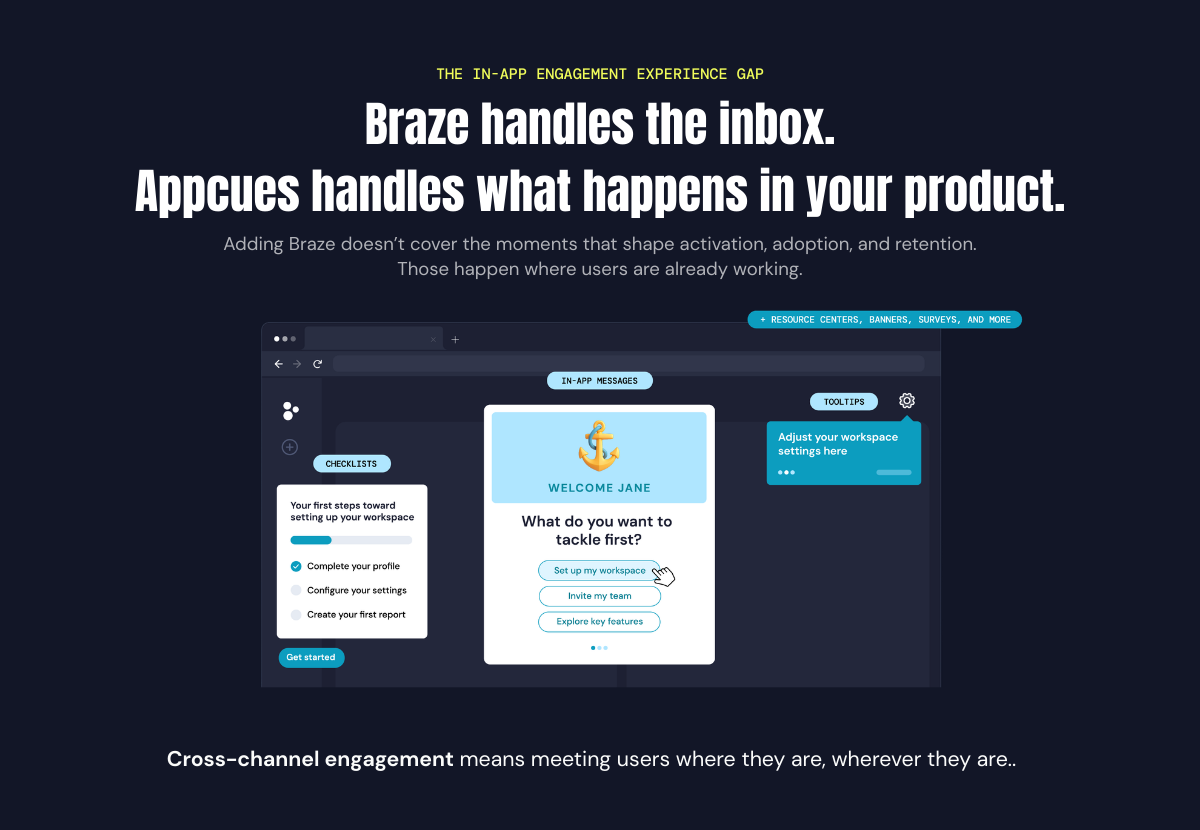
This is where the philosophical difference between the two platforms becomes most visible. Braze is designed to reach users everywhere: email, push, SMS, in-app, and web messaging, all orchestrated from a single campaign canvas. It's genuinely impressive infrastructure for teams whose engagement motion is primarily outbound.
Appcues approaches cross-channel from the other direction. The product is the anchor. In-app experiences coordinate with email and mobile, but the in-product moment is what the platform is optimized for. The difference is all about where you're starting from and what kind of engagement you're trying to create. Braze treats in-app as one message type among many. Appcues treats it as the primary engagement surface and extends outward from there.
Braze's pricing is built for enterprises running high-volume messaging operations across multiple external channels. Costs scale with message volume, monthly active users, and the number of channels in use. The platform is a significant investment even at mid-market scale, and that investment is easiest to justify when outbound messaging volume is high enough to earn it.
Appcues pricing reflects the depth of its in-product engagement capabilities. Value compounds as teams layer in more experience types, channels, and use cases across the customer lifecycle, from onboarding Flows on day one through expansion prompts months later. For teams where the highest-impact engagement happens inside the product, the unit economics tend to work out differently than they do for messaging-first platforms.
The honest framing: if outbound messaging volume is what drives your engagement strategy, Braze was built for that scale. If the in-product experience is the primary lever for activation, retention, and expansion, Appcues tends to offer stronger value for what you actually need.
Awareness: In-app feature announcements, event promotions, and contextual banners targeted to the right segments at the right moment, delivered where users are already working.
Adoption: Onboarding Flows for new users, activation Checklists that guide users toward meaningful milestones, and guided feature tours that adapt to where each user is in their journey.
Engagement: In-app NPS and Surveys to collect feedback and close the loop; re-engagement nudges and expansion triggers tied to user behavior; Pins that keep guidance available in context without interrupting the experience.
Large-scale lifecycle marketing programs — welcome sequences, win-back campaigns, promotional messaging — where email and push are the primary vehicles. Transactional messaging at scale. Cross-channel orchestration where external channels carry the weight of the engagement strategy, and in-app is one signal among many rather than the center of gravity.
If your engagement strategy depends on shaping what users experience inside your product, Appcues covers the full lifecycle. If outbound messaging at scale is the primary motion, Braze was designed for exactly that.
Appcues treats the product as the primary engagement surface. The platform connects what users do inside the product with the right experience — in-app, email, or mobile — at the right moment. It's built for marketing and digital teams who want to understand user behavior, act on it without waiting for an engineering sprint, and continuously learn what drives activation, retention, and expansion.
The result is a system where every experience is grounded in what users are actually doing, not just demographic attributes or time-based triggers. That behavioral foundation is what makes the in-product experiences feel relevant rather than generic — and it's what separates Appcues from tools that bolt in-app messaging onto a broader platform as an afterthought.
Best for: Teams where in-product experience is the growth lever — onboarding, adoption, feature engagement, and lifecycle touchpoints that happen where users are already working.
Braze treats messaging as the primary engagement surface. The platform orchestrates campaigns across email, push, SMS, and in-app messages to reach users wherever they are. It's built for teams managing large-scale, multi-channel communication programs, and its technical infrastructure is impressive at that scale.
The tradeoff is that in-app engagement is designed to serve the campaign, not the other way around. In-app messages in Braze are another delivery channel in a campaign canvas, not a dedicated system for shaping the in-product experience.
Best for: Teams where outbound messaging drives the engagement strategy — promotional campaigns, lifecycle emails, transactional communications, and re-engagement at scale.
Captain AI is Appcues' built-in AI layer, and it's integrated across the experience creation workflow rather than isolated to a single task. It can generate content for Flows, suggest targeting criteria based on behavioral data, and help teams analyze what's working and what isn't. The practical effect is a shorter path from identifying an engagement opportunity to acting on it — which matters most when teams are running multiple experience types simultaneously across different user segments.
Braze has invested in AI for the messaging layer: copy generation for campaigns, send-time optimization to improve open rates, and predictive audience scoring. These tools are genuinely useful for teams running high-volume outbound programs. They're focused on improving message performance, though — not in-app experience design or in-product behavior analysis.
Appcues connects experience performance to product outcomes. Flow reporting shows how specific experiences influence activation and adoption. Goals and Workflow analytics give a unified view across campaigns. Account Profiles add a layer of company-level context that's essential for B2B teams tracking success at the account level, not just the individual user level. Flow variation testing and control groups let teams run real experiments rather than just guessing what messaging works.
Braze's analytics shine at the campaign level. Open rates, click-through rates, conversion events: these are well-tracked and well-presented. What's harder to see is what happens after a message lands: how user behavior inside the product changes, whether an in-app notification actually moved a metric that mattered. Braze tells you how your messages performed. Appcues tells you how your experiences performed and connects that back to product engagement.
Both platforms cover multiple channels. The difference is which surface each was built to go deepest on and that shapes everything about where each one earns its investment.
The channel overlap is real. But channel breadth is different from channel depth. Braze's SMS and push infrastructure is built for high-volume, enterprise-scale operation. Appcues' in-app experience layer is built for the kind of depth and flexibility that turns a product tour into something that actually changes behavior.
Appcues doesn't offer SMS. It's also not designed for high-volume transactional messaging operations where outbound reach at scale is the primary KPI. Teams investing in Appcues get the most from it when they're running multiple experience types across the lifecycle — not when in-app is an edge case in a broader campaign stack.
Braze's in-app experience capabilities are limited compared to what a purpose-built platform offers. There are no Checklists, Banners, Pins, Launchpads, or native NPS. Design control and branded theming for in-product content are constrained. Account Profiles and Flow Priority don't exist, which creates friction for B2B teams managing complex user segments and overlapping experience logic. Many teams find that as their in-product engagement needs grow, they need to add a dedicated tool alongside Braze — which raises the question of whether a purpose-built platform was the right choice from the start.
Teams that add Appcues alongside Braze — or replace Braze's in-app capabilities with it — typically start by building out experiences that Braze can't support at the same depth: onboarding Flows, feature adoption Checklists, NPS, and Pins. The behavioral targeting in Appcues tends to be more precise for in-product use cases, and the low-code creation means marketing and digital teams can build and iterate without engineering involvement.
Some teams run both platforms: Braze handling external messaging, Appcues handling the in-product experience layer. Others consolidate over time as their engagement strategy shifts toward the product as the primary surface. Neither path is wrong — it depends entirely on where engagement is happening and who owns it.
Braze and Appcues keep ending up in the same evaluation cycle because the overlap is real. Both touch in-app messaging. Both handle behavioral targeting. Both have workflows. But they were built from opposite starting points, and the comparison tends to clarify quickly once you ask the right question: where does your most important engagement happen?
If the answer is in users' inboxes and on their phones, at scale, across multiple external channels, Braze is purpose-built for that.
If the answer is inside your product — where users are making decisions, hitting confusion, discovering features, and forming habits — Appcues gives you the depth, flexibility, and team independence to actually shape those moments.
Want to see how Appcues handles your specific use cases? Book a demo and we'll walk you through exactly what your team would build.
Lifecycle Marketing
Product Launches
In-App Messaging
Email Marketing
TL;DR
Appcues and Braze both support in-app messaging, email, and behavioral targeting but they were built from opposite starting points.
Braze is purpose-built for messaging at scale: email, push, and SMS campaigns across external channels.
Appcues is purpose-built for what happens inside your product: onboarding Flows, Checklists, Pins, NPS, and the full lifecycle of in-product engagement.
If outbound messaging is your primary motion, Braze earns it. If the product is your primary engagement surface, Appcues gives you the depth to actually shape what users experience there.
If you've found yourself comparing Appcues and Braze, you've probably noticed the overlap is real: both platforms help teams engage users through personalized, behavior-driven experiences across channels. Both support in-app messaging, email, and mobile. Both offer automation, segmentation, and analytics. On paper, they can look surprisingly similar.
But they were built from entirely different starting points, and that origin shapes everything.
Braze was built outward from messaging: email, push, SMS, and lifecycle campaigns at scale. In-app messaging came later, layered onto a platform whose native intelligence is campaign orchestration.
Appcues was built from inside the product: the Flows, Checklists, Pins, Banners, and NPS surveys that guide users through real moments of decision and confusion. The in-product experience acts as the primary engagement surface.
The result is two platforms that overlap in the middle but diverge sharply in depth. Where you feel that divergence depends on where your highest-impact engagement moments live: inside your product, or in users' inboxes.
This comparison covers core capabilities, channel strengths, AI and analytics, pricing philosophy, and the specific use cases where each platform earns its keep.
Appcues and Braze both support in-app messaging, email, and behavioral targeting, but they were built from opposite starting points. Here's how they compare at a glance.
The most important differences between Appcues and Braze show up in in-app experience depth, B2B targeting, and what each platform was built to go deepest on.
Both platforms offer segmentation, orchestration, and multi-channel reach. The difference is depth. Braze gives you sophisticated control over messaging campaigns. Appcues gives you sophisticated control over what users experience inside and around your product with a far larger toolkit of in-app patterns, more design flexibility, and enough low-code independence that non-technical teams can build out entire engagement strategies in hours.
Appcues was purpose-built for the in-product experience. Teams can build Flows with modals, tooltips, and slideouts; add Checklists to guide users toward activation milestones; deploy Pins for always-on contextual hints; run NPS surveys to close the feedback loop; and manage it all through Branded Themes that make every experience look native to their product. Custom CSS support is there for teams that want it, but most don't need it. A non-technical marketer or customer success manager can build, preview, and launch a fully branded engagement experience without touching engineering.
Braze offers in-app messaging, but it's a single content type in a platform engineered for campaign orchestration. There are no Checklists, Banners, Pins, Launchpads, or native NPS. Design control for in-app content is limited compared to what Appcues offers. The strength of Braze's content capabilities lies in its email and push template tooling, which is genuinely excellent for teams whose primary engagement surface is the inbox, not the product.
Both platforms offer strong behavioral and attribute-based segmentation; this is a genuine tie. Where they diverge is in B2B-specific functionality. Appcues adds Account Profiles, which let teams target experiences based on company-level attributes rather than just individual user behavior. Flow Priority management means you can control which experience takes precedence when a user qualifies for multiple messages at once, a problem that compounds quickly as your engagement program grows.
Braze's segmentation architecture is built for campaign targeting across external channels. That strength is real, but it doesn't extend to account-level context or in-app experience coordination. For teams selling to businesses rather than consumers, that gap shows up quickly.
This is where the philosophical difference between the two platforms becomes most visible. Braze is designed to reach users everywhere: email, push, SMS, in-app, and web messaging, all orchestrated from a single campaign canvas. It's genuinely impressive infrastructure for teams whose engagement motion is primarily outbound.
Appcues approaches cross-channel from the other direction. The product is the anchor. In-app experiences coordinate with email and mobile, but the in-product moment is what the platform is optimized for. The difference is all about where you're starting from and what kind of engagement you're trying to create. Braze treats in-app as one message type among many. Appcues treats it as the primary engagement surface and extends outward from there.
Braze's pricing is built for enterprises running high-volume messaging operations across multiple external channels. Costs scale with message volume, monthly active users, and the number of channels in use. The platform is a significant investment even at mid-market scale, and that investment is easiest to justify when outbound messaging volume is high enough to earn it.
Appcues pricing reflects the depth of its in-product engagement capabilities. Value compounds as teams layer in more experience types, channels, and use cases across the customer lifecycle, from onboarding Flows on day one through expansion prompts months later. For teams where the highest-impact engagement happens inside the product, the unit economics tend to work out differently than they do for messaging-first platforms.
The honest framing: if outbound messaging volume is what drives your engagement strategy, Braze was built for that scale. If the in-product experience is the primary lever for activation, retention, and expansion, Appcues tends to offer stronger value for what you actually need.
Awareness: In-app feature announcements, event promotions, and contextual banners targeted to the right segments at the right moment, delivered where users are already working.
Adoption: Onboarding Flows for new users, activation Checklists that guide users toward meaningful milestones, and guided feature tours that adapt to where each user is in their journey.
Engagement: In-app NPS and Surveys to collect feedback and close the loop; re-engagement nudges and expansion triggers tied to user behavior; Pins that keep guidance available in context without interrupting the experience.
Large-scale lifecycle marketing programs — welcome sequences, win-back campaigns, promotional messaging — where email and push are the primary vehicles. Transactional messaging at scale. Cross-channel orchestration where external channels carry the weight of the engagement strategy, and in-app is one signal among many rather than the center of gravity.
If your engagement strategy depends on shaping what users experience inside your product, Appcues covers the full lifecycle. If outbound messaging at scale is the primary motion, Braze was designed for exactly that.
Appcues treats the product as the primary engagement surface. The platform connects what users do inside the product with the right experience — in-app, email, or mobile — at the right moment. It's built for marketing and digital teams who want to understand user behavior, act on it without waiting for an engineering sprint, and continuously learn what drives activation, retention, and expansion.
The result is a system where every experience is grounded in what users are actually doing, not just demographic attributes or time-based triggers. That behavioral foundation is what makes the in-product experiences feel relevant rather than generic — and it's what separates Appcues from tools that bolt in-app messaging onto a broader platform as an afterthought.
Best for: Teams where in-product experience is the growth lever — onboarding, adoption, feature engagement, and lifecycle touchpoints that happen where users are already working.
Braze treats messaging as the primary engagement surface. The platform orchestrates campaigns across email, push, SMS, and in-app messages to reach users wherever they are. It's built for teams managing large-scale, multi-channel communication programs, and its technical infrastructure is impressive at that scale.
The tradeoff is that in-app engagement is designed to serve the campaign, not the other way around. In-app messages in Braze are another delivery channel in a campaign canvas, not a dedicated system for shaping the in-product experience.
Best for: Teams where outbound messaging drives the engagement strategy — promotional campaigns, lifecycle emails, transactional communications, and re-engagement at scale.
Captain AI is Appcues' built-in AI layer, and it's integrated across the experience creation workflow rather than isolated to a single task. It can generate content for Flows, suggest targeting criteria based on behavioral data, and help teams analyze what's working and what isn't. The practical effect is a shorter path from identifying an engagement opportunity to acting on it — which matters most when teams are running multiple experience types simultaneously across different user segments.
Braze has invested in AI for the messaging layer: copy generation for campaigns, send-time optimization to improve open rates, and predictive audience scoring. These tools are genuinely useful for teams running high-volume outbound programs. They're focused on improving message performance, though — not in-app experience design or in-product behavior analysis.
Appcues connects experience performance to product outcomes. Flow reporting shows how specific experiences influence activation and adoption. Goals and Workflow analytics give a unified view across campaigns. Account Profiles add a layer of company-level context that's essential for B2B teams tracking success at the account level, not just the individual user level. Flow variation testing and control groups let teams run real experiments rather than just guessing what messaging works.
Braze's analytics shine at the campaign level. Open rates, click-through rates, conversion events: these are well-tracked and well-presented. What's harder to see is what happens after a message lands: how user behavior inside the product changes, whether an in-app notification actually moved a metric that mattered. Braze tells you how your messages performed. Appcues tells you how your experiences performed and connects that back to product engagement.
Both platforms cover multiple channels. The difference is which surface each was built to go deepest on and that shapes everything about where each one earns its investment.
The channel overlap is real. But channel breadth is different from channel depth. Braze's SMS and push infrastructure is built for high-volume, enterprise-scale operation. Appcues' in-app experience layer is built for the kind of depth and flexibility that turns a product tour into something that actually changes behavior.
Appcues doesn't offer SMS. It's also not designed for high-volume transactional messaging operations where outbound reach at scale is the primary KPI. Teams investing in Appcues get the most from it when they're running multiple experience types across the lifecycle — not when in-app is an edge case in a broader campaign stack.
Braze's in-app experience capabilities are limited compared to what a purpose-built platform offers. There are no Checklists, Banners, Pins, Launchpads, or native NPS. Design control and branded theming for in-product content are constrained. Account Profiles and Flow Priority don't exist, which creates friction for B2B teams managing complex user segments and overlapping experience logic. Many teams find that as their in-product engagement needs grow, they need to add a dedicated tool alongside Braze — which raises the question of whether a purpose-built platform was the right choice from the start.
Teams that add Appcues alongside Braze — or replace Braze's in-app capabilities with it — typically start by building out experiences that Braze can't support at the same depth: onboarding Flows, feature adoption Checklists, NPS, and Pins. The behavioral targeting in Appcues tends to be more precise for in-product use cases, and the low-code creation means marketing and digital teams can build and iterate without engineering involvement.
Some teams run both platforms: Braze handling external messaging, Appcues handling the in-product experience layer. Others consolidate over time as their engagement strategy shifts toward the product as the primary surface. Neither path is wrong — it depends entirely on where engagement is happening and who owns it.
Braze and Appcues keep ending up in the same evaluation cycle because the overlap is real. Both touch in-app messaging. Both handle behavioral targeting. Both have workflows. But they were built from opposite starting points, and the comparison tends to clarify quickly once you ask the right question: where does your most important engagement happen?
If the answer is in users' inboxes and on their phones, at scale, across multiple external channels, Braze is purpose-built for that.
If the answer is inside your product — where users are making decisions, hitting confusion, discovering features, and forming habits — Appcues gives you the depth, flexibility, and team independence to actually shape those moments.
Want to see how Appcues handles your specific use cases? Book a demo and we'll walk you through exactly what your team would build.

Sign up for Quickcues and get our monthly updates!
.svg)