.png)

The way SaaS companies grow has fundamentally changed. The old playbook — hire sales reps, run demos, close deals — is giving way to a model where the product itself does the heavy lifting. That model is product-led growth, and it's behind the rise of some of the most valuable software companies of the last decade: Slack, Dropbox, Figma, Calendly.
This guide covers everything you need to understand and implement PLG: a clear definition, the history behind the movement, the mechanics that make it work, how to build a PLG strategy, how to measure it, and how tools like Appcues help you execute it. Whether you're evaluating PLG for the first time or looking to sharpen a motion you've already started, this is the resource you need.
Product-led growth (PLG) is a go-to-market strategy in which the product itself is the primary driver of user acquisition, activation, retention, and revenue expansion. Instead of relying on a salesperson to explain the product's value, users experience that value directly — before they ever speak to anyone on your team, and often before they pay a cent.
In a PLG model, the product is designed to convert free users into paying customers through the experience itself. A user signs up, reaches a meaningful outcome, and upgrades because the product earned it.
What PLG is not is equally important to understand. Offering a free trial or a freemium plan doesn't make you product-led. PLG is a fundamental organizational philosophy — one that aligns product, marketing, and sales around the user's journey through the product. It's a strategic commitment, not a pricing decision.
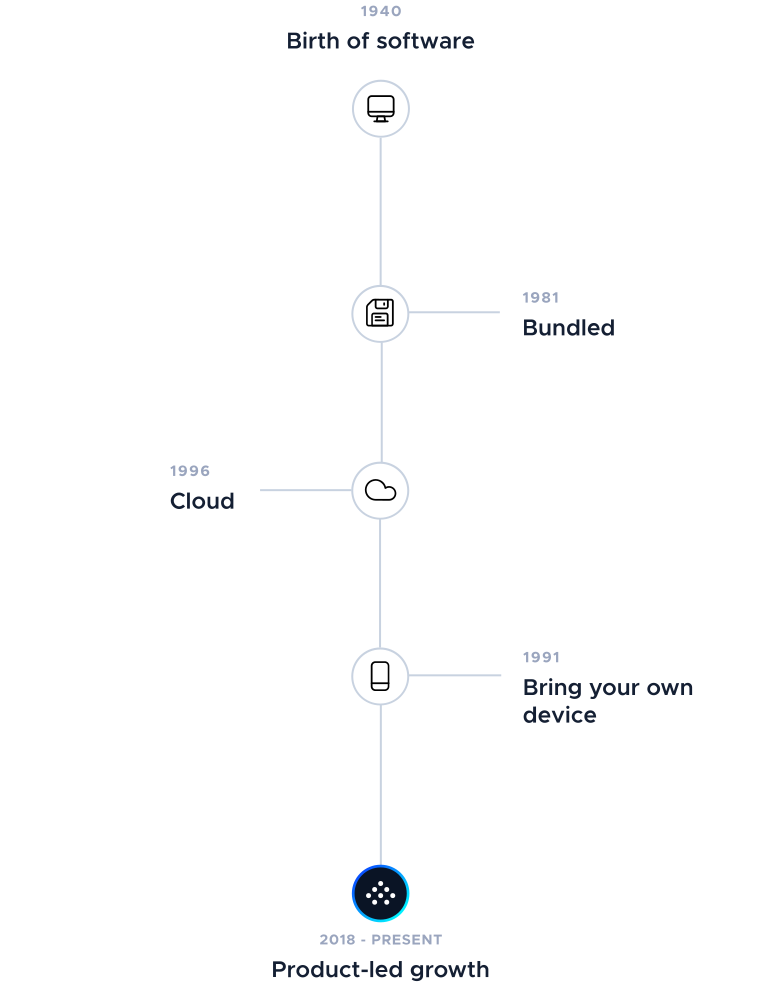
The term "product-led growth" was popularized around 2016 by OpenView Partners and analyst Blake Bartlett. But the companies that would become the canonical PLG examples — Dropbox, Atlassian — were already practicing the model years before it had a name. They had simply built products that spread through use, converted through experience, and grew without proportional sales investment.
Several forces converged to make PLG not just possible but necessary. The consumerization of enterprise software raised user expectations: people who used beautifully designed consumer apps at home stopped tolerating clunky enterprise tools at work. The rise of SaaS lowered switching costs and made it easier to try alternatives. And buyers increasingly expected to try before they buy — a demo and a PDF were no longer enough.
What started as a niche startup strategy has become a mainstream go-to-market motion. Today, companies at every stage — including large enterprises — are adding PLG layers to existing sales-led motions. The question is no longer whether PLG is viable. It's how to implement it well.
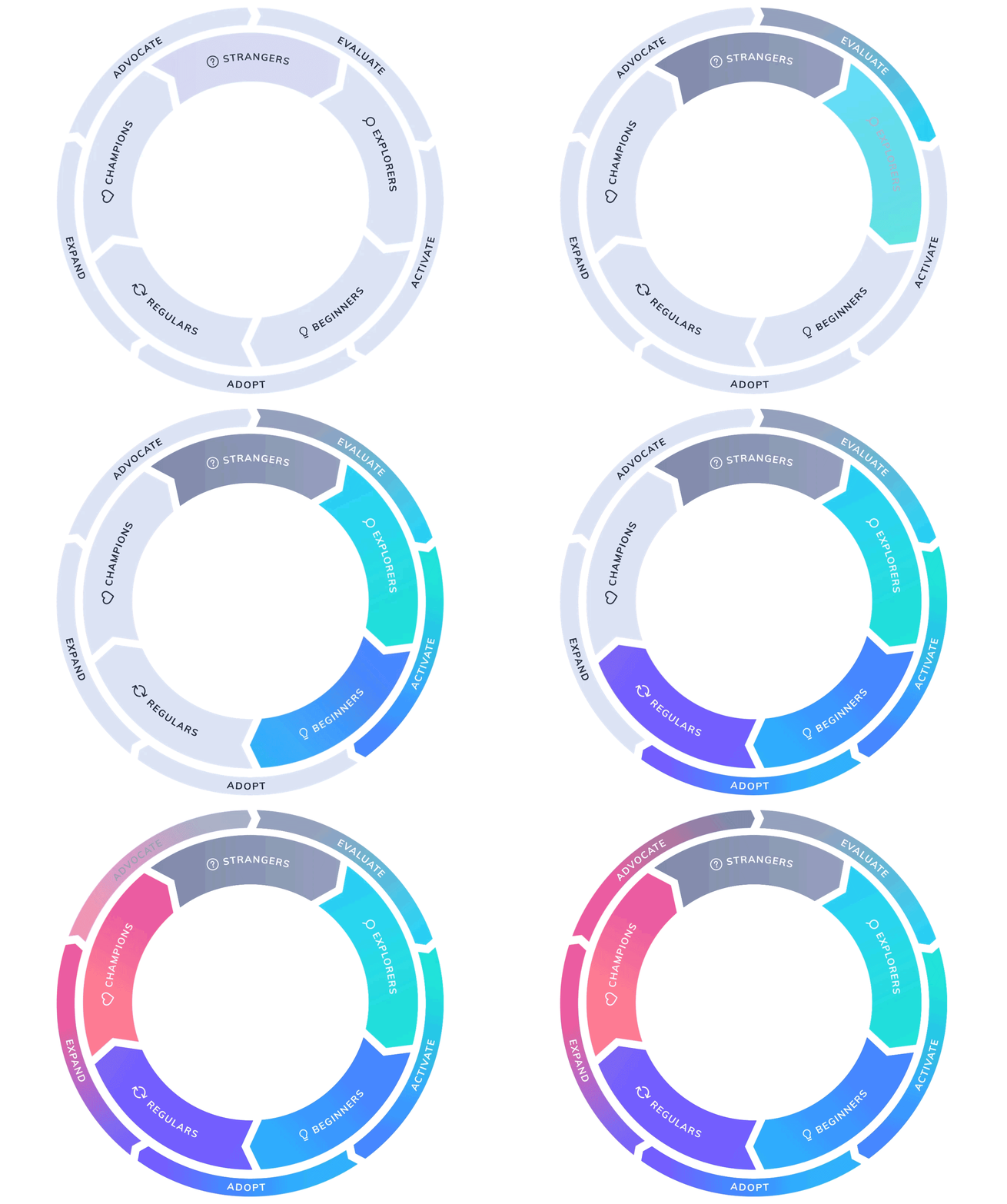
PLG doesn't work in a straight line — it works as a flywheel. Each stage feeds the next, and the whole system compounds over time.
Here's how the loop works:
The critical insight is what happens after expansion: satisfied users become advocates who drive new acquisition. They invite teammates, share outputs, and recommend the product. That closes the flywheel loop and generates compounding growth without proportional spend.
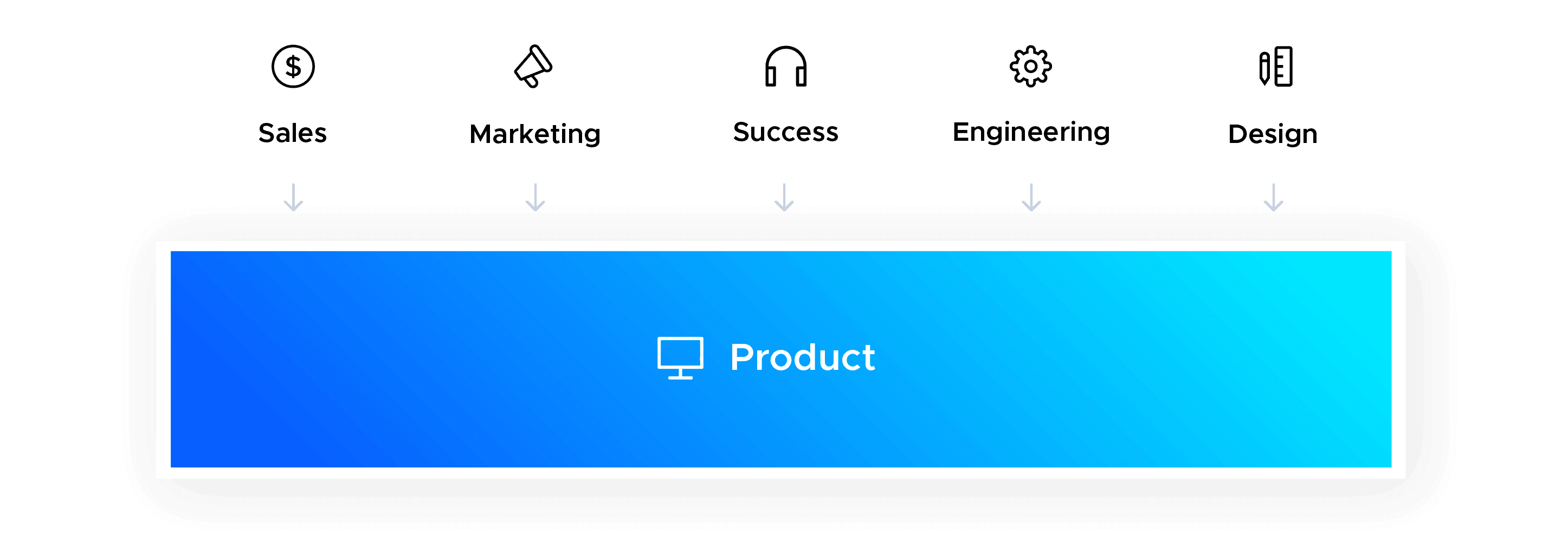
In a PLG company, the product isn't just what you sell — it's how you sell. The product functions as a marketing and sales channel that operates at scale without requiring headcount to grow in lockstep.
This happens through deliberate design choices:
The implication is significant: distribution is a product decision, not just a marketing one. The choices your product team makes about collaboration, sharing, and invitations directly influence how fast your top of funnel grows.
Understanding PLG means understanding what it's replacing — and what it isn't.
Sales-led growth relies on human-driven demos, discovery calls, and negotiations to convert prospects. It works well for complex, high-ACV products where buyers need education and customization. But it's expensive, slow to scale, and dependent on headcount.
Marketing-led growth uses content, campaigns, and demand generation to create awareness and interest, which sales then closes. It's effective at building brand and pipeline, but it still depends on a handoff to humans before value is delivered.
Product-led growth removes or delays that handoff. Users get to value first. The product does the convincing. That produces lower customer acquisition costs, faster time-to-value, and growth loops that don't require proportional investment to sustain.
That said, sales-led and marketing-led motions aren't obsolete. Most mature PLG companies blend approaches — a model sometimes called product-led sales (PLS), where the product generates usage data that sales teams use to identify and engage high-intent accounts. PLG and sales aren't opposites; they're complements when sequenced correctly.

The strategic appeal of PLG comes down to unit economics and scalability.
Lower customer acquisition costs (CAC) are the most immediate benefit. When users can sign up, onboard, and activate without a sales rep involved, the cost of acquiring each customer drops significantly. Self-serve onboarding replaces expensive human-led processes.
Higher net revenue retention follows from deeper product adoption. Users who have genuinely experienced the product's value — who have built it into their workflows — are far less likely to churn. And when those users expand their usage, upgrade to higher tiers, or add seats, revenue grows without new acquisition spend.
Scalable growth without linear headcount increases is the structural advantage that makes PLG so attractive to investors. A sales-led company that wants to double revenue typically needs to double its sales team. A PLG company can grow revenue by improving the product experience — a leverage point that doesn't require the same proportional investment.
The market has noticed. PLG companies have historically commanded higher revenue multiples and faster growth rates than their sales-led counterparts. Investors and boards now treat PLG capability as a signal of long-term defensibility — evidence that the product itself, not just the go-to-market motion, creates durable competitive advantage.
Onboarding is the most critical moment in the PLG motion. It's where users either discover the product's value or abandon it. Everything that happens between signup and first success determines whether your PLG flywheel ever starts spinning.
Frictionless onboarding looks like this in practice:
Reducing time-to-first-value isn't a UX nicety. It's a direct revenue lever. Every unnecessary step between signup and activation is a conversion loss — a user who didn't make it to the moment that would have made them a customer.
Every product has an "aha moment" — the specific point in the user journey where the product's value becomes undeniable. In Slack, it might be the first time a message gets a reply in seconds. In Dropbox, it's the first time a file syncs seamlessly across devices. PLG teams engineer the product experience to reach that moment as quickly as possible.
Identifying your aha moment requires behavioral data. Look at the actions that reliably predict long-term retention — the things users who stick around all did early on that users who churned did not. That's your activation milestone.
Once you've identified it, the work is removing every obstacle between signup and that moment. In-app prompts, onboarding checklists, guided tours, and tooltips all serve the same purpose: accelerating the path to value. Time-to-value isn't a vanity metric — it's the number PLG teams actively design toward.
PLG pricing must be anchored to the metric that best reflects how customers actually experience value. That might be seats, usage volume, features unlocked, or outcomes achieved — it depends on the product.
Misaligned pricing creates friction that kills PLG conversion. If you're charging for something users don't yet value, the upgrade decision feels arbitrary. Well-aligned pricing feels natural — it scales with the customer's success, so paying more makes sense because getting more value makes sense.
Two distinct approaches to letting users experience value before paying:
Choosing between freemium and free trial depends on your product type, your activation timeline, and how quickly users can reach the aha moment with a limited feature set.
The most efficient acquisition channel a PLG company has is its existing user base. Viral loops are the mechanism that makes this work — and they're engineered, not accidental.
Concrete examples of viral loops built into product design:
Each of these creates a loop where product usage generates new signups without paid acquisition spend. Building effective viral loops requires deliberate product decisions — they don't emerge from a good product alone.
PLG is a team sport. It's not just a product strategy — it requires organizational alignment across product, marketing, sales, and customer success. Without that alignment, you get fragmented experiences that undermine the model.
PLG companies restructure teams around the user lifecycle rather than departmental functions. The handoff signal between product and sales changes: instead of marketing qualified leads (MQLs) based on content engagement, teams use product qualified leads (PQLs) — users whose in-product behavior signals upgrade readiness.
This shift has real implications for how teams operate. Marketing focuses on getting the right users into the product, not just generating pipeline. Sales focuses on expanding accounts where usage signals intent, not cold outreach. Customer success focuses on driving activation and adoption, not just managing renewals. Everyone is working from the same map: the user's path through the product.
Before you can improve activation, you need to define it precisely. Your activation milestone is the specific action or set of actions that reliably predicts long-term retention. It's not a proxy metric — it's the real thing.
The process:
Cohort analysis is the core tool here. When you can see that users who complete a specific action in their first week retain at dramatically higher rates, you have a clear target to optimize toward. The product activation metric becomes the north star for your onboarding work.
The upgrade experience deserves the same design attention as onboarding. If converting from free to paid requires a sales conversation, you've introduced friction at exactly the moment a user is ready to pay — and you'll lose some of them.
A well-designed self-serve upgrade path includes:
The goal is to make upgrading feel like a natural next step, not a sales process. When a user is ready to pay, the path should be obvious and immediate. Free-to-paid conversion is a product surface, not a sales task.
PLG and sales aren't mutually exclusive — they're most powerful when combined correctly. Product-led sales (PLS) is the natural evolution of PLG at scale: sales teams use product usage data to identify high-intent users and accounts, then reach out with context rather than cold outreach.
Here's how it works in practice:
The critical mistake to avoid is introducing sales friction too early. If a user gets a sales call before they've had a chance to experience the product, you've undermined the PLG motion. The human touch should amplify value that already exists, not substitute for it.
PLG requires a different measurement framework than sales-led or marketing-led growth. The metrics that matter are centered on the user's journey through the product:
Each metric maps to a specific stage of the PLG flywheel. Tracking them together gives you a complete picture of where the motion is working and where it's breaking down.
PLG measurement requires behavioral data at the user level — not just aggregate traffic or revenue numbers. That means instrumenting your product to capture events: what users do, when they do it, and in what sequence.
The infrastructure you need:
The gap between product analytics and CRM data is where PLG motions often break down. If sales teams can't see product usage data in the tools they work in, PQLs don't get actioned. Closing that gap is an infrastructure priority, not an afterthought.
PLG is not a one-time implementation. It's an ongoing optimization practice built on a continuous experimentation loop: hypothesize, test, measure, iterate.
In practice, this means:
The teams that compound growth over time are the ones that treat every activation rate and time-to-value number as a hypothesis to test, not a fixed reality to accept.
The best way to understand PLG mechanics is to see them in action. A few canonical examples:
Slack grew through viral loops built directly into the product. Every time a user invited a colleague to a channel, they were pulling a new user into the product. The collaborative nature of messaging meant that Slack's value increased with every person added — a classic network effect. Teams adopted Slack bottom-up, without IT approval or sales involvement, because the product sold itself through use.
Dropbox is the textbook example of a viral loop tied to a value metric. The referral program — give storage, get storage — aligned the incentive perfectly with what users valued. Sharing a Dropbox folder exposed the product to new users organically. Frictionless onboarding meant new users reached the aha moment (seamless file sync) almost immediately.
Figma turned design collaboration into a distribution channel. Sharing a Figma file with a stakeholder or developer created a new user touchpoint every time. The product's value was highest when multiple people used it together, so every collaboration was an acquisition event. Figma's PLG motion was inseparable from its core product design.
Calendly embedded its product in every interaction. Every scheduling link sent by a Calendly user exposed the product to a new potential user — someone who experienced the product's value (frictionless scheduling) before ever signing up. The "Powered by Calendly" branding on every booking page turned every meeting into an acquisition moment.
Each of these examples reflects a deliberate product decision, not a lucky accident. The viral loops, network effects, and frictionless onboarding were engineered to produce exactly this outcome.
Understanding PLG is one thing. Executing it is another. The biggest implementation challenge isn't strategy — it's delivering the right in-product experience to the right user at the right moment, consistently, without requiring engineering resources for every change.
That's exactly what Appcues is built for.
Appcues gives product and growth teams the ability to build and iterate on onboarding flows, in-app checklists, tooltips, modals, and upgrade prompts — without writing code. That means the team closest to the activation and conversion data can act on it directly, without waiting for engineering cycles.
Specific capabilities that map to the PLG motion:
Appcues also integrates with the analytics and CRM tools PLG teams already use — connecting in-product behavior to the broader data stack rather than creating a silo. That makes it a natural fit for the PLG infrastructure described throughout this guide, not a standalone tool that requires its own workflow.
If you're serious about reducing time-to-value and improving activation rates, Appcues is where that work gets done.
Product-led growth is not a tactic. It's a strategic model that requires aligning your product experience, pricing, analytics, and organizational structure around the user's path to value. The companies winning with PLG aren't doing so because they have a better product in isolation — they've engineered every touchpoint between signup and success to reduce friction and accelerate value delivery.
The flywheel compounds when each stage is working: acquisition feeds activation, activation drives retention, retention enables expansion, and expansion generates advocacy that restarts the loop. Break any link in that chain and the whole system slows down.
The good news is that every element of this guide — frictionless onboarding, activation milestone definition, viral loop design, PQL instrumentation, continuous experimentation — is actionable. You don't need to rebuild your product from scratch. You need to start optimizing the path from signup to value, one experiment at a time.
Ready to put these principles into practice? Get the product tour of Appcues or request a demo to see how teams are using it to accelerate activation, reduce time-to-value, and build PLG motions that compound.
Product Development
Upsell & Cross-sell
Retention & Churn
Product Discovery & User Research
The way SaaS companies grow has fundamentally changed. The old playbook — hire sales reps, run demos, close deals — is giving way to a model where the product itself does the heavy lifting. That model is product-led growth, and it's behind the rise of some of the most valuable software companies of the last decade: Slack, Dropbox, Figma, Calendly.
This guide covers everything you need to understand and implement PLG: a clear definition, the history behind the movement, the mechanics that make it work, how to build a PLG strategy, how to measure it, and how tools like Appcues help you execute it. Whether you're evaluating PLG for the first time or looking to sharpen a motion you've already started, this is the resource you need.
Product-led growth (PLG) is a go-to-market strategy in which the product itself is the primary driver of user acquisition, activation, retention, and revenue expansion. Instead of relying on a salesperson to explain the product's value, users experience that value directly — before they ever speak to anyone on your team, and often before they pay a cent.
In a PLG model, the product is designed to convert free users into paying customers through the experience itself. A user signs up, reaches a meaningful outcome, and upgrades because the product earned it.
What PLG is not is equally important to understand. Offering a free trial or a freemium plan doesn't make you product-led. PLG is a fundamental organizational philosophy — one that aligns product, marketing, and sales around the user's journey through the product. It's a strategic commitment, not a pricing decision.
The term "product-led growth" was popularized around 2016 by OpenView Partners and analyst Blake Bartlett. But the companies that would become the canonical PLG examples — Dropbox, Atlassian — were already practicing the model years before it had a name. They had simply built products that spread through use, converted through experience, and grew without proportional sales investment.
Several forces converged to make PLG not just possible but necessary. The consumerization of enterprise software raised user expectations: people who used beautifully designed consumer apps at home stopped tolerating clunky enterprise tools at work. The rise of SaaS lowered switching costs and made it easier to try alternatives. And buyers increasingly expected to try before they buy — a demo and a PDF were no longer enough.
What started as a niche startup strategy has become a mainstream go-to-market motion. Today, companies at every stage — including large enterprises — are adding PLG layers to existing sales-led motions. The question is no longer whether PLG is viable. It's how to implement it well.
PLG doesn't work in a straight line — it works as a flywheel. Each stage feeds the next, and the whole system compounds over time.
Here's how the loop works:
The critical insight is what happens after expansion: satisfied users become advocates who drive new acquisition. They invite teammates, share outputs, and recommend the product. That closes the flywheel loop and generates compounding growth without proportional spend.
In a PLG company, the product isn't just what you sell — it's how you sell. The product functions as a marketing and sales channel that operates at scale without requiring headcount to grow in lockstep.
This happens through deliberate design choices:
The implication is significant: distribution is a product decision, not just a marketing one. The choices your product team makes about collaboration, sharing, and invitations directly influence how fast your top of funnel grows.
Understanding PLG means understanding what it's replacing — and what it isn't.
Sales-led growth relies on human-driven demos, discovery calls, and negotiations to convert prospects. It works well for complex, high-ACV products where buyers need education and customization. But it's expensive, slow to scale, and dependent on headcount.
Marketing-led growth uses content, campaigns, and demand generation to create awareness and interest, which sales then closes. It's effective at building brand and pipeline, but it still depends on a handoff to humans before value is delivered.
Product-led growth removes or delays that handoff. Users get to value first. The product does the convincing. That produces lower customer acquisition costs, faster time-to-value, and growth loops that don't require proportional investment to sustain.
That said, sales-led and marketing-led motions aren't obsolete. Most mature PLG companies blend approaches — a model sometimes called product-led sales (PLS), where the product generates usage data that sales teams use to identify and engage high-intent accounts. PLG and sales aren't opposites; they're complements when sequenced correctly.
The strategic appeal of PLG comes down to unit economics and scalability.
Lower customer acquisition costs (CAC) are the most immediate benefit. When users can sign up, onboard, and activate without a sales rep involved, the cost of acquiring each customer drops significantly. Self-serve onboarding replaces expensive human-led processes.
Higher net revenue retention follows from deeper product adoption. Users who have genuinely experienced the product's value — who have built it into their workflows — are far less likely to churn. And when those users expand their usage, upgrade to higher tiers, or add seats, revenue grows without new acquisition spend.
Scalable growth without linear headcount increases is the structural advantage that makes PLG so attractive to investors. A sales-led company that wants to double revenue typically needs to double its sales team. A PLG company can grow revenue by improving the product experience — a leverage point that doesn't require the same proportional investment.
The market has noticed. PLG companies have historically commanded higher revenue multiples and faster growth rates than their sales-led counterparts. Investors and boards now treat PLG capability as a signal of long-term defensibility — evidence that the product itself, not just the go-to-market motion, creates durable competitive advantage.
Onboarding is the most critical moment in the PLG motion. It's where users either discover the product's value or abandon it. Everything that happens between signup and first success determines whether your PLG flywheel ever starts spinning.
Frictionless onboarding looks like this in practice:
Reducing time-to-first-value isn't a UX nicety. It's a direct revenue lever. Every unnecessary step between signup and activation is a conversion loss — a user who didn't make it to the moment that would have made them a customer.
Every product has an "aha moment" — the specific point in the user journey where the product's value becomes undeniable. In Slack, it might be the first time a message gets a reply in seconds. In Dropbox, it's the first time a file syncs seamlessly across devices. PLG teams engineer the product experience to reach that moment as quickly as possible.
Identifying your aha moment requires behavioral data. Look at the actions that reliably predict long-term retention — the things users who stick around all did early on that users who churned did not. That's your activation milestone.
Once you've identified it, the work is removing every obstacle between signup and that moment. In-app prompts, onboarding checklists, guided tours, and tooltips all serve the same purpose: accelerating the path to value. Time-to-value isn't a vanity metric — it's the number PLG teams actively design toward.
PLG pricing must be anchored to the metric that best reflects how customers actually experience value. That might be seats, usage volume, features unlocked, or outcomes achieved — it depends on the product.
Misaligned pricing creates friction that kills PLG conversion. If you're charging for something users don't yet value, the upgrade decision feels arbitrary. Well-aligned pricing feels natural — it scales with the customer's success, so paying more makes sense because getting more value makes sense.
Two distinct approaches to letting users experience value before paying:
Choosing between freemium and free trial depends on your product type, your activation timeline, and how quickly users can reach the aha moment with a limited feature set.
The most efficient acquisition channel a PLG company has is its existing user base. Viral loops are the mechanism that makes this work — and they're engineered, not accidental.
Concrete examples of viral loops built into product design:
Each of these creates a loop where product usage generates new signups without paid acquisition spend. Building effective viral loops requires deliberate product decisions — they don't emerge from a good product alone.
PLG is a team sport. It's not just a product strategy — it requires organizational alignment across product, marketing, sales, and customer success. Without that alignment, you get fragmented experiences that undermine the model.
PLG companies restructure teams around the user lifecycle rather than departmental functions. The handoff signal between product and sales changes: instead of marketing qualified leads (MQLs) based on content engagement, teams use product qualified leads (PQLs) — users whose in-product behavior signals upgrade readiness.
This shift has real implications for how teams operate. Marketing focuses on getting the right users into the product, not just generating pipeline. Sales focuses on expanding accounts where usage signals intent, not cold outreach. Customer success focuses on driving activation and adoption, not just managing renewals. Everyone is working from the same map: the user's path through the product.
Before you can improve activation, you need to define it precisely. Your activation milestone is the specific action or set of actions that reliably predicts long-term retention. It's not a proxy metric — it's the real thing.
The process:
Cohort analysis is the core tool here. When you can see that users who complete a specific action in their first week retain at dramatically higher rates, you have a clear target to optimize toward. The product activation metric becomes the north star for your onboarding work.
The upgrade experience deserves the same design attention as onboarding. If converting from free to paid requires a sales conversation, you've introduced friction at exactly the moment a user is ready to pay — and you'll lose some of them.
A well-designed self-serve upgrade path includes:
The goal is to make upgrading feel like a natural next step, not a sales process. When a user is ready to pay, the path should be obvious and immediate. Free-to-paid conversion is a product surface, not a sales task.
PLG and sales aren't mutually exclusive — they're most powerful when combined correctly. Product-led sales (PLS) is the natural evolution of PLG at scale: sales teams use product usage data to identify high-intent users and accounts, then reach out with context rather than cold outreach.
Here's how it works in practice:
The critical mistake to avoid is introducing sales friction too early. If a user gets a sales call before they've had a chance to experience the product, you've undermined the PLG motion. The human touch should amplify value that already exists, not substitute for it.
PLG requires a different measurement framework than sales-led or marketing-led growth. The metrics that matter are centered on the user's journey through the product:
Each metric maps to a specific stage of the PLG flywheel. Tracking them together gives you a complete picture of where the motion is working and where it's breaking down.
PLG measurement requires behavioral data at the user level — not just aggregate traffic or revenue numbers. That means instrumenting your product to capture events: what users do, when they do it, and in what sequence.
The infrastructure you need:
The gap between product analytics and CRM data is where PLG motions often break down. If sales teams can't see product usage data in the tools they work in, PQLs don't get actioned. Closing that gap is an infrastructure priority, not an afterthought.
PLG is not a one-time implementation. It's an ongoing optimization practice built on a continuous experimentation loop: hypothesize, test, measure, iterate.
In practice, this means:
The teams that compound growth over time are the ones that treat every activation rate and time-to-value number as a hypothesis to test, not a fixed reality to accept.
The best way to understand PLG mechanics is to see them in action. A few canonical examples:
Slack grew through viral loops built directly into the product. Every time a user invited a colleague to a channel, they were pulling a new user into the product. The collaborative nature of messaging meant that Slack's value increased with every person added — a classic network effect. Teams adopted Slack bottom-up, without IT approval or sales involvement, because the product sold itself through use.
Dropbox is the textbook example of a viral loop tied to a value metric. The referral program — give storage, get storage — aligned the incentive perfectly with what users valued. Sharing a Dropbox folder exposed the product to new users organically. Frictionless onboarding meant new users reached the aha moment (seamless file sync) almost immediately.
Figma turned design collaboration into a distribution channel. Sharing a Figma file with a stakeholder or developer created a new user touchpoint every time. The product's value was highest when multiple people used it together, so every collaboration was an acquisition event. Figma's PLG motion was inseparable from its core product design.
Calendly embedded its product in every interaction. Every scheduling link sent by a Calendly user exposed the product to a new potential user — someone who experienced the product's value (frictionless scheduling) before ever signing up. The "Powered by Calendly" branding on every booking page turned every meeting into an acquisition moment.
Each of these examples reflects a deliberate product decision, not a lucky accident. The viral loops, network effects, and frictionless onboarding were engineered to produce exactly this outcome.
Understanding PLG is one thing. Executing it is another. The biggest implementation challenge isn't strategy — it's delivering the right in-product experience to the right user at the right moment, consistently, without requiring engineering resources for every change.
That's exactly what Appcues is built for.
Appcues gives product and growth teams the ability to build and iterate on onboarding flows, in-app checklists, tooltips, modals, and upgrade prompts — without writing code. That means the team closest to the activation and conversion data can act on it directly, without waiting for engineering cycles.
Specific capabilities that map to the PLG motion:
Appcues also integrates with the analytics and CRM tools PLG teams already use — connecting in-product behavior to the broader data stack rather than creating a silo. That makes it a natural fit for the PLG infrastructure described throughout this guide, not a standalone tool that requires its own workflow.
If you're serious about reducing time-to-value and improving activation rates, Appcues is where that work gets done.
Product-led growth is not a tactic. It's a strategic model that requires aligning your product experience, pricing, analytics, and organizational structure around the user's path to value. The companies winning with PLG aren't doing so because they have a better product in isolation — they've engineered every touchpoint between signup and success to reduce friction and accelerate value delivery.
The flywheel compounds when each stage is working: acquisition feeds activation, activation drives retention, retention enables expansion, and expansion generates advocacy that restarts the loop. Break any link in that chain and the whole system slows down.
The good news is that every element of this guide — frictionless onboarding, activation milestone definition, viral loop design, PQL instrumentation, continuous experimentation — is actionable. You don't need to rebuild your product from scratch. You need to start optimizing the path from signup to value, one experiment at a time.
Ready to put these principles into practice? Get the product tour of Appcues or request a demo to see how teams are using it to accelerate activation, reduce time-to-value, and build PLG motions that compound.

Sign up for Quickcues and get our monthly updates!
.svg)