.png)

Three approaches, not one. Customer training software spans LMS platforms for structured courses, in-app guidance tools for contextual learning, and knowledge bases for self-service support.
Match the tool to the struggle. Complex conceptual learning calls for an LMS. Procedural, "how do I do this?" moments call for in-app guidance. Reference lookups call for a knowledge base.
Seven tools across every approach. This guide covers the best options in each category, plus a framework for evaluating which combination fits your product and team.
Introduction
Customers who do not understand your product churn. They file more support tickets, adopt fewer features, take longer to hit their first value milestone, and eventually cancel. The harder question is what to do about it.
The customer training software market has expanded well beyond the traditional LMS. In-app guidance tools, knowledge bases, and hybrid approaches now compete for the same budget. Yet most "best of" lists only cover course-based platforms, which misses half the category and leaves buyers with an incomplete picture.
That gap matters. If your customers' biggest struggles are procedural (how do I configure this integration? how do I set up my first workflow?), a full LMS might be the wrong tool entirely. If they need deep conceptual grounding before they can operate effectively, a tooltip is not going to cut it. The format needs to match the learning need.
This guide covers 7 tools across every approach: LMS platforms, in-app guidance, knowledge bases, and hybrid solutions. The goal is not to rank them against each other, but to help you match the right tool to your product, your customers, and your team's resources.
Customer training software is any tool that helps your customers learn how to use your product effectively. That definition sounds simple, but the category is wider than most buyers realize.
When people search for "customer training software," they typically picture a learning management system: structured courses, quizzes, certifications, and a learner portal. Tools like Skilljar and Docebo fit that description. But the category also includes in-app guidance platforms (like Appcues) that deliver tooltips, product tours, and checklists directly inside your product. It includes knowledge bases like Zendesk Guide. And increasingly, it includes hybrid combinations that layer multiple formats together.
Here is what customer training software is not: internal employee training tools or generic eLearning platforms built for corporate HR. The distinction matters because customer-facing training has fundamentally different requirements. Your customers did not sign up for a course. They signed up for your product. The training needs to meet them where they already are.
The most common misconception is that customer training software and a customer training LMS are the same thing. They are not. An LMS is one category within a broader landscape. Depending on your product and audience, an in-app guidance tool, a knowledge base, or a combination of all three might be a better fit.
According to TSIA research, more than 90% of technology companies now have some form of customer education program. But the format varies dramatically based on product complexity, customer profile, and team resources. A customer education platform for complex enterprise software looks nothing like one for a product-led SaaS tool with thousands of self-serve users.
Untrained customers churn. That is not a hot take; it is a pattern that shows up in every SaaS retention analysis. When customers do not understand how to get value from your product, the downstream effects are predictable: higher support ticket volume, slower time-to-value, low feature adoption, and eventually, cancellation.
The support cost argument alone is compelling. Every gap in customer training becomes a ticket, a call, or a 1:1 screen share with a CSM. Multiply that across hundreds or thousands of accounts and the cost compounds fast. Forrester research has found that companies with mature customer education programs see up to 6.2% higher retention rates compared to those without structured training. For a SaaS company with $10M in ARR, even a modest improvement in retention can translate to hundreds of thousands in preserved revenue.
But retention is only part of the story. Trained customers do not just stick around; they expand. They adopt more features, discover more use cases, and become the kind of users who advocate for your product internally. HubSpot Academy is the classic proof point: HubSpot has publicly credited its free certification program with driving product adoption, customer loyalty, and word-of-mouth growth across its entire ecosystem.
The inflection point for most teams is scale. When you have 50 customers, your CS team can run onboarding calls for each one. When you have 500 or 5,000, that model breaks. Customer training software lets you systematize what used to require a human in the room for every interaction. It turns tribal knowledge into a repeatable program.
The question is not whether you need customer training. It is which approach fits your product, your customers, and your team.
Most buying guides group every tool into a single category. In practice, customer training software spans three distinct approaches: LMS platforms for structured learning, in-app guidance for contextual training, and knowledge bases for self-service support. The tools below are organized accordingly.
Appcues is a customer engagement platform that delivers training directly inside your product through tours, tooltips, checklists, and onboarding flows. Instead of sending customers to an external portal to learn, Appcues teaches them in the moment they are actually trying to get something done.
Best for: SaaS teams that need contextual, just-in-time training without engineering cycles.
Key strengths:
Tradeoffs: Appcues is not designed for formal certification programs or deep course-based learning. If your customers need to study foundational concepts before they can use your product, you will want to pair it with a course platform.
Skilljar is a purpose-built customer education LMS, now part of Gainsight. It is designed specifically for external, customer-facing training rather than repurposed employee learning.
Best for: Companies that need structured academies with monetization, certifications, and SCORM support.
Key strengths:
Tradeoffs: Requires dedicated investment in content creation (someone has to build and maintain the courses). Customers also leave your product to access training, which introduces friction between learning and doing.
Docebo is an AI-powered enterprise learning platform built to manage training across multiple audiences: customers, partners, and employees.
Best for: Large enterprises managing customer, partner, and employee training from a single platform.
Key strengths:
Tradeoffs: Enterprise pricing and implementation complexity make Docebo a significant commitment. For smaller SaaS teams, it can be overkill.
TalentLMS is a lightweight, fast-setup LMS with a free tier that gets teams to a training portal quickly.
Best for: Teams that need a training portal up and running fast without heavy configuration or a long implementation cycle.
Key strengths:
Tradeoffs: Fewer customer-specific features than purpose-built tools like Skilljar. TalentLMS was designed for broader use cases (including employee training), so customer-facing workflows may require more customization.
Zendesk Guide is an AI-powered knowledge base integrated with Zendesk's support platform. It turns your support content into a self-service training resource.
Best for: Support-led teams that want to deflect tickets through self-service content and community forums.
Key strengths:
Tradeoffs: Zendesk Guide is a knowledge base, not a structured learning platform. There are no course pathways, certifications, or in-app product guidance. If you need more than reference documentation, you will need to supplement it.
WorkRamp is an all-in-one learning platform that covers customer education, sales enablement, and employee training under a single roof.
Best for: Companies that want one platform for all training audiences (customers, sales teams, and employees) rather than managing separate tools.
Key strengths:
Tradeoffs: Breadth across audiences can mean less depth for customer-specific workflows. If your primary focus is customer education, a purpose-built tool may offer more specialized features.
Gainsight Customer Education is a training platform built into the Gainsight customer success ecosystem. It combines structured learning with CS workflow integration, and includes Skilljar as part of its education stack.
Best for: CS-led organizations already using Gainsight for customer success workflows.
Key strengths:
Tradeoffs: Gainsight Customer Education delivers the most value within the Gainsight ecosystem. If you are not already on Gainsight for CS, the standalone flexibility is more limited.
With seven tools across three approaches, the decision can feel overwhelming. Here is a five-step framework to narrow your options.
1. Start with your biggest training gap. Audit your top support ticket categories. Where do customers repeatedly ask the same questions or struggle with the same workflows? That is where training has the most immediate ROI. If 30% of your tickets are about configuring a specific integration, that is your starting point.
2. Match the format to the learning need. Conceptual knowledge (understanding why a feature exists and when to use it) lends itself to courses and structured content. Procedural knowledge (how to complete a specific task) is better served by in-app walkthroughs and contextual tooltips. Reference information (what does this setting do?) belongs in a knowledge base. Let the learning need dictate the tool, not the other way around.
3. Consider your product complexity and user volume. Enterprise products with steep learning curves and multi-role workflows tend to benefit from an LMS. Product-led SaaS tools with thousands of self-serve users often get more value from in-app guidance. High-volume support teams may start with a knowledge base. Most teams at scale eventually use a combination.
4. Evaluate integration requirements. Customer training software does not exist in a vacuum. Check for integrations with your CRM (Salesforce, HubSpot), product analytics tools, support platforms, and customer success software. These connections let you trigger training based on real signals and measure its downstream impact.
5. Plan for the full lifecycle, not just onboarding. Onboarding is the starting line, not the finish line. Feature adoption, product updates, expansion into new use cases, and new team member onboarding all create training needs. Choose a tool (or combination) that can grow with your program.
1. Defaulting to a full LMS when a lighter approach would work. Building a certification academy when you have 200 customers and three CS reps is overbuilding for your stage. Start with the minimum viable training program that addresses your top friction points. You can layer in more complexity as you scale.
2. Evaluating only course-based tools and missing the in-app category entirely. Most buying guides only list LMS platforms. That means buyers often overlook in-app guidance tools that might be a better fit for their product and users. If your customers' struggles are procedural, in-app training may deliver faster results than a course.
3. Prioritizing feature count over deployment speed. A tool with 50 features that takes three months to implement loses to a tool with 20 features that ships in a week. Speed to value matters for your customers, and it matters for your training program too. Evaluate how fast you can go from identifying a gap to having a live experience in front of users.
4. Measuring success by course completion instead of product behavior change. A 90% completion rate on your onboarding course means nothing if those users are not activating, adopting key features, or renewing. Tie training metrics to business outcomes: feature adoption rates, support ticket deflection, retention by training cohort, and time-to-value improvements. If completion does not correlate with better outcomes, the training content needs to change.
HubSpot Academy offers free certification courses covering inbound marketing, sales methodology, and CRM usage. The courses are structured, video-based, and include quizzes and certifications that users can display on LinkedIn. HubSpot has publicly credited Academy with driving product adoption and customer retention. Certified users engage with more features and retain at higher rates than non-certified users. The Academy also doubles as a top-of-funnel acquisition channel.
Why it works: HubSpot's product is broad enough that foundational conceptual training pays off. Customers need to understand inbound methodology before they can use the platform effectively. A structured LMS is the right format for that learning need.
Lemonade, the insurance technology company, uses in-app guidance to walk new users through their first policy setup. Instead of a course or a knowledge base article, customers get step-by-step contextual prompts directly inside the product flow. The result is fast activation: users complete their first policy in minutes rather than days.
Why it works: The learning need is procedural, not conceptual. Customers do not need to study insurance theory; they need to complete a specific sequence of steps. In-app guidance matches the format to the need.
Canva combines both approaches. Their Design School offers structured courses on design principles and tool-specific tutorials. At the same time, the Canva product itself is loaded with contextual guidance: drag-and-drop hints, template suggestions, and progressive disclosure of advanced features as users gain confidence.
Why it works: Design involves both conceptual and procedural learning. The courses build foundational skills, while the in-app guidance keeps users moving forward inside the tool.
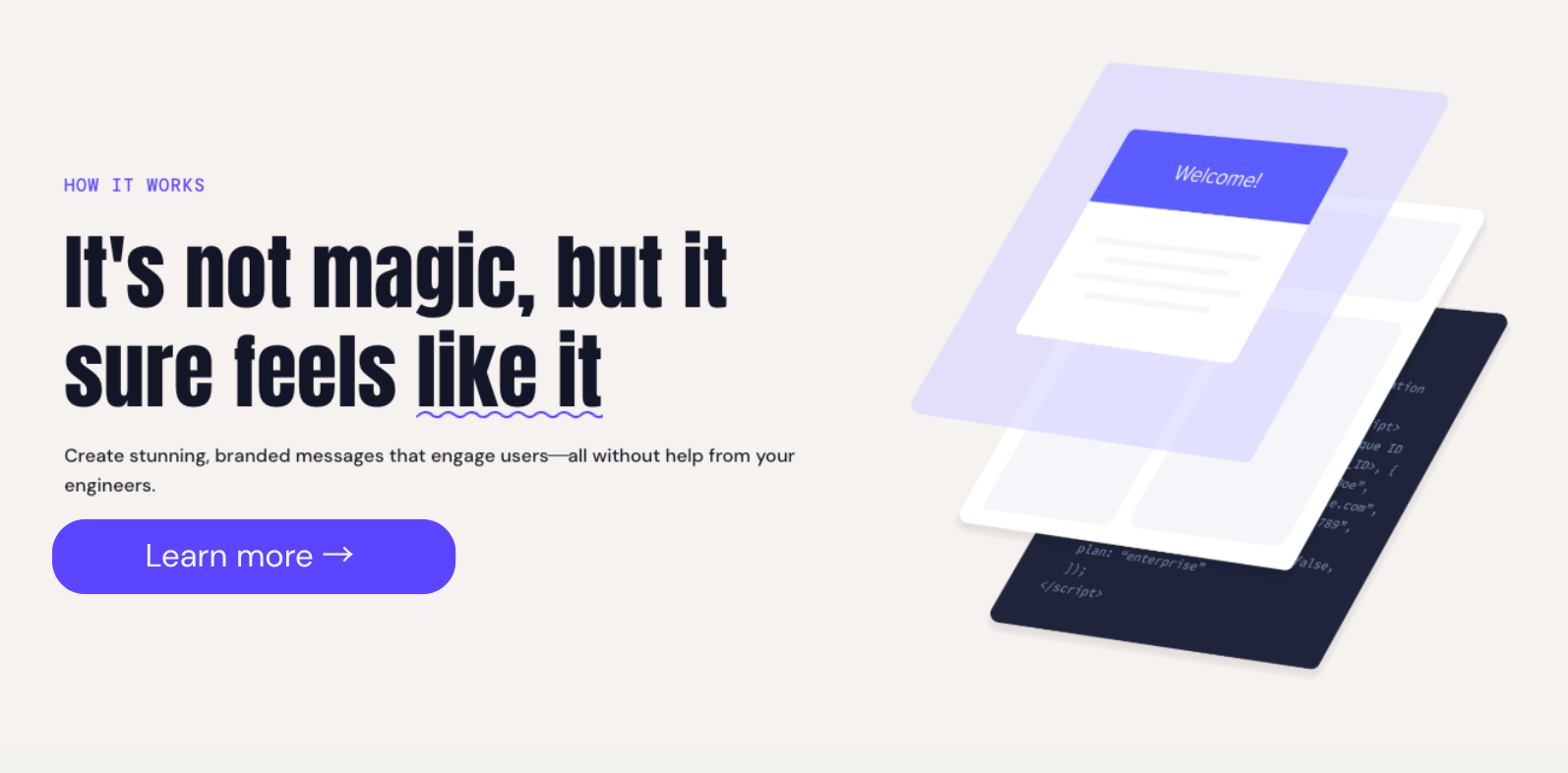
If your customers learn best by doing, in-app guidance might be the missing layer in your training program. Appcues helps teams build contextual training experiences (tours, tooltips, checklists, and onboarding flows) that reach customers at the exact moment they need help, without engineering bottlenecks.
Product Adoption
In-App Guidance & Self-Serve Support
Checklists, Tooltips & Modals
Retention & Churn
TL;DR
Three approaches, not one. Customer training software spans LMS platforms for structured courses, in-app guidance tools for contextual learning, and knowledge bases for self-service support.
Match the tool to the struggle. Complex conceptual learning calls for an LMS. Procedural, "how do I do this?" moments call for in-app guidance. Reference lookups call for a knowledge base.
Seven tools across every approach. This guide covers the best options in each category, plus a framework for evaluating which combination fits your product and team.
Introduction
Customers who do not understand your product churn. They file more support tickets, adopt fewer features, take longer to hit their first value milestone, and eventually cancel. The harder question is what to do about it.
The customer training software market has expanded well beyond the traditional LMS. In-app guidance tools, knowledge bases, and hybrid approaches now compete for the same budget. Yet most "best of" lists only cover course-based platforms, which misses half the category and leaves buyers with an incomplete picture.
That gap matters. If your customers' biggest struggles are procedural (how do I configure this integration? how do I set up my first workflow?), a full LMS might be the wrong tool entirely. If they need deep conceptual grounding before they can operate effectively, a tooltip is not going to cut it. The format needs to match the learning need.
This guide covers 7 tools across every approach: LMS platforms, in-app guidance, knowledge bases, and hybrid solutions. The goal is not to rank them against each other, but to help you match the right tool to your product, your customers, and your team's resources.
Customer training software is any tool that helps your customers learn how to use your product effectively. That definition sounds simple, but the category is wider than most buyers realize.
When people search for "customer training software," they typically picture a learning management system: structured courses, quizzes, certifications, and a learner portal. Tools like Skilljar and Docebo fit that description. But the category also includes in-app guidance platforms (like Appcues) that deliver tooltips, product tours, and checklists directly inside your product. It includes knowledge bases like Zendesk Guide. And increasingly, it includes hybrid combinations that layer multiple formats together.
Here is what customer training software is not: internal employee training tools or generic eLearning platforms built for corporate HR. The distinction matters because customer-facing training has fundamentally different requirements. Your customers did not sign up for a course. They signed up for your product. The training needs to meet them where they already are.
The most common misconception is that customer training software and a customer training LMS are the same thing. They are not. An LMS is one category within a broader landscape. Depending on your product and audience, an in-app guidance tool, a knowledge base, or a combination of all three might be a better fit.
According to TSIA research, more than 90% of technology companies now have some form of customer education program. But the format varies dramatically based on product complexity, customer profile, and team resources. A customer education platform for complex enterprise software looks nothing like one for a product-led SaaS tool with thousands of self-serve users.
Untrained customers churn. That is not a hot take; it is a pattern that shows up in every SaaS retention analysis. When customers do not understand how to get value from your product, the downstream effects are predictable: higher support ticket volume, slower time-to-value, low feature adoption, and eventually, cancellation.
The support cost argument alone is compelling. Every gap in customer training becomes a ticket, a call, or a 1:1 screen share with a CSM. Multiply that across hundreds or thousands of accounts and the cost compounds fast. Forrester research has found that companies with mature customer education programs see up to 6.2% higher retention rates compared to those without structured training. For a SaaS company with $10M in ARR, even a modest improvement in retention can translate to hundreds of thousands in preserved revenue.
But retention is only part of the story. Trained customers do not just stick around; they expand. They adopt more features, discover more use cases, and become the kind of users who advocate for your product internally. HubSpot Academy is the classic proof point: HubSpot has publicly credited its free certification program with driving product adoption, customer loyalty, and word-of-mouth growth across its entire ecosystem.
The inflection point for most teams is scale. When you have 50 customers, your CS team can run onboarding calls for each one. When you have 500 or 5,000, that model breaks. Customer training software lets you systematize what used to require a human in the room for every interaction. It turns tribal knowledge into a repeatable program.
The question is not whether you need customer training. It is which approach fits your product, your customers, and your team.
Most buying guides group every tool into a single category. In practice, customer training software spans three distinct approaches: LMS platforms for structured learning, in-app guidance for contextual training, and knowledge bases for self-service support. The tools below are organized accordingly.
Appcues is a customer engagement platform that delivers training directly inside your product through tours, tooltips, checklists, and onboarding flows. Instead of sending customers to an external portal to learn, Appcues teaches them in the moment they are actually trying to get something done.
Best for: SaaS teams that need contextual, just-in-time training without engineering cycles.
Key strengths:
Tradeoffs: Appcues is not designed for formal certification programs or deep course-based learning. If your customers need to study foundational concepts before they can use your product, you will want to pair it with a course platform.
Skilljar is a purpose-built customer education LMS, now part of Gainsight. It is designed specifically for external, customer-facing training rather than repurposed employee learning.
Best for: Companies that need structured academies with monetization, certifications, and SCORM support.
Key strengths:
Tradeoffs: Requires dedicated investment in content creation (someone has to build and maintain the courses). Customers also leave your product to access training, which introduces friction between learning and doing.
Docebo is an AI-powered enterprise learning platform built to manage training across multiple audiences: customers, partners, and employees.
Best for: Large enterprises managing customer, partner, and employee training from a single platform.
Key strengths:
Tradeoffs: Enterprise pricing and implementation complexity make Docebo a significant commitment. For smaller SaaS teams, it can be overkill.
TalentLMS is a lightweight, fast-setup LMS with a free tier that gets teams to a training portal quickly.
Best for: Teams that need a training portal up and running fast without heavy configuration or a long implementation cycle.
Key strengths:
Tradeoffs: Fewer customer-specific features than purpose-built tools like Skilljar. TalentLMS was designed for broader use cases (including employee training), so customer-facing workflows may require more customization.
Zendesk Guide is an AI-powered knowledge base integrated with Zendesk's support platform. It turns your support content into a self-service training resource.
Best for: Support-led teams that want to deflect tickets through self-service content and community forums.
Key strengths:
Tradeoffs: Zendesk Guide is a knowledge base, not a structured learning platform. There are no course pathways, certifications, or in-app product guidance. If you need more than reference documentation, you will need to supplement it.
WorkRamp is an all-in-one learning platform that covers customer education, sales enablement, and employee training under a single roof.
Best for: Companies that want one platform for all training audiences (customers, sales teams, and employees) rather than managing separate tools.
Key strengths:
Tradeoffs: Breadth across audiences can mean less depth for customer-specific workflows. If your primary focus is customer education, a purpose-built tool may offer more specialized features.
Gainsight Customer Education is a training platform built into the Gainsight customer success ecosystem. It combines structured learning with CS workflow integration, and includes Skilljar as part of its education stack.
Best for: CS-led organizations already using Gainsight for customer success workflows.
Key strengths:
Tradeoffs: Gainsight Customer Education delivers the most value within the Gainsight ecosystem. If you are not already on Gainsight for CS, the standalone flexibility is more limited.
With seven tools across three approaches, the decision can feel overwhelming. Here is a five-step framework to narrow your options.
1. Start with your biggest training gap. Audit your top support ticket categories. Where do customers repeatedly ask the same questions or struggle with the same workflows? That is where training has the most immediate ROI. If 30% of your tickets are about configuring a specific integration, that is your starting point.
2. Match the format to the learning need. Conceptual knowledge (understanding why a feature exists and when to use it) lends itself to courses and structured content. Procedural knowledge (how to complete a specific task) is better served by in-app walkthroughs and contextual tooltips. Reference information (what does this setting do?) belongs in a knowledge base. Let the learning need dictate the tool, not the other way around.
3. Consider your product complexity and user volume. Enterprise products with steep learning curves and multi-role workflows tend to benefit from an LMS. Product-led SaaS tools with thousands of self-serve users often get more value from in-app guidance. High-volume support teams may start with a knowledge base. Most teams at scale eventually use a combination.
4. Evaluate integration requirements. Customer training software does not exist in a vacuum. Check for integrations with your CRM (Salesforce, HubSpot), product analytics tools, support platforms, and customer success software. These connections let you trigger training based on real signals and measure its downstream impact.
5. Plan for the full lifecycle, not just onboarding. Onboarding is the starting line, not the finish line. Feature adoption, product updates, expansion into new use cases, and new team member onboarding all create training needs. Choose a tool (or combination) that can grow with your program.
1. Defaulting to a full LMS when a lighter approach would work. Building a certification academy when you have 200 customers and three CS reps is overbuilding for your stage. Start with the minimum viable training program that addresses your top friction points. You can layer in more complexity as you scale.
2. Evaluating only course-based tools and missing the in-app category entirely. Most buying guides only list LMS platforms. That means buyers often overlook in-app guidance tools that might be a better fit for their product and users. If your customers' struggles are procedural, in-app training may deliver faster results than a course.
3. Prioritizing feature count over deployment speed. A tool with 50 features that takes three months to implement loses to a tool with 20 features that ships in a week. Speed to value matters for your customers, and it matters for your training program too. Evaluate how fast you can go from identifying a gap to having a live experience in front of users.
4. Measuring success by course completion instead of product behavior change. A 90% completion rate on your onboarding course means nothing if those users are not activating, adopting key features, or renewing. Tie training metrics to business outcomes: feature adoption rates, support ticket deflection, retention by training cohort, and time-to-value improvements. If completion does not correlate with better outcomes, the training content needs to change.
HubSpot Academy offers free certification courses covering inbound marketing, sales methodology, and CRM usage. The courses are structured, video-based, and include quizzes and certifications that users can display on LinkedIn. HubSpot has publicly credited Academy with driving product adoption and customer retention. Certified users engage with more features and retain at higher rates than non-certified users. The Academy also doubles as a top-of-funnel acquisition channel.
Why it works: HubSpot's product is broad enough that foundational conceptual training pays off. Customers need to understand inbound methodology before they can use the platform effectively. A structured LMS is the right format for that learning need.
Lemonade, the insurance technology company, uses in-app guidance to walk new users through their first policy setup. Instead of a course or a knowledge base article, customers get step-by-step contextual prompts directly inside the product flow. The result is fast activation: users complete their first policy in minutes rather than days.
Why it works: The learning need is procedural, not conceptual. Customers do not need to study insurance theory; they need to complete a specific sequence of steps. In-app guidance matches the format to the need.
Canva combines both approaches. Their Design School offers structured courses on design principles and tool-specific tutorials. At the same time, the Canva product itself is loaded with contextual guidance: drag-and-drop hints, template suggestions, and progressive disclosure of advanced features as users gain confidence.
Why it works: Design involves both conceptual and procedural learning. The courses build foundational skills, while the in-app guidance keeps users moving forward inside the tool.
If your customers learn best by doing, in-app guidance might be the missing layer in your training program. Appcues helps teams build contextual training experiences (tours, tooltips, checklists, and onboarding flows) that reach customers at the exact moment they need help, without engineering bottlenecks.

Sign up for Quickcues and get our monthly updates!
.svg)