.png)
The biggest difference between Appcues and Userflow isn't price.
iIt's what happens when users leave your product. Userflow handles in-app onboarding well but has no email, no push notifications, and no mobile support. Appcues covers all three, plus deeper analytics, from a single platform. If your engagement strategy ends at the browser, either tool can work. If it doesn't, only one of them can keep up.
If you're evaluating Appcues vs Userflow, you've probably already figured out that both tools solve a similar problem. They help SaaS companies build in-app onboarding flows, tooltips, checklists, and surveys without writing code. Neither requires much involvement from engineering. Both are aimed at product and growth teams who need to improve user onboarding and drive product adoption without waiting in a development queue.
The challenge is that on the surface, they look almost interchangeable. The differences that actually matter tend to emerge later, once companies start hitting limits they didn't anticipate when they signed up -- usually when users outgrow the features the tool was designed to cover.
This comparison is an attempt to lay those out honestly so you can make a cleaner call upfront.
Appcues has been around since 2013, focused specifically on user engagement. It's a no-code platform that covers the full customer journey, from onboarding new users and driving product adoption through collecting NPS surveys and custom surveys, to re-engaging users who've gone quiet. It includes native mobile SDKs for iOS and Android, and serves over 1,600 customers across SaaS, fintech, healthcare, and enterprise software.
Userflow launched in 2018 with a tighter scope: fast, web-based user onboarding for companies that want to move quickly. Its Kanban-style builder is genuinely easy to use, and non-technical team members can typically create onboarding flows and checklists without help from a developer. In early 2025, Userflow was acquired by Beamer, a changelog and product roadmap tool. That acquisition is worth keeping in mind as you evaluate, since it raises reasonable questions about where in-app user onboarding sits in a changelog company's long-term priorities.
Userflow's strongest selling point is how fast companies can get up and running. The drag and drop interface is clean and intuitive, and users who know what features they want to build can go from idea to live flows in a day without dev resources. There's minimal setup friction, integrations are quick, and the learning curve is genuinely low compared to most onboarding tools in this space.
For the core features most users need when getting started, Userflow covers the ground well. You get product tours, tooltips, checklists, NPS surveys, announcement modals, custom surveys, and a resource center. Segmentation covers role-based targeting, page targeting, and user properties, which is sufficient for the majority of standard user onboarding use cases. Userflow also includes an AI Adoption Agent designed to assist users in real time based on what they're doing in the product at that moment, a compelling feature for companies that want contextual guidance -- delivered via tooltips or in-flow prompts -- built into the onboarding experience.
For startups and smaller companies with clearly defined user onboarding needs and a web-only product, Userflow is a legitimate choice. The pricing is competitive and the tool does what it says.
The most significant gap between the two platforms is what happens when users leave your product without completing onboarding. Userflow handles in-app messaging well, but has no mechanism to follow up outside of it. There's no behavioral email. There's no push notification. Once a user closes the browser, Userflow's reach ends.
Appcues connects in-app messaging with behavioral email and push notifications, all triggered by user actions and reportable in one place. If users stall partway through user onboarding, your customer team can follow up by email. If users have gone quiet, a push notification can bring them back. Having all three channels under one roof means your company isn't maintaining separate platforms for each touchpoint, and it means you can see how in-app flows, email, and push are working together to drive user progress rather than guessing which one is doing the work.

Userflow is a web-based onboarding tool. It has no support for iOS or Android. If your product has a mobile app, or if one is on your roadmap, you'd need a separate user onboarding tool for those users entirely. That means separate analytics, separate flows, and a fragmented onboarding experience depending on the device.
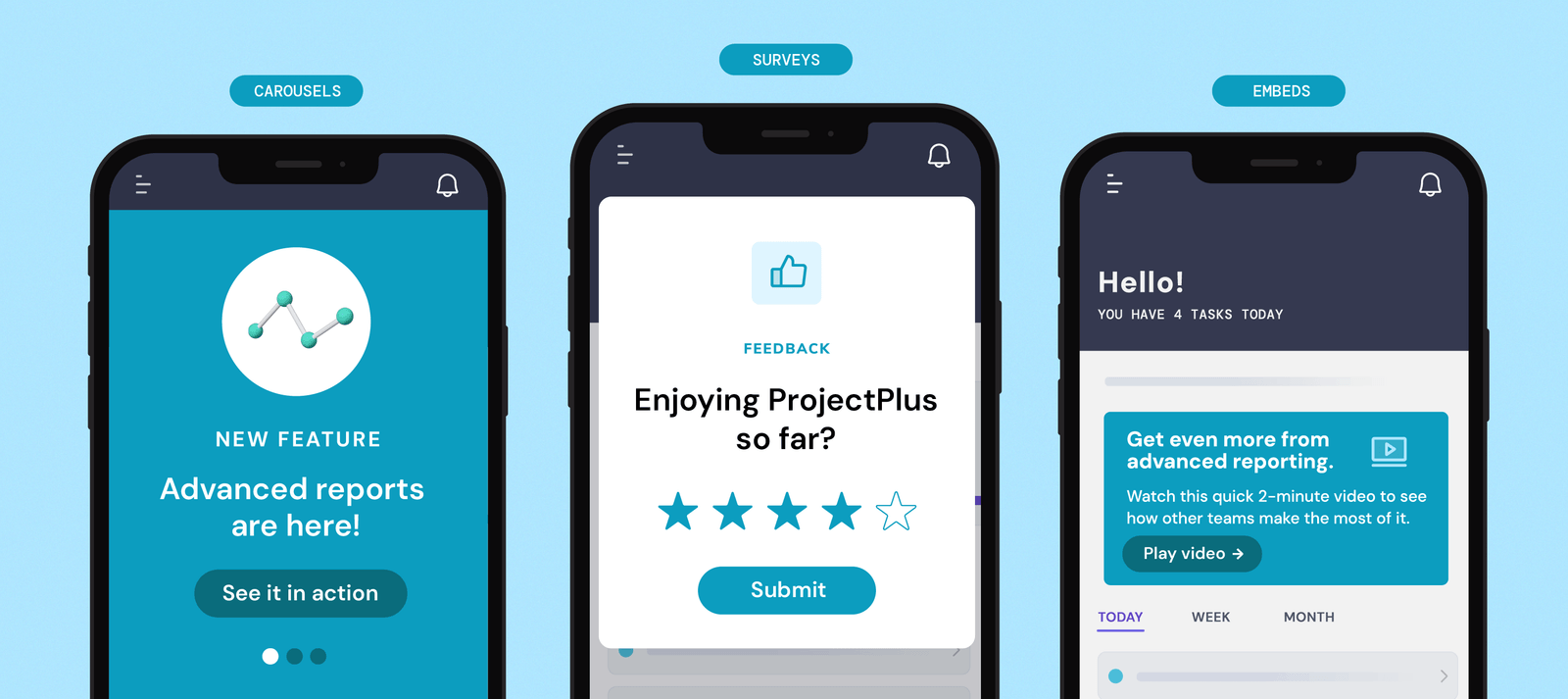
Appcues offers native mobile SDKs for both iOS and Android. Companies can build and deliver consistent onboarding flows for users across web and mobile from the same platform, with the same segmentation logic and reporting, which keeps product adoption metrics unified rather than split across two separate tools.
Appcues offers advanced segmentation built around user properties, events, pages, and complex boolean logic. For companies whose users span multiple personas, pricing tiers, or stages of activation, this level of targeting control matters a lot in practice. You can build flows that adapt based on exactly what a given user has or hasn't done inside your product, with segmentation rules that go well beyond what most onboarding tools support.
Userflow's segmentation covers the common use cases, including role-based targeting, page targeting, and basic user properties, and that's genuinely enough for straightforward scenarios. But for enterprise companies whose users have varied needs and behaviors, the ceiling shows up when you try to build experiences that respond to nuanced user actions -- and when you need analytics to understand why users aren't converting.
Appcues includes funnel analysis, goal tracking, A/B testing, and flow-level product analytics that connect to your existing stack through integrations with tools like Heap, Amplitude, Mixpanel, Segment, and Salesforce. Customer success teams can track user progress through onboarding, set goals tied to specific user actions, and measure whether the onboarding flows, tooltips, surveys, and announcement modals they've built are actually influencing activation and retention. That kind of analytics depth is what lets customer teams move from guessing to knowing.
Userflow's analytics are clean and readable, but they're lighter. There's no workflow reporting, no goal tracking tied to user behavior milestones, and no funnel analysis. For companies that need to prove the business impact of their user onboarding program, or understand which flows are moving the metrics that matter for users, the absence of deeper analytics becomes a real limitation.
Appcues integrates with a wider range of platforms, including Salesforce, HubSpot, Heap, Amplitude, Mixpanel, Segment, and Zapier. For enterprise companies where customer data lives across multiple systems, those integrations mean richer segmentation and a cleaner fit within existing workflows. Customer success and product teams can pull in user properties from the tools they already use and target users based on that data without manual imports or workarounds. Userflow covers the core integrations most smaller companies need, but the ecosystem is narrower, and customer teams with complex stacks will notice.
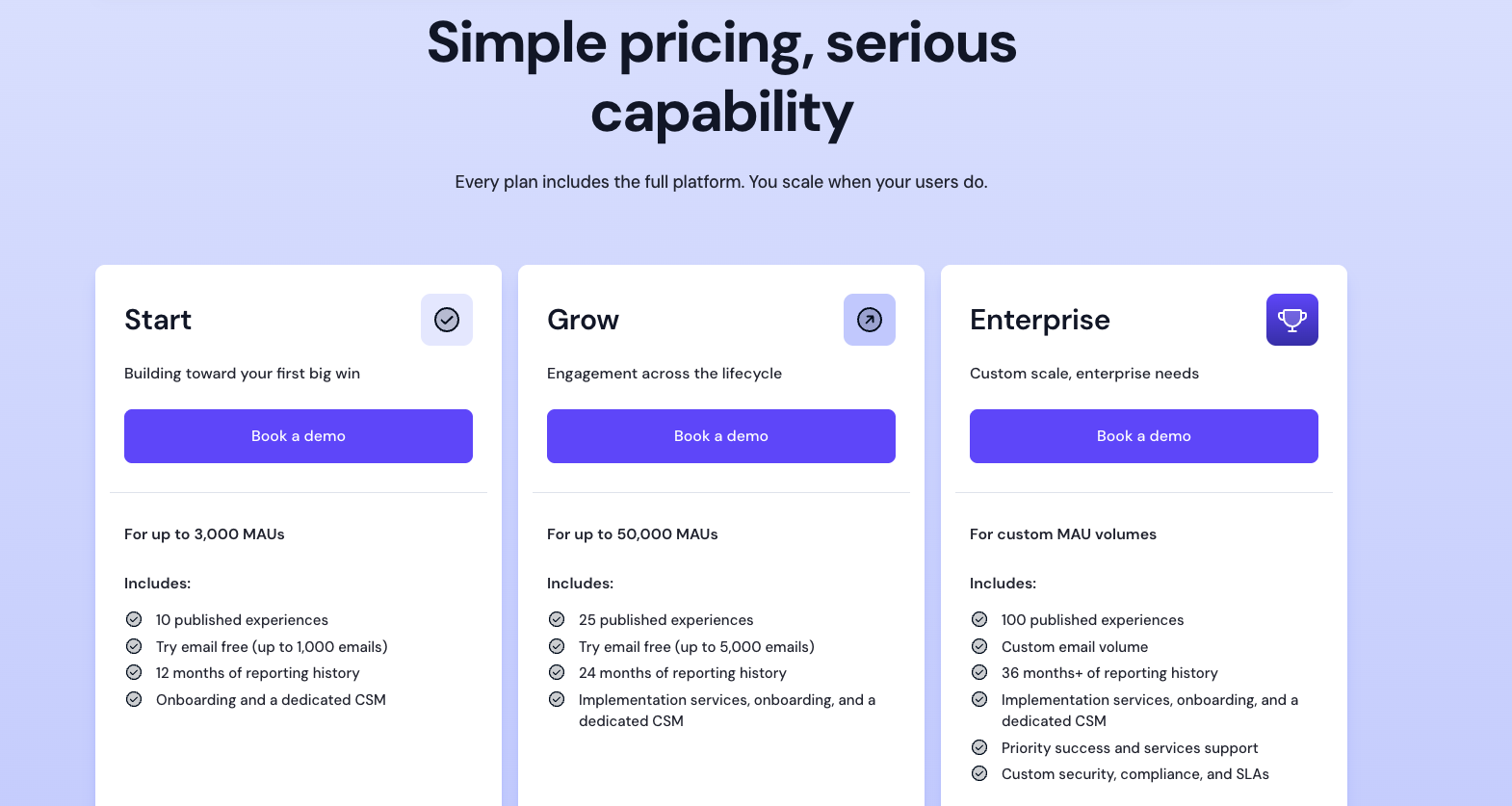
Appcues pricing is structured across three plans: Start (up to 3,000 MAUs), Grow (up to 50,000 MAUs), and Enterprise (custom volume). Every plan includes the full platform from day one, meaning all experience types, behavioral email, mobile features, integrations, and product analytics are available without gating advanced features behind higher tiers.
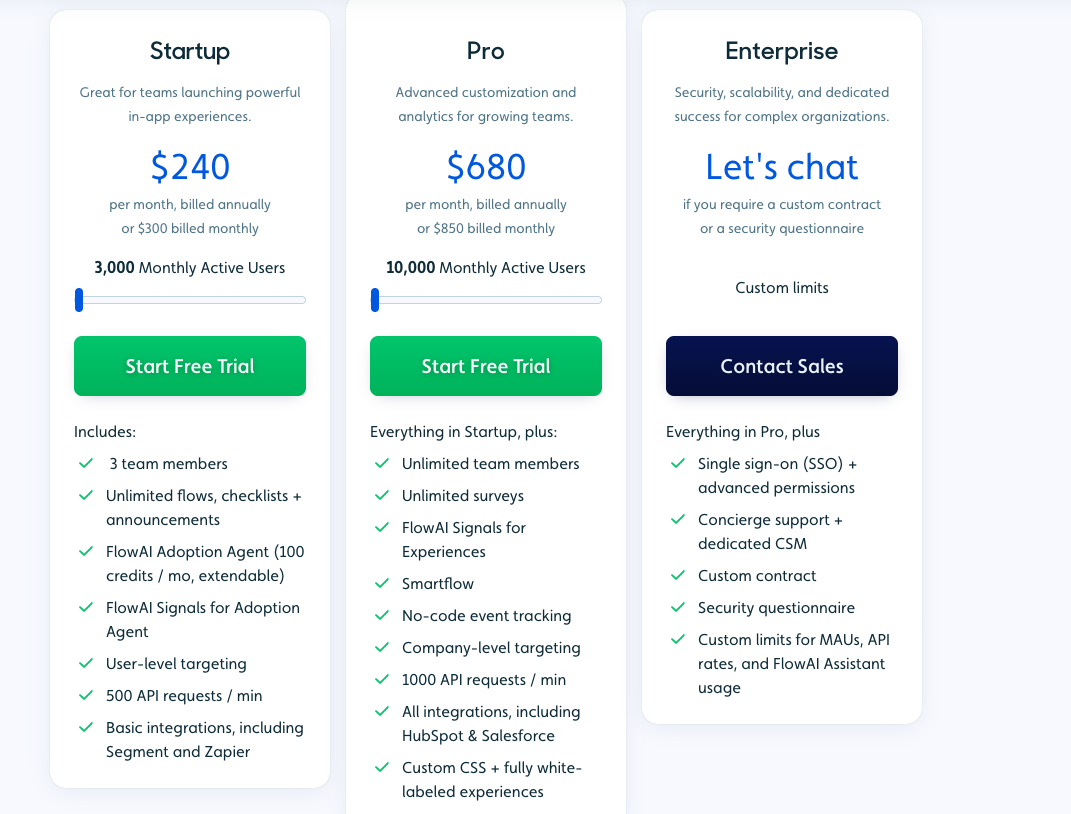
Userflow pricing is also MAU-based with custom pricing at higher volumes.
The more useful comparison isn't really the headline price. Appcues bundles email, mobile support, segmentation, and a full analytics suite into every pricing plan. With Userflow, the moment your customer team needs to reach users outside the app or build for mobile users, you'll be adding other tools to fill those gaps. The cost and complexity of managing multiple platforms is easy to underestimate when you're comparing pricing options side by side.
For budget-conscious startups, the Start plan is designed to grow alongside the product. For enterprise companies with more complex requirements, Enterprise pricing comes with priority customer support, enhanced security, and custom compliance options.
Userflow is a strong fit for companies with web-only products, straightforward user onboarding needs, and a priority on getting something live quickly. It also works for budget-sensitive companies that don't yet need multi-channel engagement, or for companies already using Beamer where the changelog integration adds value for users.
Appcues is the better fit for companies with a mobile app, that want to engage users via email, push, or announcement modals as part of the user onboarding process, or that need flows to adapt based on complex user behavior and user properties. It's also the stronger choice for customer teams focused on product adoption, enterprise companies that require Salesforce integrations and deep segmentation, and anyone building an engagement program they expect to scale alongside their user base.
If neither onboarding tool feels right, here are some best alternatives:
UserGuiding is an affordable onboarding tool with straightforward features for early-stage startups. It covers the basics well but has a lower ceiling as needs grow.
See how it compares to Appcues.
Chameleon is a more design-forward option with strong features for companies that want fine-grained control over the look and behavior of their in-app experiences, including tooltips and modals.
Pendo is an analytics-first platform built for enterprise companies that treat product analytics as a system of record. It goes deep on data but is a heavier investment to set up and maintain.
WalkMe is a legacy enterprise platform built primarily for internal employee training and large-scale IT deployments. It comes with longer implementations and more engineering resources required than most SaaS product companies want to commit.
Userflow is a well-designed user onboarding tool for companies with web-only products and straightforward needs. For customers focused on early-stage product adoption, it delivers solid value.
For customer teams who need to engage users beyond the browser, run real user onboarding analytics, or build flows with tooltips and surveys that adapt to complex user behavior, Appcues covers more ground from a single platform. Rather than patching together separate tools for in-app messaging, email, push, and mobile, Appcues handles all of it in one place, with the reporting to show what's actually working across your full customer base.
The ceiling matters when you're choosing an onboarding tool. Pick one that leaves your users room to grow.
Product Adoption
Roadmap & Release Communication
User Engagement
Email Marketing
TL;DR
The biggest difference between Appcues and Userflow isn't price.
iIt's what happens when users leave your product. Userflow handles in-app onboarding well but has no email, no push notifications, and no mobile support. Appcues covers all three, plus deeper analytics, from a single platform. If your engagement strategy ends at the browser, either tool can work. If it doesn't, only one of them can keep up.
If you're evaluating Appcues vs Userflow, you've probably already figured out that both tools solve a similar problem. They help SaaS companies build in-app onboarding flows, tooltips, checklists, and surveys without writing code. Neither requires much involvement from engineering. Both are aimed at product and growth teams who need to improve user onboarding and drive product adoption without waiting in a development queue.
The challenge is that on the surface, they look almost interchangeable. The differences that actually matter tend to emerge later, once companies start hitting limits they didn't anticipate when they signed up -- usually when users outgrow the features the tool was designed to cover.
This comparison is an attempt to lay those out honestly so you can make a cleaner call upfront.
Appcues has been around since 2013, focused specifically on user engagement. It's a no-code platform that covers the full customer journey, from onboarding new users and driving product adoption through collecting NPS surveys and custom surveys, to re-engaging users who've gone quiet. It includes native mobile SDKs for iOS and Android, and serves over 1,600 customers across SaaS, fintech, healthcare, and enterprise software.
Userflow launched in 2018 with a tighter scope: fast, web-based user onboarding for companies that want to move quickly. Its Kanban-style builder is genuinely easy to use, and non-technical team members can typically create onboarding flows and checklists without help from a developer. In early 2025, Userflow was acquired by Beamer, a changelog and product roadmap tool. That acquisition is worth keeping in mind as you evaluate, since it raises reasonable questions about where in-app user onboarding sits in a changelog company's long-term priorities.
Userflow's strongest selling point is how fast companies can get up and running. The drag and drop interface is clean and intuitive, and users who know what features they want to build can go from idea to live flows in a day without dev resources. There's minimal setup friction, integrations are quick, and the learning curve is genuinely low compared to most onboarding tools in this space.
For the core features most users need when getting started, Userflow covers the ground well. You get product tours, tooltips, checklists, NPS surveys, announcement modals, custom surveys, and a resource center. Segmentation covers role-based targeting, page targeting, and user properties, which is sufficient for the majority of standard user onboarding use cases. Userflow also includes an AI Adoption Agent designed to assist users in real time based on what they're doing in the product at that moment, a compelling feature for companies that want contextual guidance -- delivered via tooltips or in-flow prompts -- built into the onboarding experience.
For startups and smaller companies with clearly defined user onboarding needs and a web-only product, Userflow is a legitimate choice. The pricing is competitive and the tool does what it says.
The most significant gap between the two platforms is what happens when users leave your product without completing onboarding. Userflow handles in-app messaging well, but has no mechanism to follow up outside of it. There's no behavioral email. There's no push notification. Once a user closes the browser, Userflow's reach ends.
Appcues connects in-app messaging with behavioral email and push notifications, all triggered by user actions and reportable in one place. If users stall partway through user onboarding, your customer team can follow up by email. If users have gone quiet, a push notification can bring them back. Having all three channels under one roof means your company isn't maintaining separate platforms for each touchpoint, and it means you can see how in-app flows, email, and push are working together to drive user progress rather than guessing which one is doing the work.
Userflow is a web-based onboarding tool. It has no support for iOS or Android. If your product has a mobile app, or if one is on your roadmap, you'd need a separate user onboarding tool for those users entirely. That means separate analytics, separate flows, and a fragmented onboarding experience depending on the device.
Appcues offers native mobile SDKs for both iOS and Android. Companies can build and deliver consistent onboarding flows for users across web and mobile from the same platform, with the same segmentation logic and reporting, which keeps product adoption metrics unified rather than split across two separate tools.
Appcues offers advanced segmentation built around user properties, events, pages, and complex boolean logic. For companies whose users span multiple personas, pricing tiers, or stages of activation, this level of targeting control matters a lot in practice. You can build flows that adapt based on exactly what a given user has or hasn't done inside your product, with segmentation rules that go well beyond what most onboarding tools support.
Userflow's segmentation covers the common use cases, including role-based targeting, page targeting, and basic user properties, and that's genuinely enough for straightforward scenarios. But for enterprise companies whose users have varied needs and behaviors, the ceiling shows up when you try to build experiences that respond to nuanced user actions -- and when you need analytics to understand why users aren't converting.
Appcues includes funnel analysis, goal tracking, A/B testing, and flow-level product analytics that connect to your existing stack through integrations with tools like Heap, Amplitude, Mixpanel, Segment, and Salesforce. Customer success teams can track user progress through onboarding, set goals tied to specific user actions, and measure whether the onboarding flows, tooltips, surveys, and announcement modals they've built are actually influencing activation and retention. That kind of analytics depth is what lets customer teams move from guessing to knowing.
Userflow's analytics are clean and readable, but they're lighter. There's no workflow reporting, no goal tracking tied to user behavior milestones, and no funnel analysis. For companies that need to prove the business impact of their user onboarding program, or understand which flows are moving the metrics that matter for users, the absence of deeper analytics becomes a real limitation.
Appcues integrates with a wider range of platforms, including Salesforce, HubSpot, Heap, Amplitude, Mixpanel, Segment, and Zapier. For enterprise companies where customer data lives across multiple systems, those integrations mean richer segmentation and a cleaner fit within existing workflows. Customer success and product teams can pull in user properties from the tools they already use and target users based on that data without manual imports or workarounds. Userflow covers the core integrations most smaller companies need, but the ecosystem is narrower, and customer teams with complex stacks will notice.
Appcues pricing is structured across three plans: Start (up to 3,000 MAUs), Grow (up to 50,000 MAUs), and Enterprise (custom volume). Every plan includes the full platform from day one, meaning all experience types, behavioral email, mobile features, integrations, and product analytics are available without gating advanced features behind higher tiers.
Userflow pricing is also MAU-based with custom pricing at higher volumes.
The more useful comparison isn't really the headline price. Appcues bundles email, mobile support, segmentation, and a full analytics suite into every pricing plan. With Userflow, the moment your customer team needs to reach users outside the app or build for mobile users, you'll be adding other tools to fill those gaps. The cost and complexity of managing multiple platforms is easy to underestimate when you're comparing pricing options side by side.
For budget-conscious startups, the Start plan is designed to grow alongside the product. For enterprise companies with more complex requirements, Enterprise pricing comes with priority customer support, enhanced security, and custom compliance options.
Userflow is a strong fit for companies with web-only products, straightforward user onboarding needs, and a priority on getting something live quickly. It also works for budget-sensitive companies that don't yet need multi-channel engagement, or for companies already using Beamer where the changelog integration adds value for users.
Appcues is the better fit for companies with a mobile app, that want to engage users via email, push, or announcement modals as part of the user onboarding process, or that need flows to adapt based on complex user behavior and user properties. It's also the stronger choice for customer teams focused on product adoption, enterprise companies that require Salesforce integrations and deep segmentation, and anyone building an engagement program they expect to scale alongside their user base.
If neither onboarding tool feels right, here are some best alternatives:
UserGuiding is an affordable onboarding tool with straightforward features for early-stage startups. It covers the basics well but has a lower ceiling as needs grow.
See how it compares to Appcues.
Chameleon is a more design-forward option with strong features for companies that want fine-grained control over the look and behavior of their in-app experiences, including tooltips and modals.
Pendo is an analytics-first platform built for enterprise companies that treat product analytics as a system of record. It goes deep on data but is a heavier investment to set up and maintain.
WalkMe is a legacy enterprise platform built primarily for internal employee training and large-scale IT deployments. It comes with longer implementations and more engineering resources required than most SaaS product companies want to commit.
Userflow is a well-designed user onboarding tool for companies with web-only products and straightforward needs. For customers focused on early-stage product adoption, it delivers solid value.
For customer teams who need to engage users beyond the browser, run real user onboarding analytics, or build flows with tooltips and surveys that adapt to complex user behavior, Appcues covers more ground from a single platform. Rather than patching together separate tools for in-app messaging, email, push, and mobile, Appcues handles all of it in one place, with the reporting to show what's actually working across your full customer base.
The ceiling matters when you're choosing an onboarding tool. Pick one that leaves your users room to grow.

Sign up for Quickcues and get our monthly updates!
.svg)