.png)
In 2024 a mid-size product team shipped four significant releases a year. In 2026 it ships fifteen. The amount any one customer will absorb hasn't moved. That gap is what separates the two tools below: Pendo is built to increase decision velocity, Appcues is built to make each release land.
Choose Appcues if marketing owns (or majorly contributes) to customer adoption and retention and needs to run lifecycle campaigns inside your product. That way, you’re supported by software that triggers messaging and workflows based on customer behavior while being measured against a control group so you know which campaign caused the change.
Choose Pendo if a product or data team needs the broadest possible usage analytics as a system of record for roadmap decisions that need to move fast. This is best for teams that are working heavily with product iteration first, customer engagement second where signal itself is more important than acting on signal.
Pendo is built to help you ship more, faster. Appcues is built to help you land what you’re already shipping.
Here’s how it breaks down in the product:
Plenty of tools will tell you activation went up 6% in the last quarter, but Appcues is set apart from Pendo because the AI build is in lockstep with the measurement process. Pendo requires a manual build that connects to their robust analytics, but Appcues helps you build, then helps you measure “did this work”, and then helps you build improvements that grow and learn with your findings. Appcues even separates these key moments into campaigns and tactics you can tie to a stated overarching objective.
Pendo offers both guide-by-guide individual measurement and an ‘Effectiveness’ tab that pits your performance against benchmarks and other guides. With both you can see trends over time, but the goal with Pendo is different. These numbers help you move faster to make changes, not improve the nuanced adoption tactics that Appcues enables you to gather together and track based on your specific business needs.
Analytics is Pendo’s gravitational center. If your primary need is to understand product usage in as many dimensions as possible, Pendo is the smarter move.
Governance down to granular role and permission controls, per-app viewer roles, approval workflows, and bulk user management are Pendo’s strength here. If you’re a large organization where who-can-publish-what is a real question, this is a big advantage. However, this is also a double-edged sword since it adds a heavy process to what is often a bottleneck or foggier point for many teams.
Frustration signals are another area where Pendo is the better choice. You can track clicks of all kind: rage clicks, dead clicks, error clicks, U-turns, all useful information for product teams.
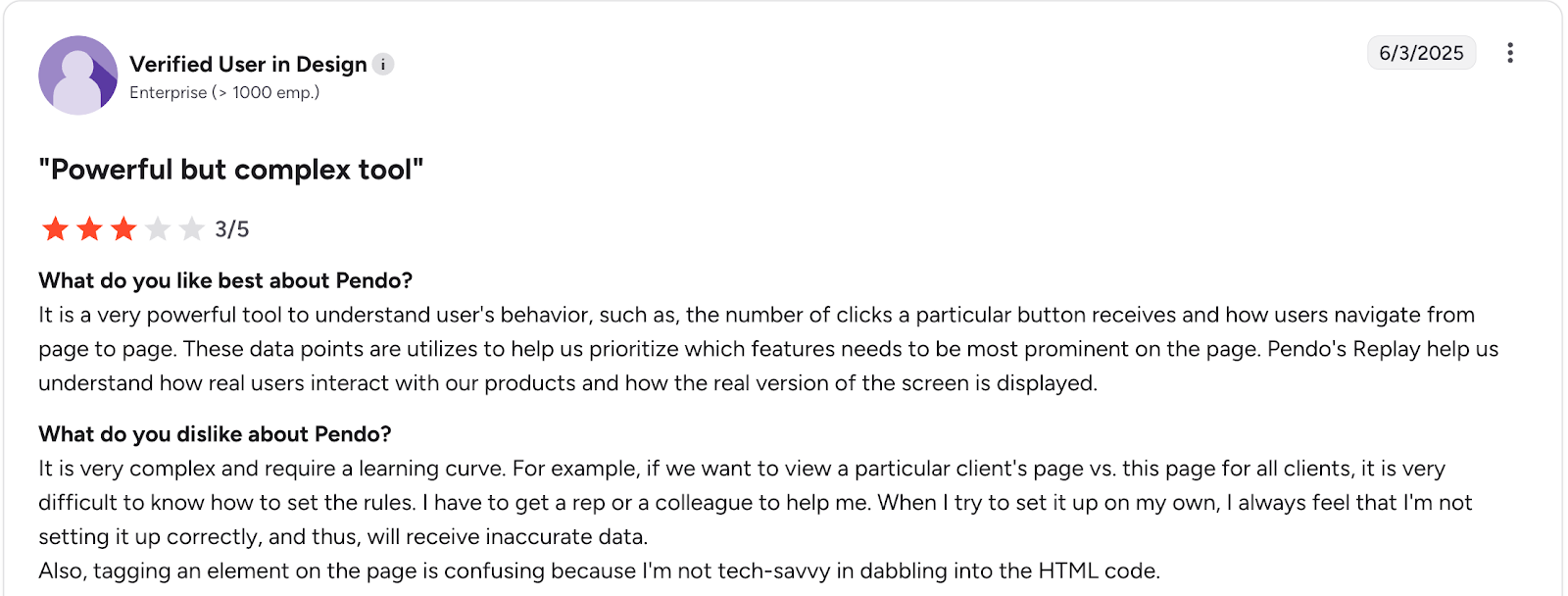
Pendo Predict is a tool meant to measure predictive churn and upsell scoring from their Forwrd.ai acquisition. But reports are varied, with some companies finding success while others reporting that organizations with messier data will see inconsistent results.
Agent Analytics is great for if you’ve shipped an AI product and need to know how your agents are performing. How often are they really completing a task and how does AI-driven creation compare to manual? However, this is a separate package and priced out as an add-on.
Appcues meets the moment. Engagement tools work when they can reach a user in the moment that matters, but all strategy falls short without behavioral data. Appcues turns what a does into the trigger for what happens next. So you can use us to see where they are, what they’ve already seen, and where they stalled out, then use that information to get the best possible fix, scaling opportunity, you name it. Your biggest growth channel gets messaging that’s grounded in real understanding.
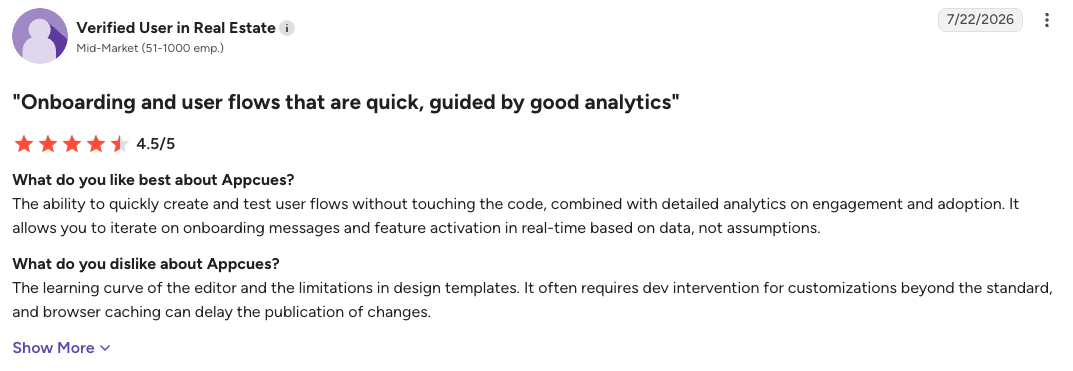
When you want to move faster, Appcues helps the person who understands the customer build the next message or flow without filling out an engineering ticket. There’s one JavaScript snippet to install for a one time technical investment, and then from there you can create in plain, prompt-driven language so marketing and product teams can publish freely.
Your work compounds. All you need to do is brief the Knowledge Hub once with your brand, product, goals, and audience. Every draft after runs with your specific context. We learn the patterns that get your favorite numbers up and to the right, then use them to build and target your next campaign. Each cycle is sharper than the last and applies across building, reporting, and recommendations.
If the above tools are already in your stack and you’re shopping Pendo vs Appcues, look at the breakdown from a high level.
Pendo’s strength is analytics depth. If Amplitude, Mixpanel, or Heap are already covering product analytics for you and across multiple teams, then you’ll see some expensive overlap. This could either be a great consolidation move, or a big effort for a minor build possibility.
Appcues sits a little differently within the stack. Analytics is included and built around the question your existing stack can’t quite get at: did my campaign work? Your warehouse tools are able to show you what a user did, while Appcues shares the why.
Appcues can work alongside your established analytics tools, or you can consolidate your focus towards building. But if you’re consolidating and need to share product usage data with engineering, that’s a different internal conversation that Pendo could help you with.
This is migration has been done many times before, and we’re only seeing it get more common as both of our products diverge in the agentic era. Here’s what our users report when they switch.
Install is easier. Appcues needs one JavaScript snippet to work. The first-time setup will usually need a technical resource for an hour, but after that and a Chrome browser extension download, you’re not waiting for anyone.
Behavior starts feeding immediately. Appcues begins tracking your user behavior as soon as install is complete. If you need to define your events after the fact, they’ll backfill so you won’t experience any whiteout.
Run both while you rebuild. Most teams keep Pendo live while they rebuild their highest-value flows in Appcues, and validate that the numbers agree with each other.
Our hands-on partnership plucks you out of a ticket queue. Pendo’s support is enterprise-tiered, while Appcues will take care of you throughout the journey. Our dedicated support team will sit with you through the process, or do it on your behalf with our white glove service.
The decisions are what take the most time. Having internal conversations around which experiences were doing real work vs the ones running because no one had thought to turn them off are a multi-layered decision tree that can eat into your rollover time. Most teams report the rebuild is a smaller task than the audit itself, which even our internal Appcues users face.
Although you’ve narrowed it to Pendo vs Appcues for a reason, here are some other options you might be thinking about if you’re still early in the consideration process.
UserGuiding: Onboarding flows and checklists at a lower price point. Strong fit for smaller teams who need in-app guidance without a broader engagement strategy.
Whatfix: Digital adoption with a strong enterprise and employee-training angle. Great for getting staff through internal software.
WalkMe: The established name in internal software adoption. Built for people and operations teams driving workflow change, not for marketing-owned programs.
Chameleon: Highly-flexible, design-forward in-app patterns. Teams that want fine control of how experiences look often prefer it. Lighter on analytics and orchestration.
Userpilot: Onboarding and product analytics aimed at mid-market SaaS. Overlaps with Pendo and Appcues with lighter analytics.
Pendo is the better purchase for product orgs building a self-improving product, where usage data feeds your product roadmap decisions.
Appcues is the better buy for cross-functional teams who need every fast paced release to turn into revenue. Great for product and marketing teams who share responsibility for whether what gets shipped is used, and need to prove it to their leadership.
Not sure which describes you? Consider who’s reporting adoption on your last three product releases.
Book a demo with one of our experts and get to know the platform better so you can make the most informed choice!
Lifecycle Marketing
Adoption
Personalization
Retention & Churn
TL;DR
In 2024 a mid-size product team shipped four significant releases a year. In 2026 it ships fifteen. The amount any one customer will absorb hasn't moved. That gap is what separates the two tools below: Pendo is built to increase decision velocity, Appcues is built to make each release land.
Choose Appcues if marketing owns (or majorly contributes) to customer adoption and retention and needs to run lifecycle campaigns inside your product. That way, you’re supported by software that triggers messaging and workflows based on customer behavior while being measured against a control group so you know which campaign caused the change.
Choose Pendo if a product or data team needs the broadest possible usage analytics as a system of record for roadmap decisions that need to move fast. This is best for teams that are working heavily with product iteration first, customer engagement second where signal itself is more important than acting on signal.
Pendo is built to help you ship more, faster. Appcues is built to help you land what you’re already shipping.
Here’s how it breaks down in the product:
Plenty of tools will tell you activation went up 6% in the last quarter, but Appcues is set apart from Pendo because the AI build is in lockstep with the measurement process. Pendo requires a manual build that connects to their robust analytics, but Appcues helps you build, then helps you measure “did this work”, and then helps you build improvements that grow and learn with your findings. Appcues even separates these key moments into campaigns and tactics you can tie to a stated overarching objective.
Pendo offers both guide-by-guide individual measurement and an ‘Effectiveness’ tab that pits your performance against benchmarks and other guides. With both you can see trends over time, but the goal with Pendo is different. These numbers help you move faster to make changes, not improve the nuanced adoption tactics that Appcues enables you to gather together and track based on your specific business needs.
Analytics is Pendo’s gravitational center. If your primary need is to understand product usage in as many dimensions as possible, Pendo is the smarter move.
Governance down to granular role and permission controls, per-app viewer roles, approval workflows, and bulk user management are Pendo’s strength here. If you’re a large organization where who-can-publish-what is a real question, this is a big advantage. However, this is also a double-edged sword since it adds a heavy process to what is often a bottleneck or foggier point for many teams.
Frustration signals are another area where Pendo is the better choice. You can track clicks of all kind: rage clicks, dead clicks, error clicks, U-turns, all useful information for product teams.
Pendo Predict is a tool meant to measure predictive churn and upsell scoring from their Forwrd.ai acquisition. But reports are varied, with some companies finding success while others reporting that organizations with messier data will see inconsistent results.
Agent Analytics is great for if you’ve shipped an AI product and need to know how your agents are performing. How often are they really completing a task and how does AI-driven creation compare to manual? However, this is a separate package and priced out as an add-on.
Appcues meets the moment. Engagement tools work when they can reach a user in the moment that matters, but all strategy falls short without behavioral data. Appcues turns what a does into the trigger for what happens next. So you can use us to see where they are, what they’ve already seen, and where they stalled out, then use that information to get the best possible fix, scaling opportunity, you name it. Your biggest growth channel gets messaging that’s grounded in real understanding.
When you want to move faster, Appcues helps the person who understands the customer build the next message or flow without filling out an engineering ticket. There’s one JavaScript snippet to install for a one time technical investment, and then from there you can create in plain, prompt-driven language so marketing and product teams can publish freely.
Your work compounds. All you need to do is brief the Knowledge Hub once with your brand, product, goals, and audience. Every draft after runs with your specific context. We learn the patterns that get your favorite numbers up and to the right, then use them to build and target your next campaign. Each cycle is sharper than the last and applies across building, reporting, and recommendations.
If the above tools are already in your stack and you’re shopping Pendo vs Appcues, look at the breakdown from a high level.
Pendo’s strength is analytics depth. If Amplitude, Mixpanel, or Heap are already covering product analytics for you and across multiple teams, then you’ll see some expensive overlap. This could either be a great consolidation move, or a big effort for a minor build possibility.
Appcues sits a little differently within the stack. Analytics is included and built around the question your existing stack can’t quite get at: did my campaign work? Your warehouse tools are able to show you what a user did, while Appcues shares the why.
Appcues can work alongside your established analytics tools, or you can consolidate your focus towards building. But if you’re consolidating and need to share product usage data with engineering, that’s a different internal conversation that Pendo could help you with.
This is migration has been done many times before, and we’re only seeing it get more common as both of our products diverge in the agentic era. Here’s what our users report when they switch.
Install is easier. Appcues needs one JavaScript snippet to work. The first-time setup will usually need a technical resource for an hour, but after that and a Chrome browser extension download, you’re not waiting for anyone.
Behavior starts feeding immediately. Appcues begins tracking your user behavior as soon as install is complete. If you need to define your events after the fact, they’ll backfill so you won’t experience any whiteout.
Run both while you rebuild. Most teams keep Pendo live while they rebuild their highest-value flows in Appcues, and validate that the numbers agree with each other.
Our hands-on partnership plucks you out of a ticket queue. Pendo’s support is enterprise-tiered, while Appcues will take care of you throughout the journey. Our dedicated support team will sit with you through the process, or do it on your behalf with our white glove service.
The decisions are what take the most time. Having internal conversations around which experiences were doing real work vs the ones running because no one had thought to turn them off are a multi-layered decision tree that can eat into your rollover time. Most teams report the rebuild is a smaller task than the audit itself, which even our internal Appcues users face.
Although you’ve narrowed it to Pendo vs Appcues for a reason, here are some other options you might be thinking about if you’re still early in the consideration process.
UserGuiding: Onboarding flows and checklists at a lower price point. Strong fit for smaller teams who need in-app guidance without a broader engagement strategy.
Whatfix: Digital adoption with a strong enterprise and employee-training angle. Great for getting staff through internal software.
WalkMe: The established name in internal software adoption. Built for people and operations teams driving workflow change, not for marketing-owned programs.
Chameleon: Highly-flexible, design-forward in-app patterns. Teams that want fine control of how experiences look often prefer it. Lighter on analytics and orchestration.
Userpilot: Onboarding and product analytics aimed at mid-market SaaS. Overlaps with Pendo and Appcues with lighter analytics.
Pendo is the better purchase for product orgs building a self-improving product, where usage data feeds your product roadmap decisions.
Appcues is the better buy for cross-functional teams who need every fast paced release to turn into revenue. Great for product and marketing teams who share responsibility for whether what gets shipped is used, and need to prove it to their leadership.
Not sure which describes you? Consider who’s reporting adoption on your last three product releases.
Book a demo with one of our experts and get to know the platform better so you can make the most informed choice!

Sign up for Quickcues and get our monthly updates!
.svg)