If you're looking for product launch examples right now, there's a good chance your roadmap is full of AI. An assistant last quarter, agents this quarter, an "AI-powered" label on half the release notes. Each one is supposed to be a big deal. None of them got a full launch, because the next one was already shipping.
You're not alone, and you're not doing it wrong. The way most teams launch was built for a slower pace and for features people already understood. This post covers what's changed, ten launches worth learning from, and how to adapt.
A product launch is the planned effort to introduce a new product or feature in a way that drives adoption, not just awareness. It covers everything from deciding who needs to hear about a release to checking, weeks later, whether they're actually using it.
Building the product is 80% of the work. The last 20%, the launch, is where you capture the value. It's also the part AI has made hardest to keep up with.
For most of the last decade, a "launch" meant a big moment: months of planning, an announcement day, then a few weeks of follow-on promotion.
AI broke that model in two ways.
There's more to launch. AI coding tools have sped up how fast product teams ship. Launch teams didn't get any bigger. One senior manager told us the number of updates in each launch is "4x what it was a year ago," which turns every launch into "a FLOOD of new information for customers and internal teams."
AI features are harder to launch. A new button explains itself. An agent that does work on your behalf doesn't. Customers need to know what it can do, what it can't, and whether to trust it. Many AI features also ship before they're finished. As one principal PMM put it: "AI means products are being shipped part-baked. There is less of a clear line of readiness."
We surveyed 60 product marketers with Navattic for the State of Product Launches 2026 report. Here's what they told us:
AI is good at the first draft of a launch: the blog post, the battle card, the help article. It doesn't get customers to adopt what you shipped. Shipping faster with AI and writing faster with AI just means more features nobody knows how to use.
One VP of Marketing summed it up: "Now, it's more like a constant stream of micro-launches. We need a new approach."
Another respondent's whole answer was four words: "We ship and forget."
The shift underneath all of this: launches are moving from big moments to always-on, targeted releases. The question is changing too. It used to be "Did they use it?" Now it's "Did our customers get the outcome they came to us for?"
Every release deserves a different level of effort. If you shout about everything, your customers stop listening.
As part of your product launch plan, every release deserves effort that matches its impact to support a successful market entry. A launch tier framework matches Go to Market Strategy effort to how much a release matters, and not every release should get the same push without a clear strategy:
This framework helps teams decide what support each release needs for a successful launch.
The 2026 update: batch the Cheers and Chirps. At today's release pace, Tier 3 and Tier 4 releases make up most of what ships. Giving each one its own announcement buries customers. Many teams now hold small releases until there's a critical mass of related ones, then launch the theme. As one survey respondent put it: "We are shifting from launching releases to supporting individual releases, but not doing a 'launch' until we've released a critical mass of related features."
And move AI features up a tier. A small AI feature can need more launch support than a big conventional one, because customers have to change how they work and trust the result. An AI summary button might look like a Tier 3 Cheer, but if users don't know when to rely on it, it needs Tier 2 treatment: introduce it in context, set expectations and ask for feedback.
Some examples below are full Tier 1 campaigns. Others are a single in-app message. Both count.

In March 2026, Appcues CEO Ryan Barry told the company it was relaunching the business on July 1, rebuilt as an agentic-first product. That meant new capabilities, pricing, positioning and services all at once. It was about as big an AI launch as a company can take on. The product team built the new Appcues alongside the old one rather than renovating it. They shipped behind feature flags, enabled one customer-facing team every week and teased the change to customers with early-access opt-ins.
On June 1, the new Appcues went to its first customer: Appcues itself. Then came a slow, deliberate rollout to everyone else.
By late October, 100% of ARR was on the new Appcues and more than 90% of customers were activated. That hit the H2 goal three months early. All before a public launch.
Why this works: A launch announcement is the bow on the gift. Landing is the work. Moving customers onto the new product first, and before the public announcement, minimized time-to-value once the broader launch happened. It also meant the public launch could point to customers already getting results instead of promising them.
How to replicate it: For a major redesign or replatform, make your own team Customer 0. Then treat the staged rollout before the public launch as the product release and move in waves you can watch: the most engaged accounts first, everyone else after. Enable one internal team at a time, so sales and CS can answer questions before customers ask them. Hold the big announcement until there's proof to announce.
Key takeaway: For the biggest launches, the date to circle isn't the announcement. It's the day most customers are already using the new thing.
On September 18, 2025, Notion released Notion 3.0. It rebuilt Notion AI around agents that can create pages, build databases and run multi-step work across a workspace. The release also added MCP connections to outside tools.

This wasn't a feature launch in the usual sense. It changed how people use the product and the product's story. Before, you clicked through pages yourself. Now you could hand an agent a task.
Why this works: Launching AI that changes behavior is a trust problem as much as an awareness problem. Customers need to know what the agent can do, what it can't, and that they're still in control. A launch like this has to show people the new way to work, not just tell them it exists.
How to replicate it: If you're launching an AI feature, identify the target audience first and plan for expectation-setting, not just announcement. Introduce it in the workflow where it helps most. Say plainly what it does and doesn't do. Ask for user feedback in the moment, right after someone tries it, not in an email a week later. And measure whether people come back and use it a second time. That's the signal that they trust it.
Key takeaway: For AI launches, adoption follows trust. Build the trust into the launch.
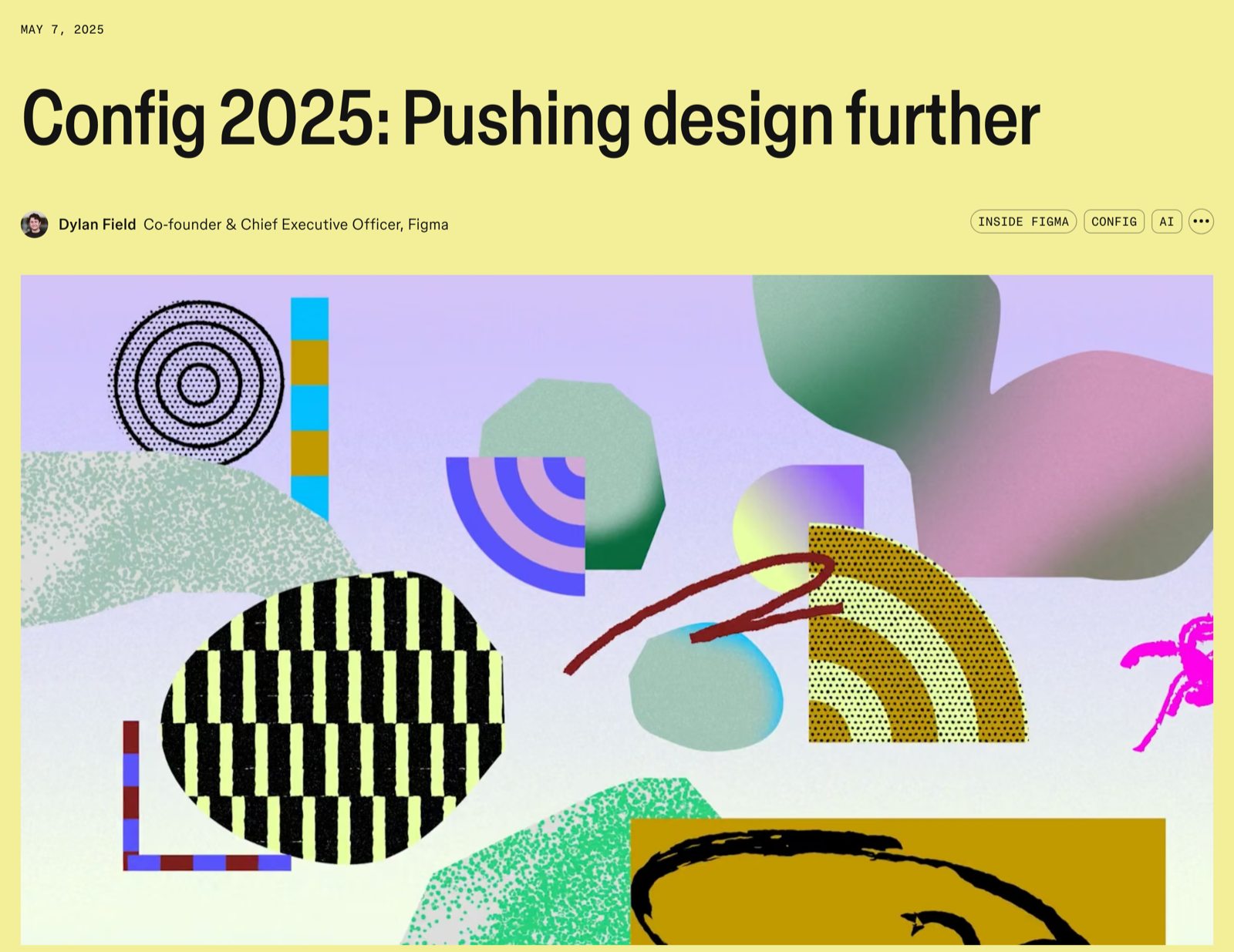
At Config 2025, Figma used its keynote to announce four new products at once: Figma Sites (build and publish websites), Figma Make (prompt-to-app prototyping), Figma Buzz (on-brand marketing assets) and Figma Draw (vector illustration). Sites and Make launched in beta.
Four products in one keynote could easily have felt scattered. Figma tied them together with one story: helping teams go from idea to launch without leaving Figma.
Why this works: A Tier 1 launch needs a narrative bigger than any single feature. Figma's story let press, customers and analysts take in four launches as one strategic move. It's the same reason the Apple iPhone debuted in 2007 through a tightly controlled keynote: narrative-led launches can reshape a category and build brand equity. Shipping in beta also let Figma learn from real use before calling anything done.
How to replicate it: If you have an annual event or a big moment, save it for releases that change your strategy, and give them a single headline that explains why they belong together. Then plan the in-product follow-through for each one separately. A keynote creates awareness. Adoption happens when a user opens the new feature for the first time and knows what to do.
Key takeaway: Big stages are for big stories. Make sure the story is bigger than the feature list.
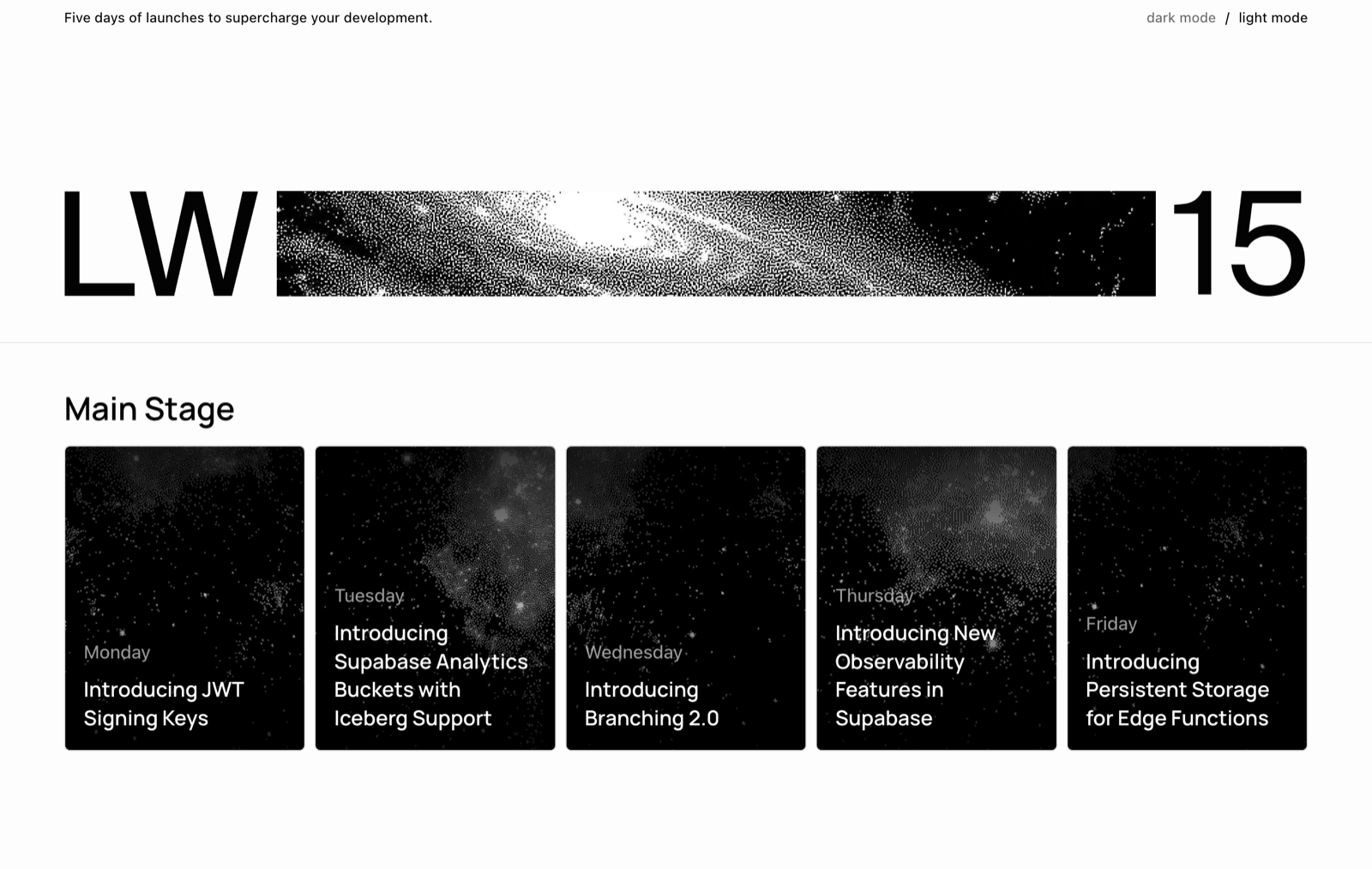
When Supabase planned a launch in March 2021, someone asked a simple question: why only one launch? The team decided to ship something every day for a week instead. Launch Week has been a recurring event ever since.
The format has settled into a pattern. Monday is Community Day, spotlighting open source tools and contributions. One or two launches land each day after that, each with its own blog post and supporting launch materials. Friday holds a "one more thing" announcement. Some editions end with a hackathon so developers build with what just shipped.
Why this works: Launch Week solves the micro-launch problem by bundling. A dozen releases that would each get ignored on their own become one event with a daily drumbeat. The audience has a reason to come back every day, and each release still gets its own spotlight.
How to replicate it: You don't need Supabase's developer following. Pick a cadence, quarterly or twice a year, and hold back Tier 2 and Tier 3 releases that share a theme. Give each day one headline release, one short post, social media posts, and one in-app message for the users it affects, and create assets for each day instead of one generic package. End with something people can do, like a live build session or office hours, so the week turns into use, not just reach.
Key takeaway: If you ship too often to launch everything, don't launch less. Bundle it.
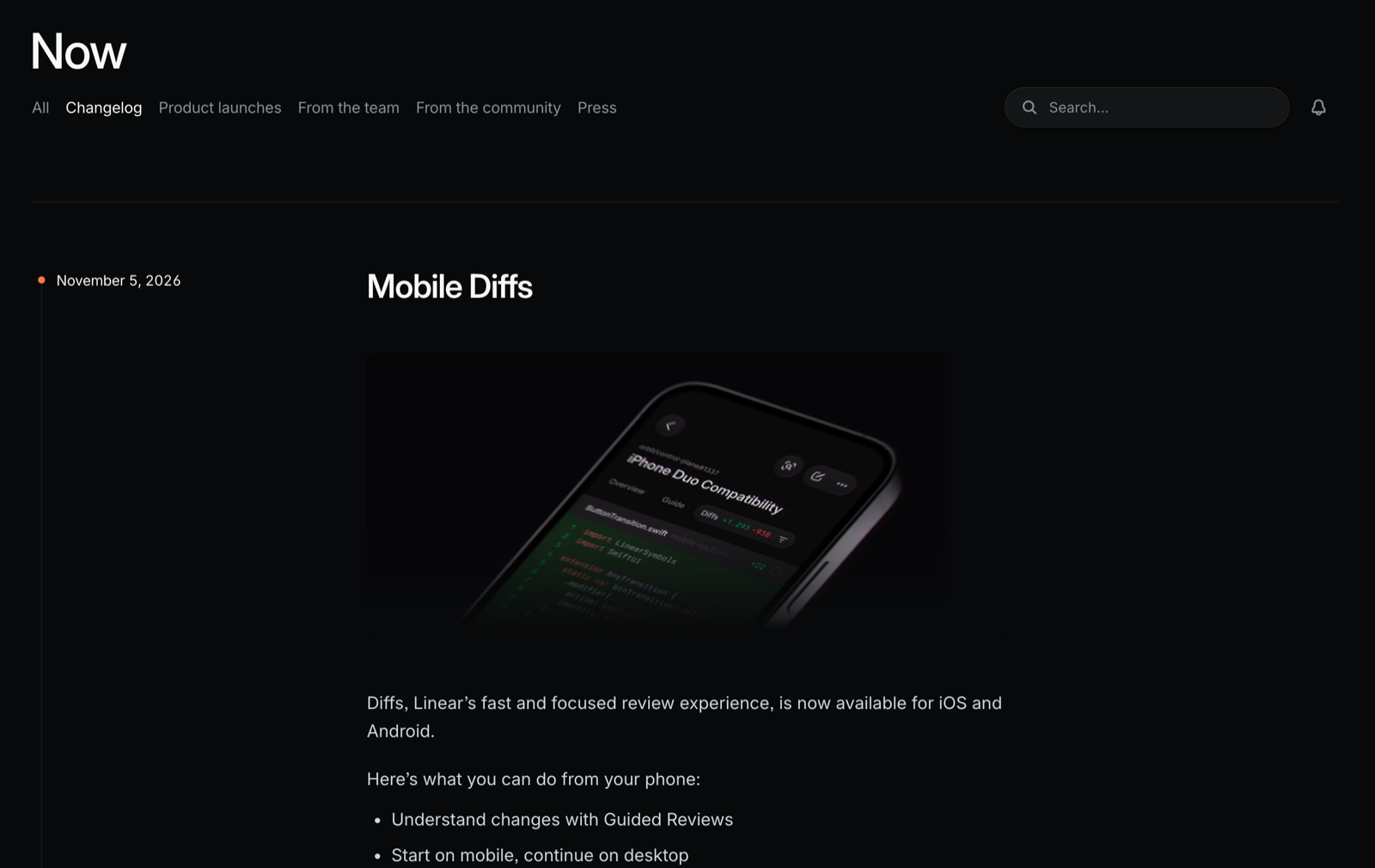
Linear doesn't rely on big launch moments. It publishes a changelog on a steady schedule, and each entry sums up what the team shipped that cycle. In Linear's own advice to startups on writing changelogs, co-founder Karri Saarinen recommends a weekly or biweekly cadence, and not letting it slip.
The changelog does two jobs. It tells customers what's new, with each entry acting as a lightweight product announcement for ongoing releases. It also shows how fast the product is improving, which is a selling point in itself.
Why this works: When releases are constant, consistency beats volume. Customers learn when and where to look. Each update builds on the last, so even small releases add to a sense of momentum and can still signal progress to a broad audience beyond existing users.
How to replicate it: Pick a cadence you can keep, and treat it as a commitment. Write entries from the customer's side: what they can do now, not what engineering did. Then connect the changelog to the product. The people a change affects shouldn't have to go looking for it. Show them in-app, in context, when they reach the part of the product that changed.
Key takeaway: Always-on launching works when it's predictable. Make the rhythm part of the product.
Customer service SaaS Feefo needed to ship a complete product redesign. The risk was that users would log into a familiar platform and find it had changed overnight. That kind of surprise drives churn.
Instead, Feefo used Appcues to build an in-app communication sequence that started weeks before the launch date:
Product manager Neil Terry explained why: "It was essential to keep them aware of what was going on to avoid upsetting them and potentially losing them."
The result was a 30% opt-in rate for the new UI before it became the default.
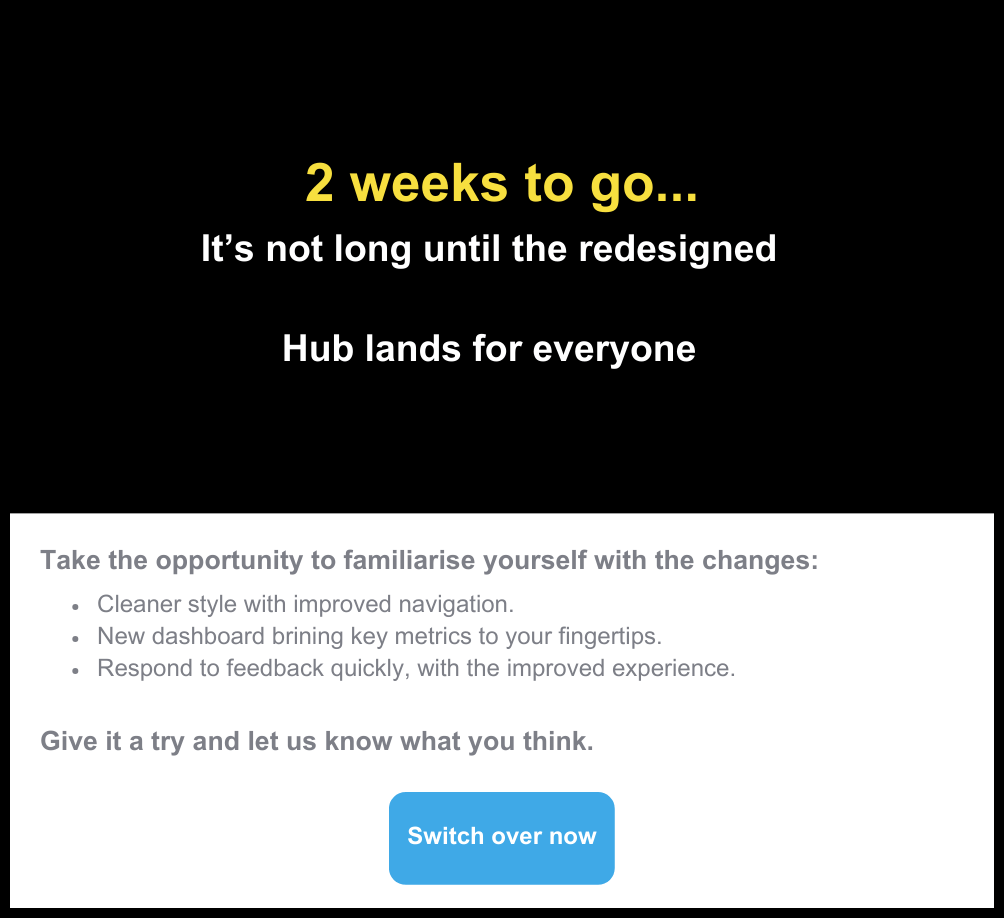
Why this works: Churn after a redesign is almost always caused by surprise, not by the change itself. Feefo gave customers a choice. Existing customers could opt in early, give feedback, and feel like insiders.
How to replicate it: Split your pre-launch window into three phases of customer communications delivered in-app before launch. Four to six weeks out, plant awareness in-app. Two to three weeks out, open an opt-in preview. One week out, switch to a countdown. If you change anything based on preview feedback, tell users with relevant information about what changed and what to do next. Closing that loop is what turns skeptics into advocates.
Key takeaway: Treat a big product change like an event, not a shock.
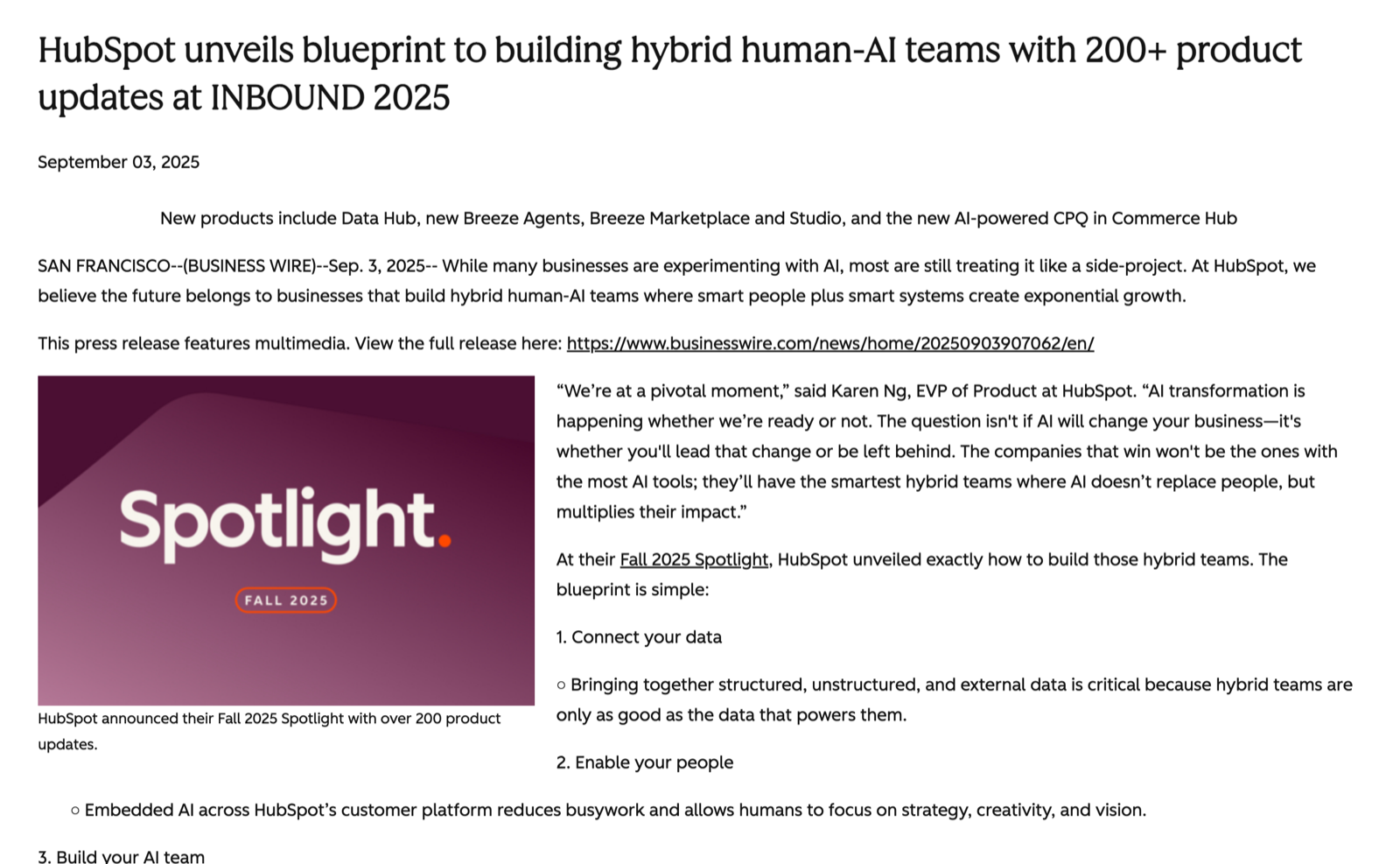
At INBOUND in September 2025, HubSpot announced more than 200 product updates. They included a new Data Hub (replacing Operations Hub), a new set of Breeze AI agents, Breeze Studio and Marketplace, and AI-powered CPQ. Many shipped in beta.
Two hundred updates is the micro-launch problem at its most extreme. HubSpot didn't try to launch them one by one. It put all of them under one idea: a "blueprint to building hybrid human-AI teams." It also introduced Loop Marketing, a playbook for how marketing teams should work now that AI is part of the team. HubSpot also published problem-focused content weeks before the launch to prepare the audience. The playbook taught the method, and the products made it possible.
Why this works: Customers can't absorb 200 updates. They can absorb one idea and then find the updates that matter to them. Publishing a playbook alongside the products does what problem-first content has always done: it gives people a reason to care before they see the feature list. Labeling early features as beta sets honest expectations, which matters even more for AI agents.
How to replicate it: When a release cycle piles up, look for the one sentence that explains why these releases belong together, and lead with it. Pair it with something that teaches the method behind the features, such as a guide, framework or template, plus supporting educational marketing materials your customers can use even before they adopt anything. Then segment the follow-through. Each segment should go only to the specific audience it affects, with tailored launch messages about the three or four updates they'll use inside the product, not all 200 in one email.
Key takeaway: When you ship more than anyone can follow, launch the idea and let customers find their features.
Social proof platform Yotpo had a familiar problem. Users installed the product and then disappeared. Not because the product was bad, but because they didn't know what to do next.
Director of Growth Omer Linhard described what they saw: "Users were completing the installation inside the admin and then they were lost. Completely lost... There was no one to guide them and they would leave."
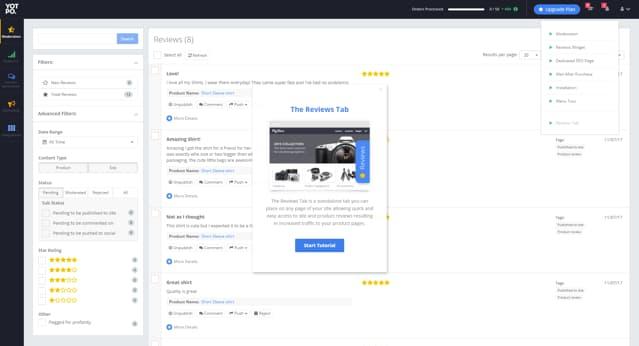
Yotpo used Appcues to build in-app guidance that responded to what each user was doing during early adoption. Someone who reached the reviews tab got a walkthrough of the reviews tab. Someone who hadn't set up a first campaign got a nudge toward it. Emails followed the same logic, triggered by where users stopped, not by a fixed schedule.
The results: 70% of users completed onboarding, one-week retention grew 50%, two-week retention grew 60% and review tab installations grew 300%.
Why this works: The gap between "installed" and "activated" is where most launches quietly fail. It's the same gap 60% of marketers in our survey named as their biggest: educating customers on what shipped. Minimizing time-to-value is what turns installs into activation.
How to replicate it: Find the milestone that predicts product success, like creating a first project or inviting a teammate. Build in-app guidance toward it, triggered by behavior. Add one behavior-triggered email for each step where users commonly drop off. Combining analytics with product onboarding tools gives you better customer insights, and those two channels together beat either one alone.
Key takeaway: A launch isn't done until customers can actually use what you shipped.
Before launching in 2013, Robinhood opened a waitlist. Signing up showed your place in line, and every friend who joined through your link moved you up. The loop fed itself: sign up, share, move up, friends share. Robinhood collected close to a million signups before launch.
Why this works: Waiting alone creates impatience, not loyalty. Robinhood gave people something to do while they waited, which helped generate awareness before the product was even available, and they felt invested before they ever logged in.
How to replicate it: A waitlist works for a new product or a gated beta, too, especially for early adopters and potential customers who are interested before launch. Show people their position, let referrals move it, and send a short update every week so the wait feels like being on the inside, not stuck in a queue.
Key takeaway: A delayed reward only works if you keep people excited while they wait.
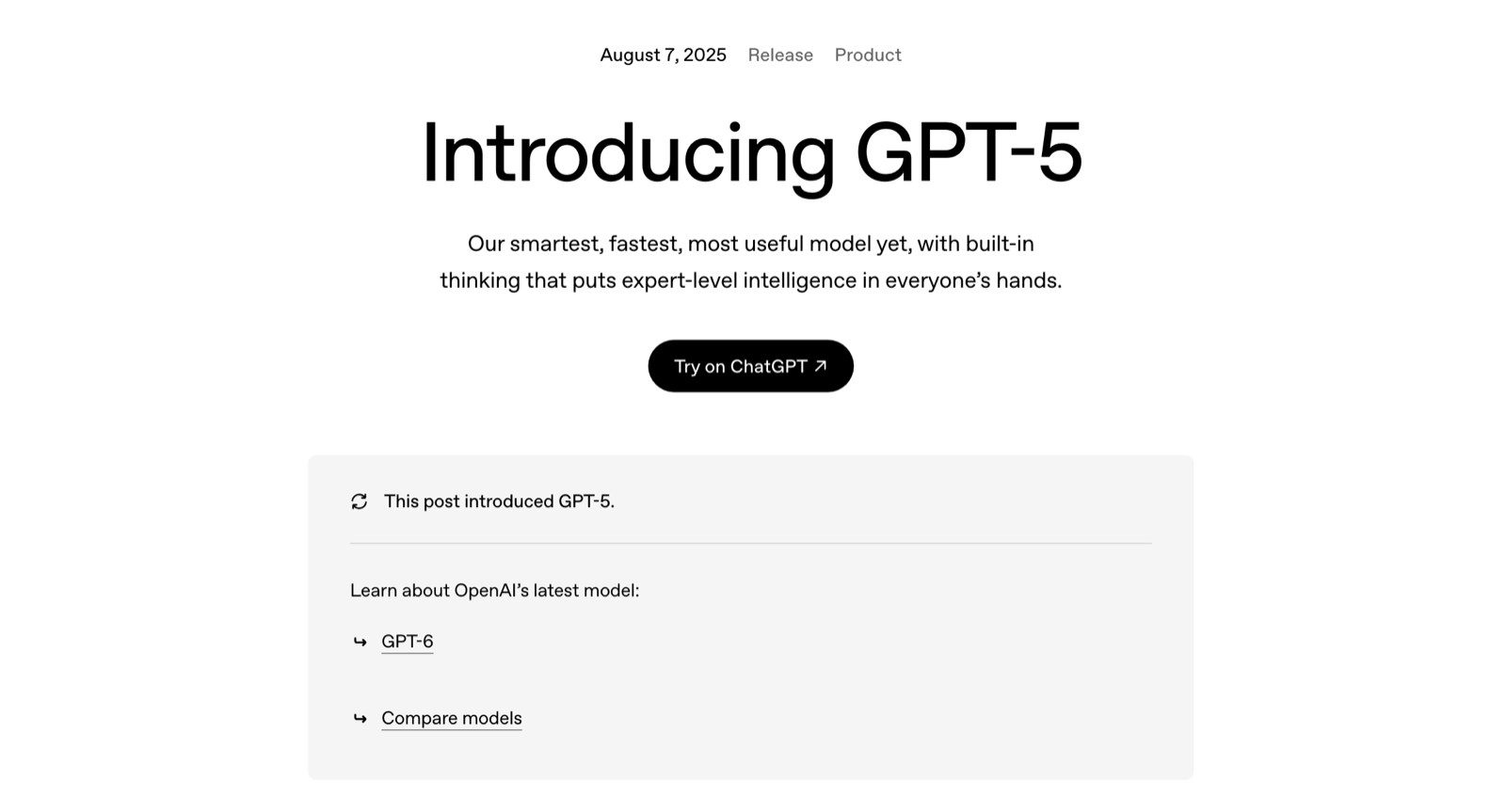
OpenAI launched GPT-5 on August 7, 2025, with a livestream and the full Tier 1 treatment. At the same time, ChatGPT moved everyone to the new model and removed the menu that let people choose older models like GPT-4o.
Many users were upset. Some had built habits and workflows around GPT-4o, and many found GPT-5's tone colder. Within days, OpenAI brought GPT-4o back for paying users, raised GPT-5's usage limits and promised a warmer personality. Sam Altman admitted that "suddenly deprecating old models" users depended on was a mistake (The Register).
Why this matters: The new model wasn't the problem. Taking away the old one without warning was, because even when it's the same product at a high level, removing the version people rely on changes the experience completely. It's the same lesson as Feefo's redesign, at a much bigger scale: people adapt to change, but they push back when change is done to them. AI features make this sharper, because users build habits around how a model behaves, not just what buttons it has.
How to replicate it (the right way): For any launch that replaces something people rely on, announce the retirement date separately from the launch, give people a period where both versions are available, and tell the users who rely most on the old version first. Watch the direct line from those users through usage signals and customer feedback closely in the first week, and decide in advance what you'll do if adoption stalls or sentiment drops.
Key takeaway: A big launch can't make up for a surprise. Plan the transition as carefully as the announcement.
Across the examples, the AI launches that worked had a few things in common. Use this as a product launch checklist to launch a product successfully.
Every example above used more than one channel. Here's how the mix looks now.
Email gets ignored and social posts scroll past. A message inside the product reaches a user at the moment they can act on it. For Tier 2 to 4 releases, in-app is often the whole launch. Target by role, plan, account or behavior, so the admin who needs to know sees only the relevant information and nobody else gets interrupted. When the update needs more explanation or a conversion step, send users from the message to help docs or product pages.
More customers now reach products through an AI chat, an agent or an MCP connection instead of clicking through a UI. That means fewer screens where a pop-up makes sense. Agent conversations become a new place to explain what changed, and a new source of signal about whether customers get it.
People trust recommendations from people they know. Give your team and your most engaged customers—the loyal fans most likely to advocate—early access, a short demo video and a clear ask to share across social media channels. Peer stories, like the case studies HubSpot gathers after every launch, make a release feel real.
Product Hunt and communities like Hacker News can still bring a surge of new users and new shoppers from outside your audience. Follow a step-by-step Product Hunt launch guide, and show up as a member, not a marketer.
Publish content about the problem weeks before the release, like HubSpot does, because content and SEO can lift signals like website traffic around a launch. Make release notes and help docs clear and current, and treat content, SEO, and AI search as product launch channels alongside the ones you already own, because AI assistants and AI search increasingly answer "what's new in [product]" using them. One survey respondent put it this way: updating a help center that feeds an AI support bot "can have more revenue impact when it reduces churn than a brand new nav icon." For Tier 1 launches, pair that distribution with press releases for broader visibility.
Short video ads at different funnel stages can reach users and lapsed customers who aren't opening your emails, so pair them with email campaigns when coordinating Tier 1 and Tier 2 releases.
They match effort to the release. Tier 1 gets the stage. Tier 3 and 4 get batched into themes or handled with a single in-app message.
They bring teams in early. Product, sales, CS and marketing know the date, the message, the launch goals, and their role before customers do, which is essential during the launch phase. In our survey, only 7% of marketers said those teams are strongly aligned on launches today.
They put the launch inside the product. In-app messages are the last mile: the explanation shows up where and when the user meets the change.
They keep going after launch day. How-tos, webinars and case studies carry customers through the stages of product adoption.
They measure the outcome, not the announcement. Initial sales matter, but reach and press are marketing metrics, not product success metrics. Whether customers reached the outcome the release was built for is the one that matters.
Tier 1, new product or new market: The full playbook. One source of truth for the plan, including the marketing plan. Work backward from the launch date to map key milestones, then build a content runway before launch, a split vision/how-to launch day and a post-launch content sprint. Consider landing it with your most engaged customers first, then announcing.
Tier 2, major feature for existing users: Lead with contextual in-app notifications targeted to the users it affects, sending the message to the specific audience most likely to care. Segment email by persona and activity. Follow up personally with customers who asked for it.
Tier 2, redesign or AI feature: Use the Feefo model: tease, preview, collect feedback, count down. Treat the preview as a soft launch to a limited group before the wider release. For AI features, add expectation-setting and in-the-moment feedback.
Tier 3 and 4, small updates: Changelog entry, a "what's new" spot in-app and, at most, a single tooltip to highlight the change. Better yet, batch them into a monthly or quarterly theme.
Our survey respondents were blunt about this one. "Measuring launch is still an enigma, even when we have the tracking tools and analytics set up," said one product marketing manager. The fix is to decide what success means before you ship, not after, and track progress against launch goals before and after release.
If AI is why your team ships faster, it should also help your launches keep up. Appcues is built to help teams run a successful product launch at that pace. It combines an intelligence layer, which shows how users behave, feel and react, with a team of agents that turn those signals into action.
Your team ships AI features every week. Appcues makes sure customers actually find out, and shows you whether it worked. See how it works.
The AI launches will keep coming. You don't need a bigger team to keep up. You need a launch process built for the pace. The teams in this post didn't treat launch as a day. Notion showed people a new way to work. Supabase made launch a week. Linear made it a weekly habit. Appcues made it the last step, after customers were already on board.
Building the product is 80% of the work. The other 20% is where you capture the value. To see how 60 product marketers are rethinking that 20%, get the State of Product Launches 2026 report. For the full playbook, read our ultimate guide to product launches.
Product Development
Product Launches
Retention & Churn
Email Marketing
TL;DR
If you're looking for product launch examples right now, there's a good chance your roadmap is full of AI. An assistant last quarter, agents this quarter, an "AI-powered" label on half the release notes. Each one is supposed to be a big deal. None of them got a full launch, because the next one was already shipping.
You're not alone, and you're not doing it wrong. The way most teams launch was built for a slower pace and for features people already understood. This post covers what's changed, ten launches worth learning from, and how to adapt.
A product launch is the planned effort to introduce a new product or feature in a way that drives adoption, not just awareness. It covers everything from deciding who needs to hear about a release to checking, weeks later, whether they're actually using it.
Building the product is 80% of the work. The last 20%, the launch, is where you capture the value. It's also the part AI has made hardest to keep up with.
For most of the last decade, a "launch" meant a big moment: months of planning, an announcement day, then a few weeks of follow-on promotion.
AI broke that model in two ways.
There's more to launch. AI coding tools have sped up how fast product teams ship. Launch teams didn't get any bigger. One senior manager told us the number of updates in each launch is "4x what it was a year ago," which turns every launch into "a FLOOD of new information for customers and internal teams."
AI features are harder to launch. A new button explains itself. An agent that does work on your behalf doesn't. Customers need to know what it can do, what it can't, and whether to trust it. Many AI features also ship before they're finished. As one principal PMM put it: "AI means products are being shipped part-baked. There is less of a clear line of readiness."
We surveyed 60 product marketers with Navattic for the State of Product Launches 2026 report. Here's what they told us:
AI is good at the first draft of a launch: the blog post, the battle card, the help article. It doesn't get customers to adopt what you shipped. Shipping faster with AI and writing faster with AI just means more features nobody knows how to use.
One VP of Marketing summed it up: "Now, it's more like a constant stream of micro-launches. We need a new approach."
Another respondent's whole answer was four words: "We ship and forget."
The shift underneath all of this: launches are moving from big moments to always-on, targeted releases. The question is changing too. It used to be "Did they use it?" Now it's "Did our customers get the outcome they came to us for?"
Every release deserves a different level of effort. If you shout about everything, your customers stop listening.
As part of your product launch plan, every release deserves effort that matches its impact to support a successful market entry. A launch tier framework matches Go to Market Strategy effort to how much a release matters, and not every release should get the same push without a clear strategy:
This framework helps teams decide what support each release needs for a successful launch.
The 2026 update: batch the Cheers and Chirps. At today's release pace, Tier 3 and Tier 4 releases make up most of what ships. Giving each one its own announcement buries customers. Many teams now hold small releases until there's a critical mass of related ones, then launch the theme. As one survey respondent put it: "We are shifting from launching releases to supporting individual releases, but not doing a 'launch' until we've released a critical mass of related features."
And move AI features up a tier. A small AI feature can need more launch support than a big conventional one, because customers have to change how they work and trust the result. An AI summary button might look like a Tier 3 Cheer, but if users don't know when to rely on it, it needs Tier 2 treatment: introduce it in context, set expectations and ask for feedback.
Some examples below are full Tier 1 campaigns. Others are a single in-app message. Both count.
In March 2026, Appcues CEO Ryan Barry told the company it was relaunching the business on July 1, rebuilt as an agentic-first product. That meant new capabilities, pricing, positioning and services all at once. It was about as big an AI launch as a company can take on. The product team built the new Appcues alongside the old one rather than renovating it. They shipped behind feature flags, enabled one customer-facing team every week and teased the change to customers with early-access opt-ins.
On June 1, the new Appcues went to its first customer: Appcues itself. Then came a slow, deliberate rollout to everyone else.
By late October, 100% of ARR was on the new Appcues and more than 90% of customers were activated. That hit the H2 goal three months early. All before a public launch.
Why this works: A launch announcement is the bow on the gift. Landing is the work. Moving customers onto the new product first, and before the public announcement, minimized time-to-value once the broader launch happened. It also meant the public launch could point to customers already getting results instead of promising them.
How to replicate it: For a major redesign or replatform, make your own team Customer 0. Then treat the staged rollout before the public launch as the product release and move in waves you can watch: the most engaged accounts first, everyone else after. Enable one internal team at a time, so sales and CS can answer questions before customers ask them. Hold the big announcement until there's proof to announce.
Key takeaway: For the biggest launches, the date to circle isn't the announcement. It's the day most customers are already using the new thing.
On September 18, 2025, Notion released Notion 3.0. It rebuilt Notion AI around agents that can create pages, build databases and run multi-step work across a workspace. The release also added MCP connections to outside tools.
This wasn't a feature launch in the usual sense. It changed how people use the product and the product's story. Before, you clicked through pages yourself. Now you could hand an agent a task.
Why this works: Launching AI that changes behavior is a trust problem as much as an awareness problem. Customers need to know what the agent can do, what it can't, and that they're still in control. A launch like this has to show people the new way to work, not just tell them it exists.
How to replicate it: If you're launching an AI feature, identify the target audience first and plan for expectation-setting, not just announcement. Introduce it in the workflow where it helps most. Say plainly what it does and doesn't do. Ask for user feedback in the moment, right after someone tries it, not in an email a week later. And measure whether people come back and use it a second time. That's the signal that they trust it.
Key takeaway: For AI launches, adoption follows trust. Build the trust into the launch.
At Config 2025, Figma used its keynote to announce four new products at once: Figma Sites (build and publish websites), Figma Make (prompt-to-app prototyping), Figma Buzz (on-brand marketing assets) and Figma Draw (vector illustration). Sites and Make launched in beta.
Four products in one keynote could easily have felt scattered. Figma tied them together with one story: helping teams go from idea to launch without leaving Figma.
Why this works: A Tier 1 launch needs a narrative bigger than any single feature. Figma's story let press, customers and analysts take in four launches as one strategic move. It's the same reason the Apple iPhone debuted in 2007 through a tightly controlled keynote: narrative-led launches can reshape a category and build brand equity. Shipping in beta also let Figma learn from real use before calling anything done.
How to replicate it: If you have an annual event or a big moment, save it for releases that change your strategy, and give them a single headline that explains why they belong together. Then plan the in-product follow-through for each one separately. A keynote creates awareness. Adoption happens when a user opens the new feature for the first time and knows what to do.
Key takeaway: Big stages are for big stories. Make sure the story is bigger than the feature list.
When Supabase planned a launch in March 2021, someone asked a simple question: why only one launch? The team decided to ship something every day for a week instead. Launch Week has been a recurring event ever since.
The format has settled into a pattern. Monday is Community Day, spotlighting open source tools and contributions. One or two launches land each day after that, each with its own blog post and supporting launch materials. Friday holds a "one more thing" announcement. Some editions end with a hackathon so developers build with what just shipped.
Why this works: Launch Week solves the micro-launch problem by bundling. A dozen releases that would each get ignored on their own become one event with a daily drumbeat. The audience has a reason to come back every day, and each release still gets its own spotlight.
How to replicate it: You don't need Supabase's developer following. Pick a cadence, quarterly or twice a year, and hold back Tier 2 and Tier 3 releases that share a theme. Give each day one headline release, one short post, social media posts, and one in-app message for the users it affects, and create assets for each day instead of one generic package. End with something people can do, like a live build session or office hours, so the week turns into use, not just reach.
Key takeaway: If you ship too often to launch everything, don't launch less. Bundle it.
Linear doesn't rely on big launch moments. It publishes a changelog on a steady schedule, and each entry sums up what the team shipped that cycle. In Linear's own advice to startups on writing changelogs, co-founder Karri Saarinen recommends a weekly or biweekly cadence, and not letting it slip.
The changelog does two jobs. It tells customers what's new, with each entry acting as a lightweight product announcement for ongoing releases. It also shows how fast the product is improving, which is a selling point in itself.
Why this works: When releases are constant, consistency beats volume. Customers learn when and where to look. Each update builds on the last, so even small releases add to a sense of momentum and can still signal progress to a broad audience beyond existing users.
How to replicate it: Pick a cadence you can keep, and treat it as a commitment. Write entries from the customer's side: what they can do now, not what engineering did. Then connect the changelog to the product. The people a change affects shouldn't have to go looking for it. Show them in-app, in context, when they reach the part of the product that changed.
Key takeaway: Always-on launching works when it's predictable. Make the rhythm part of the product.
Customer service SaaS Feefo needed to ship a complete product redesign. The risk was that users would log into a familiar platform and find it had changed overnight. That kind of surprise drives churn.
Instead, Feefo used Appcues to build an in-app communication sequence that started weeks before the launch date:
Product manager Neil Terry explained why: "It was essential to keep them aware of what was going on to avoid upsetting them and potentially losing them."
The result was a 30% opt-in rate for the new UI before it became the default.
Why this works: Churn after a redesign is almost always caused by surprise, not by the change itself. Feefo gave customers a choice. Existing customers could opt in early, give feedback, and feel like insiders.
How to replicate it: Split your pre-launch window into three phases of customer communications delivered in-app before launch. Four to six weeks out, plant awareness in-app. Two to three weeks out, open an opt-in preview. One week out, switch to a countdown. If you change anything based on preview feedback, tell users with relevant information about what changed and what to do next. Closing that loop is what turns skeptics into advocates.
Key takeaway: Treat a big product change like an event, not a shock.
At INBOUND in September 2025, HubSpot announced more than 200 product updates. They included a new Data Hub (replacing Operations Hub), a new set of Breeze AI agents, Breeze Studio and Marketplace, and AI-powered CPQ. Many shipped in beta.
Two hundred updates is the micro-launch problem at its most extreme. HubSpot didn't try to launch them one by one. It put all of them under one idea: a "blueprint to building hybrid human-AI teams." It also introduced Loop Marketing, a playbook for how marketing teams should work now that AI is part of the team. HubSpot also published problem-focused content weeks before the launch to prepare the audience. The playbook taught the method, and the products made it possible.
Why this works: Customers can't absorb 200 updates. They can absorb one idea and then find the updates that matter to them. Publishing a playbook alongside the products does what problem-first content has always done: it gives people a reason to care before they see the feature list. Labeling early features as beta sets honest expectations, which matters even more for AI agents.
How to replicate it: When a release cycle piles up, look for the one sentence that explains why these releases belong together, and lead with it. Pair it with something that teaches the method behind the features, such as a guide, framework or template, plus supporting educational marketing materials your customers can use even before they adopt anything. Then segment the follow-through. Each segment should go only to the specific audience it affects, with tailored launch messages about the three or four updates they'll use inside the product, not all 200 in one email.
Key takeaway: When you ship more than anyone can follow, launch the idea and let customers find their features.
Social proof platform Yotpo had a familiar problem. Users installed the product and then disappeared. Not because the product was bad, but because they didn't know what to do next.
Director of Growth Omer Linhard described what they saw: "Users were completing the installation inside the admin and then they were lost. Completely lost... There was no one to guide them and they would leave."
Yotpo used Appcues to build in-app guidance that responded to what each user was doing during early adoption. Someone who reached the reviews tab got a walkthrough of the reviews tab. Someone who hadn't set up a first campaign got a nudge toward it. Emails followed the same logic, triggered by where users stopped, not by a fixed schedule.
The results: 70% of users completed onboarding, one-week retention grew 50%, two-week retention grew 60% and review tab installations grew 300%.
Why this works: The gap between "installed" and "activated" is where most launches quietly fail. It's the same gap 60% of marketers in our survey named as their biggest: educating customers on what shipped. Minimizing time-to-value is what turns installs into activation.
How to replicate it: Find the milestone that predicts product success, like creating a first project or inviting a teammate. Build in-app guidance toward it, triggered by behavior. Add one behavior-triggered email for each step where users commonly drop off. Combining analytics with product onboarding tools gives you better customer insights, and those two channels together beat either one alone.
Key takeaway: A launch isn't done until customers can actually use what you shipped.
Before launching in 2013, Robinhood opened a waitlist. Signing up showed your place in line, and every friend who joined through your link moved you up. The loop fed itself: sign up, share, move up, friends share. Robinhood collected close to a million signups before launch.
Why this works: Waiting alone creates impatience, not loyalty. Robinhood gave people something to do while they waited, which helped generate awareness before the product was even available, and they felt invested before they ever logged in.
How to replicate it: A waitlist works for a new product or a gated beta, too, especially for early adopters and potential customers who are interested before launch. Show people their position, let referrals move it, and send a short update every week so the wait feels like being on the inside, not stuck in a queue.
Key takeaway: A delayed reward only works if you keep people excited while they wait.
OpenAI launched GPT-5 on August 7, 2025, with a livestream and the full Tier 1 treatment. At the same time, ChatGPT moved everyone to the new model and removed the menu that let people choose older models like GPT-4o.
Many users were upset. Some had built habits and workflows around GPT-4o, and many found GPT-5's tone colder. Within days, OpenAI brought GPT-4o back for paying users, raised GPT-5's usage limits and promised a warmer personality. Sam Altman admitted that "suddenly deprecating old models" users depended on was a mistake (The Register).
Why this matters: The new model wasn't the problem. Taking away the old one without warning was, because even when it's the same product at a high level, removing the version people rely on changes the experience completely. It's the same lesson as Feefo's redesign, at a much bigger scale: people adapt to change, but they push back when change is done to them. AI features make this sharper, because users build habits around how a model behaves, not just what buttons it has.
How to replicate it (the right way): For any launch that replaces something people rely on, announce the retirement date separately from the launch, give people a period where both versions are available, and tell the users who rely most on the old version first. Watch the direct line from those users through usage signals and customer feedback closely in the first week, and decide in advance what you'll do if adoption stalls or sentiment drops.
Key takeaway: A big launch can't make up for a surprise. Plan the transition as carefully as the announcement.
Across the examples, the AI launches that worked had a few things in common. Use this as a product launch checklist to launch a product successfully.
Every example above used more than one channel. Here's how the mix looks now.
Email gets ignored and social posts scroll past. A message inside the product reaches a user at the moment they can act on it. For Tier 2 to 4 releases, in-app is often the whole launch. Target by role, plan, account or behavior, so the admin who needs to know sees only the relevant information and nobody else gets interrupted. When the update needs more explanation or a conversion step, send users from the message to help docs or product pages.
More customers now reach products through an AI chat, an agent or an MCP connection instead of clicking through a UI. That means fewer screens where a pop-up makes sense. Agent conversations become a new place to explain what changed, and a new source of signal about whether customers get it.
People trust recommendations from people they know. Give your team and your most engaged customers—the loyal fans most likely to advocate—early access, a short demo video and a clear ask to share across social media channels. Peer stories, like the case studies HubSpot gathers after every launch, make a release feel real.
Product Hunt and communities like Hacker News can still bring a surge of new users and new shoppers from outside your audience. Follow a step-by-step Product Hunt launch guide, and show up as a member, not a marketer.
Publish content about the problem weeks before the release, like HubSpot does, because content and SEO can lift signals like website traffic around a launch. Make release notes and help docs clear and current, and treat content, SEO, and AI search as product launch channels alongside the ones you already own, because AI assistants and AI search increasingly answer "what's new in [product]" using them. One survey respondent put it this way: updating a help center that feeds an AI support bot "can have more revenue impact when it reduces churn than a brand new nav icon." For Tier 1 launches, pair that distribution with press releases for broader visibility.
Short video ads at different funnel stages can reach users and lapsed customers who aren't opening your emails, so pair them with email campaigns when coordinating Tier 1 and Tier 2 releases.
They match effort to the release. Tier 1 gets the stage. Tier 3 and 4 get batched into themes or handled with a single in-app message.
They bring teams in early. Product, sales, CS and marketing know the date, the message, the launch goals, and their role before customers do, which is essential during the launch phase. In our survey, only 7% of marketers said those teams are strongly aligned on launches today.
They put the launch inside the product. In-app messages are the last mile: the explanation shows up where and when the user meets the change.
They keep going after launch day. How-tos, webinars and case studies carry customers through the stages of product adoption.
They measure the outcome, not the announcement. Initial sales matter, but reach and press are marketing metrics, not product success metrics. Whether customers reached the outcome the release was built for is the one that matters.
Tier 1, new product or new market: The full playbook. One source of truth for the plan, including the marketing plan. Work backward from the launch date to map key milestones, then build a content runway before launch, a split vision/how-to launch day and a post-launch content sprint. Consider landing it with your most engaged customers first, then announcing.
Tier 2, major feature for existing users: Lead with contextual in-app notifications targeted to the users it affects, sending the message to the specific audience most likely to care. Segment email by persona and activity. Follow up personally with customers who asked for it.
Tier 2, redesign or AI feature: Use the Feefo model: tease, preview, collect feedback, count down. Treat the preview as a soft launch to a limited group before the wider release. For AI features, add expectation-setting and in-the-moment feedback.
Tier 3 and 4, small updates: Changelog entry, a "what's new" spot in-app and, at most, a single tooltip to highlight the change. Better yet, batch them into a monthly or quarterly theme.
Our survey respondents were blunt about this one. "Measuring launch is still an enigma, even when we have the tracking tools and analytics set up," said one product marketing manager. The fix is to decide what success means before you ship, not after, and track progress against launch goals before and after release.
If AI is why your team ships faster, it should also help your launches keep up. Appcues is built to help teams run a successful product launch at that pace. It combines an intelligence layer, which shows how users behave, feel and react, with a team of agents that turn those signals into action.
Your team ships AI features every week. Appcues makes sure customers actually find out, and shows you whether it worked. See how it works.
The AI launches will keep coming. You don't need a bigger team to keep up. You need a launch process built for the pace. The teams in this post didn't treat launch as a day. Notion showed people a new way to work. Supabase made launch a week. Linear made it a weekly habit. Appcues made it the last step, after customers were already on board.
Building the product is 80% of the work. The other 20% is where you capture the value. To see how 60 product marketers are rethinking that 20%, get the State of Product Launches 2026 report. For the full playbook, read our ultimate guide to product launches.

Sign up for Quickcues and get our monthly updates!