.png)
Appcues and Whatfix both show up in DAP searches, but they were built for different users solving different problems. Whatfix is purpose-built for employee onboarding and internal software adoption — think IT teams rolling out a new ERP system. Appcues is purpose-built for customer-facing engagement — onboarding new users, driving feature adoption, and retaining customers across in-app, email, push, and mobile. Teams evaluating both are often solving two different problems. This comparison breaks down where each tool is genuinely stronger and where the differences are meaningful enough to drive the decision.
When teams search for a digital adoption platform, Appcues and Whatfix keep landing in the same shortlist. Same category. Similar features. Nearly identical surface-level pitch.
Feature matrices don't tell you who a digital adoption platform was actually built for — and with these two, that question matters more than any individual feature or capability.
A note on perspective: This post is written by Appcues. We've tried to represent Whatfix accurately, and we'll call out where they're the stronger choice.
Appcues and Whatfix both show up in digital adoption searches, but they were built for fundamentally different problems. Here's how they compare at a glance.
The customer onboarding platform market includes tools designed for different problems. Here's how the leading platforms compare:
Appcues leads with behavior-based targeting, A/B experimentation, cross-channel orchestration, and goals tracking. It's built for teams engaging their own users across the full lifecycle.
Whatfix leads with third-party app support (Salesforce, SAP, Workday), flow branching, and SCORM/LMS compliance.
Before you evaluate a single feature, answer this: are you guiding your own users through your own product, or getting employees productive on software your company purchased?
Whatfix is a digital adoption platform built for the second problem. Their sweet spot is the enterprise company rolling out Salesforce, Workday, SAP, or ServiceNow to employees who didn't choose the tools and resist learning them. Over 80 Fortune 500 companies use Whatfix for employee training, compliance, and change management — that's where their investment, expertise, and roadmap all point.
Appcues is a digital adoption platform built for the first problem. Every Appcues feature — behavior-based targeting, cross-channel orchestration, A/B experimentation, goals and outcomes tracking — was designed for teams trying to onboard their own users, drive feature adoption, and keep users from churning. Appcues wasn't adapted for that use case; it was built for it.
This shows up everywhere: which integrations get prioritized, how analytics are structured, what the support team coaches you on. A digital adoption platform optimized for employee training creates friction when your goal is customer engagement — not because it's a bad tool, but because it's the wrong one.
Both Appcues and Whatfix offer core features for in-app user guidance: modals, tooltips, checklists, product tours, and interactive walkthroughs. For basic onboarding flows and in app messaging, either digital adoption platform handles the job.
Where they split:
Appcues adds slideouts, pins, A/B experimentation, flow prioritization, and a goals system that ties user engagement to business outcomes. These aren't extras — they're what separates a digital adoption program you can measure and improve from one you just set up and hope works.
Whatfix has stronger flow branching for complex, process-oriented interactive walkthroughs — genuinely useful when you're guiding employees through multi-step enterprise workflows where the path varies by role or context. Whatfix also supports Citrix, VDI, and desktop applications, which Appcues doesn't target.
The table below compares Appcues and Whatfix across twelve core capabilities. Appcues leads on experimentation, goals, cross-channel reach, and flow prioritization. Whatfix leads on flow branching and third-party app support.

For customer-facing digital adoption, targeting is most of the job. The right user segments, the right moment, triggered by what users have done — not a generic bucket they fell into at signup.
Appcues uses behavior-based segmentation built on events, user attributes, and account properties. Two-way integrations with analytics tools like Amplitude, Mixpanel, and Heap mean behavioral data flows in both directions — you analyze user behavior in your existing tools, and Appcues features fire automatically based on what users have done. No manual handoff, no guessing.
Whatfix offers contextual user guidance based on where users are in an application — useful for employee training scenarios. But integration depth is narrower: Whatfix has only a one-way connection with Heap and no Mixpanel integration. For digital adoption programs that depend on user behavior data flowing across the stack, that's a hard constraint.
Appcues coordinates user engagement across in-app, email, mobile apps, and push notifications. Users aren't always in your product when you need to reach them. Lapsed users need email. Mobile apps users need push. A digital adoption platform that only works inside the app leaves a lot of user behavior — and a lot of users — unaddressed.
Whatfix digital adoption platform tools support embedding content within apps — SCORM compliance, LMS integration — but those tools serve the employee training use case. No email. No push. No cross-channel reach for users outside the product.
Appcues has two-way integrations with the tools most SaaS teams already use: Segment, Salesforce, HubSpot, Amplitude, Mixpanel, Heap. Behavioral data flows in both directions, so the user guidance Appcues delivers is actually powered by what users do across your whole stack.
Whatfix connects well with SAP, Workday, Oracle, and ServiceNow — the right tools for employee training. But the integration story with product analytics and marketing tools is thin. Non technical teams building customer-facing digital adoption programs will hit that limit quickly.
The speed gap is one of the starkest differences in any Whatfix Appcues comparison, and G2 reviewers bring it up constantly.
Appcues gets users live in hours. One line of code, and non technical users — product managers, marketers, CX leads — can start building user onboarding flows, product tours, and user guidance the same day. No professional services. No sprint dependencies. Users see something on day one.
Whatfix implementations average three months — typically with professional services and engineering teams involved throughout. For enterprise organizations with real change management and compliance needs, that investment can make sense. For teams trying to ship and learn quickly, three months before users see anything is a tough ask.
G2 ratings reflect this: Appcues 4.7/5 (1,600+ reviews) vs. Whatfix 4.6/5 (500+). The scores are close; the written reviews aren't. Appcues reviewers cite fast iteration and tools that non technical teams can own. Whatfix reviewers more often flag confusing dashboards and extra clicks for basic tasks. Whatfix also routinely recommends professional services for ongoing content creation, which layers onto support costs.
Appcues treats detailed analytics as part of the loop, not a reporting afterthought. Set goals tied to real outcomes — user onboarding, feature usage, retention — then measure whether user behavior changed. A/B experimentation shows what actually moved users. Detailed analytics connect user engagement data to the outcomes Appcues is meant to drive.
Whatfix has flow-level detailed analytics — completion rates, user engagement with content, exportable reports — that work well for employee training, where knowing whether users finished the walkthrough is the primary question. But there's no goal-setting, no A/B testing, no way to tie user guidance to business results. The Whatfix digital adoption platform tells you what happened inside the tool, not whether the digital adoption program worked.
Appcues pricing scales with the scope of your customer engagement programs — no mandatory professional services layer on top.
Whatfix is priced for enterprise buyers. Platform licensing typically runs $24K–$32K/year, which looks accessible compared to WalkMe's ~$79K. But professional services for implementation and content creation often push the real number to $40K–$70K or more, before ongoing support costs as users and content volume grow. The initial quote rarely matches what you pay six months later.
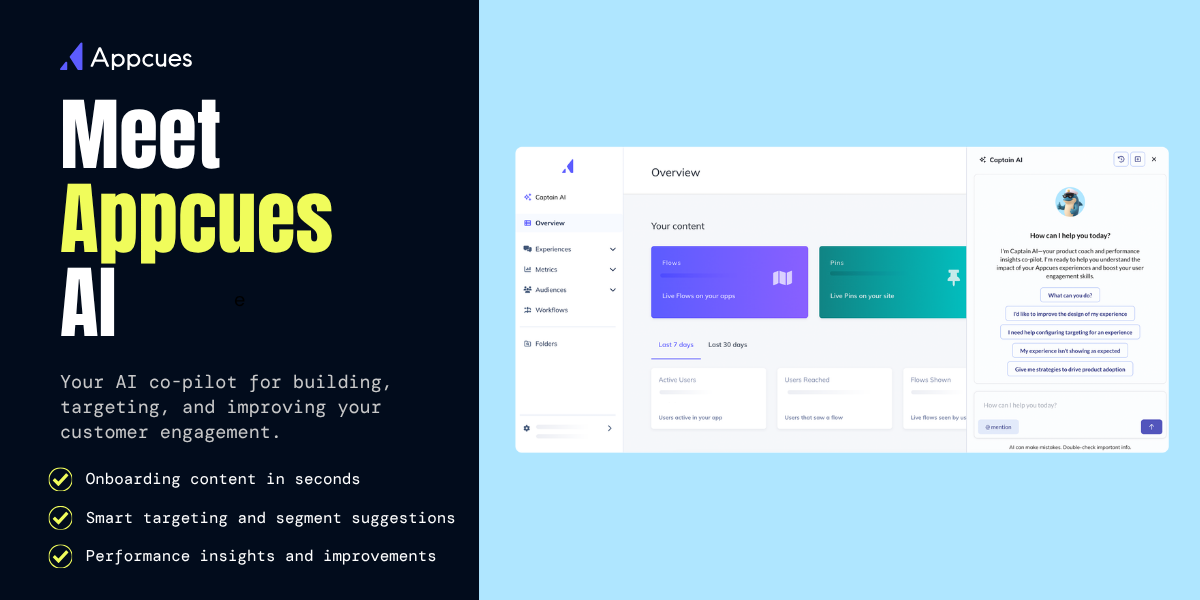
Appcues AI helps non technical teams create and iterate faster: content generation, targeting suggestions, performance analysis, AI localization on mobile apps. Less time in the weeds of building, more time actually improving what users experience.
Whatfix has AI writing assistance and AI Do — in-app task automation that completes actions for users inside enterprise tools. For employee users, AI Do is a legitimate differentiator: automating repetitive clicks inside Salesforce or helping to streamline workflows in complex enterprise software has real user productivity value. For customer-facing user engagement — where the goal is personalized coaching that moves users toward value, not automating clicks for them — Captain AI is more relevant.
Appcues:
Whatfix:
Appcues makes sense if:
Whatfix makes sense if:
Whatfix is a strong digital adoption platform if your core challenge is getting employees productive on complex, third-party enterprise software. The professional services model, the enterprise integrations, the SCORM compliance — all of it is built around that problem.
Appcues is a digital adoption platform built for a different challenge: engaging your own users across their full lifecycle, in every channel they use. Non technical teams get live in hours. Appcues features like A/B experimentation, goals, and detailed analytics tell you whether the digital adoption program is working — not just whether users clicked through a flow. And when users aren't in the app, Appcues reaches them by email, mobile apps, or push.
Two digital adoption platforms, two different problems, two different user bases. Easy call once you're honest about which one you have.
Product Adoption
Email Marketing
User Engagement
Product Tours & Walkthroughs
TL;DR
Appcues and Whatfix both show up in DAP searches, but they were built for different users solving different problems. Whatfix is purpose-built for employee onboarding and internal software adoption — think IT teams rolling out a new ERP system. Appcues is purpose-built for customer-facing engagement — onboarding new users, driving feature adoption, and retaining customers across in-app, email, push, and mobile. Teams evaluating both are often solving two different problems. This comparison breaks down where each tool is genuinely stronger and where the differences are meaningful enough to drive the decision.
When teams search for a digital adoption platform, Appcues and Whatfix keep landing in the same shortlist. Same category. Similar features. Nearly identical surface-level pitch.
Feature matrices don't tell you who a digital adoption platform was actually built for — and with these two, that question matters more than any individual feature or capability.
A note on perspective: This post is written by Appcues. We've tried to represent Whatfix accurately, and we'll call out where they're the stronger choice.
Appcues and Whatfix both show up in digital adoption searches, but they were built for fundamentally different problems. Here's how they compare at a glance.
The customer onboarding platform market includes tools designed for different problems. Here's how the leading platforms compare:
Appcues leads with behavior-based targeting, A/B experimentation, cross-channel orchestration, and goals tracking. It's built for teams engaging their own users across the full lifecycle.
Whatfix leads with third-party app support (Salesforce, SAP, Workday), flow branching, and SCORM/LMS compliance.
Before you evaluate a single feature, answer this: are you guiding your own users through your own product, or getting employees productive on software your company purchased?
Whatfix is a digital adoption platform built for the second problem. Their sweet spot is the enterprise company rolling out Salesforce, Workday, SAP, or ServiceNow to employees who didn't choose the tools and resist learning them. Over 80 Fortune 500 companies use Whatfix for employee training, compliance, and change management — that's where their investment, expertise, and roadmap all point.
Appcues is a digital adoption platform built for the first problem. Every Appcues feature — behavior-based targeting, cross-channel orchestration, A/B experimentation, goals and outcomes tracking — was designed for teams trying to onboard their own users, drive feature adoption, and keep users from churning. Appcues wasn't adapted for that use case; it was built for it.
This shows up everywhere: which integrations get prioritized, how analytics are structured, what the support team coaches you on. A digital adoption platform optimized for employee training creates friction when your goal is customer engagement — not because it's a bad tool, but because it's the wrong one.
Both Appcues and Whatfix offer core features for in-app user guidance: modals, tooltips, checklists, product tours, and interactive walkthroughs. For basic onboarding flows and in app messaging, either digital adoption platform handles the job.
Where they split:
Appcues adds slideouts, pins, A/B experimentation, flow prioritization, and a goals system that ties user engagement to business outcomes. These aren't extras — they're what separates a digital adoption program you can measure and improve from one you just set up and hope works.
Whatfix has stronger flow branching for complex, process-oriented interactive walkthroughs — genuinely useful when you're guiding employees through multi-step enterprise workflows where the path varies by role or context. Whatfix also supports Citrix, VDI, and desktop applications, which Appcues doesn't target.
The table below compares Appcues and Whatfix across twelve core capabilities. Appcues leads on experimentation, goals, cross-channel reach, and flow prioritization. Whatfix leads on flow branching and third-party app support.
For customer-facing digital adoption, targeting is most of the job. The right user segments, the right moment, triggered by what users have done — not a generic bucket they fell into at signup.
Appcues uses behavior-based segmentation built on events, user attributes, and account properties. Two-way integrations with analytics tools like Amplitude, Mixpanel, and Heap mean behavioral data flows in both directions — you analyze user behavior in your existing tools, and Appcues features fire automatically based on what users have done. No manual handoff, no guessing.
Whatfix offers contextual user guidance based on where users are in an application — useful for employee training scenarios. But integration depth is narrower: Whatfix has only a one-way connection with Heap and no Mixpanel integration. For digital adoption programs that depend on user behavior data flowing across the stack, that's a hard constraint.
Appcues coordinates user engagement across in-app, email, mobile apps, and push notifications. Users aren't always in your product when you need to reach them. Lapsed users need email. Mobile apps users need push. A digital adoption platform that only works inside the app leaves a lot of user behavior — and a lot of users — unaddressed.
Whatfix digital adoption platform tools support embedding content within apps — SCORM compliance, LMS integration — but those tools serve the employee training use case. No email. No push. No cross-channel reach for users outside the product.
Appcues has two-way integrations with the tools most SaaS teams already use: Segment, Salesforce, HubSpot, Amplitude, Mixpanel, Heap. Behavioral data flows in both directions, so the user guidance Appcues delivers is actually powered by what users do across your whole stack.
Whatfix connects well with SAP, Workday, Oracle, and ServiceNow — the right tools for employee training. But the integration story with product analytics and marketing tools is thin. Non technical teams building customer-facing digital adoption programs will hit that limit quickly.
The speed gap is one of the starkest differences in any Whatfix Appcues comparison, and G2 reviewers bring it up constantly.
Appcues gets users live in hours. One line of code, and non technical users — product managers, marketers, CX leads — can start building user onboarding flows, product tours, and user guidance the same day. No professional services. No sprint dependencies. Users see something on day one.
Whatfix implementations average three months — typically with professional services and engineering teams involved throughout. For enterprise organizations with real change management and compliance needs, that investment can make sense. For teams trying to ship and learn quickly, three months before users see anything is a tough ask.
G2 ratings reflect this: Appcues 4.7/5 (1,600+ reviews) vs. Whatfix 4.6/5 (500+). The scores are close; the written reviews aren't. Appcues reviewers cite fast iteration and tools that non technical teams can own. Whatfix reviewers more often flag confusing dashboards and extra clicks for basic tasks. Whatfix also routinely recommends professional services for ongoing content creation, which layers onto support costs.
Appcues treats detailed analytics as part of the loop, not a reporting afterthought. Set goals tied to real outcomes — user onboarding, feature usage, retention — then measure whether user behavior changed. A/B experimentation shows what actually moved users. Detailed analytics connect user engagement data to the outcomes Appcues is meant to drive.
Whatfix has flow-level detailed analytics — completion rates, user engagement with content, exportable reports — that work well for employee training, where knowing whether users finished the walkthrough is the primary question. But there's no goal-setting, no A/B testing, no way to tie user guidance to business results. The Whatfix digital adoption platform tells you what happened inside the tool, not whether the digital adoption program worked.
Appcues pricing scales with the scope of your customer engagement programs — no mandatory professional services layer on top.
Whatfix is priced for enterprise buyers. Platform licensing typically runs $24K–$32K/year, which looks accessible compared to WalkMe's ~$79K. But professional services for implementation and content creation often push the real number to $40K–$70K or more, before ongoing support costs as users and content volume grow. The initial quote rarely matches what you pay six months later.
Appcues AI helps non technical teams create and iterate faster: content generation, targeting suggestions, performance analysis, AI localization on mobile apps. Less time in the weeds of building, more time actually improving what users experience.
Whatfix has AI writing assistance and AI Do — in-app task automation that completes actions for users inside enterprise tools. For employee users, AI Do is a legitimate differentiator: automating repetitive clicks inside Salesforce or helping to streamline workflows in complex enterprise software has real user productivity value. For customer-facing user engagement — where the goal is personalized coaching that moves users toward value, not automating clicks for them — Captain AI is more relevant.
Appcues:
Whatfix:
Appcues makes sense if:
Whatfix makes sense if:
Whatfix is a strong digital adoption platform if your core challenge is getting employees productive on complex, third-party enterprise software. The professional services model, the enterprise integrations, the SCORM compliance — all of it is built around that problem.
Appcues is a digital adoption platform built for a different challenge: engaging your own users across their full lifecycle, in every channel they use. Non technical teams get live in hours. Appcues features like A/B experimentation, goals, and detailed analytics tell you whether the digital adoption program is working — not just whether users clicked through a flow. And when users aren't in the app, Appcues reaches them by email, mobile apps, or push.
Two digital adoption platforms, two different problems, two different user bases. Easy call once you're honest about which one you have.

Sign up for Quickcues and get our monthly updates!
.svg)