.png)

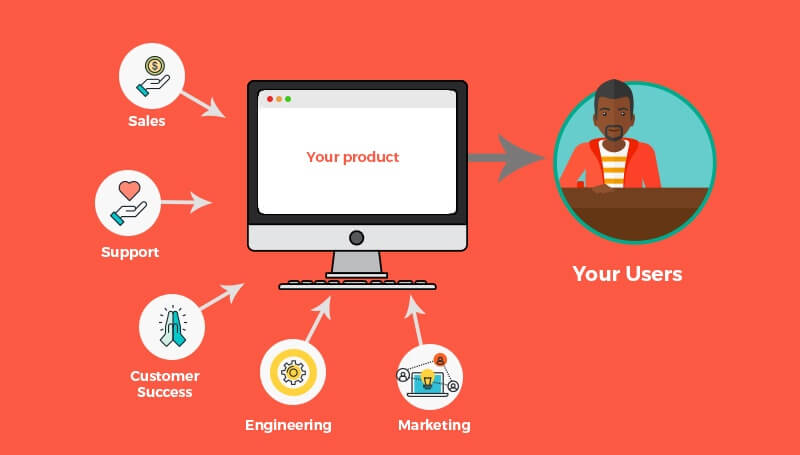
Most lifecycle marketing guides forget the channel where your customers actually spend their time: your product.
The math has changed. Customer acquisition costs have climbed steadily over the past five years, and for most SaaS companies, the cost of acquiring a new customer now outpaces what that customer generates in their first months. That pressure is why lifecycle marketing keeps showing up in roadmaps and hiring plans. Teams are realizing that a coordinated, stage-aware approach to customer engagement drives better retention and a healthier business.
But here is the thing most teams get wrong: they default to email drip sequences and call it a lifecycle marketing strategy. A welcome series here, a re-engagement campaign there, and a quarterly newsletter to keep the lights on.
Email is a core lifecycle channel, but for SaaS companies it is rarely the most impactful one.
Your product is where customers experience value. It is where they onboard, adopt features, hit milestones, and decide whether to stay or leave. If your lifecycle marketing program does not include in-app experiences, you are running a half-built strategy. And onboarding is the most important part of the customer journey for getting this right.
This guide covers what lifecycle marketing actually is, how the stages work (including the one most frameworks skip), and how to build a lifecycle marketing strategy that treats the product experience as a first-class channel.
Lifecycle marketing is a strategy that engages customers with relevant messages and experiences at every stage of their relationship with your brand, from first awareness through long-term advocacy.
That is the short version. Here is what it actually means in practice.
A lifecycle marketing strategy coordinates messaging across multiple channels (email, in-app, push notifications, ads, and the product itself) based on where each customer is in their journey. Instead of blasting the same message to your entire database, you deliver targeted experiences that match what the customer needs right now.
What lifecycle marketing includes: behavioral segmentation, stage-specific goals, multi-channel orchestration, and content tailored to where someone is in their relationship with your product.
What it is not: a single email drip campaign, a CRM workflow, or a one-time onboarding sequence. Those are tactics within a lifecycle strategy, not the strategy itself.
The most common misconception? That lifecycle marketing is just email marketing with extra steps. In reality, customer lifecycle marketing spans every touchpoint where you interact with your customers. For SaaS teams, that means extending lifecycle thinking into the product. In-app tours, feature announcements, contextual tooltips, and onboarding checklists are all lifecycle touchpoints. They just live inside your product instead of your inbox.
Think of it this way: if lifecycle marketing is about delivering the right message, to the right person, at the right moment, then your product is the place where timing and context are richest.
Here is a quick way to frame lifecycle marketing for your own team:
Lifecycle marketing for [your company] means delivering [message type, e.g., onboarding checklist, feature tip, upgrade prompt] to [segment, e.g., new trial users, power users, lapsed accounts] when they [behavioral trigger, e.g., complete signup, hit a usage milestone, go inactive for 7 days] to drive [outcome, e.g., activation, feature adoption, expansion revenue].
If you can fill in those blanks for each lifecycle stage, you have the foundation for a lifecycle marketing strategy.
You have heard the stat: acquiring a new customer costs five to 25 times more than retaining an existing one. It has been cited so often it has lost its edge. But the underlying math has only gotten more extreme.
For SaaS companies operating in a product-led model, lifecycle marketing is the operating system for growth. It determines whether you retain the customers you work so hard to acquire.
Retention is the revenue multiplier. A 5% increase in customer retention can increase profits by 25% to 95%, according to research from Bain & Company. Lifecycle marketing is how you make that retention intentional rather than accidental.
The alternative is expensive. Without a lifecycle approach, you end up with batch-and-blast messaging that ignores where the customer actually is. New users get upgrade prompts before they have seen value. Power users get beginner tips. The result: unsubscribes, disengagement, and churn.
In a product-led company, the product IS the primary lifecycle touchpoint. Your customers are inside your product every day. That is where they experience value and make the decision to stay or expand. If your lifecycle marketing strategy only touches them via email and ads, you are reaching them in the channels where they spend the least time and missing the channel where context is richest. Building effective customer engagement strategies that span the full lifecycle starts with recognizing this.
Teams that take lifecycle marketing seriously, and extend it into the product experience, see the results in their activation and retention numbers. It is a compounding advantage, not a theory.
Most lifecycle marketing frameworks describe four to six stages. We use seven, because for SaaS teams, onboarding deserves its own stage. Skipping it is like building a funnel with a hole in the middle.
Here is each stage, what it looks like, and the metrics that tell you whether it is working.
Goal: Get on the radar.
This is the top of the funnel. Potential customers discover your brand through content marketing, SEO, paid ads, social media, or word of mouth. The objective is simple: make people aware that you exist and that you solve a problem they care about.
Key channels: Blog content, search, paid campaigns, social media.
Metric to watch: Reach, website traffic, branded search volume.
Goal: Educate and build trust.
Prospects know you exist. Now they are evaluating whether you are worth their time. This stage is about providing proof: comparison pages, case studies, webinars, and detailed product content that helps them understand your value.
Key channels: Comparison pages, webinars, case studies, product demos.
Metric to watch: Engagement rate, marketing qualified leads (MQLs).
Goal: Turn interest into action.
This is where a prospect becomes a customer (or at least a trial user). For SaaS companies, conversion might mean starting a free trial, signing up for a freemium plan, or completing a purchase.
Key channels: Landing pages, pricing pages, in-app CTAs, signup flows.
Metric to watch: Conversion rate, trial starts, cost per acquisition.
Goal: Deliver first value, fast.
This is the stage most lifecycle marketing frameworks skip, and it is arguably the most important for SaaS teams. Onboarding is where churn is won or lost. If a new user does not reach their "aha moment" quickly, they leave.
Effective user onboarding goes beyond a welcome email. It includes in-app checklists, guided product tours, contextual tooltips, and progressive disclosure that helps users build competence without feeling overwhelmed.
Key channels: In-app flows, welcome emails, onboarding checklists, product tours.
Metric to watch: Activation rate, time-to-value, onboarding completion rate.
Goal: Keep users engaged and coming back.
Once users are activated, the job becomes keeping them engaged. Retention-stage lifecycle marketing surfaces relevant features, prompts habitual usage, and re-engages users who are drifting away.
Key channels: In-app nudges, feature adoption prompts, email re-engagement campaigns.
Metric to watch: DAU/MAU ratio, churn rate, session frequency.
Goal: Grow revenue from existing customers.
Happy, engaged customers are your best growth engine. Expansion-stage marketing identifies upsell and cross-sell opportunities based on usage patterns and behavioral triggers.
Key channels: In-app upsell prompts, usage-based triggers, cross-sell campaigns.
Metric to watch: Expansion MRR, net revenue retention (NRR).
Goal: Turn happy customers into promoters.
The final stage closes the loop. Advocates refer new customers, leave reviews, and contribute to your community. They make acquisition cheaper and more credible.
Key channels: NPS surveys, referral programs, in-app review prompts, community programs.
Metric to watch: NPS, referral rate, review volume.
Start with your actual customer journey, not a generic template. Where do users drop off? Where do they accelerate? The answers are specific to your product.
Audit your existing touchpoints across email, in-app, and push. Identify gaps (stages with no messaging) and overlaps (stages with too many conflicting messages). Then define clear goals and ownership for each stage before you write a single campaign. A lifecycle marketing guide can help you structure this audit.
Lifecycle stage audit template (copy and fill in for each stage):
Most lifecycle programs start with time-based drip campaigns: day 1, send welcome email; day 3, send feature highlight; day 7, send check-in. The problem? Your users do not progress through your product on a fixed schedule.
Event-based triggers (user completed an onboarding step, hit a usage milestone, abandoned a key workflow) outperform scheduled drips because they match the message to what the customer actually did. A prompt to explore an advanced feature lands differently when it arrives right after someone masters the basics.
This is the practice most teams skip entirely, and it is the biggest missed opportunity in SaaS lifecycle marketing.
In-app messages, tooltips, onboarding checklists, and feature announcements are lifecycle touchpoints. They reach users at the moment of highest context and attention: while they are using your product. A well-timed in-app nudge during onboarding or a contextual upsell prompt when a user hits a plan limit can drive more impact than a dozen emails.
Tools like Appcues make it possible for marketing teams to build and launch these in-app lifecycle experiences without engineering support, turning the product into an active part of your lifecycle strategy. For a deeper look at how this works in practice, see our guide on aligning lifecycle emails with in-app messaging.
In SaaS, lifecycle marketing is not just marketing's job. Onboarding might be owned by product. Retention campaigns might be shared between marketing and customer success. Expansion is often a collaboration between marketing and sales.
Define who owns what at each lifecycle stage. Shared visibility into customer journey data keeps everyone coordinated and prevents conflicting messages from reaching the same user on the same day.
Open rates and click-through rates are useful, but they do not tell you whether your lifecycle strategy is working. Track metrics that map to each stage: activation rate for onboarding, feature adoption for retention, expansion MRR for growth, NPS for advocacy. A solid set of user engagement metrics gives you the visibility to act on what you find.
When you measure by stage, you can spot breakdowns in the journey and fix them with precision instead of guessing which email subject line needs a rewrite.
Email is a critical lifecycle channel. It is not the only one. When your lifecycle program lives entirely in your ESP, you are missing the channels where customers make real decisions: inside your product, on mobile, and in response to contextual triggers.
The fix: audit every stage of your lifecycle for channel coverage. If onboarding, retention, and expansion stages only have email touchpoints, you have gaps to fill.
Most lifecycle frameworks jump from conversion straight to retention. That gap is where SaaS churn lives. If a new user signs up and the next lifecycle touchpoint is a "we miss you" re-engagement email two weeks later, you have already lost them.
The fix: treat onboarding as its own stage with dedicated goals (activation, time-to-value), dedicated channels (in-app flows, checklists, welcome sequences), and dedicated metrics. This is where you earn the right to retain. Our product onboarding guide covers this in depth.
A trial user exploring your product for the first time and a power user managing a team of 50 are in completely different lifecycle stages. Sending them the same newsletter or the same in-app announcement wastes both their time.
The fix: segment by lifecycle stage and layer in behavioral data. Lifecycle stage plus in-product behavior equals relevance. Research from McKinsey on personalization shows that companies getting this right see significantly higher engagement and revenue. The more precisely you target, the fewer messages you need to send and the more impact each one delivers.
HubSpot's onboarding experience is a strong lifecycle marketing example because it personalizes based on the user's role and goals. During signup, users indicate what they want to accomplish, and HubSpot tailors the onboarding sequence accordingly: different setup guides, different feature highlights, different email cadences.
The result is a faster path to value for each user segment. Instead of a one-size-fits-all welcome tour, new users see the features most relevant to their use case within their first session. This behavioral approach to onboarding directly supports activation, and HubSpot's strong free-to-paid conversion rates reflect it. For more onboarding examples across SaaS, see our full breakdown.
Dropbox is a classic example of lifecycle marketing at the expansion stage. When a user approaches their storage limit, Dropbox does not wait for a scheduled email campaign. It triggers contextual upgrade prompts at the moment the user is most likely to feel the constraint.
This usage-based trigger approach means the upsell message arrives with built-in context: the user is actively trying to do something, and the upgrade removes the blocker. Dropbox's ability to grow revenue from existing users (rather than relying solely on new signups) is a direct result of lifecycle marketing that responds to product behavior in real time.
Canva uses in-app messaging as a core lifecycle channel at multiple stages. New users see interactive onboarding flows that guide them through their first design. As users become more proficient, Canva surfaces feature discovery prompts (templates, brand kit tools, collaboration features) that match the user's growing skill level.
At the retention and expansion stages, Canva uses in-app nudges to highlight premium features within the workflow where they are most relevant. The key is timing: Canva does not interrupt users with upgrade pitches on login. It surfaces them when a user tries to use a premium feature, creating a natural connection between the value and the ask.
Next step: Audit your current lifecycle program stage by stage. For each of the seven stages, ask: What messaging exists? What channels are we using? What is the gap? Start filling gaps where the drop-off is highest.
Lifecycle marketing works best when it includes the place your customers spend the most time: your product. Appcues helps marketing teams build in-app experiences, from onboarding flows to expansion prompts, without waiting on engineering.
Lifecycle Marketing
Email Marketing
Retention & Churn
Customer Engagement
TL;DR
Most lifecycle marketing guides forget the channel where your customers actually spend their time: your product.
The math has changed. Customer acquisition costs have climbed steadily over the past five years, and for most SaaS companies, the cost of acquiring a new customer now outpaces what that customer generates in their first months. That pressure is why lifecycle marketing keeps showing up in roadmaps and hiring plans. Teams are realizing that a coordinated, stage-aware approach to customer engagement drives better retention and a healthier business.
But here is the thing most teams get wrong: they default to email drip sequences and call it a lifecycle marketing strategy. A welcome series here, a re-engagement campaign there, and a quarterly newsletter to keep the lights on.
Email is a core lifecycle channel, but for SaaS companies it is rarely the most impactful one.
Your product is where customers experience value. It is where they onboard, adopt features, hit milestones, and decide whether to stay or leave. If your lifecycle marketing program does not include in-app experiences, you are running a half-built strategy. And onboarding is the most important part of the customer journey for getting this right.
This guide covers what lifecycle marketing actually is, how the stages work (including the one most frameworks skip), and how to build a lifecycle marketing strategy that treats the product experience as a first-class channel.
Lifecycle marketing is a strategy that engages customers with relevant messages and experiences at every stage of their relationship with your brand, from first awareness through long-term advocacy.
That is the short version. Here is what it actually means in practice.
A lifecycle marketing strategy coordinates messaging across multiple channels (email, in-app, push notifications, ads, and the product itself) based on where each customer is in their journey. Instead of blasting the same message to your entire database, you deliver targeted experiences that match what the customer needs right now.
What lifecycle marketing includes: behavioral segmentation, stage-specific goals, multi-channel orchestration, and content tailored to where someone is in their relationship with your product.
What it is not: a single email drip campaign, a CRM workflow, or a one-time onboarding sequence. Those are tactics within a lifecycle strategy, not the strategy itself.
The most common misconception? That lifecycle marketing is just email marketing with extra steps. In reality, customer lifecycle marketing spans every touchpoint where you interact with your customers. For SaaS teams, that means extending lifecycle thinking into the product. In-app tours, feature announcements, contextual tooltips, and onboarding checklists are all lifecycle touchpoints. They just live inside your product instead of your inbox.
Think of it this way: if lifecycle marketing is about delivering the right message, to the right person, at the right moment, then your product is the place where timing and context are richest.
Here is a quick way to frame lifecycle marketing for your own team:
Lifecycle marketing for [your company] means delivering [message type, e.g., onboarding checklist, feature tip, upgrade prompt] to [segment, e.g., new trial users, power users, lapsed accounts] when they [behavioral trigger, e.g., complete signup, hit a usage milestone, go inactive for 7 days] to drive [outcome, e.g., activation, feature adoption, expansion revenue].
If you can fill in those blanks for each lifecycle stage, you have the foundation for a lifecycle marketing strategy.
You have heard the stat: acquiring a new customer costs five to 25 times more than retaining an existing one. It has been cited so often it has lost its edge. But the underlying math has only gotten more extreme.
For SaaS companies operating in a product-led model, lifecycle marketing is the operating system for growth. It determines whether you retain the customers you work so hard to acquire.
Retention is the revenue multiplier. A 5% increase in customer retention can increase profits by 25% to 95%, according to research from Bain & Company. Lifecycle marketing is how you make that retention intentional rather than accidental.
The alternative is expensive. Without a lifecycle approach, you end up with batch-and-blast messaging that ignores where the customer actually is. New users get upgrade prompts before they have seen value. Power users get beginner tips. The result: unsubscribes, disengagement, and churn.
In a product-led company, the product IS the primary lifecycle touchpoint. Your customers are inside your product every day. That is where they experience value and make the decision to stay or expand. If your lifecycle marketing strategy only touches them via email and ads, you are reaching them in the channels where they spend the least time and missing the channel where context is richest. Building effective customer engagement strategies that span the full lifecycle starts with recognizing this.
Teams that take lifecycle marketing seriously, and extend it into the product experience, see the results in their activation and retention numbers. It is a compounding advantage, not a theory.
Most lifecycle marketing frameworks describe four to six stages. We use seven, because for SaaS teams, onboarding deserves its own stage. Skipping it is like building a funnel with a hole in the middle.
Here is each stage, what it looks like, and the metrics that tell you whether it is working.
Goal: Get on the radar.
This is the top of the funnel. Potential customers discover your brand through content marketing, SEO, paid ads, social media, or word of mouth. The objective is simple: make people aware that you exist and that you solve a problem they care about.
Key channels: Blog content, search, paid campaigns, social media.
Metric to watch: Reach, website traffic, branded search volume.
Goal: Educate and build trust.
Prospects know you exist. Now they are evaluating whether you are worth their time. This stage is about providing proof: comparison pages, case studies, webinars, and detailed product content that helps them understand your value.
Key channels: Comparison pages, webinars, case studies, product demos.
Metric to watch: Engagement rate, marketing qualified leads (MQLs).
Goal: Turn interest into action.
This is where a prospect becomes a customer (or at least a trial user). For SaaS companies, conversion might mean starting a free trial, signing up for a freemium plan, or completing a purchase.
Key channels: Landing pages, pricing pages, in-app CTAs, signup flows.
Metric to watch: Conversion rate, trial starts, cost per acquisition.
Goal: Deliver first value, fast.
This is the stage most lifecycle marketing frameworks skip, and it is arguably the most important for SaaS teams. Onboarding is where churn is won or lost. If a new user does not reach their "aha moment" quickly, they leave.
Effective user onboarding goes beyond a welcome email. It includes in-app checklists, guided product tours, contextual tooltips, and progressive disclosure that helps users build competence without feeling overwhelmed.
Key channels: In-app flows, welcome emails, onboarding checklists, product tours.
Metric to watch: Activation rate, time-to-value, onboarding completion rate.
Goal: Keep users engaged and coming back.
Once users are activated, the job becomes keeping them engaged. Retention-stage lifecycle marketing surfaces relevant features, prompts habitual usage, and re-engages users who are drifting away.
Key channels: In-app nudges, feature adoption prompts, email re-engagement campaigns.
Metric to watch: DAU/MAU ratio, churn rate, session frequency.
Goal: Grow revenue from existing customers.
Happy, engaged customers are your best growth engine. Expansion-stage marketing identifies upsell and cross-sell opportunities based on usage patterns and behavioral triggers.
Key channels: In-app upsell prompts, usage-based triggers, cross-sell campaigns.
Metric to watch: Expansion MRR, net revenue retention (NRR).
Goal: Turn happy customers into promoters.
The final stage closes the loop. Advocates refer new customers, leave reviews, and contribute to your community. They make acquisition cheaper and more credible.
Key channels: NPS surveys, referral programs, in-app review prompts, community programs.
Metric to watch: NPS, referral rate, review volume.
Start with your actual customer journey, not a generic template. Where do users drop off? Where do they accelerate? The answers are specific to your product.
Audit your existing touchpoints across email, in-app, and push. Identify gaps (stages with no messaging) and overlaps (stages with too many conflicting messages). Then define clear goals and ownership for each stage before you write a single campaign. A lifecycle marketing guide can help you structure this audit.
Lifecycle stage audit template (copy and fill in for each stage):
Most lifecycle programs start with time-based drip campaigns: day 1, send welcome email; day 3, send feature highlight; day 7, send check-in. The problem? Your users do not progress through your product on a fixed schedule.
Event-based triggers (user completed an onboarding step, hit a usage milestone, abandoned a key workflow) outperform scheduled drips because they match the message to what the customer actually did. A prompt to explore an advanced feature lands differently when it arrives right after someone masters the basics.
This is the practice most teams skip entirely, and it is the biggest missed opportunity in SaaS lifecycle marketing.
In-app messages, tooltips, onboarding checklists, and feature announcements are lifecycle touchpoints. They reach users at the moment of highest context and attention: while they are using your product. A well-timed in-app nudge during onboarding or a contextual upsell prompt when a user hits a plan limit can drive more impact than a dozen emails.
Tools like Appcues make it possible for marketing teams to build and launch these in-app lifecycle experiences without engineering support, turning the product into an active part of your lifecycle strategy. For a deeper look at how this works in practice, see our guide on aligning lifecycle emails with in-app messaging.
In SaaS, lifecycle marketing is not just marketing's job. Onboarding might be owned by product. Retention campaigns might be shared between marketing and customer success. Expansion is often a collaboration between marketing and sales.
Define who owns what at each lifecycle stage. Shared visibility into customer journey data keeps everyone coordinated and prevents conflicting messages from reaching the same user on the same day.
Open rates and click-through rates are useful, but they do not tell you whether your lifecycle strategy is working. Track metrics that map to each stage: activation rate for onboarding, feature adoption for retention, expansion MRR for growth, NPS for advocacy. A solid set of user engagement metrics gives you the visibility to act on what you find.
When you measure by stage, you can spot breakdowns in the journey and fix them with precision instead of guessing which email subject line needs a rewrite.
Email is a critical lifecycle channel. It is not the only one. When your lifecycle program lives entirely in your ESP, you are missing the channels where customers make real decisions: inside your product, on mobile, and in response to contextual triggers.
The fix: audit every stage of your lifecycle for channel coverage. If onboarding, retention, and expansion stages only have email touchpoints, you have gaps to fill.
Most lifecycle frameworks jump from conversion straight to retention. That gap is where SaaS churn lives. If a new user signs up and the next lifecycle touchpoint is a "we miss you" re-engagement email two weeks later, you have already lost them.
The fix: treat onboarding as its own stage with dedicated goals (activation, time-to-value), dedicated channels (in-app flows, checklists, welcome sequences), and dedicated metrics. This is where you earn the right to retain. Our product onboarding guide covers this in depth.
A trial user exploring your product for the first time and a power user managing a team of 50 are in completely different lifecycle stages. Sending them the same newsletter or the same in-app announcement wastes both their time.
The fix: segment by lifecycle stage and layer in behavioral data. Lifecycle stage plus in-product behavior equals relevance. Research from McKinsey on personalization shows that companies getting this right see significantly higher engagement and revenue. The more precisely you target, the fewer messages you need to send and the more impact each one delivers.
HubSpot's onboarding experience is a strong lifecycle marketing example because it personalizes based on the user's role and goals. During signup, users indicate what they want to accomplish, and HubSpot tailors the onboarding sequence accordingly: different setup guides, different feature highlights, different email cadences.
The result is a faster path to value for each user segment. Instead of a one-size-fits-all welcome tour, new users see the features most relevant to their use case within their first session. This behavioral approach to onboarding directly supports activation, and HubSpot's strong free-to-paid conversion rates reflect it. For more onboarding examples across SaaS, see our full breakdown.
Dropbox is a classic example of lifecycle marketing at the expansion stage. When a user approaches their storage limit, Dropbox does not wait for a scheduled email campaign. It triggers contextual upgrade prompts at the moment the user is most likely to feel the constraint.
This usage-based trigger approach means the upsell message arrives with built-in context: the user is actively trying to do something, and the upgrade removes the blocker. Dropbox's ability to grow revenue from existing users (rather than relying solely on new signups) is a direct result of lifecycle marketing that responds to product behavior in real time.
Canva uses in-app messaging as a core lifecycle channel at multiple stages. New users see interactive onboarding flows that guide them through their first design. As users become more proficient, Canva surfaces feature discovery prompts (templates, brand kit tools, collaboration features) that match the user's growing skill level.
At the retention and expansion stages, Canva uses in-app nudges to highlight premium features within the workflow where they are most relevant. The key is timing: Canva does not interrupt users with upgrade pitches on login. It surfaces them when a user tries to use a premium feature, creating a natural connection between the value and the ask.
Next step: Audit your current lifecycle program stage by stage. For each of the seven stages, ask: What messaging exists? What channels are we using? What is the gap? Start filling gaps where the drop-off is highest.
Lifecycle marketing works best when it includes the place your customers spend the most time: your product. Appcues helps marketing teams build in-app experiences, from onboarding flows to expansion prompts, without waiting on engineering.

Sign up for Quickcues and get our monthly updates!
.svg)