


For years, product launch processes ran on one assumption: product set the pace and marketing waited for a launch. In 2026, AI has disrupted this. Product is no longer the bottleneck. Go-to-market motions are.
AI-enabled engineering teams are moving at lightning speed. It can feel impossible to keep up with the value they’re adding to products. Anecdotally, we knew that this was the case–we heard it from our customers, it was the topic of nearly every networking conversation, and it was happening to us. We just needed some data to back up our assumptions.
In partnership with Navattic, we surveyed 60 marketers on the state of product launches. Today, the report is live. And the findings? Equal parts validating and frustrating, and, at times, a little surprising.
Product development is outpacing the traditional product launch: 75% of marketers say their product is shipping faster than last year. Only 7% say their launch process is keeping up.
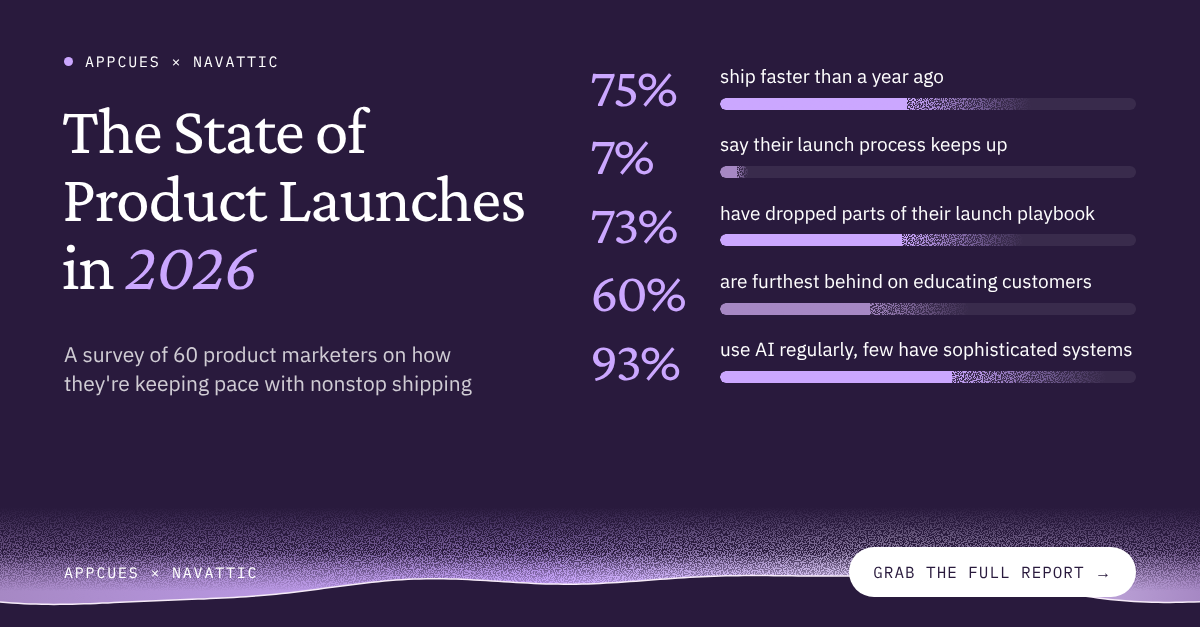
The result is launch debt: features piling up faster than customers can absorb them.
"You just end up with a bunch of new features that nobody knows how to use, because you didn’t market them." — Director of Marketing, 51–200 employees
These truths have all but erased the faint essence of GTM-product alignment that once existed. The lack of role clarity, ownership, and empowerment for most product marketing functions has been exacerbated by product’s breakneck speed. Only 7% describe alignment across product, sales, CS and marketing as strong.
On top of that, most folks haven’t figured out how to leverage AI to solve the high velocity problem it created. Instead, AI is mostly helping teams write announcements nobody sees. It’s rarely being used to automate plays or facilitate segmented launches. And almost no one is using AI to reach customers in the product. These dueling quotes shape the spectrum of how people leverage AI.
“Eh.. it helps me draft things” and
“Every tier 3 launch is fully automated via a GTM plugin PMM has built.”
Ultimately, the data paints a picture of strained marketing teams, cross-functional dysfunction, and stalled product adoption. Teams are drowning in releases. Customers are dying of thirst. Nobody’s getting a glass of water.
We built this report because we were living it. In March, our CEO catalyzed the team when he announced we’d relaunch our company in July.

Since then, our team’s been on an accelerated journey to reshape our business and product for the agentic era and help our customers do the same.
By April, our VP of Product and Engineering had set a new pace and a new approach to development that kept problems in focus and made releases nearly continuous. By July, our platform had gone from a point-and-click UI to a fully agentic surface in addition to solving a new set of customer problems. On the go-to-market side, we’d also refreshed our brand, set new pricing, and updated our service packages. By September, we’d granted all of our customers access.
Somewhere along the way, we tossed the go-to-market process we’d just crystallized in February. The speed we were moving had made it completely irrelevant by August. We had to change how our product and marketing teams collaborated and shift how we’d keep customer-facing teams in the loop. More importantly, we had to rethink how to bring our customers along for a ride they never asked for.
Our launch process just wasn’t built for the old way of shipping. We couldn’t help customers recognize the value at the speed we were shipping it and our own teams couldn’t keep up either.
As we talked to our customers and contacts about our experience, we realized this was happening across our space. In August, I told the marketing team we had to hear more directly from other people. I just knew we couldn’t be alone. Turns out we weren’t.
"We are running around like chickens with our heads cut off it seems trying to use AI, trying to show our value, trying to stay ahead of the competition, and trying to stay differentiated. It’s a strange and unsettling time...” — Director of Product Marketing, 1,001–5,000 employees
This data tells us we need to take a moment to reframe and redefine our release and launch strategies for the agentic era. It’s evident that marketing has to renegotiate its role in driving product adoption and customer outcomes.
Product marketing suffers the most when cross-functional priorities are misaligned.
That can start with a conversation about the role of PMM, but I’d start by recontracting the relationship between product and marketing, and between marketing and the customer-facing teams. Everyone needs to get on the same page about what a launch looks like at the current rate of product velocity.
If you do one thing after reading this data, start the conversation about reworking your launch and go-to-market processes collaboratively, as a cross-functional team.
More tactically, the report suggests five things you can do today to mitigate this tension:
You don’t have to overcome launch debt alone. If you’re navigating this, check out the full report, and feel free to get in touch. We’re happy to chat in more detail about our experience.
Product Adoption
For years, product launch processes ran on one assumption: product set the pace and marketing waited for a launch. In 2026, AI has disrupted this. Product is no longer the bottleneck. Go-to-market motions are.
AI-enabled engineering teams are moving at lightning speed. It can feel impossible to keep up with the value they’re adding to products. Anecdotally, we knew that this was the case–we heard it from our customers, it was the topic of nearly every networking conversation, and it was happening to us. We just needed some data to back up our assumptions.
In partnership with Navattic, we surveyed 60 marketers on the state of product launches. Today, the report is live. And the findings? Equal parts validating and frustrating, and, at times, a little surprising.
Product development is outpacing the traditional product launch: 75% of marketers say their product is shipping faster than last year. Only 7% say their launch process is keeping up.
The result is launch debt: features piling up faster than customers can absorb them.
"You just end up with a bunch of new features that nobody knows how to use, because you didn’t market them." — Director of Marketing, 51–200 employees
These truths have all but erased the faint essence of GTM-product alignment that once existed. The lack of role clarity, ownership, and empowerment for most product marketing functions has been exacerbated by product’s breakneck speed. Only 7% describe alignment across product, sales, CS and marketing as strong.
On top of that, most folks haven’t figured out how to leverage AI to solve the high velocity problem it created. Instead, AI is mostly helping teams write announcements nobody sees. It’s rarely being used to automate plays or facilitate segmented launches. And almost no one is using AI to reach customers in the product. These dueling quotes shape the spectrum of how people leverage AI.
“Eh.. it helps me draft things” and
“Every tier 3 launch is fully automated via a GTM plugin PMM has built.”
Ultimately, the data paints a picture of strained marketing teams, cross-functional dysfunction, and stalled product adoption. Teams are drowning in releases. Customers are dying of thirst. Nobody’s getting a glass of water.
We built this report because we were living it. In March, our CEO catalyzed the team when he announced we’d relaunch our company in July.
Since then, our team’s been on an accelerated journey to reshape our business and product for the agentic era and help our customers do the same.
By April, our VP of Product and Engineering had set a new pace and a new approach to development that kept problems in focus and made releases nearly continuous. By July, our platform had gone from a point-and-click UI to a fully agentic surface in addition to solving a new set of customer problems. On the go-to-market side, we’d also refreshed our brand, set new pricing, and updated our service packages. By September, we’d granted all of our customers access.
Somewhere along the way, we tossed the go-to-market process we’d just crystallized in February. The speed we were moving had made it completely irrelevant by August. We had to change how our product and marketing teams collaborated and shift how we’d keep customer-facing teams in the loop. More importantly, we had to rethink how to bring our customers along for a ride they never asked for.
Our launch process just wasn’t built for the old way of shipping. We couldn’t help customers recognize the value at the speed we were shipping it and our own teams couldn’t keep up either.
As we talked to our customers and contacts about our experience, we realized this was happening across our space. In August, I told the marketing team we had to hear more directly from other people. I just knew we couldn’t be alone. Turns out we weren’t.
"We are running around like chickens with our heads cut off it seems trying to use AI, trying to show our value, trying to stay ahead of the competition, and trying to stay differentiated. It’s a strange and unsettling time...” — Director of Product Marketing, 1,001–5,000 employees
This data tells us we need to take a moment to reframe and redefine our release and launch strategies for the agentic era. It’s evident that marketing has to renegotiate its role in driving product adoption and customer outcomes.
Product marketing suffers the most when cross-functional priorities are misaligned.
That can start with a conversation about the role of PMM, but I’d start by recontracting the relationship between product and marketing, and between marketing and the customer-facing teams. Everyone needs to get on the same page about what a launch looks like at the current rate of product velocity.
If you do one thing after reading this data, start the conversation about reworking your launch and go-to-market processes collaboratively, as a cross-functional team.
More tactically, the report suggests five things you can do today to mitigate this tension:
You don’t have to overcome launch debt alone. If you’re navigating this, check out the full report, and feel free to get in touch. We’re happy to chat in more detail about our experience.

Sign up for Quickcues and get our monthly updates!


