Product launches are overlooked in software companies. It baffles us.
Launching new product is intrinsic to what software companies do. They exist entirely to give more value by consistently launching incrementally better software. And that's pretty much it. Yet so many companies just aren't killing it in that category. They simply deploy new product and hope people find it. They suck at coordinating across teams. They publish a press release on their product when no one cares. They don't leverage their beta user group enough. The worst: they forget to take their features out of beta.
We won't sugarcoat it: product launches are a lot of work. But after helping SaaS companies launch products for nearly a decade, we've learned a thing or two. Whether you're launching a new product into the world or adding exciting new features to your existing product, you want to prepare users—both potential and existing—to dive right in and give it a try. If you get your product launch right, your new product can make a splash right away, and you'll see a quicker ROI on your development efforts.
This guide pulls together everything we've packaged up into frameworks, strategies, and videos to get you from discovery to launch day with ease.
What is a product launch, and why it matters
A product launch is a detailed plan to put a new product on the market. It's a series of actions across various teams—marketing, sales, customer support, product—to ensure a coherent and impactful debut. Put simply, it's the go-to-market strategy devised to help successfully launch a product. The main goal is to create enough buzz around the release to pique the interest of the product's target audience.
Product launches shouldn't only be reserved for main releases. You do a lot of work to your product offerings throughout the year that deserves a shout. From a marketing perspective, celebrating the "small wins" is equally important for customer acquisition and retention.
Product launch vs. go-to-market strategy
A product launch is the event of introducing a new product to the market, focused on generating excitement, building awareness, and driving initial adoption. A go-to-market (GTM) strategy is the comprehensive plan leading up to that event: identifying the target market, positioning the product, deciding on pricing, and planning distribution channels. The launch is what the GTM strategy produces.
The 4 Ps of a product launch
Most companies launch products with the goal of driving engagement, adoption, and market growth, but a structured approach makes all the difference. The 4 Ps provide a framework to ensure every launch aspect is thoughtfully planned:
Product: Define the product's unique value proposition and what problem it solves.
Pricing: Determine a pricing strategy aligned with customer value and market positioning.
Placement: Choose distribution channels that best reach your target audience.
Promotion: Plan an outreach strategy—email, social media, paid ads—to build excitement and drive awareness.
Who's responsible for product launches?
Product marketers, stand tall. This is your race. You should own the product launch vision and strategy (and rely on your marketing team for execution, of course).
When it's product launch go-time, product marketers act as conductors leading the cross-functional orchestra: keeping everyone organized, accountable, and on target to hit the end goal of launch day. But while every good launch needs a strong leader, they can't be planned in a silo. Representatives from product management, sales, customer success and support, and marketing are most common contributors. Schedule weekly meetings to keep communication high; as you get closer to the big day, consider increasing the meeting cadence with daily standups.
Common product launch failures
Launches that prioritize awareness over relevance
These launches focus on making sure everyone sees the feature, rather than making sure the right people see it at the right time. Users who are not ready or not interested learn to ignore launches altogether.
Launches that explain features instead of enabling outcomes
These launches describe what’s new but do not help users accomplish anything meaningful. Users understand the feature intellectually but never experience its value firsthand.
Launches that end on launch day
These launches treat shipping as the finish line. There is no follow-through, no reinforcement, and no plan to support users who engage later or partially.
Launches that measure attention instead of behavior
These launches look successful early, then quietly fail. Opens, clicks, and pageviews spike, while adoption stagnates.
Recognizing which of these patterns shows up in your own launches is the first step toward fixing them.
What success actually means in a product launch
A launch is successful only if it causes a meaningful change in user behavior.
That sounds obvious, but most teams never commit to a specific behavioral outcome. They talk about awareness, excitement, or engagement because those are easy to observe quickly. Behavior change takes longer and forces clarity.
Without a clear behavioral goal, teams can’t tell whether a launch is early, weak, or fundamentally broken. Everything looks like “mixed results.”
So the first job of a launch is not messaging or rollout. It’s deciding what behavior would prove that the interruption was worth it.
This behavior needs to be concrete enough that a team can recognize it when it happens, and rare enough that it doesn’t occur by accident. If the behavior happens, the launch worked. If it doesn’t, something upstream failed.
Once success is defined this way, launches stop being vague. But a new problem appears.
If success is a specific behavior, then not every user is equally likely to perform it.
Planning a successful product launch
Set a clear launch goal
Before choosing a launch date or drafting announcements, define what success looks like. Are you aiming to:
Increase activation for a new feature?
Drive upgrades or expansion?
Re-engage dormant users?
Validate demand with early adopters?
Your launch goal should directly map to a measurable outcome, like feature adoption rate, trial-to-paid conversion, or activation milestone completion.
Choose the right launch type
Not every launch needs the same level of fanfare. In fact, most can be organized along a series of tiers.
This framework allows you to strategize how you take products to market because:
You can't shout about each product and feature (or give each the same level of promotion), otherwise your customers will just stop listening.
You have restraints on time and resources, so you need to make sure you prioritize the launches that will provide the largest business impact.
A framework creates a fair and consistent way of prioritizing launch activities, so that something doesn't get extra love just because the champion was a little bit louder (we've all been there).
With a tiered approach, you essentially have a repeatable playbook for every launch. Getting buy-in on what tier a feature belongs to ahead of time is key to making this all work.
Set a realistic launch timeline
A strong launch timeline includes:
Alignment with goals, launch details, messaging, value, and the tactical plan
Internal enablement and QA
Pre-launch testing or soft rollout
Announcement and in-app messaging
Post-launch measurement
Further iteration
Build in time for feedback loops, especially if you’re using beta users or staged rollouts.
Start with product discovery and beta testing
What product managers believe customers want and what they actually want don't always align. Leading or participating in product discovery surfaces valuable insights you can use to optimize positioning and messaging, and it should inform your launch goals.
Research. Ask customers directly via surveys and customer interviews. Include in-app behavior data if you're tracking it.
Ideation. Identify the solution that best addresses customer needs while factoring in development and cost considerations. Mind-mapping, sketching, and storyboarding all help.
Beta testing. Before a broader release, put an early version in front of a smaller segment of your target audience to catch bugs, surface friction, and gather quotes you can use at launch. There's no standard length: a week or several months can both work. What matters is establishing clear, measurable success criteria upfront.
Launch plan fundamentals: positioning, messaging, and pricing
Product positioning is how your product fits into the market and what pain point it solves. Typically not customer-facing, your positioning statement is most effective as an internal tool to keep your teams aligned. A simple template:
Product positioning template: [Product name] is the [market category] that provides [benefit that sets it apart] for [target user group] who [need/want X solution].
Product messaging is the words you use to convey your positioning to your target audience. It's the expression of the positioning—where it comes to life. Unlike positioning, messaging is written with an external audience in mind. It should resonate with your target and be used consistently across your website, sales collateral, and marketing campaigns.
Pricing and packaging deserve their own conversation. Pricing strategies typically consider what competitors charge and/or what the product is worth to your customers. While there's no one-size-fits-all, we generally recommend pricing based primarily on value—competitor pricing acts as an anchor, but willingness to pay is what converts. The simplest starting point: ask your customers what they think it's worth. If they won't put a dollar figure on it, ask them to rank your new product's value relative to other products and features they already use.
Questions to ask before your next launch
Before running the usual gamut (email, blog, social), get clear internally:
Why did we build this product? This reveals the pain points it solves and the benefits it delivers. It's probably the most important question, because it lets you start with why when you communicate.
Who did we build this product for? Is there a segment that benefits more? Are there others that can't? You don't want to bug customers with an irrelevant message.
What happens if everyone uses it? Imagine 100% adoption. This helps you word the ambitious vision for how the launch impacts your customers.
What happens if no one uses it? Open your mind to the possibility that your hypothesis is wrong so you can adjust. This also makes you acknowledge the risk and investment.
How did your last launch go? Double down on what worked. Cut what didn't.
Pre-launch enablement: arm every team
Product launches take a village. You need collective buy-in from your entire organization to nail it.
Sales needs to understand positioning, pricing, and packaging, and how to clearly articulate value. Arm them with a product demo, a one-pager, new slides for the sales deck, and at least one case study from beta customers.
Customer Success and Support need to "sell" the value to existing customers and field questions on day one. Polish self-service documentation and FAQs. Set up an easy workflow—a Slack channel or support ticket tag—to capture the feedback they'll hear.
Marketing now has positioning and messaging in hand and can decide the most effective channels to reach your audience. Bake launch campaigns (and the steps to execute them) into the plan as early as possible.
Executives don't need every detail, but they need confidence. Share your launch OKRs. Show them you're organized, communicative, thorough, and results-oriented. Tell them how you'll report on results in the first days, weeks, and months post-launch.
Setting clear product launch goals
Every successful product launch starts with a clear goal. Without one, teams default to vanity metrics (opens, impressions, or general excitement) instead of outcomes that reflect real user value.
Start with the user outcome
The most effective launch goals focus on what you want users to do differently after the launch. Ask:
What new behavior should this launch unlock?
What problem does this release help users solve faster or better?
How will users know they’re successful?
Examples of user-centric outcomes include:
Completing a key workflow for the first time
Reaching an “aha” moment faster
Adopting a newly released feature within an existing flow
Align launch goals to the release type
Not all launches should be measured the same way. Your goal should reflect what you’re actually shipping.
Defining the category upfront prevents misalignment between product, marketing, and customer teams.
Choose one primary metric (and a few supporting ones)
Strong launches have one primary success metric, the clearest signal that the launch worked. Examples:
Percentage of active users who adopt the feature
Time-to-value for users exposed to the launch
Conversion rate from announcement to action
Then layer in 2–3 supporting metrics, such as:
Engagement with in-app messages
Completion of related onboarding steps
Qualitative feedback or survey responses
This keeps teams focused while still giving context.
Set realistic targets and timeframes
Launch goals should be ambitious but achievable. Consider:
Historical adoption rates for similar launches
The size of the eligible user audience
Whether the feature requires habit change or setup
Also define when you’ll measure success:
Day 7 adoption
First 30 days of usage
Post-onboarding impact
Clear timeframes prevent premature conclusions or lingering uncertainty.
Make goals visible across teams
Once defined, launch goals should be shared widely:
Included in the launch plan
Reinforced in internal enablement
Referenced in post-launch reviews
When every team understands the goal, decisions about messaging, targeting, and follow-up become much easier and far more effective.
Different product launch types
There are a few product launch types to choose from, but never forget the most important thing: context. Your choices are tied to the larger goals for the year. Are you increasing your customer’s value? If so, that’s big enough for a T1 Scream. If you’re working on market differentiation, that might not even be close to T1. Stay in line with your goals as you plan out the launch, or else you might get stuck spinning your wheels with launches that don’t move the needle.
T1: Scream/Big Bang Launch (Major Product or Rebrand)
Primary goal: Awareness + early adoption at scale
When to use it
Net-new product or platform
Major replay or positioning shift
High-impact release for a broad audience
Best in-app tactics
Full-screen modals to announce the release
Guided walkthroughs to orient users in the new experience
Launch checklists to drive initial activation steps
Persistent banners for ongoing visibility
Resource center highlights linking to deeper education
Why this works:
Big launches create excitement but, without guidance, users can feel overwhelmed. In-app education can turn awareness into action.
T2: Shout/Iterative Feature Launch (Enhancement or Improvement)
Primary goal: Increase feature adoption among relevant users
When to use it
Feature improvements
Workflow optimizations
Enhancements to existing functionality
Best in-app tactics
Contextual tooltips or hotspots near the updated UI
Targeted banners for eligible users only
Inline nudges tied to relevant actions
Optional walkthroughs for deeper learning
Why this works:
Users don’t need a “launch moment”. They need a reason to try something new while they’re already working.
T3: Cheer/Quiet Launch (Beta or Early Access)
Primary goal: Learn, iterate, and validate demand
When to use it
Experimental features
Early validation
Controlled rollouts
Best in-app tactics
Opt-in banners or modals (“Try it early”)
Pins or hotspots to signal availability without interruption
Micro-surveys to collect feedback
Lightweight onboarding flows for testers
Why this works:
Quiet launches reduce risk while still creating a sense of exclusivity and ownership among early users.
T4: Chirp/Targeted Launch (Segment-Specific)
Primary goal: Drive relevance and faster time-to-value
When to use it
Role-based features
Plan-specific functionality
Use-case-driven releases
Best in-app tactics
Segmented banners and/or modals based on role, plan, or behavior
Personalized walkthroughs tailored to the user’s job-to-be-done
Contextual checklists focused on one outcome
Follow-up nudges for incomplete actions
Why this works:
Relevance beats reach. Targeted launches feel helpful instead of noisy and convert better as a result.
Post-Launch Reinforcement (Often missed, but critical)
Primary goal: Sustain adoption beyond launch day
When to use it
Any launch with behavior change
Features with low initial adoption
Long-term activation goals
Best in-app tactics
Behavior-triggered reminders for non-adopters
Success messages when users complete key actions
Follow-up tips as users explore deeper functionality
Surveys to understand user thoughts
Re-announcements framed around outcomes, not features
Why this works:
Most adoption doesn’t happen on day one. Reinforcement turns launches into lasting growth drivers.
How to choose the right launch type
If you’re unsure which launch type fits, ask:
How big is the behavior change?
Who actually needs to know about this?
Is awareness enough—or is guidance required?
Will success happen in one session or over time?
The clearer your answers, the more effective your in-app strategy will be.
Defining product launch success metrics
A product launch is only as successful as the behavior change it creates. That’s why strong launch measurement goes beyond vanity metrics like impressions or opens and focuses on signals of real user value. The right metrics help you:
Validate whether users understood the launch
See if the product delivered on its promise
Identify friction points early
Decide what to reinforce, iterate on, or roll back
Before launch day, you should know exactly which metrics will tell you if the launch worked.
Draw a line in the sane before you ship
One of the most useful concepts in Lean Analytics is what the authors call "drawing a line in the sand": before you release any new product or feature, set a measurable target that will determine whether or not the release was successful. It sounds obvious, and yet very few product teams actually do it. Empowered teams set quarterly OKRs and measure themselves against those, but the same rigor rarely gets applied at the feature level.
What happens instead is what we call Fun Facts—contextless numbers generated after a release that make people feel good at the cost of actual success measurement. "Over 4,000 people have used this feature already!" "Awesome funnel conversion—60%!" These stats get quoted in weekly standups, everyone nods, nobody knows whether the launch actually worked. At best they're irrelevant. At worst they spread as memes inside the company and shape misguided product strategy.
The fix: insist on setting KPIs before the first line of code is written. As Ben Horowitz puts it in The Hard Thing About Hard Things, "All decisions were objective until the first line of code was written. After that, all decisions were emotional." Setting targets upfront makes review meetings easy because the "is this good or bad?" context is already baked in.
Core categories of product launch metrics
Most launch metrics fall into a few core categories. The key is choosing the ones that align with your launch goal—not tracking everything.
Adoption Metrics
Primary goal: Measure whether users actually use what you launched.
Examples:
Feature adoption rate
Percentage of eligible users who try the feature
First-time usage within a defined time window
Best for: Feature launches, enhancements, targeted rollouts
Activation & Time-to-Value Metrics
Primary goal: Measure how quickly users reach meaningful value.
Examples:
Time to first key action
Checklist or onboarding completion rate
Drop-off between steps in a new workflow
Best for: New products, major launches, onboarding-related releases
Activation Rate Equation: Activation Rate = (Number of users who reach activation ÷ Total new users) × 100
Time to Value Equation: Time to Value = Timestamp of activation - Timestamp of signup
This is usually tracked as:
Median TTV (most useful)
Or average TTV (look for outliers)
Engagement Metrics
Primary goal: Measure depth and frequency of usage over time.
Examples:
Repeat usage of a feature
Session frequency tied to the launched capability
Engagement with supporting UI (tips, nudges, reminders)
Best for: Iterative launches, engagement-focused releases
Upgrade Rate Equation: Upgrade Rate=Number of eligible users/Number of users who upgraded×100
Feedback & Qualitative Signals
Primary goal: Measure user perception and clarity.
Examples:
In-app survey responses
Qualitative feedback from beta users
Support ticket volume related to the launch
Best for: Betas, quiet launches, complex releases
Avoid These Common Metric Mistakes
Measuring too many things Not all metrics are created equal.
Measuring awareness instead of action Opens and views don’t equal adoption.
Using the same metrics for every launch A beta launch and a rebrand shouldn’t be judged the same way.
Declaring success too early Some launches need reinforcement before results show up.
Strong metrics give you clarity, and an understanding of behavior beyond numbers.
Final Takeaway: measure what you’re trying to change
The best product teams ask “Did this change user behavior in the way we intended?” When your metrics match your launch type and goal, launches stop being stressful events and start becoming repeatable growth levers.
Creating a realistic product launch timeline
One of the most common reasons product launches underperform is unrealistic timelines. Teams rush to hit a date, skip enablement or testing, and end up spending weeks after launch fixing avoidable issues. A realistic product launch timeline balances speed, quality, and adoption. It gives teams enough runway to prepare users beyond just shipping code.
Anchor the timeline to the user experience (not the ship date)
Instead of planning backward from “launch day,” start with the moment when users are expected to successfully use the product or feature. Ask:
When should users first discover this?
When should they reach value?
What learning or setup needs to happen before that?
Your launch timeline should support these moments, not just the release itself.
A practical product launch timeline framework
Below is a flexible timeline you can adapt based on launch size and complexity. Smaller launches may compress phases; larger launches may extend them.
Phase 1: Strategy & Alignment
When: 4-6 weeks before launch
Focus: Clarity and coordination
Key activities:
Define launch goal and success metrics
Choose launch type (big bang, targeted, quiet, etc.)
Identify target users and segments
Align product, marketing, sales, and support
Draft the launch plan and responsibilities
Why this matters: Misalignment here leads to conflicting messages and last-minute changes later.
Quiet launches: Extended beta phase, lighter launch day
Targeted launches: More time spent on segmentation and personalization
There’s no universal timeline, only one that fits your users and goals.
Build in buffers (you’ll need them)
Always account for:
Last-minute UX tweaks
Messaging revisions
QA delays
Internal feedback loops
A realistic timeline includes slack, not just tasks.
Final takeaway
A great product launch doesn’t feel rushed to users or to your team. By planning around user readiness, leaving room to learn, and investing in post-launch reinforcement, you create launches that drive adoption instead of regret.
Product launch timeline: In-app experiences + metrics (all in one view)
The most effective launches intentionally pair timing, in-app experiences, and metrics. This means you’re not just launching features but actively guiding users toward value and measuring what matters at each stage.
Use the table below to plan what to show, when to show it, and how to measure success across the entire launch lifecycle.
Product Launch Timeline Framework
Product launch timeline framework: seven launch phases from strategy and alignment through launch review and iteration, with primary goals, recommended in-app experiences, and key metrics to track for each phase.
🗓️ Launch phase
🎯 Primary goal
💻 In-app experiences to use
📊 Key metrics to track
Strategy & alignment4–6 weeks before
Define success and prepare internally
(No user-facing experiences yet)
Internal walkthroughs for sales/CS
Internal release notes or enablement tours
Internal readiness checklist completion
Enablement adoption (sales/CS usage)
Stakeholder alignment sign-off
Build & QA2–4 weeks before
Ensure product and UX readiness
Internal-only tours
QA checklists
Preview walkthroughs in staging
QA issue count and resolution time
UX friction identified in testing
Internal feedback volume
Pre-launch / soft rollout1–2 weeks before
Validate messaging and reduce risk
Opt-in modals or banners
Pins or hotspots signaling availability
Lightweight walkthroughs
Micro-surveys
Opt-in rate
First-time usage rate
Time to first value (beta cohort)
Qualitative feedback responses
Launch dayDay 0
Drive awareness and first use
Modals or banners announcing the launch
Guided walkthroughs
Launch checklists
Resource center highlights
Engagement with launch UI
Walkthrough or checklist completion
First-use adoption rate
Support volume (early signal)
Early adoption windowWeeks 1–2
Turn discovery into usage
Contextual tooltips or nudges
Follow-up banners for non-adopters
Success messages after key actions
Feature adoption rate
Drop-off between steps
Repeat usage within 7–14 days
Post-launch reinforcementWeeks 3–6+
Sustain adoption and deepen value
Behavior-triggered nudges
Advanced tips or secondary walkthroughs
Re-announcements framed around outcomes
Lift in adoption after reinforcement
Time to value improvement
Engagement depth
Launch review & iterationOngoing
Learn and improve future launches
(Typically no new UI)
Targeted surveys for learnings
Retrospective dashboards
Primary launch goal metric
Segment-level performance
Feedback themes and
How to use this table in practice
Before launch: Fill in each row for your specific release
During launch: Use it as a coordination tool across teams
After launch: Compare expected vs. actual metrics per phase
If you can’t clearly answer which in-app experience and which metric applies to a phase, that’s a signal the launch plan needs tightening.
Why this approach works
Most launch failures happen because:
Teams only plan for launch day
Metrics don’t match the launch goal
In-app experiences are added reactively
This framework ensures:
Every phase has a purpose
Every experience drives a behavior
Every metric tells a clear story
Real-world examples of product launches that drove adoption
The most effective product launches don’t rely on hype alone. They combine clear goals, thoughtful timing, and in-app experiences that guide users toward value. The examples below show how different teams applied these principles to drive measurable results.
AdRoll: Turning product launches into a 60% conversion engine
Launch type: Iterative and targeted feature launches
Company: Adroll
Launch challenge
AdRoll’s growth team needed a better way to drive feature discovery and conversion without relying solely on outbound marketing or sales-led motion.
In-app launch approach
Contextual in-app messages surfaced new and relevant features
Targeting ensured users only saw launches aligned with their use case
Follow-up nudges reinforced value after initial exposure
Timeline strategy
Soft rollout to validate messaging
Ongoing reinforcement after launch day
Continuous iteration based on user behavior
Key metrics
Feature engagement and adoption
Conversion rate lift tied to in-app messaging
Downstream impact on revenue-driving actions
Why it worked: Instead of treating launches as one-time announcements, AdRoll used in-app experiences as an ongoing growth lever, meeting users at the right moment and tying launches directly to conversion outcomes. It resulted in a few wins, but most significantly, saw a 60% increase in an underutilized feature.
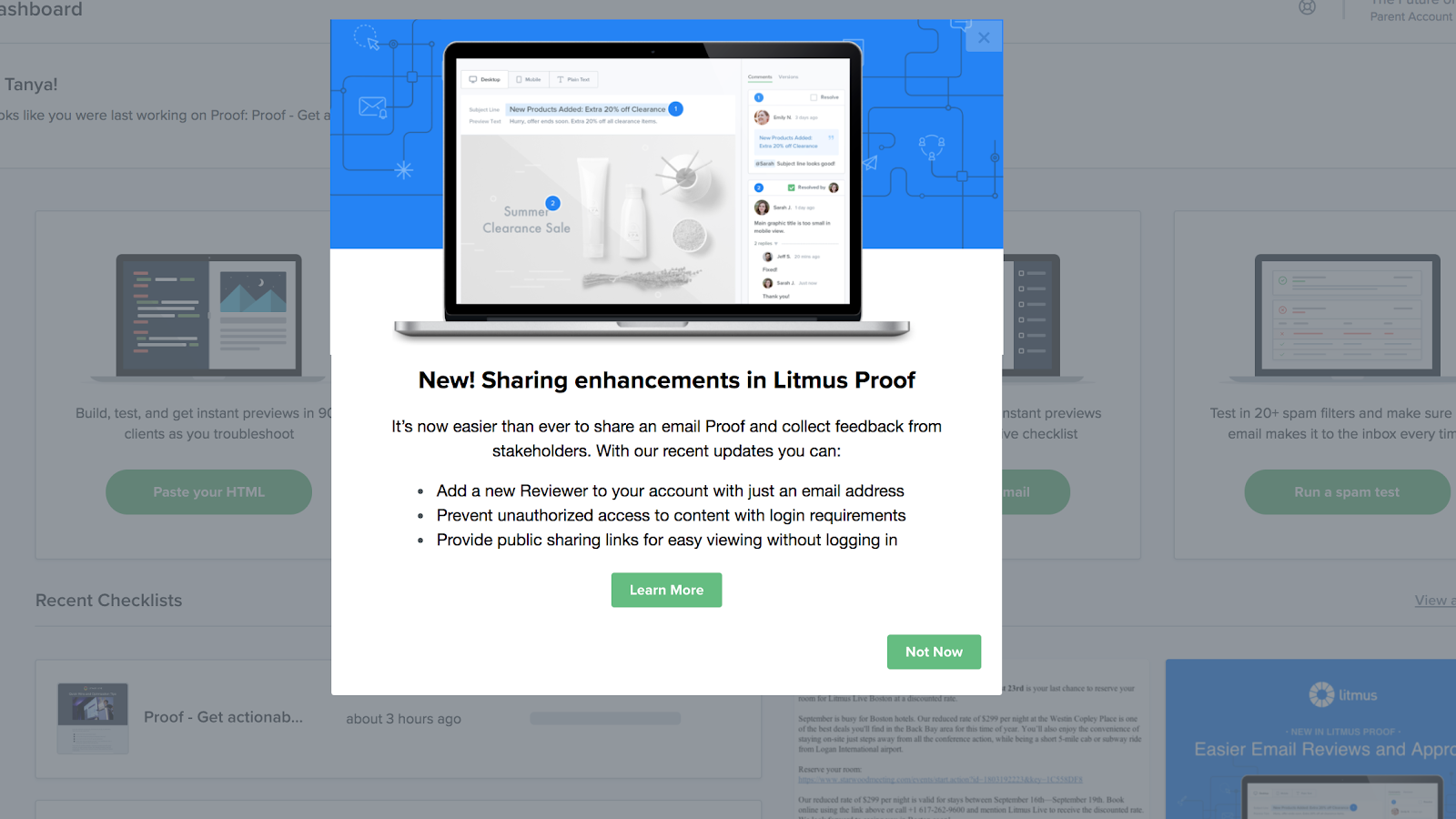
Litmus: Driving 2100% feature adoption through in-app launches
Launch type: Targeted feature launch with post-launch reinforcement
Company: Litmus
Launch challenge
Litmus was shipping powerful features, but many users didn’t know they existed—or how to use them effectively.
In-app launch approach
Contextual walkthroughs introduced new functionality
Tooltips and prompts appeared directly in relevant workflows
Reinforcement messages encouraged repeat usage
Timeline strategy
Launch-day guidance focused on clarity
Post-launch nudges targeted users who hadn’t adopted yet
Measurement and iteration continued well beyond launch week
Key metrics
Feature adoption rate
Repeat usage over time
Reduction in “unused feature” gap
Why it worked: Litmus focused less on awareness and more on education. By embedding launch messaging inside the product, they removed friction and helped users understand the value of new features, resulting in a dramatic increase in adoption.
North One: Delivering a mobile launch that increased conversions by 25%
Launch type: Big bang launch for a mobile product experience
Company: North One
Launch challenge
North One needed to launch a new mobile experience in a way that felt intuitive and supportive without overwhelming users on a small screen.
In-app launch approach
Guided mobile walkthroughs introduced the new experience
Clear, step-by-step flows reduced cognitive load
Messaging was played specifically for mobile interaction patterns
Timeline strategy
Heavy focus on pre-launch UX and QA
Strong launch-day guidance for first-time use
Immediate measurement and optimization post-launch
Key metrics
Mobile conversion rate
Completion of key onboarding steps
Early engagement and retention signals
Why it worked: North One treated the launch as a mobile onboarding moment, not just an announcement. By prioritizing usability and sequencing information carefully, they helped users reach value quickly, driving a significant lift in conversions.
What these examples have in common
Across all three launches, a few patterns stand out:
Clear launch goals tied to user behavior
In-app experiences matched to the launch type
Measurement focused on adoption and conversion—not vanity metrics
Reinforcement after launch day, not just during it
These teams didn’t just ship features, they launched them with intention.
Coordinate across teams: the messy politics of launching
Product launches are powerful. They can modify the way business is run, even if only by a bit. And because of that power, they're often politically charged by stakeholders with different agendas. The better you can coordinate across teams, mediums, and audiences, the more impact you'll have.
Know your stakeholders
Product has the best use case in mind and the best data. Align closely from the onset of planning. But their proximity can also make them insist on having a say in how your job gets done—be wary of that, yet respect your Product Managers.
Marketing (you, most likely) drives all channels of communication. You can make the greatest launch or the worst—the fate of the product is in your hands.
Customer Success acts as the internal voice of your customers, and will have sensitivities around timing and language of your release.
Sales needs to know who the new product is best suited for and how to communicate effectively to prospects through emails and demos. The clearer you can be, the better.
Support needs to be knowledgeable for inbound questions and may need to update your help center. They're on the front lines but often get left out of the loop. Communicate your expectations.
Coordinate your deliverables
Not every launch needs every asset, but here's the checklist to pull from when planning a Tier 1 or Tier 2:
Storylines — customer-centric stories, each about the length of a marketing email
Press release —coordinate with Marcomms/PR early; this takes longest to set up
In-app communications — begin at the start of the relevant workflow, not the top-level dashboard
Blog post — define persona and use case through an outline
Sales collateral — one-sheet if the feature is collateral-worthySales collateral
Customer email — better to over-announce than under; segment by activity, industry, or plan
Prospect email — target by persona; decide mass-send vs. sales-rep delivery
Internal training — product demos the tool, marketing adds color with stories
Website updates — consult your keyword build; new features can be perfefct for SEO
App store updates — bring your launch storyline into the descriptions
Analyst briefings — usually wait until you have data and customer quotes
Help center updates — pass product's notes to support for how-tos and FAQs
Final Thoughts: Turn every launch into a growth lever
A successful product launch isn’t defined by how loudly you announce it; it’s defined by how many users actually succeed with what you’ve shipped.
The teams that consistently drive adoption treat launches as intentional experiences, not one-time events. They set clear goals, choose the right launch type, plan realistic timelines, guide users in-app at the right moments, and measure success based on behavior, not the hype. Throughout this guide, a few principles keep coming up:
Launches should be user-led, not marketing-led Awareness matters, but adoption is what moves the business forward.
In-app experiences are the fastest path to value The best time to teach users is when they’re already in the product.
Launch day is just the beginning Reinforcement, iteration, and measurement are where real impact happens.
Every launch is a chance to learn The data you collect today makes the next launch even stronger.
When launches are planned this way, they stop being stressful fire drills and start becoming a repeatable system for growth.
Whether you’re rolling out a small feature, launching a major replay, or testing something entirely new, the goal is the same: help the right users discover value faster—and keep them coming back.
If you build your launches around that idea, success becomes much easier to repeat.
Put these launch ideas to work
Planning a good launch is only half the job. What really matters is helping users notice what’s new, understand it, and actually use it; not just on launch day, but over time.
Ready to see what your journey could look like with Appcues?
See how your team can remove friction, move faster, and deliver experiences that are easy for users... and safe for your systems. We’ll walk through your workflows, your governance needs, and the outcomes that matter most to your business.
Product launches are overlooked in software companies. It baffles us.
Launching new product is intrinsic to what software companies do. They exist entirely to give more value by consistently launching incrementally better software. And that's pretty much it. Yet so many companies just aren't killing it in that category. They simply deploy new product and hope people find it. They suck at coordinating across teams. They publish a press release on their product when no one cares. They don't leverage their beta user group enough. The worst: they forget to take their features out of beta.
We won't sugarcoat it: product launches are a lot of work. But after helping SaaS companies launch products for nearly a decade, we've learned a thing or two. Whether you're launching a new product into the world or adding exciting new features to your existing product, you want to prepare users—both potential and existing—to dive right in and give it a try. If you get your product launch right, your new product can make a splash right away, and you'll see a quicker ROI on your development efforts.
This guide pulls together everything we've packaged up into frameworks, strategies, and videos to get you from discovery to launch day with ease.
What is a product launch, and why it matters
A product launch is a detailed plan to put a new product on the market. It's a series of actions across various teams—marketing, sales, customer support, product—to ensure a coherent and impactful debut. Put simply, it's the go-to-market strategy devised to help successfully launch a product. The main goal is to create enough buzz around the release to pique the interest of the product's target audience.
Product launches shouldn't only be reserved for main releases. You do a lot of work to your product offerings throughout the year that deserves a shout. From a marketing perspective, celebrating the "small wins" is equally important for customer acquisition and retention.
Product launch vs. go-to-market strategy
A product launch is the event of introducing a new product to the market, focused on generating excitement, building awareness, and driving initial adoption. A go-to-market (GTM) strategy is the comprehensive plan leading up to that event: identifying the target market, positioning the product, deciding on pricing, and planning distribution channels. The launch is what the GTM strategy produces.
The 4 Ps of a product launch
Most companies launch products with the goal of driving engagement, adoption, and market growth, but a structured approach makes all the difference. The 4 Ps provide a framework to ensure every launch aspect is thoughtfully planned:
Product: Define the product's unique value proposition and what problem it solves.
Pricing: Determine a pricing strategy aligned with customer value and market positioning.
Placement: Choose distribution channels that best reach your target audience.
Promotion: Plan an outreach strategy—email, social media, paid ads—to build excitement and drive awareness.
Who's responsible for product launches?
Product marketers, stand tall. This is your race. You should own the product launch vision and strategy (and rely on your marketing team for execution, of course).
When it's product launch go-time, product marketers act as conductors leading the cross-functional orchestra: keeping everyone organized, accountable, and on target to hit the end goal of launch day. But while every good launch needs a strong leader, they can't be planned in a silo. Representatives from product management, sales, customer success and support, and marketing are most common contributors. Schedule weekly meetings to keep communication high; as you get closer to the big day, consider increasing the meeting cadence with daily standups.
Common product launch failures
Launches that prioritize awareness over relevance
These launches focus on making sure everyone sees the feature, rather than making sure the right people see it at the right time. Users who are not ready or not interested learn to ignore launches altogether.
Launches that explain features instead of enabling outcomes
These launches describe what’s new but do not help users accomplish anything meaningful. Users understand the feature intellectually but never experience its value firsthand.
Launches that end on launch day
These launches treat shipping as the finish line. There is no follow-through, no reinforcement, and no plan to support users who engage later or partially.
Launches that measure attention instead of behavior
These launches look successful early, then quietly fail. Opens, clicks, and pageviews spike, while adoption stagnates.
Recognizing which of these patterns shows up in your own launches is the first step toward fixing them.
What success actually means in a product launch
A launch is successful only if it causes a meaningful change in user behavior.
That sounds obvious, but most teams never commit to a specific behavioral outcome. They talk about awareness, excitement, or engagement because those are easy to observe quickly. Behavior change takes longer and forces clarity.
Without a clear behavioral goal, teams can’t tell whether a launch is early, weak, or fundamentally broken. Everything looks like “mixed results.”
So the first job of a launch is not messaging or rollout. It’s deciding what behavior would prove that the interruption was worth it.
This behavior needs to be concrete enough that a team can recognize it when it happens, and rare enough that it doesn’t occur by accident. If the behavior happens, the launch worked. If it doesn’t, something upstream failed.
Once success is defined this way, launches stop being vague. But a new problem appears.
If success is a specific behavior, then not every user is equally likely to perform it.
Planning a successful product launch
Set a clear launch goal
Before choosing a launch date or drafting announcements, define what success looks like. Are you aiming to:
Increase activation for a new feature?
Drive upgrades or expansion?
Re-engage dormant users?
Validate demand with early adopters?
Your launch goal should directly map to a measurable outcome, like feature adoption rate, trial-to-paid conversion, or activation milestone completion.
Choose the right launch type
Not every launch needs the same level of fanfare. In fact, most can be organized along a series of tiers.
This framework allows you to strategize how you take products to market because:
You can't shout about each product and feature (or give each the same level of promotion), otherwise your customers will just stop listening.
You have restraints on time and resources, so you need to make sure you prioritize the launches that will provide the largest business impact.
A framework creates a fair and consistent way of prioritizing launch activities, so that something doesn't get extra love just because the champion was a little bit louder (we've all been there).
With a tiered approach, you essentially have a repeatable playbook for every launch. Getting buy-in on what tier a feature belongs to ahead of time is key to making this all work.
Set a realistic launch timeline
A strong launch timeline includes:
Alignment with goals, launch details, messaging, value, and the tactical plan
Internal enablement and QA
Pre-launch testing or soft rollout
Announcement and in-app messaging
Post-launch measurement
Further iteration
Build in time for feedback loops, especially if you’re using beta users or staged rollouts.
Start with product discovery and beta testing
What product managers believe customers want and what they actually want don't always align. Leading or participating in product discovery surfaces valuable insights you can use to optimize positioning and messaging, and it should inform your launch goals.
Research. Ask customers directly via surveys and customer interviews. Include in-app behavior data if you're tracking it.
Ideation. Identify the solution that best addresses customer needs while factoring in development and cost considerations. Mind-mapping, sketching, and storyboarding all help.
Beta testing. Before a broader release, put an early version in front of a smaller segment of your target audience to catch bugs, surface friction, and gather quotes you can use at launch. There's no standard length: a week or several months can both work. What matters is establishing clear, measurable success criteria upfront.
Launch plan fundamentals: positioning, messaging, and pricing
Product positioning is how your product fits into the market and what pain point it solves. Typically not customer-facing, your positioning statement is most effective as an internal tool to keep your teams aligned. A simple template:
Product positioning template: [Product name] is the [market category] that provides [benefit that sets it apart] for [target user group] who [need/want X solution].
Product messaging is the words you use to convey your positioning to your target audience. It's the expression of the positioning—where it comes to life. Unlike positioning, messaging is written with an external audience in mind. It should resonate with your target and be used consistently across your website, sales collateral, and marketing campaigns.
Pricing and packaging deserve their own conversation. Pricing strategies typically consider what competitors charge and/or what the product is worth to your customers. While there's no one-size-fits-all, we generally recommend pricing based primarily on value—competitor pricing acts as an anchor, but willingness to pay is what converts. The simplest starting point: ask your customers what they think it's worth. If they won't put a dollar figure on it, ask them to rank your new product's value relative to other products and features they already use.
Questions to ask before your next launch
Before running the usual gamut (email, blog, social), get clear internally:
Why did we build this product? This reveals the pain points it solves and the benefits it delivers. It's probably the most important question, because it lets you start with why when you communicate.
Who did we build this product for? Is there a segment that benefits more? Are there others that can't? You don't want to bug customers with an irrelevant message.
What happens if everyone uses it? Imagine 100% adoption. This helps you word the ambitious vision for how the launch impacts your customers.
What happens if no one uses it? Open your mind to the possibility that your hypothesis is wrong so you can adjust. This also makes you acknowledge the risk and investment.
How did your last launch go? Double down on what worked. Cut what didn't.
Pre-launch enablement: arm every team
Product launches take a village. You need collective buy-in from your entire organization to nail it.
Sales needs to understand positioning, pricing, and packaging, and how to clearly articulate value. Arm them with a product demo, a one-pager, new slides for the sales deck, and at least one case study from beta customers.
Customer Success and Support need to "sell" the value to existing customers and field questions on day one. Polish self-service documentation and FAQs. Set up an easy workflow—a Slack channel or support ticket tag—to capture the feedback they'll hear.
Marketing now has positioning and messaging in hand and can decide the most effective channels to reach your audience. Bake launch campaigns (and the steps to execute them) into the plan as early as possible.
Executives don't need every detail, but they need confidence. Share your launch OKRs. Show them you're organized, communicative, thorough, and results-oriented. Tell them how you'll report on results in the first days, weeks, and months post-launch.
Setting clear product launch goals
Every successful product launch starts with a clear goal. Without one, teams default to vanity metrics (opens, impressions, or general excitement) instead of outcomes that reflect real user value.
Start with the user outcome
The most effective launch goals focus on what you want users to do differently after the launch. Ask:
What new behavior should this launch unlock?
What problem does this release help users solve faster or better?
How will users know they’re successful?
Examples of user-centric outcomes include:
Completing a key workflow for the first time
Reaching an “aha” moment faster
Adopting a newly released feature within an existing flow
Align launch goals to the release type
Not all launches should be measured the same way. Your goal should reflect what you’re actually shipping.
Defining the category upfront prevents misalignment between product, marketing, and customer teams.
Choose one primary metric (and a few supporting ones)
Strong launches have one primary success metric, the clearest signal that the launch worked. Examples:
Percentage of active users who adopt the feature
Time-to-value for users exposed to the launch
Conversion rate from announcement to action
Then layer in 2–3 supporting metrics, such as:
Engagement with in-app messages
Completion of related onboarding steps
Qualitative feedback or survey responses
This keeps teams focused while still giving context.
Set realistic targets and timeframes
Launch goals should be ambitious but achievable. Consider:
Historical adoption rates for similar launches
The size of the eligible user audience
Whether the feature requires habit change or setup
Also define when you’ll measure success:
Day 7 adoption
First 30 days of usage
Post-onboarding impact
Clear timeframes prevent premature conclusions or lingering uncertainty.
Make goals visible across teams
Once defined, launch goals should be shared widely:
Included in the launch plan
Reinforced in internal enablement
Referenced in post-launch reviews
When every team understands the goal, decisions about messaging, targeting, and follow-up become much easier and far more effective.
Different product launch types
There are a few product launch types to choose from, but never forget the most important thing: context. Your choices are tied to the larger goals for the year. Are you increasing your customer’s value? If so, that’s big enough for a T1 Scream. If you’re working on market differentiation, that might not even be close to T1. Stay in line with your goals as you plan out the launch, or else you might get stuck spinning your wheels with launches that don’t move the needle.
T1: Scream/Big Bang Launch (Major Product or Rebrand)
Primary goal: Awareness + early adoption at scale
When to use it
Net-new product or platform
Major replay or positioning shift
High-impact release for a broad audience
Best in-app tactics
Full-screen modals to announce the release
Guided walkthroughs to orient users in the new experience
Launch checklists to drive initial activation steps
Persistent banners for ongoing visibility
Resource center highlights linking to deeper education
Why this works:
Big launches create excitement but, without guidance, users can feel overwhelmed. In-app education can turn awareness into action.
T2: Shout/Iterative Feature Launch (Enhancement or Improvement)
Primary goal: Increase feature adoption among relevant users
When to use it
Feature improvements
Workflow optimizations
Enhancements to existing functionality
Best in-app tactics
Contextual tooltips or hotspots near the updated UI
Targeted banners for eligible users only
Inline nudges tied to relevant actions
Optional walkthroughs for deeper learning
Why this works:
Users don’t need a “launch moment”. They need a reason to try something new while they’re already working.
T3: Cheer/Quiet Launch (Beta or Early Access)
Primary goal: Learn, iterate, and validate demand
When to use it
Experimental features
Early validation
Controlled rollouts
Best in-app tactics
Opt-in banners or modals (“Try it early”)
Pins or hotspots to signal availability without interruption
Micro-surveys to collect feedback
Lightweight onboarding flows for testers
Why this works:
Quiet launches reduce risk while still creating a sense of exclusivity and ownership among early users.
T4: Chirp/Targeted Launch (Segment-Specific)
Primary goal: Drive relevance and faster time-to-value
When to use it
Role-based features
Plan-specific functionality
Use-case-driven releases
Best in-app tactics
Segmented banners and/or modals based on role, plan, or behavior
Personalized walkthroughs tailored to the user’s job-to-be-done
Contextual checklists focused on one outcome
Follow-up nudges for incomplete actions
Why this works:
Relevance beats reach. Targeted launches feel helpful instead of noisy and convert better as a result.
Post-Launch Reinforcement (Often missed, but critical)
Primary goal: Sustain adoption beyond launch day
When to use it
Any launch with behavior change
Features with low initial adoption
Long-term activation goals
Best in-app tactics
Behavior-triggered reminders for non-adopters
Success messages when users complete key actions
Follow-up tips as users explore deeper functionality
Surveys to understand user thoughts
Re-announcements framed around outcomes, not features
Why this works:
Most adoption doesn’t happen on day one. Reinforcement turns launches into lasting growth drivers.
How to choose the right launch type
If you’re unsure which launch type fits, ask:
How big is the behavior change?
Who actually needs to know about this?
Is awareness enough—or is guidance required?
Will success happen in one session or over time?
The clearer your answers, the more effective your in-app strategy will be.
Defining product launch success metrics
A product launch is only as successful as the behavior change it creates. That’s why strong launch measurement goes beyond vanity metrics like impressions or opens and focuses on signals of real user value. The right metrics help you:
Validate whether users understood the launch
See if the product delivered on its promise
Identify friction points early
Decide what to reinforce, iterate on, or roll back
Before launch day, you should know exactly which metrics will tell you if the launch worked.
Draw a line in the sane before you ship
One of the most useful concepts in Lean Analytics is what the authors call "drawing a line in the sand": before you release any new product or feature, set a measurable target that will determine whether or not the release was successful. It sounds obvious, and yet very few product teams actually do it. Empowered teams set quarterly OKRs and measure themselves against those, but the same rigor rarely gets applied at the feature level.
What happens instead is what we call Fun Facts—contextless numbers generated after a release that make people feel good at the cost of actual success measurement. "Over 4,000 people have used this feature already!" "Awesome funnel conversion—60%!" These stats get quoted in weekly standups, everyone nods, nobody knows whether the launch actually worked. At best they're irrelevant. At worst they spread as memes inside the company and shape misguided product strategy.
The fix: insist on setting KPIs before the first line of code is written. As Ben Horowitz puts it in The Hard Thing About Hard Things, "All decisions were objective until the first line of code was written. After that, all decisions were emotional." Setting targets upfront makes review meetings easy because the "is this good or bad?" context is already baked in.
Core categories of product launch metrics
Most launch metrics fall into a few core categories. The key is choosing the ones that align with your launch goal—not tracking everything.
Adoption Metrics
Primary goal: Measure whether users actually use what you launched.
Examples:
Feature adoption rate
Percentage of eligible users who try the feature
First-time usage within a defined time window
Best for: Feature launches, enhancements, targeted rollouts
Activation & Time-to-Value Metrics
Primary goal: Measure how quickly users reach meaningful value.
Examples:
Time to first key action
Checklist or onboarding completion rate
Drop-off between steps in a new workflow
Best for: New products, major launches, onboarding-related releases
Activation Rate Equation: Activation Rate = (Number of users who reach activation ÷ Total new users) × 100
Time to Value Equation: Time to Value = Timestamp of activation - Timestamp of signup
This is usually tracked as:
Median TTV (most useful)
Or average TTV (look for outliers)
Engagement Metrics
Primary goal: Measure depth and frequency of usage over time.
Examples:
Repeat usage of a feature
Session frequency tied to the launched capability
Engagement with supporting UI (tips, nudges, reminders)
Best for: Iterative launches, engagement-focused releases
Upgrade Rate Equation: Upgrade Rate=Number of eligible users/Number of users who upgraded×100
Feedback & Qualitative Signals
Primary goal: Measure user perception and clarity.
Examples:
In-app survey responses
Qualitative feedback from beta users
Support ticket volume related to the launch
Best for: Betas, quiet launches, complex releases
Avoid These Common Metric Mistakes
Measuring too many things Not all metrics are created equal.
Measuring awareness instead of action Opens and views don’t equal adoption.
Using the same metrics for every launch A beta launch and a rebrand shouldn’t be judged the same way.
Declaring success too early Some launches need reinforcement before results show up.
Strong metrics give you clarity, and an understanding of behavior beyond numbers.
Final Takeaway: measure what you’re trying to change
The best product teams ask “Did this change user behavior in the way we intended?” When your metrics match your launch type and goal, launches stop being stressful events and start becoming repeatable growth levers.
Creating a realistic product launch timeline
One of the most common reasons product launches underperform is unrealistic timelines. Teams rush to hit a date, skip enablement or testing, and end up spending weeks after launch fixing avoidable issues. A realistic product launch timeline balances speed, quality, and adoption. It gives teams enough runway to prepare users beyond just shipping code.
Anchor the timeline to the user experience (not the ship date)
Instead of planning backward from “launch day,” start with the moment when users are expected to successfully use the product or feature. Ask:
When should users first discover this?
When should they reach value?
What learning or setup needs to happen before that?
Your launch timeline should support these moments, not just the release itself.
A practical product launch timeline framework
Below is a flexible timeline you can adapt based on launch size and complexity. Smaller launches may compress phases; larger launches may extend them.
Phase 1: Strategy & Alignment
When: 4-6 weeks before launch
Focus: Clarity and coordination
Key activities:
Define launch goal and success metrics
Choose launch type (big bang, targeted, quiet, etc.)
Identify target users and segments
Align product, marketing, sales, and support
Draft the launch plan and responsibilities
Why this matters: Misalignment here leads to conflicting messages and last-minute changes later.
Quiet launches: Extended beta phase, lighter launch day
Targeted launches: More time spent on segmentation and personalization
There’s no universal timeline, only one that fits your users and goals.
Build in buffers (you’ll need them)
Always account for:
Last-minute UX tweaks
Messaging revisions
QA delays
Internal feedback loops
A realistic timeline includes slack, not just tasks.
Final takeaway
A great product launch doesn’t feel rushed to users or to your team. By planning around user readiness, leaving room to learn, and investing in post-launch reinforcement, you create launches that drive adoption instead of regret.
Product launch timeline: In-app experiences + metrics (all in one view)
The most effective launches intentionally pair timing, in-app experiences, and metrics. This means you’re not just launching features but actively guiding users toward value and measuring what matters at each stage.
Use the table below to plan what to show, when to show it, and how to measure success across the entire launch lifecycle.
Product Launch Timeline Framework
Product launch timeline framework: seven launch phases from strategy and alignment through launch review and iteration, with primary goals, recommended in-app experiences, and key metrics to track for each phase.
🗓️ Launch phase
🎯 Primary goal
💻 In-app experiences to use
📊 Key metrics to track
Strategy & alignment4–6 weeks before
Define success and prepare internally
(No user-facing experiences yet)
Internal walkthroughs for sales/CS
Internal release notes or enablement tours
Internal readiness checklist completion
Enablement adoption (sales/CS usage)
Stakeholder alignment sign-off
Build & QA2–4 weeks before
Ensure product and UX readiness
Internal-only tours
QA checklists
Preview walkthroughs in staging
QA issue count and resolution time
UX friction identified in testing
Internal feedback volume
Pre-launch / soft rollout1–2 weeks before
Validate messaging and reduce risk
Opt-in modals or banners
Pins or hotspots signaling availability
Lightweight walkthroughs
Micro-surveys
Opt-in rate
First-time usage rate
Time to first value (beta cohort)
Qualitative feedback responses
Launch dayDay 0
Drive awareness and first use
Modals or banners announcing the launch
Guided walkthroughs
Launch checklists
Resource center highlights
Engagement with launch UI
Walkthrough or checklist completion
First-use adoption rate
Support volume (early signal)
Early adoption windowWeeks 1–2
Turn discovery into usage
Contextual tooltips or nudges
Follow-up banners for non-adopters
Success messages after key actions
Feature adoption rate
Drop-off between steps
Repeat usage within 7–14 days
Post-launch reinforcementWeeks 3–6+
Sustain adoption and deepen value
Behavior-triggered nudges
Advanced tips or secondary walkthroughs
Re-announcements framed around outcomes
Lift in adoption after reinforcement
Time to value improvement
Engagement depth
Launch review & iterationOngoing
Learn and improve future launches
(Typically no new UI)
Targeted surveys for learnings
Retrospective dashboards
Primary launch goal metric
Segment-level performance
Feedback themes and
How to use this table in practice
Before launch: Fill in each row for your specific release
During launch: Use it as a coordination tool across teams
After launch: Compare expected vs. actual metrics per phase
If you can’t clearly answer which in-app experience and which metric applies to a phase, that’s a signal the launch plan needs tightening.
Why this approach works
Most launch failures happen because:
Teams only plan for launch day
Metrics don’t match the launch goal
In-app experiences are added reactively
This framework ensures:
Every phase has a purpose
Every experience drives a behavior
Every metric tells a clear story
Real-world examples of product launches that drove adoption
The most effective product launches don’t rely on hype alone. They combine clear goals, thoughtful timing, and in-app experiences that guide users toward value. The examples below show how different teams applied these principles to drive measurable results.
AdRoll: Turning product launches into a 60% conversion engine
Launch type: Iterative and targeted feature launches
Company: Adroll
Launch challenge
AdRoll’s growth team needed a better way to drive feature discovery and conversion without relying solely on outbound marketing or sales-led motion.
In-app launch approach
Contextual in-app messages surfaced new and relevant features
Targeting ensured users only saw launches aligned with their use case
Follow-up nudges reinforced value after initial exposure
Timeline strategy
Soft rollout to validate messaging
Ongoing reinforcement after launch day
Continuous iteration based on user behavior
Key metrics
Feature engagement and adoption
Conversion rate lift tied to in-app messaging
Downstream impact on revenue-driving actions
Why it worked: Instead of treating launches as one-time announcements, AdRoll used in-app experiences as an ongoing growth lever, meeting users at the right moment and tying launches directly to conversion outcomes. It resulted in a few wins, but most significantly, saw a 60% increase in an underutilized feature.
Litmus: Driving 2100% feature adoption through in-app launches
Launch type: Targeted feature launch with post-launch reinforcement
Company: Litmus
Launch challenge
Litmus was shipping powerful features, but many users didn’t know they existed—or how to use them effectively.
In-app launch approach
Contextual walkthroughs introduced new functionality
Tooltips and prompts appeared directly in relevant workflows
Reinforcement messages encouraged repeat usage
Timeline strategy
Launch-day guidance focused on clarity
Post-launch nudges targeted users who hadn’t adopted yet
Measurement and iteration continued well beyond launch week
Key metrics
Feature adoption rate
Repeat usage over time
Reduction in “unused feature” gap
Why it worked: Litmus focused less on awareness and more on education. By embedding launch messaging inside the product, they removed friction and helped users understand the value of new features, resulting in a dramatic increase in adoption.
North One: Delivering a mobile launch that increased conversions by 25%
Launch type: Big bang launch for a mobile product experience
Company: North One
Launch challenge
North One needed to launch a new mobile experience in a way that felt intuitive and supportive without overwhelming users on a small screen.
In-app launch approach
Guided mobile walkthroughs introduced the new experience
Clear, step-by-step flows reduced cognitive load
Messaging was played specifically for mobile interaction patterns
Timeline strategy
Heavy focus on pre-launch UX and QA
Strong launch-day guidance for first-time use
Immediate measurement and optimization post-launch
Key metrics
Mobile conversion rate
Completion of key onboarding steps
Early engagement and retention signals
Why it worked: North One treated the launch as a mobile onboarding moment, not just an announcement. By prioritizing usability and sequencing information carefully, they helped users reach value quickly, driving a significant lift in conversions.
What these examples have in common
Across all three launches, a few patterns stand out:
Clear launch goals tied to user behavior
In-app experiences matched to the launch type
Measurement focused on adoption and conversion—not vanity metrics
Reinforcement after launch day, not just during it
These teams didn’t just ship features, they launched them with intention.
Coordinate across teams: the messy politics of launching
Product launches are powerful. They can modify the way business is run, even if only by a bit. And because of that power, they're often politically charged by stakeholders with different agendas. The better you can coordinate across teams, mediums, and audiences, the more impact you'll have.
Know your stakeholders
Product has the best use case in mind and the best data. Align closely from the onset of planning. But their proximity can also make them insist on having a say in how your job gets done—be wary of that, yet respect your Product Managers.
Marketing (you, most likely) drives all channels of communication. You can make the greatest launch or the worst—the fate of the product is in your hands.
Customer Success acts as the internal voice of your customers, and will have sensitivities around timing and language of your release.
Sales needs to know who the new product is best suited for and how to communicate effectively to prospects through emails and demos. The clearer you can be, the better.
Support needs to be knowledgeable for inbound questions and may need to update your help center. They're on the front lines but often get left out of the loop. Communicate your expectations.
Coordinate your deliverables
Not every launch needs every asset, but here's the checklist to pull from when planning a Tier 1 or Tier 2:
Storylines — customer-centric stories, each about the length of a marketing email
Press release —coordinate with Marcomms/PR early; this takes longest to set up
In-app communications — begin at the start of the relevant workflow, not the top-level dashboard
Blog post — define persona and use case through an outline
Sales collateral — one-sheet if the feature is collateral-worthySales collateral
Customer email — better to over-announce than under; segment by activity, industry, or plan
Prospect email — target by persona; decide mass-send vs. sales-rep delivery
Internal training — product demos the tool, marketing adds color with stories
Website updates — consult your keyword build; new features can be perfefct for SEO
App store updates — bring your launch storyline into the descriptions
Analyst briefings — usually wait until you have data and customer quotes
Help center updates — pass product's notes to support for how-tos and FAQs
Final Thoughts: Turn every launch into a growth lever
A successful product launch isn’t defined by how loudly you announce it; it’s defined by how many users actually succeed with what you’ve shipped.
The teams that consistently drive adoption treat launches as intentional experiences, not one-time events. They set clear goals, choose the right launch type, plan realistic timelines, guide users in-app at the right moments, and measure success based on behavior, not the hype. Throughout this guide, a few principles keep coming up:
Launches should be user-led, not marketing-led Awareness matters, but adoption is what moves the business forward.
In-app experiences are the fastest path to value The best time to teach users is when they’re already in the product.
Launch day is just the beginning Reinforcement, iteration, and measurement are where real impact happens.
Every launch is a chance to learn The data you collect today makes the next launch even stronger.
When launches are planned this way, they stop being stressful fire drills and start becoming a repeatable system for growth.
Whether you’re rolling out a small feature, launching a major replay, or testing something entirely new, the goal is the same: help the right users discover value faster—and keep them coming back.
If you build your launches around that idea, success becomes much easier to repeat.
Put these launch ideas to work
Planning a good launch is only half the job. What really matters is helping users notice what’s new, understand it, and actually use it; not just on launch day, but over time.
Stay connected with Appcues
Sign up for Quickcues and get our monthly updates!
.png)







.svg)