

The year is 2030. Somewhere, in B2B SaaS…
It’s a Tuesday, and Maya’s biggest launch of the year has been live for six days. It’s the first one in a while she’s gotten everyone on board for, nevermind that all the little new features keep piling up. This new reporting workspace is the one that matters, that will finally make a difference for her customers. Meanwhile, one of those same customers opens her product where an AI assistant welcomes them in.
The customer then asks: “How do I export last quarter’s data to a spreadsheet? I need to build a chart for my board.”
The agent gives a clear, accurate, five-step answer. The customer follows it, builds the chart by hand, and, with a quick thank you, closes the chat.
Maya finds the conversation a week later. The new reporting workspace, the one her team spent a quarter building, makes board-ready charts in two clicks. It’s meant to be a massive upgrade. The agent knew it existed; it was right there in the changelog. But technically, the AI was still right. It answered the question it was asked perfectly.
Nobody told the agent that it was time to bring it up.
Flash back to today. We are all very much aware that the way people use software is shifting away from screens a user clicks through to agents that do the work on their behalf. That’s not to say screens are going away for good. They’re becoming the place you go to check, compare, and approve an output, while more of the doing happens in conversation.
The plumbing for this new shift has already been installed. The Model Context Protocol (everyone’s favorite MCP) is the standard that lets AI assistants connect to other software, and has more than 10,000 public servers. ChatGPT alone has 1.2 billion weekly users. Developer tools were the sector that got there first: AI coding tools are now an expected part of valuation jetfuel. For example, 70% of new Supabase databases are now started by AI.
But what about everyone else? The software a property manager, a law firm or a car dealership will move more slowly. Our read is that until around 2030, people will still mostly get work done by clicking through screens, not by asking an agent to do it for them. Agents still struggle with long, real-world tasks, and many users aren’t ready to hand over the keys yet.
But slower doesn’t mean never.
There are two AI agents in this story. One is the assistant built into your product. The other is the one your customers already use, like ChatGPT, which will increasingly talk to your product on their behalf. The first one is already here.
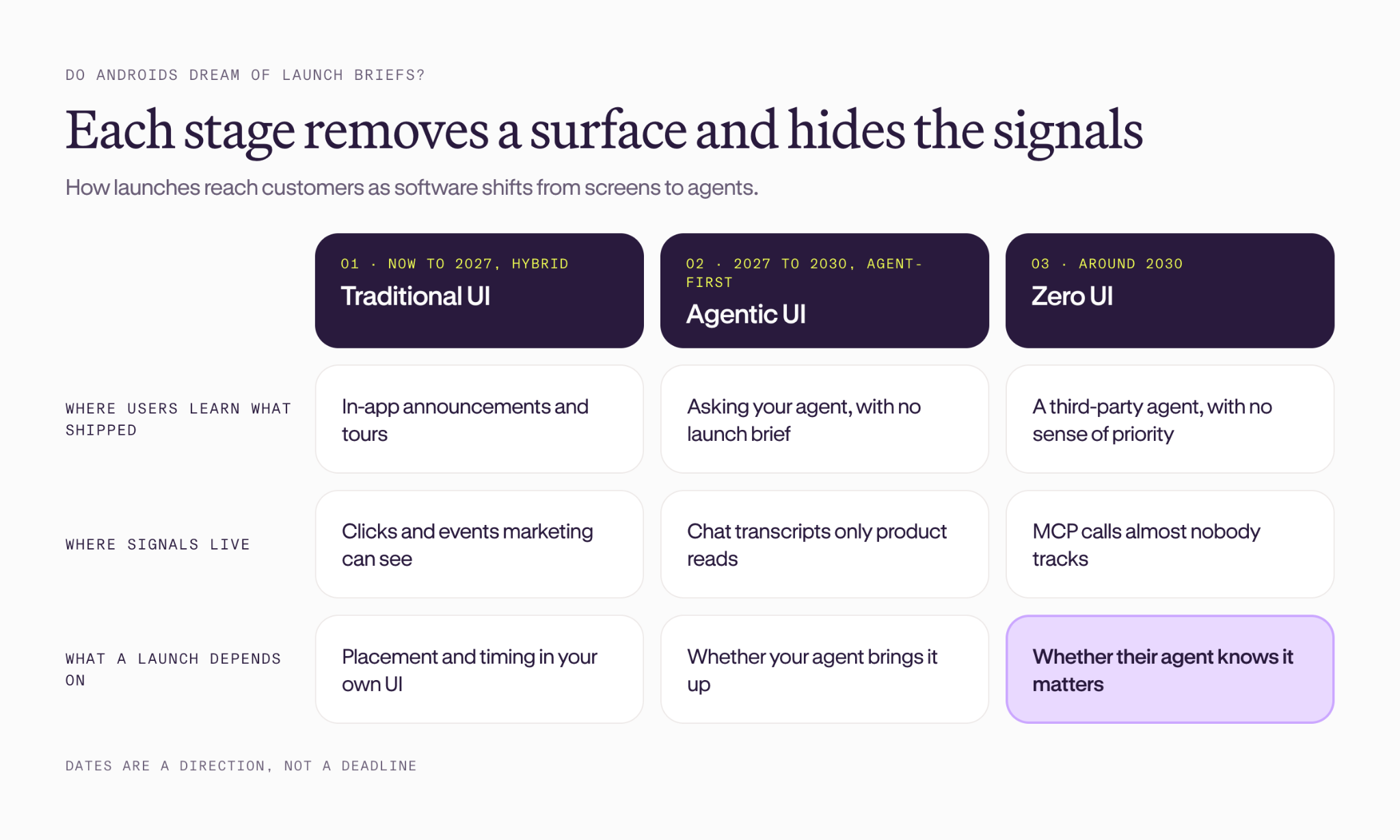
That first agent is your product’s AI assistant, and it’s effectively your newest rep. It’s always on, it can talk to more customers in a day than your sales team does in a quarter, and it spends all day fielding “what’s new?” questions, some of which are really upgrade opportunities.
But like the androids in Philip K. Dick’s novel, it only knows the memories it’s been given. It can search the release notes for an answer to whatever it’s asked. What it can’t do is tell which release matters to this customer. It’s like handing a new rep 200 pages of release notes on day one and sending them straight out on calls.
If that rep sounds overwhelmed, it’s in good company.
If being handed 200 pages of release notes sounds hauntingly familiar, it should. In our State of Product Launches 2026 survey with Navattic, 75% of product marketers said their company ships faster than it did a year ago. Only 7% said their launch process is keeping up. More than half (56%) hear about releases close to launch or after the fact, and the median respondent owns five different functions.
One respondent summed it up in four words: "We ship and forget."
When there's too much to launch, something’s gotta give. Our survey found that the tactics teams dropped most often were per-release sales training (40%), long-form launch content (36%) and individual release emails (34%) (State of Product Launches 2026). And those explained what shipped and why it mattered. So customers and reps hear less about each release than they did a year ago, even though there are more releases to hear about than ever before.
That new AI rep arrived while launch teams are mid-triage. Product built them, so product owns it. But their concern is accuracy first and foremost, and iteration. Briefing it on launches, that’s not anyone's job.
That's not a failure on Product's part. Nobody told them the agent needed briefing, any more than anyone would think to hand release notes to the search bar. AI isn't filling the gap on the launch side either. 93% of teams use AI to keep up with launches, mostly to draft content faster. When we asked what AI was most useful for, only one of 44 answers mentioned reaching customers inside the product (State of Product Launches 2026).
Releases come faster than PMMs can launch, and faster than the agent can sort through them. It has access to the whole changelog, and the year's biggest launch weighed the same as a bug fix. Who’s giving it the outside context when competing launches come through?
And it waits to be asked. Customers don't ask about features they don't know exist, so the release that would solve their problem never comes up. If they do, the answer is often written like a help doc in technical-first language that a busy customer looking for a quick fix will bounce off of.
Here’s what we predict will happen if things keep going as they are today.
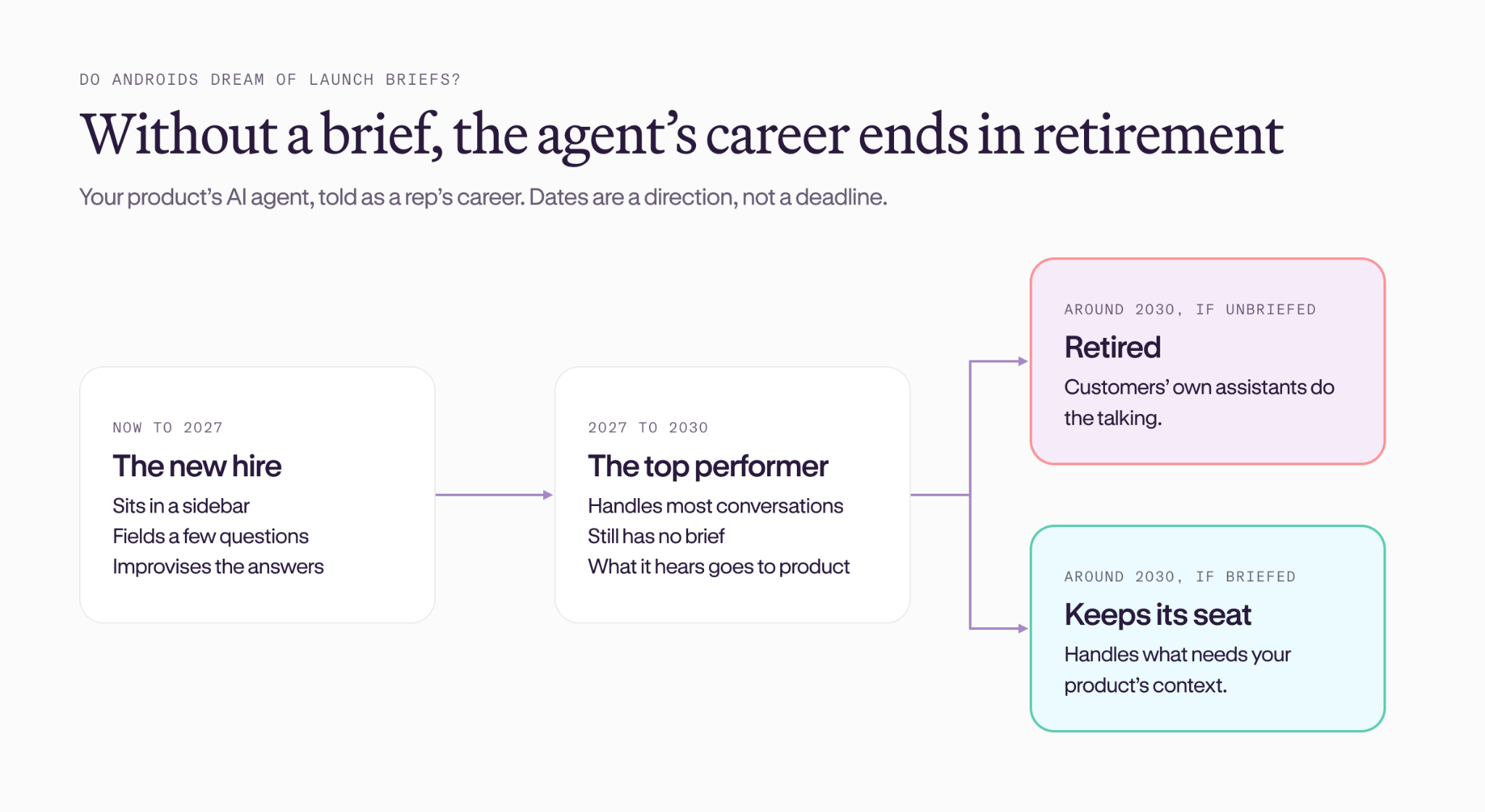
Remember those two trends we mentioned earlier? Launch teams are already dropping tactics to keep up. A new channel with no extra time joins sales training and release emails on the dropped list, and Product ends up owning what the agent says about every launch by default.
Product tunes the agent to answer accurately, which works for Product. They want to build a tool that works. But an agent can't tell which release matters to who and why, so it waits to be asked and ends up giving the same kind of answers any assistant could.
Meanwhile, customers already have a general-purpose assistant they use every day, where they already work, across every tool. Once it reaches your product, it answers the same questions. If your agent isn't clearly better, there's no reason to leave their preferred assistant for it. And you can't wall that off, companies have tried. When Amazon tried to block Perplexity's shopping agent, an appeals court lifted the injunction, reasoning that it's the user, not Perplexity, accessing Amazon.
Your agent doesn't get retired because the customer's assistant is better. It gets retired because yours has nothing theirs doesn't.
In our opinion, the future is a hybrid. General assistants will take quick lookups and work that spans tools. Your agent keeps what needs your product's context: answers specific to the customer's account, actions taken with their permissions, and moments where they need to trust the result.
And that trust is why the hybrid future is slow moving. On realistic business tasks, today's best agents succeed only about 30% to 58% of the time, depending on the test. Only 46% of people say they're willing to trust AI. For the work software most of us sell, that leaves a window of a few years: enough time to build a system that briefs the agent, if someone can take on the job.
If you thought "so now I'm supposed to enable the agent too?"... yeah. Not gonna happen. You're already behind. But this isn't another channel to feed. Done right, it's a trade: briefing the agent once replaces the repetitive work you've already had to drop.
It's what our survey's advice to decouple the launch from the release looks like in practice. Every release gets explained when it's relevant, without a launch moment for each one.
Don't brief the agent release by release; that's going to get you back into the launch debt hole. Give the agent a single lasting brief: what you sell, who it's for, what each segment cares about and what it must never say. Release details can flow in from what Product already publishes.
A changelog tells the agent what shipped, while a launch brief tells it what matters. Launch tiers are that written prioritization, so the brief is what lets the agent bring up the right release before anyone asks.
Your attention can then go where it counts: the launches that matter most, and wherever the agent is struggling.
This takes a quick burst of energy up front. Writing a lasting brief takes effort, and connecting the agent to release information is often a product or engineering step. But after that, every release costs less and you can start to get a little breathing room back.
Product should keep owning how the agent works. What Marketing brings is what it knows: positioning, segments and priorities. Marketing gets something back, too: a running record of what customers are asking for and where they're stuck. Agree on guardrails up front and make sure it’s signed off by Product. It’ll turn "marketing wants access to our agent" into a clear yes and better collaboration.
Remember, the goal isn't more answers. You’re looking to see if there’s more adoption of what you shipped. Judge the effectiveness of your brief by whether customers who hear about a release from the agent go on to use it.
Some customers will skip your agent entirely and ask their own assistant about your product. You can't brief that assistant directly, but you can make sure your launches are easy for it to find and understand. That means clear, current release notes written for machines as well as people, and accurate answers wherever your product connects to outside AI tools. Think of it as briefing the agents you'll never meet.
You don't need a program. One lasting brief plus one source of release information connected to your agent will go much further. Then, ask one question that you can answer in a month: did customers who asked about a new release go on to use it?
Androids don't dream of launch briefs. But they remember the ones they're given.
Your agent is already talking to your customers. The only question is whether anyone told it what to bring up.
Want the full picture of how launch teams are keeping up, and where they aren't? Read State of Product Launches 2026.
Product Adoption
The year is 2030. Somewhere, in B2B SaaS…
It’s a Tuesday, and Maya’s biggest launch of the year has been live for six days. It’s the first one in a while she’s gotten everyone on board for, nevermind that all the little new features keep piling up. This new reporting workspace is the one that matters, that will finally make a difference for her customers. Meanwhile, one of those same customers opens her product where an AI assistant welcomes them in.
The customer then asks: “How do I export last quarter’s data to a spreadsheet? I need to build a chart for my board.”
The agent gives a clear, accurate, five-step answer. The customer follows it, builds the chart by hand, and, with a quick thank you, closes the chat.
Maya finds the conversation a week later. The new reporting workspace, the one her team spent a quarter building, makes board-ready charts in two clicks. It’s meant to be a massive upgrade. The agent knew it existed; it was right there in the changelog. But technically, the AI was still right. It answered the question it was asked perfectly.
Nobody told the agent that it was time to bring it up.
Flash back to today. We are all very much aware that the way people use software is shifting away from screens a user clicks through to agents that do the work on their behalf. That’s not to say screens are going away for good. They’re becoming the place you go to check, compare, and approve an output, while more of the doing happens in conversation.
The plumbing for this new shift has already been installed. The Model Context Protocol (everyone’s favorite MCP) is the standard that lets AI assistants connect to other software, and has more than 10,000 public servers. ChatGPT alone has 1.2 billion weekly users. Developer tools were the sector that got there first: AI coding tools are now an expected part of valuation jetfuel. For example, 70% of new Supabase databases are now started by AI.
But what about everyone else? The software a property manager, a law firm or a car dealership will move more slowly. Our read is that until around 2030, people will still mostly get work done by clicking through screens, not by asking an agent to do it for them. Agents still struggle with long, real-world tasks, and many users aren’t ready to hand over the keys yet.
But slower doesn’t mean never.
There are two AI agents in this story. One is the assistant built into your product. The other is the one your customers already use, like ChatGPT, which will increasingly talk to your product on their behalf. The first one is already here.
That first agent is your product’s AI assistant, and it’s effectively your newest rep. It’s always on, it can talk to more customers in a day than your sales team does in a quarter, and it spends all day fielding “what’s new?” questions, some of which are really upgrade opportunities.
But like the androids in Philip K. Dick’s novel, it only knows the memories it’s been given. It can search the release notes for an answer to whatever it’s asked. What it can’t do is tell which release matters to this customer. It’s like handing a new rep 200 pages of release notes on day one and sending them straight out on calls.
If that rep sounds overwhelmed, it’s in good company.
If being handed 200 pages of release notes sounds hauntingly familiar, it should. In our State of Product Launches 2026 survey with Navattic, 75% of product marketers said their company ships faster than it did a year ago. Only 7% said their launch process is keeping up. More than half (56%) hear about releases close to launch or after the fact, and the median respondent owns five different functions.
One respondent summed it up in four words: "We ship and forget."
When there's too much to launch, something’s gotta give. Our survey found that the tactics teams dropped most often were per-release sales training (40%), long-form launch content (36%) and individual release emails (34%) (State of Product Launches 2026). And those explained what shipped and why it mattered. So customers and reps hear less about each release than they did a year ago, even though there are more releases to hear about than ever before.
That new AI rep arrived while launch teams are mid-triage. Product built them, so product owns it. But their concern is accuracy first and foremost, and iteration. Briefing it on launches, that’s not anyone's job.
That's not a failure on Product's part. Nobody told them the agent needed briefing, any more than anyone would think to hand release notes to the search bar. AI isn't filling the gap on the launch side either. 93% of teams use AI to keep up with launches, mostly to draft content faster. When we asked what AI was most useful for, only one of 44 answers mentioned reaching customers inside the product (State of Product Launches 2026).
Releases come faster than PMMs can launch, and faster than the agent can sort through them. It has access to the whole changelog, and the year's biggest launch weighed the same as a bug fix. Who’s giving it the outside context when competing launches come through?
And it waits to be asked. Customers don't ask about features they don't know exist, so the release that would solve their problem never comes up. If they do, the answer is often written like a help doc in technical-first language that a busy customer looking for a quick fix will bounce off of.
Here’s what we predict will happen if things keep going as they are today.
Remember those two trends we mentioned earlier? Launch teams are already dropping tactics to keep up. A new channel with no extra time joins sales training and release emails on the dropped list, and Product ends up owning what the agent says about every launch by default.
Product tunes the agent to answer accurately, which works for Product. They want to build a tool that works. But an agent can't tell which release matters to who and why, so it waits to be asked and ends up giving the same kind of answers any assistant could.
Meanwhile, customers already have a general-purpose assistant they use every day, where they already work, across every tool. Once it reaches your product, it answers the same questions. If your agent isn't clearly better, there's no reason to leave their preferred assistant for it. And you can't wall that off, companies have tried. When Amazon tried to block Perplexity's shopping agent, an appeals court lifted the injunction, reasoning that it's the user, not Perplexity, accessing Amazon.
Your agent doesn't get retired because the customer's assistant is better. It gets retired because yours has nothing theirs doesn't.
In our opinion, the future is a hybrid. General assistants will take quick lookups and work that spans tools. Your agent keeps what needs your product's context: answers specific to the customer's account, actions taken with their permissions, and moments where they need to trust the result.
And that trust is why the hybrid future is slow moving. On realistic business tasks, today's best agents succeed only about 30% to 58% of the time, depending on the test. Only 46% of people say they're willing to trust AI. For the work software most of us sell, that leaves a window of a few years: enough time to build a system that briefs the agent, if someone can take on the job.
If you thought "so now I'm supposed to enable the agent too?"... yeah. Not gonna happen. You're already behind. But this isn't another channel to feed. Done right, it's a trade: briefing the agent once replaces the repetitive work you've already had to drop.
It's what our survey's advice to decouple the launch from the release looks like in practice. Every release gets explained when it's relevant, without a launch moment for each one.
Don't brief the agent release by release; that's going to get you back into the launch debt hole. Give the agent a single lasting brief: what you sell, who it's for, what each segment cares about and what it must never say. Release details can flow in from what Product already publishes.
A changelog tells the agent what shipped, while a launch brief tells it what matters. Launch tiers are that written prioritization, so the brief is what lets the agent bring up the right release before anyone asks.
Your attention can then go where it counts: the launches that matter most, and wherever the agent is struggling.
This takes a quick burst of energy up front. Writing a lasting brief takes effort, and connecting the agent to release information is often a product or engineering step. But after that, every release costs less and you can start to get a little breathing room back.
Product should keep owning how the agent works. What Marketing brings is what it knows: positioning, segments and priorities. Marketing gets something back, too: a running record of what customers are asking for and where they're stuck. Agree on guardrails up front and make sure it’s signed off by Product. It’ll turn "marketing wants access to our agent" into a clear yes and better collaboration.
Remember, the goal isn't more answers. You’re looking to see if there’s more adoption of what you shipped. Judge the effectiveness of your brief by whether customers who hear about a release from the agent go on to use it.
Some customers will skip your agent entirely and ask their own assistant about your product. You can't brief that assistant directly, but you can make sure your launches are easy for it to find and understand. That means clear, current release notes written for machines as well as people, and accurate answers wherever your product connects to outside AI tools. Think of it as briefing the agents you'll never meet.
You don't need a program. One lasting brief plus one source of release information connected to your agent will go much further. Then, ask one question that you can answer in a month: did customers who asked about a new release go on to use it?
Androids don't dream of launch briefs. But they remember the ones they're given.
Your agent is already talking to your customers. The only question is whether anyone told it what to bring up.
Want the full picture of how launch teams are keeping up, and where they aren't? Read State of Product Launches 2026.

Sign up for Quickcues and get our monthly updates!


