

Working with new writers in tech, especially subject matters experts who rarely put their thoughts to the page, is a rewarding part of my job. However, the blank page can be an overwhelming wall when writing, which stops many an article in its tracks. One of the biggest pieces of advice I give isi: when you’re starting out and overwhelmed, it’s ok to use AI. But don’t write. Talk to it first and tell it your thoughts. And nine times out of ten, it creates if not a pretty polished outline, a good place for a new writer to start.
But why? I have my own theories, but is there a meaningful difference between voice and text prompting? And I don’t mean in the tool itself. What is happening in the relationship between myself and the AI, and how does it help understand how to use voice and text for better quality work?
I ran a small experiment to find out. II chose three jobs I had to do this week of different levels of complexity, then I asked AI through voice and then text for help. I tried to keep the main parts of the projects same between both, alternating between voice and text to begin with, since whichever went second would automatically benefit what I learned from.the first. Then, I compared the results, and brought my coworkers under the tent to see which one they preferred.
Here's what I learned, but before we get into the results, let's zoom out and talk about what people are already saying about this phenomenon.
Talking to AI at work isn't out of the ordinary. Most of major AI assistants now have a voice mode, new dictation apps built for prompting AI have found an audience, and even developers have begun to descrie their work as a conversation. In a viral 2025 LinkedIn post where he coined “vibe coding,” Andrej Karpathy revealed he barely touches the keyboard anymore and just talks to his code editor. Other people who’ve made the switch mostly say two things: talking is faster, and, when they talk, they notice that they include context they’d cut when typing.
But adoption is still lopsided. sWhere people work shapes how much of this they try. Talking to a laptop is easy at a home desk and kind of awkward in an open office. So for many, voice remains a tool they use when no one's around.
The question that lives beneath is older than AI. In 1805, the German writer Heinrich von Kleist wrote to a friend who was stuck on a problem and advised him to start talking it through with whoever was nearby. His line was l’idée vient en parlant: the idea comes while speaking.
Paul Graham, a British-American scientist and investor, made the opposite case in 2024. Writing is thinking, he argued, and as AI takes away the pressure to write, fewer people will engage in the kind of thinking that writing forces.
So this conversation has two parts. The practical side is about speed and how much context a prompt carries. The older about thinking: whether speaking helps you find an idea, or whether you have to write to work it out. I wanted to see what both looked like in practice.
Each of the three tasks called for a different kind of thinking:
I prompted each one twice with the same assistant, once spoken through dictation and once typed. I timed each prompt, kept it exactly as it came out, and rated each output from 1 to 5 on how close it was to usable. Then I showed a different coworker each unlabeled pair and asked which one they’d use.
My speeds matched the research: roughly 150 to 190 words a minute spoken, and 25 to 50 typed. Speed, though, doesn’t explain why the outputs were different.
The linguist Wallace Chafe spent years comparing how people speak and how they write. In 1982 he described two differences. Writing has time, so it integrates: ideas get packed together and polished. Speech doesn’t have that time, so it comes in fragments. And speakers stay involved with their listener, while writers stay detached.
Both showed up in my prompts.
When I typed, I could revise before I sent. I ended up editing the idea before I’d finished having it, so my typed prompts asked what I thought I should ask.
When I talked, I couldn’t take anything back. The spoken blog outline came back with a thesis I hadn’t typed anywhere yet. My note on it: “an interesting perspective I had suspected but hadn’t thought to declare.” I’d been circling that idea out loud, and the model named it.
Tone worked the same way. For the Slack note, I typed a description of the tone I wanted: nothing cheerful or patronizing, no emojis, but not cold. What came back was so stiff that my note on it says, in full: “The day I talk to a colleague like this is the day I move to a cave and become an official hermit.”
When I spoke, I didn’t describe the tone. I just talked the way I felt. I said I was “very excited” and that I didn’t want “emojis out the wazoo.” The draft matched that. Elana, colleague and Director of Customer Marketing, picked it right away: “the first reads very Claude to me.”
Psychologists call part of this language style matching. In conversation, people mirror each other’s small words (pronouns, articles, prepositions) without either side noticing. Models seem to do something similar. When I typed, the model got a description of the tone I wanted. When I spoke, it got an example of that tone, and the example worked better.
Yes, though it varies.
The content plan is where Graham’s argument held up. Partway through the spoken prompt, I said, “Good looks like, boy, honestly, I’m frankly not sure what good looks like.” The model didn’t settle that for me. The plan it returned was thorough but had no point of view. I gave it a 1.
The typed version took ten minutes, and most of that time went into deciding what I wanted, not typing it. I gave its output a 4.
Lindsay, who leads growth, preferred the spoken one anyway, for “more value.” I was grading the plan against what I’d meant. She was grading what was on the page. The spoken plan showed that I hadn’t made up my mind, and whether that was a problem came down to who was reading it.
The biggest change was in how I addressed the model, which is Chafe’s second difference.
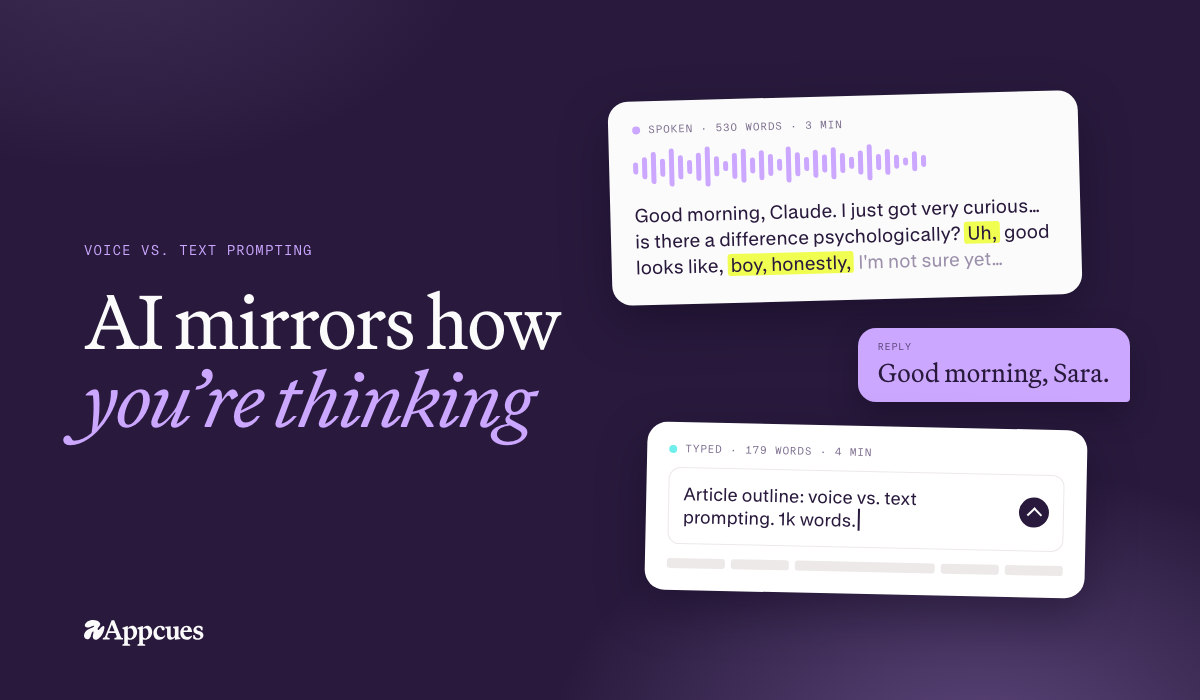
When I spoke, I said good morning, explained why I was asking and admitted what I didn’t know, the way I’d talk to a colleague. When I typed, I wrote a spec for a machine.
Speaking made me treat the model like a person, so I gave it the context I’d give a person. That part doesn’t require a microphone. You can type who it’s for, why it matters and what you’re unsure about. Most people just don’t, because typing to a machine feels like filling out a search box.
Yes, but: This is three tasks, one person writing the prompts, and three readers making one choice each. It’s a way of looking at the question, not a finding. And voice has a cost: you can’t skim back over what you just said.
I started out asking which one gets better results. After three tasks, I don’t think there’s a single answer.
Speaking worked better when I was still figuring out what I thought, or when tone mattered. Typing worked better when I needed a decision, because typing made me make it first. In every case, the model worked with what I gave it, including the parts I hadn’t sorted out yet.
If you’re choosing between the two, it helps to know which of those situations you’re in.
I made my test and answers into a quick quiz. See where your preferences take you: voice prompting or text?
Product Development
Working with new writers in tech, especially subject matters experts who rarely put their thoughts to the page, is a rewarding part of my job. However, the blank page can be an overwhelming wall when writing, which stops many an article in its tracks. One of the biggest pieces of advice I give isi: when you’re starting out and overwhelmed, it’s ok to use AI. But don’t write. Talk to it first and tell it your thoughts. And nine times out of ten, it creates if not a pretty polished outline, a good place for a new writer to start.
But why? I have my own theories, but is there a meaningful difference between voice and text prompting? And I don’t mean in the tool itself. What is happening in the relationship between myself and the AI, and how does it help understand how to use voice and text for better quality work?
I ran a small experiment to find out. II chose three jobs I had to do this week of different levels of complexity, then I asked AI through voice and then text for help. I tried to keep the main parts of the projects same between both, alternating between voice and text to begin with, since whichever went second would automatically benefit what I learned from.the first. Then, I compared the results, and brought my coworkers under the tent to see which one they preferred.
Here's what I learned, but before we get into the results, let's zoom out and talk about what people are already saying about this phenomenon.
Talking to AI at work isn't out of the ordinary. Most of major AI assistants now have a voice mode, new dictation apps built for prompting AI have found an audience, and even developers have begun to descrie their work as a conversation. In a viral 2025 LinkedIn post where he coined “vibe coding,” Andrej Karpathy revealed he barely touches the keyboard anymore and just talks to his code editor. Other people who’ve made the switch mostly say two things: talking is faster, and, when they talk, they notice that they include context they’d cut when typing.
But adoption is still lopsided. sWhere people work shapes how much of this they try. Talking to a laptop is easy at a home desk and kind of awkward in an open office. So for many, voice remains a tool they use when no one's around.
The question that lives beneath is older than AI. In 1805, the German writer Heinrich von Kleist wrote to a friend who was stuck on a problem and advised him to start talking it through with whoever was nearby. His line was l’idée vient en parlant: the idea comes while speaking.
Paul Graham, a British-American scientist and investor, made the opposite case in 2024. Writing is thinking, he argued, and as AI takes away the pressure to write, fewer people will engage in the kind of thinking that writing forces.
So this conversation has two parts. The practical side is about speed and how much context a prompt carries. The older about thinking: whether speaking helps you find an idea, or whether you have to write to work it out. I wanted to see what both looked like in practice.
Each of the three tasks called for a different kind of thinking:
I prompted each one twice with the same assistant, once spoken through dictation and once typed. I timed each prompt, kept it exactly as it came out, and rated each output from 1 to 5 on how close it was to usable. Then I showed a different coworker each unlabeled pair and asked which one they’d use.
My speeds matched the research: roughly 150 to 190 words a minute spoken, and 25 to 50 typed. Speed, though, doesn’t explain why the outputs were different.
The linguist Wallace Chafe spent years comparing how people speak and how they write. In 1982 he described two differences. Writing has time, so it integrates: ideas get packed together and polished. Speech doesn’t have that time, so it comes in fragments. And speakers stay involved with their listener, while writers stay detached.
Both showed up in my prompts.
When I typed, I could revise before I sent. I ended up editing the idea before I’d finished having it, so my typed prompts asked what I thought I should ask.
When I talked, I couldn’t take anything back. The spoken blog outline came back with a thesis I hadn’t typed anywhere yet. My note on it: “an interesting perspective I had suspected but hadn’t thought to declare.” I’d been circling that idea out loud, and the model named it.
Tone worked the same way. For the Slack note, I typed a description of the tone I wanted: nothing cheerful or patronizing, no emojis, but not cold. What came back was so stiff that my note on it says, in full: “The day I talk to a colleague like this is the day I move to a cave and become an official hermit.”
When I spoke, I didn’t describe the tone. I just talked the way I felt. I said I was “very excited” and that I didn’t want “emojis out the wazoo.” The draft matched that. Elana, colleague and Director of Customer Marketing, picked it right away: “the first reads very Claude to me.”
Psychologists call part of this language style matching. In conversation, people mirror each other’s small words (pronouns, articles, prepositions) without either side noticing. Models seem to do something similar. When I typed, the model got a description of the tone I wanted. When I spoke, it got an example of that tone, and the example worked better.
Yes, though it varies.
The content plan is where Graham’s argument held up. Partway through the spoken prompt, I said, “Good looks like, boy, honestly, I’m frankly not sure what good looks like.” The model didn’t settle that for me. The plan it returned was thorough but had no point of view. I gave it a 1.
The typed version took ten minutes, and most of that time went into deciding what I wanted, not typing it. I gave its output a 4.
Lindsay, who leads growth, preferred the spoken one anyway, for “more value.” I was grading the plan against what I’d meant. She was grading what was on the page. The spoken plan showed that I hadn’t made up my mind, and whether that was a problem came down to who was reading it.
The biggest change was in how I addressed the model, which is Chafe’s second difference.
When I spoke, I said good morning, explained why I was asking and admitted what I didn’t know, the way I’d talk to a colleague. When I typed, I wrote a spec for a machine.
Speaking made me treat the model like a person, so I gave it the context I’d give a person. That part doesn’t require a microphone. You can type who it’s for, why it matters and what you’re unsure about. Most people just don’t, because typing to a machine feels like filling out a search box.
Yes, but: This is three tasks, one person writing the prompts, and three readers making one choice each. It’s a way of looking at the question, not a finding. And voice has a cost: you can’t skim back over what you just said.
I started out asking which one gets better results. After three tasks, I don’t think there’s a single answer.
Speaking worked better when I was still figuring out what I thought, or when tone mattered. Typing worked better when I needed a decision, because typing made me make it first. In every case, the model worked with what I gave it, including the parts I hadn’t sorted out yet.
If you’re choosing between the two, it helps to know which of those situations you’re in.
I made my test and answers into a quick quiz. See where your preferences take you: voice prompting or text?

Sign up for Quickcues and get our monthly updates!