.png)

Lifecycle marketing may be in a fight for its future.
For the past three years, marketing has been absorbing the new technical skillset that AI brought to the conversation, and almost every role has seen a shift towards “engineer”: GTM Engineers, Growth Engineers, and even now Content Engineers. Lifecycle marketing, however, is the lone exception, and that detail hides a fight in plain sight.
Roughly 9,000 traditionally titled lifecycle jobs are open right now, compared to zero “Lifecycle Engineers”. But don’t let that fool you: the titles may not be changing, but there’s heavy shifts behind the scenes. The technical work, like using behavior and signals to map customer journeys, is being quietly rerouted.
In April 2026, LearnUpon, a learning management platform, was one of the first to cross an unspoken line when they listed a “GTM Engineer, Retention & Growth” title.
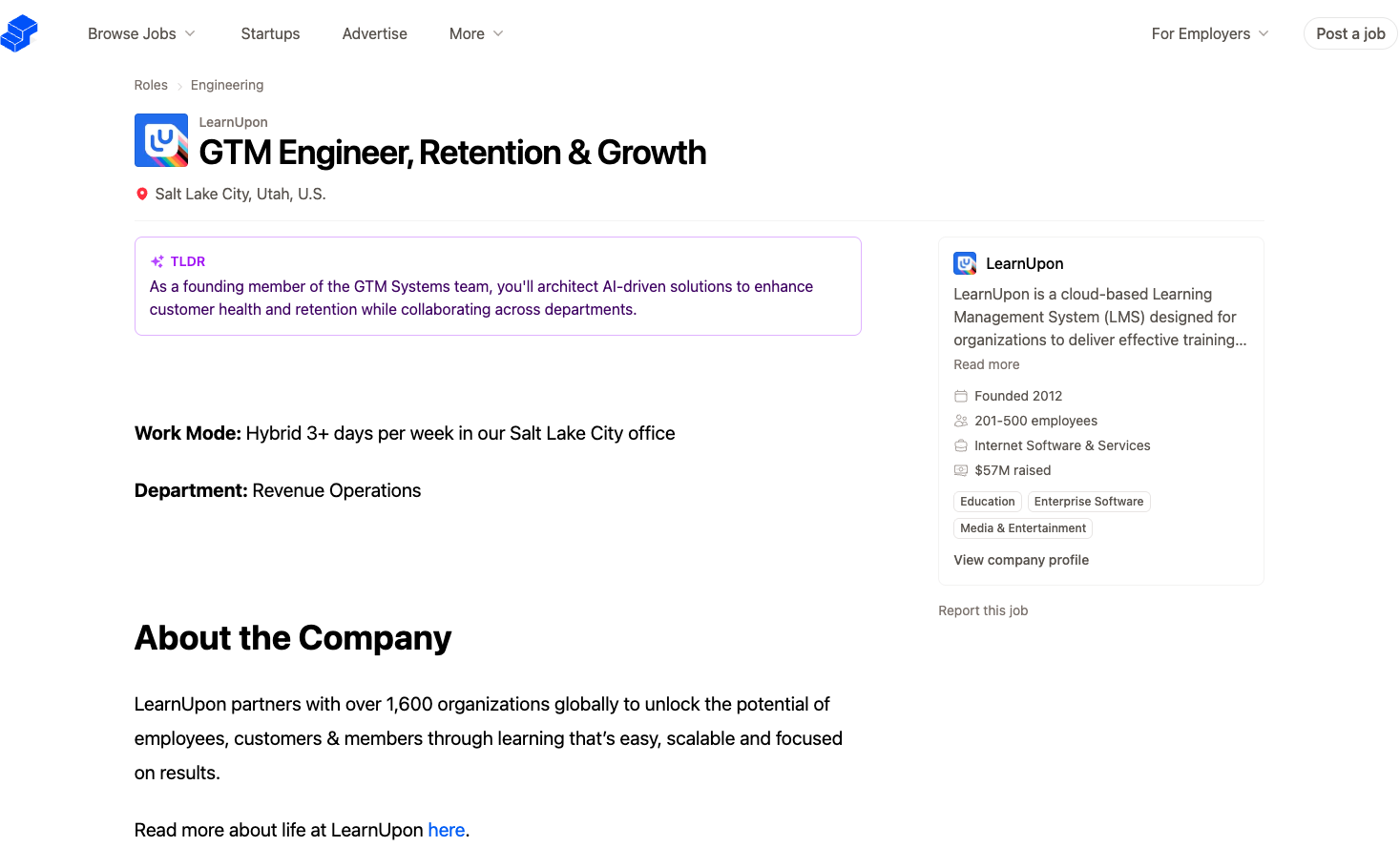
This role’s responsibilities: leverage AI to take customer signal data and use it to monitor account health, build win-back playbooks, and create entire expansion engines from in-product behavior. To a lifecycle marketer, that’s home turf. The role reports to RevOps.
So…who gets lifecycle?
This is the path already underway, and the territory is being cornered through subtle language changes and content releases:
On this path, the jobs migrate. Ownership of the system moves next door: the churn models, the expansion triggers, the signal architecture all get built by an engineer-titled role in RevOps. And there’s a cost beyond the org chart: when the technical layer belongs to whoever understands the customer, teams drift from customer-led to dashboard-led. The behavioral understanding sits in one room while the strategy and execution sits in another.
Len Lee, Senior Product Manager at Appcues, watches this tension from the product side, and pointed out to us that ops people are often “some of the smartest people in the room”, the first line of defense and the biggest experts on what’s going on because of how close they are to the data. But they’re “held accountable to metrics but not really empowered on strategy.” Read through this lens, the GTM engineer title is a long-overdue promotion for people who have been doing the work.
But Len had a caveat: splitting the roles “inserts natural tension into battling over sharing the same outcomes… I wonder if this gets halfway there but doesn’t get all the way there.”
If the pattern sounds familiar, it should. The webmaster went extinct within a decade once specialization took its tasks, and marketing has run this play against itself before. Web went to engineering and analytics went to data teams. Each time, marketing kept the brief and lost the build. And if organizations decide the technical layer belongs to the AI operator alone, the role thins the way prompt engineering did, absorbed into software and adjacent titles within 30 months.
The second path keeps ownership where the customer knowledge lives, within the marketing org.
Practitioners like Naomi West are writing conditional logic with AI directly in their platforms; Notion's Meli Musson argues AI is finally letting lifecycle marketers deliver on the discipline's promises. West's framing:
"The technical barriers that used to stand between a great idea and its execution are coming down fast... this moment doesn't threaten the role — it expands it."
On this path, AI agents aren’t a rival, but instead tools that make up-leveling possible. The lifecycle marketer learns to direct systems while keeping their judgment about message, timing, and the customer journey. If lifecycle takes this path, it becomes the rare function that absorbs an engineering skill set without surrendering its title. The counter-pattern from history backs this: sales engineering and SRE roles endured because the technical skills stayed attached to the people closest to the problem.
What the retitle wave is building is a dichotomy between technical roles versus relationship roles, where one person owns the data and another owns the customer. Marketing has always been part art and part science. The irony of this moment is that AI is automating the technical parts faster than anything else, while judgement, timing, and customer intuition remain the hardest things to replace.
Yet, job titles keep reaching for technical language to signal value.
There’s a specific mechanism behind this, and ops veterans know it as the denominator problem. As Len put it for us: “If I become too focused on my one metric in my phase of the funnel,I’m just gaming a numerator-denominator math problem and that often comes at the expense of whoever has to deal with whatever I’m sending on to them in the next phase.”
Split the data from the relationship, an each half optimizes its own number while the customer’s actual journey falls between them. When you split the work in two, who loses?
The answer, disproportionately, may be women.
The engineer rebrand has reached every corner of marketing, a traditionally female-dominated field. Women hold about 60% of US marketing roles; they're 16% of US engineers. Brand consultant Miranda Shanahan put the blunt version in front of a million viewers this spring: marketing jobs are being rebranded "so that boys can do it too." "UGC engineer" coiner Julia Pintar disagrees, arguing the titles give the work "the integrity it deserves." Shanahan took her argument to Time this month.
Both make compelling points. But who is getting the integrity in practice? If the engineer title is fundamentally about status and pay — and the $20K–$70K premium says it is — then the choice isn’t cosmetic.
Path 1 moves the highest-paid version of lifecycle work into RevOps, a field that itself skews male at roughly two-to-one per LinkedIn profile data, while the function itself stays untitled. And the people it moves away from are the ones with decades of customer experience and every capacity to meet this moment with a technology skill-up.
Worth mentioning, no one has ever published a gender breakdown of GTM Engineers. The 2026 State of GTM Engineering (a 228-respondent community survey) publicly reports age, geography, and comp but no gender split; the LinkedIn profile analyses track prior roles and seniority, not gender. LinkedIn's own Jobs on the Rise reports publish gender for comparable rising roles — AI Engineer skews 77% male — but GTM Engineer hasn't made the list. For a title this hyped, no one is counting who it includes.
The capacity to skill up isn’t theoretical. Len, who started in content marketing and “crawled and scraped” her way into product, is blunt about it: “You would just technically upskill all of these women who have been in these so-called soft roles – who actually aren’t soft. They have a lot of hard skills.” Len’s own career is proof: “I”m still functioning as a marketer, in a room full of engineers.”
The stakes are concrete: there’s a ~$40K premium for coding skills that lifecycle marketers doing engineer work at marketer comp are subsidizing, and a rebrand window (the GTM Engineer title is a mid-career rebrand, median 8 prior roles) that closes when the title standardizes.
Our read, after all this research: the strongest version of lifecycle is where the data and relationship stay in the same role, the one lifecycle marketers already hold. This role doesn’t need a new name, but instead an investment: AI enablement, technical skills, and the premium flowing to the people already in the seat rather than a parallel role built next door by default.
Or, as Len put it: “Instead of getting rid of roles, we’re adding roles, we’re making them more modern and we’re sharing the product love across more disciplines in an organization.”
Every retitle wave began with a manifesto: Ellis, 2010; Chen, 2012; HBR, 2014; Clay, 2023. "The Lifecycle Engineer" hasn't been written. Expect it within the year. The people who built this discipline over twenty years deserve to be its authors, not its subjects.
Lifecycle Marketing
AI
Marketing
Lifecycle marketing may be in a fight for its future.
For the past three years, marketing has been absorbing the new technical skillset that AI brought to the conversation, and almost every role has seen a shift towards “engineer”: GTM Engineers, Growth Engineers, and even now Content Engineers. Lifecycle marketing, however, is the lone exception, and that detail hides a fight in plain sight.
Roughly 9,000 traditionally titled lifecycle jobs are open right now, compared to zero “Lifecycle Engineers”. But don’t let that fool you: the titles may not be changing, but there’s heavy shifts behind the scenes. The technical work, like using behavior and signals to map customer journeys, is being quietly rerouted.
In April 2026, LearnUpon, a learning management platform, was one of the first to cross an unspoken line when they listed a “GTM Engineer, Retention & Growth” title.
This role’s responsibilities: leverage AI to take customer signal data and use it to monitor account health, build win-back playbooks, and create entire expansion engines from in-product behavior. To a lifecycle marketer, that’s home turf. The role reports to RevOps.
So…who gets lifecycle?
This is the path already underway, and the territory is being cornered through subtle language changes and content releases:
On this path, the jobs migrate. Ownership of the system moves next door: the churn models, the expansion triggers, the signal architecture all get built by an engineer-titled role in RevOps. And there’s a cost beyond the org chart: when the technical layer belongs to whoever understands the customer, teams drift from customer-led to dashboard-led. The behavioral understanding sits in one room while the strategy and execution sits in another.
Len Lee, Senior Product Manager at Appcues, watches this tension from the product side, and pointed out to us that ops people are often “some of the smartest people in the room”, the first line of defense and the biggest experts on what’s going on because of how close they are to the data. But they’re “held accountable to metrics but not really empowered on strategy.” Read through this lens, the GTM engineer title is a long-overdue promotion for people who have been doing the work.
But Len had a caveat: splitting the roles “inserts natural tension into battling over sharing the same outcomes… I wonder if this gets halfway there but doesn’t get all the way there.”
If the pattern sounds familiar, it should. The webmaster went extinct within a decade once specialization took its tasks, and marketing has run this play against itself before. Web went to engineering and analytics went to data teams. Each time, marketing kept the brief and lost the build. And if organizations decide the technical layer belongs to the AI operator alone, the role thins the way prompt engineering did, absorbed into software and adjacent titles within 30 months.
The second path keeps ownership where the customer knowledge lives, within the marketing org.
Practitioners like Naomi West are writing conditional logic with AI directly in their platforms; Notion's Meli Musson argues AI is finally letting lifecycle marketers deliver on the discipline's promises. West's framing:
"The technical barriers that used to stand between a great idea and its execution are coming down fast... this moment doesn't threaten the role — it expands it."
On this path, AI agents aren’t a rival, but instead tools that make up-leveling possible. The lifecycle marketer learns to direct systems while keeping their judgment about message, timing, and the customer journey. If lifecycle takes this path, it becomes the rare function that absorbs an engineering skill set without surrendering its title. The counter-pattern from history backs this: sales engineering and SRE roles endured because the technical skills stayed attached to the people closest to the problem.
What the retitle wave is building is a dichotomy between technical roles versus relationship roles, where one person owns the data and another owns the customer. Marketing has always been part art and part science. The irony of this moment is that AI is automating the technical parts faster than anything else, while judgement, timing, and customer intuition remain the hardest things to replace.
Yet, job titles keep reaching for technical language to signal value.
There’s a specific mechanism behind this, and ops veterans know it as the denominator problem. As Len put it for us: “If I become too focused on my one metric in my phase of the funnel,I’m just gaming a numerator-denominator math problem and that often comes at the expense of whoever has to deal with whatever I’m sending on to them in the next phase.”
Split the data from the relationship, an each half optimizes its own number while the customer’s actual journey falls between them. When you split the work in two, who loses?
The answer, disproportionately, may be women.
The engineer rebrand has reached every corner of marketing, a traditionally female-dominated field. Women hold about 60% of US marketing roles; they're 16% of US engineers. Brand consultant Miranda Shanahan put the blunt version in front of a million viewers this spring: marketing jobs are being rebranded "so that boys can do it too." "UGC engineer" coiner Julia Pintar disagrees, arguing the titles give the work "the integrity it deserves." Shanahan took her argument to Time this month.
Both make compelling points. But who is getting the integrity in practice? If the engineer title is fundamentally about status and pay — and the $20K–$70K premium says it is — then the choice isn’t cosmetic.
Path 1 moves the highest-paid version of lifecycle work into RevOps, a field that itself skews male at roughly two-to-one per LinkedIn profile data, while the function itself stays untitled. And the people it moves away from are the ones with decades of customer experience and every capacity to meet this moment with a technology skill-up.
Worth mentioning, no one has ever published a gender breakdown of GTM Engineers. The 2026 State of GTM Engineering (a 228-respondent community survey) publicly reports age, geography, and comp but no gender split; the LinkedIn profile analyses track prior roles and seniority, not gender. LinkedIn's own Jobs on the Rise reports publish gender for comparable rising roles — AI Engineer skews 77% male — but GTM Engineer hasn't made the list. For a title this hyped, no one is counting who it includes.
The capacity to skill up isn’t theoretical. Len, who started in content marketing and “crawled and scraped” her way into product, is blunt about it: “You would just technically upskill all of these women who have been in these so-called soft roles – who actually aren’t soft. They have a lot of hard skills.” Len’s own career is proof: “I”m still functioning as a marketer, in a room full of engineers.”
The stakes are concrete: there’s a ~$40K premium for coding skills that lifecycle marketers doing engineer work at marketer comp are subsidizing, and a rebrand window (the GTM Engineer title is a mid-career rebrand, median 8 prior roles) that closes when the title standardizes.
Our read, after all this research: the strongest version of lifecycle is where the data and relationship stay in the same role, the one lifecycle marketers already hold. This role doesn’t need a new name, but instead an investment: AI enablement, technical skills, and the premium flowing to the people already in the seat rather than a parallel role built next door by default.
Or, as Len put it: “Instead of getting rid of roles, we’re adding roles, we’re making them more modern and we’re sharing the product love across more disciplines in an organization.”
Every retitle wave began with a manifesto: Ellis, 2010; Chen, 2012; HBR, 2014; Clay, 2023. "The Lifecycle Engineer" hasn't been written. Expect it within the year. The people who built this discipline over twenty years deserve to be its authors, not its subjects.

Sign up for Quickcues and get our monthly updates!
.svg)